How to Integrate Microsoft Forms with SharePoint for Enterprise Data Collection
Microsoft Forms integrated with SharePoint provides a powerful combination for enterprise data collection, survey management, and workflow automation, allowing organizations to create forms that automatically store responses in SharePoint lists for analysis, reporting, and process automation. This integration eliminates manual data entry, centralizes response data, and enables downstream workflows through Power Automate.
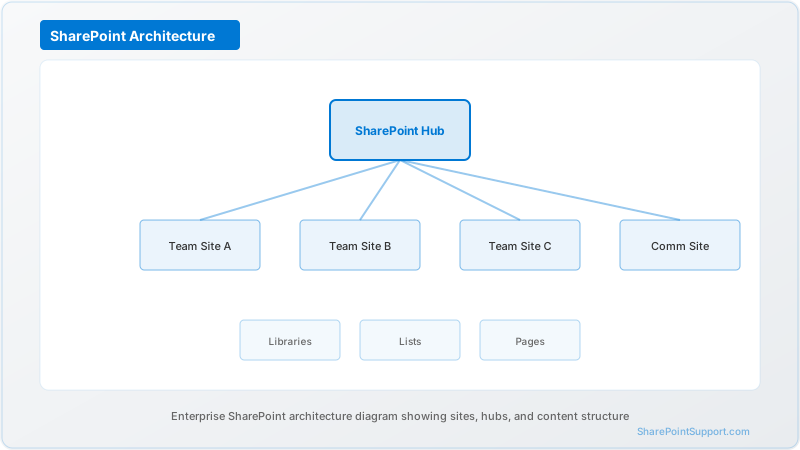
In our 25+ years of building SharePoint solutions for large organizations, we have implemented Forms-to-SharePoint integrations for employee onboarding processes, customer feedback systems, compliance attestation workflows, and facility management request systems. This guide covers the integration architecture, configuration steps, and best practices for production-grade implementations.
Integration Architecture
Microsoft Forms can connect to SharePoint in several ways. The simplest approach embeds a form directly on a SharePoint page using the Microsoft Forms web part. Responses are stored in the Forms service and can be viewed in SharePoint. For deeper integration, use Power Automate to capture form responses and write them to a custom SharePoint list with additional processing, routing, or notification logic.
Embedding Forms on SharePoint Pages
Add the Microsoft Forms web part to any SharePoint page. Select an existing form or create a new one directly from the web part. Configure whether to show the form inline or as a link. Set the form dimensions and appearance options to match your site design.
This approach is ideal for simple surveys, feedback forms, and quick polls where the form responses can remain in the Forms service without needing SharePoint list storage.
Forms to SharePoint List via Power Automate
For enterprise scenarios, create a Power Automate flow triggered by When a new response is submitted in Microsoft Forms. The flow reads the response details, maps form fields to SharePoint list columns, and creates a new list item. This approach provides full control over data storage, enables additional processing like approval routing, and keeps response data within SharePoint's governance framework.
```
Flow: Form Response to SharePoint
Trigger: When a new response is submitted (Microsoft Forms)
Action: Get response details
Action: Create item (SharePoint list)
Action: Send email notification to submitter
```
Designing Forms for Enterprise Use
Question Types and Best Practices
Microsoft Forms supports text, choice, rating, date, ranking, Likert scale, file upload, and Net Promoter Score question types. For enterprise forms, use branching logic to show relevant questions based on previous answers. Set required fields for critical data points. Add descriptions and instructions to complex questions. Use sections to organize long forms into logical groups.
Form Security Settings
Configure form access to control who can respond. Options include anyone with the link, people in your organization, or specific people. For internal business processes, restrict to people in your organization and require sign-in to track who submitted each response. Enable or disable the option for respondents to edit their responses after submission.
Building the SharePoint Response List
Design your SharePoint list schema to match the form fields. Create columns for each form question with appropriate data types. Add metadata columns for processing status, assigned reviewer, completion date, and priority level. Configure views that filter responses by status, date range, or assignee.
Column Mapping Considerations
Map form question types to SharePoint column types carefully. Choice questions map to Choice columns. Date questions map to Date columns. Rating questions map to Number columns. File upload questions require a special handling approach where the Power Automate flow saves uploaded files to a document library and stores the file link in the list item.
Workflow Automation with Responses
Approval Workflows
Route form responses through approval workflows. A facility maintenance request form can automatically create a SharePoint list item, assign it to the appropriate maintenance team based on the facility location, send approval requests to the facility manager, update the status as the request progresses, and notify the submitter when the work is completed.
Notification and Escalation
Configure notifications for new responses that require attention. Send summary emails to managers with daily or weekly response digests. Escalate overdue responses that have not been reviewed within the SLA. Use adaptive cards in Teams to provide rich notification experiences with inline action buttons.
Analytics and Reporting
Built-In Forms Analytics
Microsoft Forms provides basic analytics including response counts, individual response details, and summary charts for choice questions. For simple surveys, these built-in analytics may be sufficient.
SharePoint List Reporting
When responses flow to a SharePoint list, you gain access to SharePoint's full reporting capabilities. Create list views with grouping, filtering, and totals. Build Power BI dashboards that connect to the SharePoint list for real-time visual analytics. Use calculated columns and column formatting to highlight trends and outliers.
Power BI Integration
Connect Power BI to your SharePoint response list for advanced analytics. Build dashboards that show response volume over time, satisfaction score trends, response breakdown by department or location, and comparison of current period responses to historical baselines.
Compliance and Data Governance
For organizations in regulated industries, form response data may contain sensitive information that requires protection. Apply sensitivity labels to SharePoint lists containing PHI, PII, or financial data. Configure retention policies to preserve response records for the required duration. Use DLP policies to prevent unauthorized sharing of response data.
Ensure that forms collecting personal information include appropriate privacy notices and consent language. Document the data flow from form submission through SharePoint storage to any downstream processing or reporting systems.
Common Integration Patterns
Employee Onboarding Checklists
Create onboarding forms that new hires complete during their first week. Responses flow to a SharePoint list where HR tracks completion progress. Power Automate flows assign tasks to IT for equipment setup, facilities for workspace preparation, and managers for first-week scheduling.
Customer Feedback Collection
Embed feedback forms on external-facing SharePoint sites. Responses create list items that are automatically categorized by sentiment and routed to the appropriate product or service team. Monthly reports aggregate feedback trends for leadership review.
Compliance Attestation
Annual compliance attestation forms require employees to confirm they have read and understood specific policies. Responses flow to a SharePoint list that tracks completion rates by department. Automated reminders target employees who have not yet responded. Compliance officers generate completion reports for auditors.
Enterprise Survey Architecture and Analytics
For organizations running multiple surveys and forms across departments, establish a centralized survey architecture that standardizes how form responses are stored, analyzed, and reported. Create a dedicated SharePoint site for organizational surveys with separate lists for each survey type. Standardize column naming conventions so that common fields like department, location, and submission date use consistent names across all response lists. This standardization enables cross-survey analysis using Power BI dashboards that connect to multiple SharePoint lists and provide enterprise-wide insights into employee feedback, customer satisfaction, and operational metrics.
Design your SharePoint list schema with reporting requirements in mind from the start. Include calculated columns or Power Automate flows that categorize responses for easier analysis, such as converting numeric satisfaction scores into High, Medium, and Low categories. Create SharePoint views that give department managers filtered access to their team responses without exposing data from other departments. Use audience targeting on the survey results pages to show relevant dashboards to different stakeholder groups.
Our SharePoint consulting team designs and implements Forms-to-SharePoint integrations for enterprise business processes. Contact us to discuss your form and workflow automation requirements.
Advanced Forms Integration Patterns
Multi-Form Process Orchestration
For complex business processes that span multiple forms, orchestrate the flow using Power Automate and SharePoint as the coordination layer. An employee onboarding process might start with an HR intake form that creates a master record in a SharePoint list. This triggers three parallel forms: an IT equipment request form, a facilities workspace request form, and a manager welcome plan form. Each form response links back to the master record using a lookup column. A dashboard page shows the overall onboarding progress by aggregating status from all related list items.
Forms with Approval Routing
Combine Microsoft Forms with Power Automate approval actions for processes that require managerial or departmental approval. A purchase request form collects the item description, estimated cost, justification, and department. The Power Automate flow routes the request to the department manager for amounts under ten thousand dollars or to both the department manager and finance director for larger amounts. Approval decisions, comments, and timestamps are recorded in the SharePoint list for audit purposes.
External-Facing Forms with SharePoint Backend
Microsoft Forms can be shared externally for customer feedback, vendor registration, event registration, and partner surveys. External responses flow into SharePoint through Power Automate, where they can be processed, categorized, and acted upon using the same governance framework applied to internal content. Apply sensitivity labels to response lists containing personally identifiable information collected from external respondents.
Forms Data Quality and Validation
Preventing Duplicate Submissions
Implement duplicate detection logic in your Power Automate flows. Before creating a new SharePoint list item, query the existing items to check for duplicates based on key fields such as email address, employee ID, or request number. If a duplicate is detected, update the existing record rather than creating a new one, and notify the submitter that their response has been updated.
Data Cleansing Flows
Create Power Automate flows that validate and cleanse form response data before writing to SharePoint. Standardize phone number formats, normalize company names, validate email addresses against a known domain list, and flag responses that contain suspicious patterns. Store raw responses in an intake list and write cleansed responses to a production list, maintaining data quality for downstream reporting and analytics.
Scaling Forms to Enterprise Volume
For high-volume data collection scenarios processing thousands of responses per day, optimize your Power Automate flows for performance and reliability. Use batch processing patterns that collect multiple responses before writing to SharePoint. Implement retry logic for transient failures. Monitor flow run history for failures and configure alerts for error rates exceeding your threshold.
Consider using Dataverse instead of SharePoint lists for extremely high-volume scenarios where SharePoint list throttling limits may impact performance. Dataverse provides higher throughput, richer data types, and better integration with Power Platform components. However, for most enterprise scenarios, SharePoint lists with properly designed columns and indexed views handle form response volumes without issues.
Security Considerations for Forms Data
Evaluate the sensitivity of data collected through forms and apply appropriate security controls. Forms collecting PHI must comply with HIPAA requirements including encryption, access controls, and audit logging. Forms collecting PII must comply with privacy regulations including GDPR and CCPA. Configure the SharePoint response list with sensitivity labels, DLP policies, and retention policies appropriate to the data classification.
Enterprise Implementation Best Practices
In our 25+ years of enterprise SharePoint consulting, we have guided hundreds of organizations through complex SharePoint initiatives spanning every industry and organizational scale. The implementation patterns that consistently deliver successful outcomes share common characteristics regardless of the specific feature or capability being deployed.
- Conduct a Thorough Requirements and Readiness Assessment: Before beginning any SharePoint implementation, invest time in understanding both the business requirements and the technical readiness of your environment. Assess your current content architecture, permission structures, integration dependencies, and user readiness. This assessment typically reveals 20 to 30 percent more complexity than initial stakeholder estimates suggest.
- Deploy in Controlled Phases with Pilot Groups: Start with a pilot group of 50 to 100 representative users from different departments and roles. Define measurable success criteria for each phase and collect structured feedback through surveys and interviews. Phased deployment reduces risk, builds organizational confidence, and generates the internal success stories that accelerate broader adoption.
- Invest in Change Management and Training: Technology implementations fail when organizations underinvest in helping people adapt to new tools and processes. Develop role-specific training that demonstrates how the new capability helps users accomplish their actual daily tasks. Create champion networks, host office hours, and celebrate early wins to build momentum across the organization.
- Automate Governance and Compliance Controls: Manual governance does not scale beyond a few dozen users or sites. Implement automated policy enforcement using Power Automate workflows, sensitivity labels, retention policies, and SharePoint administrative tools that ensure consistent compliance without creating bottlenecks or relying on individual user behavior.
- Establish Monitoring, Metrics, and Continuous Improvement: Define key performance indicators before deployment and track them systematically. Monitor adoption rates, user satisfaction, performance metrics, and business outcome improvements. Review these metrics monthly with stakeholders and use them to drive iterative improvements rather than treating the initial deployment as the finished state.
Governance and Compliance Considerations
Governance frameworks must satisfy the compliance requirements specific to your industry while remaining practical enough for daily operation. The most effective governance frameworks are those designed with regulatory compliance as a core requirement rather than an afterthought.
For HIPAA-regulated healthcare organizations, your governance framework must include specific controls for protected health information including access logging, minimum necessary access enforcement, encryption requirements, and business associate agreement tracking for any external sharing. Sensitivity labels should automatically apply encryption to documents containing PHI, and your retention policies must align with HIPAA's six-year minimum retention requirement.
Financial services organizations operating under SOC 2 need governance controls that demonstrate security, availability, processing integrity, confidentiality, and privacy of customer data. Your governance framework should map directly to SOC 2 trust service criteria, with automated evidence collection for audit readiness. SharePoint audit logs, access reviews, and change management records all serve as SOC 2 evidence.
Government agencies and contractors subject to FedRAMP or CMMC must implement governance controls satisfying federal security requirements including FIPS 140-2 compliant encryption, strict access controls based on security clearance levels, and comprehensive audit trails meeting NIST 800-53 control families.
Regardless of your specific regulatory environment, your governance framework should include data classification policies, retention schedules complying with applicable regulations, incident response procedures, and regular compliance assessments verifying controls function as designed. Working with experienced SharePoint governance consultants who understand your regulatory landscape ensures your framework addresses compliance from day one.
Ready to transform your SharePoint environment into a strategic business asset? Our specialists have guided hundreds of enterprises through successful SharePoint implementations across healthcare, financial services, government, and other regulated industries. Contact our team for a comprehensive assessment, and discover how our SharePoint consulting services can deliver the outcomes your organization needs.
Common Challenges and Solutions
Organizations implementing Microsoft Forms + SharePoint consistently encounter obstacles that, if left unaddressed, undermine adoption and erode stakeholder confidence. Drawing on two decades of enterprise SharePoint consulting, these are the challenges we see most frequently and the proven approaches for overcoming them.
Challenge 1: Content Sprawl and Information Architecture Degradation
Over time, Microsoft Forms + SharePoint environments accumulate redundant, outdated, and trivial content that degrades search relevance and confuses users. Without proactive content lifecycle management, the signal-to-noise ratio deteriorates and user trust in the platform erodes. The resolution requires a structured approach: establishing automated retention policies that flag content for review after defined periods of inactivity, combined with content owner accountability structures that assign clear responsibility for each site collection and library. Organizations that address this proactively report 40 to 60 percent fewer support tickets within the first 90 days of deployment. Establishing a dedicated governance committee with representatives from IT, compliance, and business stakeholders ensures ongoing alignment between technical configuration and organizational objectives.
Challenge 2: Compliance and Audit Readiness Gaps
Microsoft Forms + SharePoint implementations in regulated industries often lack the audit trail depth and policy enforcement rigor required by frameworks such as HIPAA, SOC 2, and GDPR. Retroactive compliance remediation is significantly more expensive and disruptive than building compliance into the initial design. We recommend embedding compliance requirements into the information architecture from day one. Configure Microsoft Purview retention labels, DLP policies, and audit logging before deploying content, and validate compliance posture through regular internal audits. Tracking these metrics through SharePoint health dashboards provides early warning indicators that allow administrators to intervene before minor issues become systemic problems affecting enterprise-wide productivity.
Challenge 3: Inconsistent Governance Across Business Units
When different departments implement Microsoft Forms + SharePoint independently, inconsistent naming conventions, metadata schemas, and security configurations create silos that undermine cross-functional collaboration and complicate compliance reporting. The most effective mitigation strategy involves centralizing governance policy definition while allowing controlled flexibility at the departmental level. A hub-and-spoke governance model balances enterprise consistency with departmental autonomy. Enterprises operating in regulated industries such as healthcare and financial services must pay particular attention to this challenge because compliance violations carry significant financial and reputational consequences. Regular audits conducted quarterly at minimum help organizations maintain alignment with evolving regulatory requirements and internal policy updates.
Challenge 4: Migration and Legacy Content Complexity
Organizations transitioning legacy content into Microsoft Forms + SharePoint often underestimate the complexity of mapping old structures, metadata, and permissions to modern architectures. Failed migrations erode user confidence and create parallel systems that duplicate effort. Addressing this requires conducting thorough pre-migration content audits that classify and prioritize content based on business value. Invest in automated migration tools that preserve metadata fidelity and permission integrity while providing detailed validation reports. Organizations that invest in structured change management programs achieve adoption rates 35 percent higher than those relying on organic discovery alone. Executive sponsorship combined with department-level champions creates the organizational momentum necessary for sustained success.
Integration with Microsoft 365 Ecosystem
Microsoft Forms + SharePoint does not operate in isolation. Its value multiplies when connected to the broader Microsoft 365 ecosystem, creating unified workflows that eliminate context switching and reduce manual data transfer between applications.
Microsoft Teams Integration: Configure Teams notifications that alert stakeholders when Microsoft Forms + SharePoint content changes, ensuring that distributed teams stay informed about updates without relying on manual communication workflows. Teams channels automatically provision SharePoint document libraries, which means microsoft forms + sharepoint configurations and content flow seamlessly between collaborative conversations and structured document management. Users can surface SharePoint content directly within Teams tabs, reducing the friction that typically causes adoption to stall.
Power Automate Workflows: Create event-driven automations that respond to Microsoft Forms + SharePoint changes in real time, triggering downstream processes such as notifications, data transformations, and cross-system synchronization. Automated workflows triggered by SharePoint events such as document uploads, metadata changes, or approval completions eliminate repetitive manual tasks. Organizations typically automate 15 to 25 processes within the first quarter, saving an average of 8 hours per week per department. These automations also create audit trails that satisfy compliance requirements for regulated industries.
Power BI Analytics: Connect Microsoft Forms + SharePoint list and library data to Power BI datasets for advanced analytics that transform raw operational data into strategic business intelligence accessible to decision makers across the organization. Connecting SharePoint data to Power BI dashboards provides real-time visibility into content usage patterns, adoption metrics, and operational KPIs. Decision makers gain actionable intelligence without requiring manual report generation, enabling faster response to emerging trends and potential issues.
Microsoft Purview and Compliance: Configure data loss prevention policies that monitor Microsoft Forms + SharePoint content for sensitive information patterns, blocking or restricting sharing actions that could violate compliance requirements. Sensitivity labels, data loss prevention policies, and retention schedules configured in Microsoft Purview extend automatically to microsoft forms + sharepoint content. This unified compliance framework ensures that governance policies apply consistently across the entire Microsoft 365 environment rather than requiring separate configuration for each workload. For organizations subject to HIPAA, SOC 2, or FedRAMP requirements, this integrated approach significantly reduces compliance management overhead.
Getting Started: Next Steps
Implementing Microsoft Forms + SharePoint effectively requires more than technical configuration. It demands a strategic approach grounded in your organization's specific business requirements, compliance obligations, and growth trajectory. The difference between a deployment that delivers measurable ROI and one that becomes shelfware often comes down to the quality of upfront planning and expert guidance.
Begin with a focused assessment of your current SharePoint environment. Evaluate your existing information architecture, permission structures, content lifecycle policies, and user adoption patterns. Identify gaps between your current state and the target state required for successful microsoft forms + sharepoint implementation. This assessment typically takes 2 to 4 weeks and produces a prioritized roadmap that aligns technical work with business outcomes.
Our SharePoint specialists have guided organizations across healthcare, financial services, government, and education through hundreds of successful implementations. We bring deep expertise in SharePoint architecture, governance frameworks, and compliance alignment that accelerates time to value while minimizing risk.
Ready to move forward? Contact our team for a complimentary consultation. We will assess your environment, identify quick wins, and develop a phased implementation plan tailored to your organization's needs and timeline. Whether you are starting from scratch or optimizing an existing deployment, our enterprise SharePoint consultants deliver the depth and accountability enterprise SharePoint work requires.
Written by the SharePoint Support Team
Senior SharePoint Consultants | 25+ Years Microsoft Ecosystem Experience
Our senior SharePoint consultants bring deep expertise spanning 500+ enterprise migrations and compliance implementations across HIPAA, SOC 2, and FedRAMP environments. We cover SharePoint Online, Microsoft 365, migrations, Copilot readiness, and large-scale governance.
Expert SharePoint Services
Frequently Asked Questions
How does SharePoint integrate with Microsoft Teams?▼
What are the benefits of integrating Power BI with SharePoint?▼
How do we manage permissions across integrated Microsoft 365 services?▼
Can SharePoint integrate with non-Microsoft applications?▼
What SharePoint workflows can be automated with Power Automate?▼
Need Expert Help?
Our SharePoint consultants are ready to help you implement these strategies in your organization.
Continue Reading in Integration
Federated Copilot Connectors: Live Intranet Data
Federated Copilot Connectors went GA at Build 2026. They query third-party systems live at prompt time — no indexing, no data residency headaches. Here are the top three intranet use cases and the setup steps.
IntegrationSharePoint and Microsoft Teams Integration: The Guide
Master the integration between SharePoint and Teams to create seamless collaboration experiences.
IntegrationPower BI + SharePoint: Embedded Analytics Guide
Embed Power BI reports in SharePoint for seamless data visualization. Learn embedding methods, security considerations, and best practices.
IntegrationMicrosoft Loop and SharePoint: Future of Collaboration
Explore how Microsoft Loop components integrate with SharePoint to create fluid, real-time collaboration experiences across the Microsoft 365 ecosystem.
IntegrationMicrosoft Stream + SharePoint: Video Content Management
Discover how the new Microsoft Stream built on SharePoint transforms enterprise video management with seamless integration, enhanced security, and improved discoverability.
IntegrationMicrosoft Planner + SharePoint: Task Management
Learn how to integrate Microsoft Planner with SharePoint for seamless task management, project tracking, and team collaboration within your digital workplace.