OneDrive vs SharePoint: Understanding the Difference
One of the most common questions from Microsoft 365 users is "Should I save this to OneDrive or SharePoint?" While both services store files in the cloud and share similar technology, they serve fundamentally different purposes.
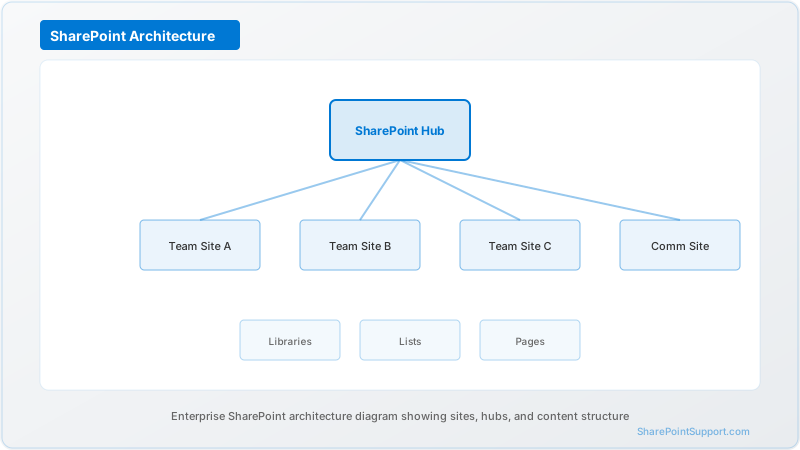
The Simple Distinction
OneDrive for Business: Personal cloud storage for individual work files
SharePoint: Team and organizational content collaboration
Think of it this way:
- OneDrive = Your personal desk drawer
- SharePoint = The shared filing cabinets and project rooms
OneDrive for Business: Personal Productivity
Purpose
OneDrive is designed for files you primarily work on yourself:
- Draft documents before sharing
- Personal notes and references
- Working copies of files
- Content from multiple devices
- Backup of important personal files
Key Features
Personal Storage
- 1TB+ per user (depending on license)
- Syncs across all devices
- Files On-Demand reduces local storage
- Personal vault for sensitive documents
Selective Sharing
- Share specific files or folders
- Set expiration dates on links
- Password-protect shared links
- Control download permissions
Mobile Access
- iOS and Android apps
- Automatic photo backup
- Offline access to key files
- Document scanning
When to Use OneDrive
✅ Good for OneDrive:
- Working draft of a presentation you're creating
- Personal reference materials
- Files only you need access to
- Content you're working on before it's ready to share
- Documents from multiple clients (consultants)
❌ Not ideal for OneDrive:
- Files multiple team members need to edit
- Official company documents
- Content that needs formal governance
- Files that should persist after you leave
SharePoint: Team Collaboration
Purpose
SharePoint is built for content that teams, departments, or the entire organization needs to access and collaborate on.
Key Features
Team Sites
- Shared document libraries
- Microsoft Teams integration
- Co-authoring in real-time
- Automatic file organization
- Site-level permissions
Communication Sites
- Company announcements
- Department news
- Project portals
- Executive communications
Advanced Capabilities
- Metadata and content types
- Retention policies
- Workflows and automation
- Search across organization
- Compliance and eDiscovery
When to Use SharePoint
✅ Good for SharePoint:
- Department shared drives
- Project documentation
- Company policies and procedures
- Team collaboration spaces
- Content requiring formal governance
- Files that must persist regardless of employee status
❌ Not ideal for SharePoint:
- Personal working files
- Drafts not ready for team review
- Files only you use
- Temporary or scratch files
Technical Comparison
| Feature | OneDrive | SharePoint |
|---------|----------|------------|
| Primary Use | Personal files | Team collaboration |
| Storage | 1TB+ per user | 1TB + 10GB per license |
| Sharing | Individual control | Site permissions |
| Retention | User-managed | Policy-driven |
| Teams Integration | Personal files tab | Team files storage |
| Governance | Limited | Extensive |
| Metadata | Basic | Advanced |
| Workflows | Basic | Power Automate |
The Hidden Connection
Here's what many users don't realize: SharePoint and OneDrive use the same underlying technology. In fact, every OneDrive for Business is technically a SharePoint site collection—it's just presented differently.
This means:
- Same storage infrastructure
- Same sync client (OneDrive app)
- Same file collaboration features
- Same security and compliance backend
Best Practices
Establish Clear Guidelines
Create a simple decision framework for your organization:
- Personal Working Files → OneDrive
- Team Collaboration → SharePoint Team Site
- Department Content → SharePoint Department Site
- Company-wide Documents → SharePoint Communication Site
Avoid Common Mistakes
Don't:
- Store team files in personal OneDrive and share links
- Create SharePoint sites for individual projects
- Duplicate files between OneDrive and SharePoint
- Use either for temporary/scratch files
Do:
- Move files to SharePoint when ready for team access
- Use OneDrive for works in progress
- Train users on the distinction
- Establish governance policies for SharePoint
When Files Move
Sometimes files naturally transition:
- Draft to Final: Create in OneDrive → Move to SharePoint
- Personal to Team: Individual research → Team knowledge base
- Project Complete: SharePoint active → SharePoint archive
Conclusion
The OneDrive vs SharePoint decision becomes simple once you understand their purposes. OneDrive is your personal workspace; SharePoint is for team collaboration. When in doubt, ask: "Will others need to work on this?" If yes, use SharePoint.
Need help establishing storage governance policies for your organization? Our consultants can create clear guidelines tailored to your business needs.
Enterprise Implementation Best Practices
In our 25+ years managing enterprise SharePoint environments, one of the most frequent support requests we receive involves confusion between OneDrive and SharePoint. Organizations that establish clear storage governance from the beginning avoid the costly remediation required when thousands of employees develop inconsistent storage habits.
- Create a Storage Decision Matrix: Develop a simple, visual decision matrix that every employee can reference when deciding where to store content. Post this matrix on your intranet homepage, include it in new employee onboarding materials, and display it as a desktop wallpaper or Teams background during the adoption period. The matrix should clearly map common file scenarios to the appropriate storage location with no ambiguity.
- Configure OneDrive Known Folder Move: Deploy Known Folder Move through Group Policy or Intune to automatically redirect Desktop, Documents, and Pictures folders to OneDrive. This provides automatic backup of personal work files, enables access from any device, and establishes OneDrive as the default personal storage location without requiring users to change their behavior. Known Folder Move is one of the highest-value, lowest-effort configurations in the Microsoft 365 ecosystem.
- Implement Storage Quotas Strategically: Configure OneDrive storage quotas that encourage appropriate use without creating artificial barriers. The default 1 TB per user is sufficient for most knowledge workers. For SharePoint, allocate site collection storage based on content type and business function with automated alerts at 80 percent capacity. Implement storage reporting dashboards that help site owners understand their consumption and take proactive action before hitting limits.
- Automate File Lifecycle Transitions: Use Power Automate to create workflows that facilitate the natural transition of files from OneDrive to SharePoint. When an employee marks a draft document as final, trigger a flow that moves it to the appropriate SharePoint library, applies required metadata, and notifies team members. When project files in SharePoint are marked complete, trigger archival workflows that move them to long-term storage. These automated transitions enforce your storage governance without requiring manual compliance through SharePoint consulting guidance.
- Monitor and Report on Storage Patterns: Deploy storage analytics that track where content is being created and stored across your Microsoft 365 tenant. Identify users who store team collaboration files in OneDrive instead of SharePoint, departments that create excessive SharePoint sites for individual use, and content duplication patterns between OneDrive and SharePoint. Use these analytics to target governance coaching and policy adjustments.
Governance and Compliance Considerations
The distinction between OneDrive and SharePoint has direct compliance implications that organizations in regulated industries must address through explicit storage governance policies.
When an employee stores team collaboration files in their personal OneDrive and shares links, those files are subject to the employee's OneDrive retention policies rather than the more stringent retention policies typically applied to SharePoint team sites. If that employee leaves the organization, their OneDrive content enters a 30-day administrator retention period by default. Without intervention, business-critical files shared through OneDrive links become inaccessible to team members, potentially violating regulatory retention requirements.
For HIPAA-regulated organizations, PHI stored in an employee's personal OneDrive may lack the governance controls applied to designated SharePoint libraries including specific sensitivity labels, DLP policies, and audit monitoring. Establish clear policies prohibiting the storage of PHI in OneDrive and configure DLP policies that detect and remediate PHI content in OneDrive locations automatically.
Data loss prevention policies must be configured consistently across both OneDrive and SharePoint to prevent governance gaps. A DLP policy that blocks external sharing of sensitive content from SharePoint but does not cover OneDrive creates an obvious bypass that users will discover and exploit. Audit your DLP policy scope regularly to ensure OneDrive and SharePoint are both covered by every applicable policy. Partner with SharePoint migration experts to remediate existing storage governance violations discovered during audits.
Measuring Success and ROI
Storage governance success is measured through behavioral compliance metrics and cost optimization indicators that demonstrate employees are using the right tool for the right purpose.
Track the percentage of team collaboration files stored in SharePoint versus OneDrive targeting 90 percent or higher in SharePoint. Monitor the number of OneDrive sharing links that point to content that should reside in SharePoint targeting a continuous decrease toward zero. Measure OneDrive Known Folder Move adoption targeting 95 percent of managed devices enrolled. Track storage cost per user comparing actual consumption against allocated quotas and industry benchmarks. Monitor offboarding incidents where business-critical content was at risk due to OneDrive storage targeting zero incidents through proper governance. Survey employees quarterly on their confidence in choosing the correct storage location targeting 90 percent reporting clarity on the OneDrive versus SharePoint decision.
Eliminate storage confusion across your organization with clear governance and expert guidance. Contact our team for a storage governance assessment and discover how our SharePoint support services can establish clarity across your Microsoft 365 storage environment.
Common Challenges and Solutions
Organizations implementing OneDrive vs SharePoint consistently encounter obstacles that, if left unaddressed, undermine adoption and erode stakeholder confidence. Drawing on two decades of enterprise SharePoint consulting, these are the challenges we see most frequently and the proven approaches for overcoming them.
Challenge 1: Content Sprawl and Information Architecture Degradation
Over time, OneDrive vs SharePoint environments accumulate redundant, outdated, and trivial content that degrades search relevance and confuses users. Without proactive content lifecycle management, the signal-to-noise ratio deteriorates and user trust in the platform erodes. The resolution requires a structured approach: establishing automated retention policies that flag content for review after defined periods of inactivity, combined with content owner accountability structures that assign clear responsibility for each site collection and library. Organizations that address this proactively report 40 to 60 percent fewer support tickets within the first 90 days of deployment. Establishing a dedicated governance committee with representatives from IT, compliance, and business stakeholders ensures ongoing alignment between technical configuration and organizational objectives.
Challenge 2: Compliance and Audit Readiness Gaps
OneDrive vs SharePoint implementations in regulated industries often lack the audit trail depth and policy enforcement rigor required by frameworks such as HIPAA, SOC 2, and GDPR. Retroactive compliance remediation is significantly more expensive and disruptive than building compliance into the initial design. We recommend embedding compliance requirements into the information architecture from day one. Configure Microsoft Purview retention labels, DLP policies, and audit logging before deploying content, and validate compliance posture through regular internal audits. Tracking these metrics through SharePoint health dashboards provides early warning indicators that allow administrators to intervene before minor issues become systemic problems affecting enterprise-wide productivity.
Challenge 3: Inconsistent Governance Across Business Units
When different departments implement OneDrive vs SharePoint independently, inconsistent naming conventions, metadata schemas, and security configurations create silos that undermine cross-functional collaboration and complicate compliance reporting. The most effective mitigation strategy involves centralizing governance policy definition while allowing controlled flexibility at the departmental level. A hub-and-spoke governance model balances enterprise consistency with departmental autonomy. Enterprises operating in regulated industries such as healthcare and financial services must pay particular attention to this challenge because compliance violations carry significant financial and reputational consequences. Regular audits conducted quarterly at minimum help organizations maintain alignment with evolving regulatory requirements and internal policy updates.
Challenge 4: Migration and Legacy Content Complexity
Organizations transitioning legacy content into OneDrive vs SharePoint often underestimate the complexity of mapping old structures, metadata, and permissions to modern architectures. Failed migrations erode user confidence and create parallel systems that duplicate effort. Addressing this requires conducting thorough pre-migration content audits that classify and prioritize content based on business value. Invest in automated migration tools that preserve metadata fidelity and permission integrity while providing detailed validation reports. Organizations that invest in structured change management programs achieve adoption rates 35 percent higher than those relying on organic discovery alone. Executive sponsorship combined with department-level champions creates the organizational momentum necessary for sustained success.
Integration with Microsoft 365 Ecosystem
OneDrive vs SharePoint does not operate in isolation. Its value multiplies when connected to the broader Microsoft 365 ecosystem, creating unified workflows that eliminate context switching and reduce manual data transfer between applications.
Microsoft Teams Integration: Embed OneDrive vs SharePoint dashboards and document libraries as Teams tabs to create unified workspaces where conversations and structured content management coexist within a single interface. Teams channels automatically provision SharePoint document libraries, which means onedrive vs sharepoint configurations and content flow seamlessly between collaborative conversations and structured document management. Users can surface SharePoint content directly within Teams tabs, reducing the friction that typically causes adoption to stall.
Power Automate Workflows: Implement scheduled flows that perform routine OneDrive vs SharePoint maintenance tasks including permission reports, content audits, and usage analytics without requiring manual intervention. Automated workflows triggered by SharePoint events such as document uploads, metadata changes, or approval completions eliminate repetitive manual tasks. Organizations typically automate 15 to 25 processes within the first quarter, saving an average of 8 hours per week per department. These automations also create audit trails that satisfy compliance requirements for regulated industries.
Power BI Analytics: Build executive dashboards that aggregate OneDrive vs SharePoint metrics alongside other business KPIs, providing a holistic view of digital workplace effectiveness and investment returns. Connecting SharePoint data to Power BI dashboards provides real-time visibility into content usage patterns, adoption metrics, and operational KPIs. Decision makers gain actionable intelligence without requiring manual report generation, enabling faster response to emerging trends and potential issues.
Microsoft Purview and Compliance: Implement retention policies that automatically manage OneDrive vs SharePoint content lifecycle, preserving business-critical records for required periods while disposing of transient content to reduce storage costs and compliance exposure. Sensitivity labels, data loss prevention policies, and retention schedules configured in Microsoft Purview extend automatically to onedrive vs sharepoint content. This unified compliance framework ensures that governance policies apply consistently across the entire Microsoft 365 environment rather than requiring separate configuration for each workload. For organizations subject to HIPAA, SOC 2, or FedRAMP requirements, this integrated approach significantly reduces compliance management overhead.
Getting Started: Next Steps
Implementing OneDrive vs SharePoint effectively requires more than technical configuration. It demands a strategic approach grounded in your organization's specific business requirements, compliance obligations, and growth trajectory. The difference between a deployment that delivers measurable ROI and one that becomes shelfware often comes down to the quality of upfront planning and expert guidance.
Begin with a focused assessment of your current SharePoint environment. Evaluate your existing information architecture, permission structures, content lifecycle policies, and user adoption patterns. Identify gaps between your current state and the target state required for successful onedrive vs sharepoint implementation. This assessment typically takes 2 to 4 weeks and produces a prioritized roadmap that aligns technical work with business outcomes.
Our SharePoint specialists have guided organizations across healthcare, financial services, government, and education through hundreds of successful implementations. We bring deep expertise in SharePoint architecture, governance frameworks, and compliance alignment that accelerates time to value while minimizing risk.
Ready to move forward? Contact our team for a complimentary consultation. We will assess your environment, identify quick wins, and develop a phased implementation plan tailored to your organization's needs and timeline. Whether you are starting from scratch or optimizing an existing deployment, our enterprise SharePoint consultants deliver the depth and accountability enterprise SharePoint work requires.
Written by the SharePoint Support Team
Senior SharePoint Consultants | 25+ Years Microsoft Ecosystem Experience
Our senior SharePoint consultants bring deep expertise spanning 500+ enterprise migrations and compliance implementations across HIPAA, SOC 2, and FedRAMP environments. We cover SharePoint Online, Microsoft 365, migrations, Copilot readiness, and large-scale governance.
Expert SharePoint Services
Frequently Asked Questions
How do we evaluate SharePoint against competing platforms?▼
What are the key factors when choosing a SharePoint consulting partner?▼
Why do enterprises choose SharePoint over other collaboration platforms?▼
What is the total cost of ownership for SharePoint Online?▼
What are the most important daily tasks for a SharePoint administrator?▼
Need Expert Help?
Our SharePoint consultants are ready to help you implement these strategies in your organization.
Continue Reading in Comparison
SharePoint Online vs On-Prem: 5 Deal-Breakers
Before you migrate, read this. 5 critical factors that decide whether SharePoint Online or on-premises is right for your org. Free decision checklist included.
Comparison10 Best SharePoint Consulting Firms for Enterprise in 2026
We evaluated 40+ SharePoint consulting firms on Microsoft partnership tier, migration volume, compliance expertise, and client outcomes. Here are the 10 that consistently deliver for enterprises with 500+ users.
Comparison10 Best SharePoint Migration Services & Tools
Choosing the wrong migration partner is the most expensive SharePoint mistake an enterprise can make. We ranked the 10 best migration services based on completion volume, zero-data-loss track record, and compliance handling.
Comparison10 Best SharePoint Support Services for Enterprise in 2026
Your SharePoint environment is running 24/7. Your support should be too. We evaluated the top managed SharePoint support providers on SLA guarantees, response times, proactive monitoring, and compliance expertise.
ComparisonSharePoint Online vs On-Premises in 2026: The Decision Guide That Actually Helps
Forget the generic comparison charts. This is the decision framework we use with enterprise clients based on 500+ migrations, not vendor marketing.
Comparison10 Best SharePoint Intranet Design Companies
A SharePoint intranet that nobody uses is worse than no intranet at all. We ranked the 10 best intranet design firms on employee adoption rates, UX quality, and Viva integration.