Two Platforms, Two Different Problems
Power Pages and SharePoint Communication Sites are the two Microsoft tools most commonly confused when organizations plan web publishing projects. Both render pages, both support authentication, both integrate with the Microsoft ecosystem, and both can be stood up quickly. The decision between them looks like a toss-up at first, and that is where most of the mistakes happen.
In practice they solve different problems. Choosing the wrong platform produces either an expensive build when a simpler option would work, or a rebuild in year two when the chosen platform hits a ceiling it was never designed to exceed.
This decision framework walks through when each platform is the right choice, the capabilities that differentiate them, and the architecture considerations that shape the long-term outcome.
The Fundamental Difference
The easiest way to think about the distinction: SharePoint Communication Sites are a content publishing platform for an authenticated internal audience. Power Pages is a low-code external-facing web platform that can integrate with Dataverse and other business systems.
Communication Sites assume the audience is inside your Microsoft 365 tenant (employees, contractors with guest access, internal stakeholders). Power Pages assumes the audience is outside your tenant (customers, partners, constituents, the general public) and supports anonymous access, external identity providers, and customer portal patterns.
That distinction drives most of the downstream architectural decisions.
Use Communication Sites When
Communication Sites are the right choice in six specific scenarios.
1. Internal Communications and News
The classic communication site use case is the internal news portal, the department site, or the project communication hub. The content targets employees, the authoring happens in the business, and the publishing cadence is continuous. Communication sites include native news web parts, hero web parts, highlighted content rollups, and audience targeting that makes this pattern trivial to implement.
2. Internal Intranets
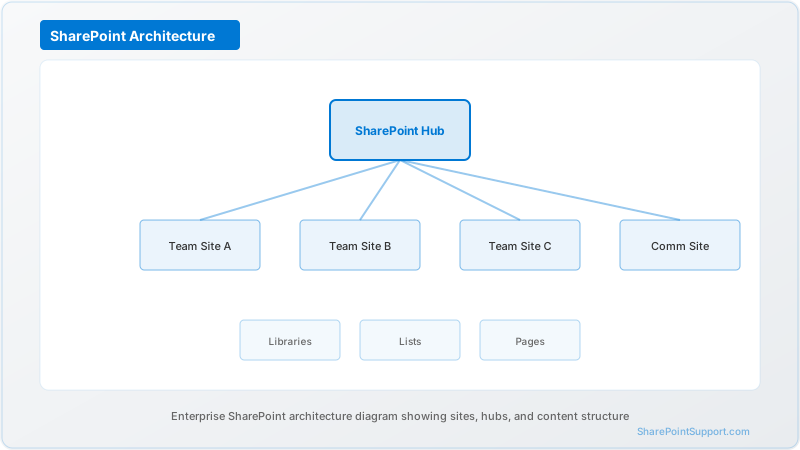
Modern intranets built on SharePoint hub architecture use communication sites as the top-level hub, the departmental landing pages, and most of the broadcast-style content. Communication sites support the Kadence-level visual polish that modern intranets require without requiring custom development.
3. Policy and Procedure Publishing
Organizations publishing internal policies, procedures, employee handbooks, or compliance documentation use communication sites because they integrate with SharePoint document libraries, inherit the tenant's sensitivity labels and retention policies, and support versioning natively.
4. Project Status and Program Rollups
Program management offices publishing project status, cross-project dashboards, and executive rollups use communication sites because they integrate with Power BI, SharePoint Lists, and Planner for status aggregation.
5. Employee Experience and Viva
Communication sites are the foundation of Viva Connections, which surfaces SharePoint content inside Microsoft Teams as a unified employee experience. If Viva Connections is part of the roadmap, communication sites are the content layer.
6. Training and Learning Portals
Internal training content, onboarding materials, and knowledge bases published through communication sites integrate with Viva Learning and Microsoft Search for employee discoverability.
In all six scenarios the audience is internal, the authoring is distributed across the business, and the content integrates with other Microsoft 365 workloads.
Use Power Pages When
Power Pages is the right choice in six different scenarios.
1. Public Customer Portals
Customer portals where external customers log in to view orders, submit tickets, download documents, or self-service account management. Power Pages supports customer authentication (including Azure AD B2C), integrates with Dataverse for customer data, and supports transaction-style interactions that communication sites do not.
2. Partner Portals
Partner portals for distributors, resellers, vendors, and supply chain partners. Partners authenticate through Azure AD B2B or third-party identity providers, access partner-specific content, submit forms and documents, and interact with partner-managed data in Dataverse.
3. Constituent or Citizen Portals
Government and public sector constituent engagement portals where citizens request services, submit applications, track status, and receive notifications. Power Pages supports the authentication, forms, and workflow patterns required for constituent interaction at scale.
4. Public Marketing Sites
Public-facing marketing sites for product lines, events, or campaigns. Power Pages supports SEO, anonymous access, lead capture forms, and integration with Dynamics 365 Marketing. It does not replace dedicated marketing platforms like HubSpot or Marketo but works well for Microsoft-aligned marketing workflows.
5. Low-Code Data-Driven Applications
Applications that primarily surface Dataverse data to external users with moderate transactional complexity. Examples include event registration, application intake, survey and feedback collection, and simple workflow initiation. Power Pages lets these applications be built with minimal custom development.
6. Regulated External Portals
Healthcare patient portals, financial services client portals, and legal client portals that need strong authentication, detailed audit trails, and integration with the organization's compliance framework. Power Pages inherits the Dataverse and Power Platform governance capabilities, which is important for regulated industries.
In all six scenarios the audience is external, the primary content model involves authenticated data access or transactions, and integration with Dataverse is valuable.
The Capability Comparison
A side-by-side comparison of capabilities that most often drive the decision.
Authentication
- Communication Sites: Azure AD, Azure AD B2B guests. No anonymous access pattern.
- Power Pages: Azure AD, Azure AD B2C, third-party identity providers (LinkedIn, Google, Microsoft account), and anonymous access. Full customer portal identity flexibility.
Data Integration
- Communication Sites: SharePoint Lists, SharePoint Libraries, SharePoint Search, Power BI, Graph-connected content. Limited direct integration with Dataverse or external systems.
- Power Pages: Dataverse natively, plus connectors to 600+ systems through Power Platform. Full external data integration.
Forms and Workflow
- Communication Sites: Microsoft Forms and Power Apps via embedded experiences. Good for internal surveys and simple workflows.
- Power Pages: Native form designer with validation, multi-step flows, file upload, and integration with Power Automate. Good for structured data collection at scale.
Licensing and Cost
- Communication Sites: Included in Microsoft 365 E3/E5 and comparable plans. No incremental cost for page creation or traffic.
- Power Pages: Separate per-user or per-authenticated-user licensing plus per-anonymous-user licensing for public-facing sites. Cost scales with traffic and user count.
SEO and Public Discovery
- Communication Sites: Not designed for public discovery. Not search engine optimized. Content is not indexed by external search engines in most configurations.
- Power Pages: Designed for public indexing when configured as public sites. Supports SEO metadata, sitemap generation, and structured data markup.
Customization Flexibility
- Communication Sites: SharePoint Framework (SPFx) extensions, custom web parts, themes. Deep customization possible but follows SharePoint's model.
- Power Pages: HTML, CSS, JavaScript, Liquid templating. More flexibility for pixel-perfect design at the cost of more development work.
Governance
- Communication Sites: Inherits SharePoint and Microsoft 365 governance including sensitivity labels, retention, DLP, eDiscovery, and audit logging.
- Power Pages: Inherits Power Platform governance including environments, data loss prevention policies, and ALM capabilities.
The Hybrid Pattern
Many enterprises use both platforms. Communication sites host internal content, and Power Pages hosts external-facing portals. The two platforms can integrate through several mechanisms.
Content published in SharePoint can be surfaced in Power Pages through the Power Pages SharePoint integration, which lets external users access SharePoint documents with Power Pages authentication. Dataverse data managed in Power Pages can be surfaced in SharePoint communication sites through Power Apps embedded components. Microsoft Graph enables cross-platform data access for solutions that span both.
The hybrid pattern works well for organizations that have both internal communication needs and external portal needs. The key is keeping the boundaries clear. Communication sites should not try to serve external users, and Power Pages should not try to be the internal intranet.
Common Mistakes
Three mistakes recur often enough to call out explicitly.
Mistake 1: Using communication sites for external audiences. Organizations occasionally try to serve external users by making communication sites available to guest accounts. This works at small scale but breaks down for scenarios involving hundreds or thousands of external users, anonymous access, or customer self-service. The rebuild into Power Pages usually comes within 18 months.
Mistake 2: Using Power Pages for internal content. Organizations occasionally build internal portals on Power Pages because the team has Power Platform expertise. The resulting platform delivers worse integration with Microsoft 365 workloads, higher ongoing cost, and a less familiar experience for employees. Communication sites are the right choice for internal audiences in almost every case.
Mistake 3: Not planning for governance. Both platforms require governance models. Communication sites need site classification, permission audits, and content lifecycle. Power Pages needs environment strategy, DLP policies, and ALM processes. Skipping governance on either platform leads to sprawl and eventual cleanup projects.
The Decision Framework in Summary
If the primary audience is internal and the content is broadcast-style, choose communication sites. If the audience is external and the primary content model involves authenticated data access or transactions, choose Power Pages. If both are needed, plan for the hybrid pattern from the start and draw the boundaries explicitly.
Our SharePoint specialists help enterprises plan content platforms that span internal and external audiences, typically combining communication sites, Power Pages, and the right governance model for each. Contact our team to scope a content platform engagement, or review our SharePoint consulting services for the full decision framework.
Written by the SharePoint Support Team
Senior SharePoint Consultants | 25+ Years Microsoft Ecosystem Experience
Our senior SharePoint consultants bring deep expertise spanning 500+ enterprise migrations and compliance implementations across HIPAA, SOC 2, and FedRAMP environments. We cover SharePoint Online, Microsoft 365, migrations, Copilot readiness, and large-scale governance.
Expert SharePoint Services
Frequently Asked Questions
What is the main difference between Power Pages and SharePoint Communication Sites?▼
Can SharePoint Communication Sites be made public?▼
Which platform is cheaper for a customer portal?▼
Can we integrate Power Pages with SharePoint content?▼
What is the right platform for an internal intranet?▼
Does Power Pages support SEO for public marketing sites?▼
Can we use both platforms in the same organization?▼
Which platform has stronger governance capabilities?▼
Need Expert Help?
Our SharePoint consultants are ready to help you implement these strategies in your organization.
Continue Reading in Architecture
SharePoint Online Limits in 2026: What Actually Breaks at Scale
Everyone can recite the 5,000-item threshold. Almost nobody can tell you what genuinely fails first in a large tenant — and in 2026 the answer changed, because agents and Copilot now query your lists too.
ArchitectureSharePoint Hub Sites: Building Connected Experiences
Design an effective hub site architecture that connects related sites, shares navigation, and creates a cohesive experience across your SharePoint environment.
ArchitectureSharePoint Site Collections: Best Practices
Understand SharePoint site collection architecture with best practices for planning, creating, and managing site collections in your Microsoft 365 environment.
ArchitectureSharePoint Information Architecture Guide
Design a scalable SharePoint information architecture with hub sites, metadata taxonomy, navigation patterns, and governance frameworks that serve enterprise organizations for years.
ArchitectureSharePoint Hub Sites: Architecture Guide for 2026
Design and implement SharePoint hub sites that unify navigation, branding, search, and governance across your enterprise. Covers hub planning, association strategies, and real-world architecture patterns.
ArchitectureSharePoint Hub Sites at Scale: 500+ Sites
Hub sites work beautifully for 20 sites and collapse at 500. A proven architecture, governance, and automation model for large enterprises in 2026.