SharePoint for Project Management: Does It Work?
SharePoint is not a purpose-built project management tool — but it powers effective project management for thousands of enterprises. The key is knowing when to use it, how to structure it, and how to integrate it with Microsoft Planner, Teams, and Power BI for a complete PMO solution.
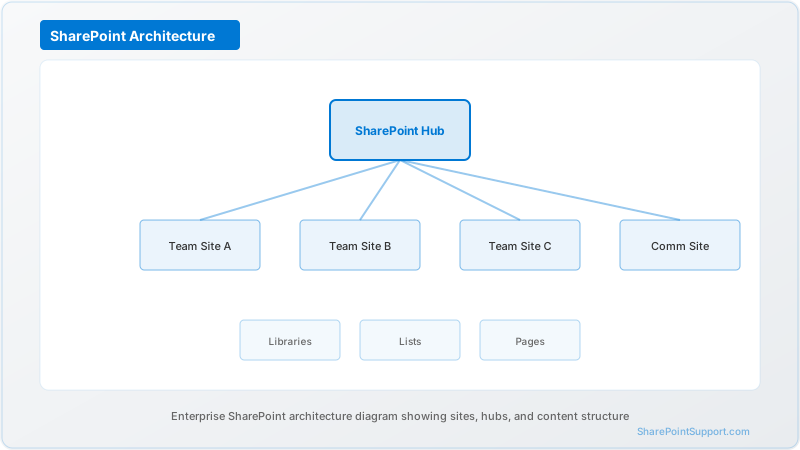
This guide covers everything you need to know to implement SharePoint-based project management at an enterprise scale.
What SharePoint Does Well for Project Management
Document Management and Version Control
Every project generates documents: proposals, statements of work, plans, meeting notes, deliverables. SharePoint provides:
- Versioned document libraries with full edit history
- Co-authoring (multiple people editing simultaneously)
- Check-in/check-out workflows
- Metadata tagging (project phase, status, owner, due date)
- Search across all project documents instantly
Project Portals
A SharePoint project site gives every project a dedicated workspace:
- Team news and announcements
- Document library by phase or workstream
- Issue/risk tracking lists
- Meeting agenda and notes pages
- Project calendar
- Links to related Teams channels and meetings
Status Reporting
SharePoint lists and Power BI embedded views enable automated project reporting:
- Milestone tracking lists with traffic light indicators
- Budget tracking with calculated columns
- Risk register with priority scoring
- Executive dashboard pages that aggregate across projects
Access Control
Unlike many SaaS PM tools, SharePoint gives you enterprise-grade permissions:
- Project-specific permissions for internal vs external collaborators
- Site-level, library-level, and document-level permissions
- Integration with Azure AD for automatic access based on group membership
- Audit logs for compliance requirements (HIPAA, SOC 2)
SharePoint Project Management Architecture
PMO Hub Site
The foundation of enterprise SharePoint PM is a PMO hub site that aggregates all project sites:
- Hub navigation providing consistent header/footer across all project sites
- Hub search that searches across all project content
- Executive rollup page showing status across all active projects
- Resource calendar showing team availability
- Template library for new project site creation
Project Site Template
Standardize project sites so every project has the same structure:
- Documents: Organized by phase (Initiation, Planning, Execution, Closure)
- Tasks: Microsoft Planner web part embedded in the site
- Issues/Risks: SharePoint list with Priority, Status, Owner, Due Date columns
- Milestones: SharePoint list tracking key dates and percentage complete
- Team: Quick links to team members and their roles
- Reports: Power BI report embedded showing project metrics
Integration with Microsoft Planner
SharePoint and Microsoft Planner (now Microsoft Planner Premium / Project for Web) integrate natively:
- Planner web part embeds task boards directly in SharePoint project sites
- Tasks appear in team members' Microsoft To Do
- Planner integrates with Teams for task management in channels
- Project for the Web provides Gantt charts and resource management
Setting Up a SharePoint Project Site in 5 Steps
Step 1: Create the Project Site
From SharePoint admin center or the SharePoint start page:
- Create a new Team site (connected to Microsoft 365 Group for Teams integration)
- Use your PMO site template if available
- Set project metadata in site information (start date, project code, sponsor)
Step 2: Configure Document Library Structure
Default structure recommendation:
```
Project Documents Library
├── 01 - Initiation
│ ├── Business Case
│ ├── Project Charter
│ └── Stakeholder Register
├── 02 - Planning
│ ├── Project Plan
│ ├── Requirements
│ └── Risk Register
├── 03 - Execution
│ ├── Meeting Notes
│ ├── Deliverables
│ └── Change Requests
└── 04 - Closure
├── Lessons Learned
├── Final Report
└── Sign-offs
```
Step 3: Create Tracking Lists
Essential SharePoint lists for project management:
- Tasks: Title, Owner, Start Date, Due Date, Status, % Complete, Priority
- Issues: Title, Description, Reporter, Assignee, Severity, Status, Resolution Date
- Risks: Title, Description, Probability, Impact, Risk Score, Mitigation, Owner
- Milestones: Title, Target Date, Actual Date, Status, Notes
Step 4: Add Status Reporting
Use SharePoint pages to create status dashboards:
- Embed Power BI reports for visual project metrics
- Use Quick Chart web parts for simple milestone tracking
- Create a "Project Status" page with embedded list views filtered by status
- Configure alerts so team members are notified of overdue items
Step 5: Connect to Teams
When creating a SharePoint Team site, a Teams channel is automatically created. This enables:
- Files tab in Teams shows the SharePoint document library
- Meeting recordings stored in SharePoint
- Chat and collaboration alongside project documents
- External stakeholders can be invited as guests
SharePoint vs Dedicated PM Tools: When to Use Each
| Criteria | SharePoint | Dedicated PM (Jira, Asana, Monday) |
|----------|-----------|----------------------------------|
| Document-heavy projects | ✅ Excellent | ❌ Limited |
| Complex task dependencies | ❌ Limited (use Planner Premium) | ✅ Excellent |
| Compliance/audit requirements | ✅ Enterprise audit trails | ❌ Varies |
| Microsoft 365 users already | ✅ No additional cost | ❌ Additional license |
| External client collaboration | ✅ Guest access available | ✅ Good |
| Resource management at scale | ❌ Requires Planner Premium | ✅ Dedicated tools better |
| Agile/Scrum methodology | ❌ Requires add-ons | ✅ Native support |
| Custom reporting | ✅ Power BI integration | ❌ Limited |
Use SharePoint when: Your projects are document-intensive, you're already in Microsoft 365, compliance is important, or you need integration with enterprise content management.
Use dedicated PM tools when: You need advanced scheduling (critical path, dependencies), resource leveling, or agile sprint management as the primary workflow.
Best practice: Use both. SharePoint for document management and project portals, Planner/Project for the Web for task management and scheduling.
Enterprise PMO SharePoint Implementation
For organizations managing 50+ simultaneous projects, a formal PMO SharePoint implementation includes:
Portfolio Management: Power BI dashboard embedded in the PMO hub site showing all projects, their status, health scores, budget variance, and milestone trends across the entire portfolio.
Governance: Site templates, naming conventions, metadata standards, and automated provisioning (using SharePoint PnP templates or Microsoft 365 DSC) ensure consistency.
Resource Management: A central resource availability list showing team members' project allocations, enabling capacity planning.
Project Lifecycle Automation: Power Automate flows that notify stakeholders when milestones are missed, auto-escalate overdue risks, and generate weekly status email digests.
SharePoint + Microsoft Project: For projects needing Gantt charts and critical path analysis, Microsoft Project for the Web (now Microsoft Planner Premium) can be embedded in SharePoint pages and stores data in Dataverse.
Getting Started with SharePoint Project Management
Whether you're implementing SharePoint PM for the first time or modernizing an existing setup, our team can help:
- PMO SharePoint Assessment: Review your current project management processes and design an optimal SharePoint architecture
- SharePoint PMO Implementation: Build your PMO hub site, project templates, and reporting dashboards
- Migration from Legacy Tools: Move project data from Excel, legacy PM tools, or file shares to SharePoint
- Training and Adoption: Ensure your project managers and teams are using SharePoint effectively
Schedule a free SharePoint consultation → to discuss your project management requirements.
Enterprise Implementation Best Practices
In our 25+ years managing enterprise SharePoint environments, we have deployed project management solutions for organizations running everything from 10 concurrent projects to enterprise PMOs managing 500 or more simultaneous initiatives. The implementation patterns that consistently deliver success include the following.
- Standardize Project Site Provisioning: Create a governed provisioning process that deploys project sites from approved templates with pre-configured document libraries, task lists, risk registers, and status reporting pages. Use PnP provisioning templates or Microsoft 365 DSC to ensure every project site includes the same foundational structure. Include metadata columns for project classification such as priority, portfolio alignment, and compliance sensitivity level.
- Build Cross-Project Reporting with Power BI: Individual project sites provide project-level visibility, but PMO leadership needs portfolio-level reporting. Connect Power BI to SharePoint list data across all project sites using the Microsoft Graph API or SharePoint REST data sources. Build dashboards showing portfolio health scores, milestone variance across projects, resource utilization, and budget tracking. Embed these dashboards in the PMO hub site for instant visibility.
- Integrate Project Sites with Teams Channels: Create a Teams team for each project with channels mapping to project workstreams. Connect the project SharePoint site as the Teams file storage backend. Add the project dashboard SharePoint page as a Teams tab. This integration gives project teams a unified workspace where conversations, documents, and status tracking coexist without application switching through SharePoint consulting design.
- Automate Project Lifecycle Events: Configure Power Automate flows that trigger at key project lifecycle milestones. Automatically notify stakeholders when project status changes from green to yellow or red. Generate weekly status digest emails from SharePoint list data. Create tasks automatically when risks are escalated to issues. Archive project sites automatically 90 days after project closure with appropriate retention policies.
- Implement Time and Resource Tracking: For organizations requiring resource management, create a centralized resource allocation list that tracks team member assignments across projects. Use calculated columns to identify overallocation and Power BI visualizations to display capacity across the portfolio. This visibility prevents the common problem of project managers competing for the same resources without coordination.
Governance and Compliance Considerations
Project management in SharePoint must satisfy governance requirements that vary based on industry, project type, and the sensitivity of deliverables produced. Organizations managing projects that produce regulated deliverables need additional governance controls.
For healthcare organizations managing clinical system implementation projects, project documentation may contain references to PHI in requirements documents, testing scripts, and user acceptance testing results. Apply sensitivity labels to project site document libraries based on the project's data classification and ensure that guest access for external vendors is properly scoped and time-limited.
Government contractors managing projects under federal contracts must maintain project records in compliance with FAR recordkeeping requirements. Configure retention policies on project sites that satisfy contract-specific retention periods which commonly extend 3 to 6 years after contract completion. Ensure that project audit trails maintained in SharePoint lists are preserved for the full retention period and included in SharePoint migration planning when infrastructure changes occur.
Financial services organizations must ensure that project management processes for technology implementations include appropriate change management documentation, risk assessment records, and approval trails that satisfy SOC 2 change management controls and regulatory examination requirements.
Measuring Success and ROI
Project management on SharePoint delivers ROI through improved project execution, reduced administrative overhead, and better portfolio visibility that enables smarter investment decisions.
Track on-time project delivery rates before and after SharePoint PM implementation targeting a 20 percent improvement. Monitor the time project managers spend on administrative tasks such as status reporting and document organization targeting a 40 percent reduction through automation. Measure stakeholder satisfaction with project visibility through quarterly surveys targeting 4.0 or higher. Track the reduction in duplicate and inconsistent project documentation across the portfolio. Monitor the time from project request to project kickoff targeting a 30 percent reduction through automated provisioning. Calculate the total cost of project management infrastructure comparing SharePoint-based PM against dedicated tool licensing costs.
Transform your project management with enterprise SharePoint solutions. Contact our team for a PMO assessment and discover how our SharePoint consulting services can streamline your project delivery across the portfolio.
Common Challenges and Solutions
Organizations implementing SharePoint Project Management consistently encounter obstacles that, if left unaddressed, undermine adoption and erode stakeholder confidence. Drawing on two decades of enterprise SharePoint consulting, these are the challenges we see most frequently and the proven approaches for overcoming them.
Challenge 1: Migration and Legacy Content Complexity
Organizations transitioning legacy content into SharePoint Project Management often underestimate the complexity of mapping old structures, metadata, and permissions to modern architectures. Failed migrations erode user confidence and create parallel systems that duplicate effort. The resolution requires a structured approach: conducting thorough pre-migration content audits that classify and prioritize content based on business value. Invest in automated migration tools that preserve metadata fidelity and permission integrity while providing detailed validation reports. Organizations that address this proactively report 40 to 60 percent fewer support tickets within the first 90 days of deployment. Establishing a dedicated governance committee with representatives from IT, compliance, and business stakeholders ensures ongoing alignment between technical configuration and organizational objectives.
Challenge 2: Permission and Access Sprawl
As SharePoint Project Management scales across departments, permission structures inevitably become more complex. Without active governance, permission inheritance breaks down, sharing links proliferate, and sensitive content becomes accessible to unintended audiences. We recommend implementing quarterly access reviews using the SharePoint Admin Center combined with automated reports that flag permission anomalies. Establish a principle of least privilege as the default and require documented justification for elevated access grants. Tracking these metrics through SharePoint health dashboards provides early warning indicators that allow administrators to intervene before minor issues become systemic problems affecting enterprise-wide productivity.
Challenge 3: Performance and Scalability Bottlenecks
Large-scale SharePoint Project Management deployments frequently encounter performance issues as content volumes grow beyond initial design parameters. Large lists, deeply nested folder structures, and poorly optimized custom solutions contribute to slow page loads and frustrated users. The most effective mitigation strategy involves conducting regular performance audits that identify bottlenecks before they impact user experience. Implement list view thresholds, indexed columns, and pagination strategies that maintain responsive performance at enterprise scale. Enterprises operating in regulated industries such as healthcare and financial services must pay particular attention to this challenge because compliance violations carry significant financial and reputational consequences. Regular audits conducted quarterly at minimum help organizations maintain alignment with evolving regulatory requirements and internal policy updates.
Challenge 4: Search Relevance and Content Discoverability
Poor search experiences are among the top complaints users raise about SharePoint Project Management deployments. When search returns irrelevant results or fails to surface critical documents, users abandon the platform in favor of ad-hoc workarounds like email attachments and local file shares. Addressing this requires investing in managed metadata term stores, consistent content type usage, and search schema configuration. Promote high-value content through bookmarks and acronyms in Microsoft Search, and regularly review search analytics to identify and close discoverability gaps. Organizations that invest in structured change management programs achieve adoption rates 35 percent higher than those relying on organic discovery alone. Executive sponsorship combined with department-level champions creates the organizational momentum necessary for sustained success.
Integration with Microsoft 365 Ecosystem
SharePoint Project Management does not operate in isolation. Its value multiplies when connected to the broader Microsoft 365 ecosystem, creating unified workflows that eliminate context switching and reduce manual data transfer between applications.
Microsoft Teams Integration: Configure Teams notifications that alert stakeholders when SharePoint Project Management content changes, ensuring that distributed teams stay informed about updates without relying on manual communication workflows. Teams channels automatically provision SharePoint document libraries, which means sharepoint project management configurations and content flow seamlessly between collaborative conversations and structured document management. Users can surface SharePoint content directly within Teams tabs, reducing the friction that typically causes adoption to stall.
Power Automate Workflows: Create event-driven automations that respond to SharePoint Project Management changes in real time, triggering downstream processes such as notifications, data transformations, and cross-system synchronization. Automated workflows triggered by SharePoint events such as document uploads, metadata changes, or approval completions eliminate repetitive manual tasks. Organizations typically automate 15 to 25 processes within the first quarter, saving an average of 8 hours per week per department. These automations also create audit trails that satisfy compliance requirements for regulated industries.
Power BI Analytics: Connect SharePoint Project Management list and library data to Power BI datasets for advanced analytics that transform raw operational data into strategic business intelligence accessible to decision makers across the organization. Connecting SharePoint data to Power BI dashboards provides real-time visibility into content usage patterns, adoption metrics, and operational KPIs. Decision makers gain actionable intelligence without requiring manual report generation, enabling faster response to emerging trends and potential issues.
Microsoft Purview and Compliance: Configure data loss prevention policies that monitor SharePoint Project Management content for sensitive information patterns, blocking or restricting sharing actions that could violate compliance requirements. Sensitivity labels, data loss prevention policies, and retention schedules configured in Microsoft Purview extend automatically to sharepoint project management content. This unified compliance framework ensures that governance policies apply consistently across the entire Microsoft 365 environment rather than requiring separate configuration for each workload. For organizations subject to HIPAA, SOC 2, or FedRAMP requirements, this integrated approach significantly reduces compliance management overhead.
Getting Started: Next Steps
Implementing SharePoint Project Management effectively requires more than technical configuration. It demands a strategic approach grounded in your organization's specific business requirements, compliance obligations, and growth trajectory. The difference between a deployment that delivers measurable ROI and one that becomes shelfware often comes down to the quality of upfront planning and expert guidance.
Begin with a focused assessment of your current SharePoint environment. Evaluate your existing information architecture, permission structures, content lifecycle policies, and user adoption patterns. Identify gaps between your current state and the target state required for successful sharepoint project management implementation. This assessment typically takes 2 to 4 weeks and produces a prioritized roadmap that aligns technical work with business outcomes.
Our SharePoint specialists have guided organizations across healthcare, financial services, government, and education through hundreds of successful implementations. We bring deep expertise in SharePoint architecture, governance frameworks, and compliance alignment that accelerates time to value while minimizing risk.
Ready to move forward? Contact our team for a complimentary consultation. We will assess your environment, identify quick wins, and develop a phased implementation plan tailored to your organization's needs and timeline. Whether you are starting from scratch or optimizing an existing deployment, our enterprise SharePoint consultants deliver the depth and accountability enterprise SharePoint work requires.
Written by the SharePoint Support Team
Senior SharePoint Consultants | 25+ Years Microsoft Ecosystem Experience
Our senior SharePoint consultants bring deep expertise spanning 500+ enterprise migrations and compliance implementations across HIPAA, SOC 2, and FedRAMP environments. We cover SharePoint Online, Microsoft 365, migrations, Copilot readiness, and large-scale governance.
Expert SharePoint Services
Frequently Asked Questions
What should enterprises consider before implementing features solutions in SharePoint?▼
How do we ensure our SharePoint environment follows enterprise best practices?▼
What ongoing maintenance does a SharePoint environment require?▼
How do we get leadership buy-in for SharePoint improvements?▼
Need Expert Help?
Our SharePoint consultants are ready to help you implement these strategies in your organization.
Continue Reading in Features
SharePoint Version History & File Management Best Practices
Master SharePoint version history, version limits, storage impact, and file lifecycle management. Learn when to keep versions, how to configure limits, restore previous versions, and automate cleanup for enterprise-scale document libraries.
FeaturesSharePoint Hub Sites for Enterprise
Master SharePoint hub sites to create a connected, unified intranet experience. Learn hub site architecture patterns, hub of hubs design, navigation inheritance, shared search scope, and how to design a hub hierarchy that scales with your organization.
FeaturesSharePoint News Web Part: Guide to Intranet Communications
Master the SharePoint News web part to build an engaging, targeted intranet news experience. Learn news post types, audience targeting, approval workflows, news digests, and best practices for driving employee engagement through SharePoint.
FeaturesSharePoint List vs. Library: When to Use Each (Guide)
Understand the difference between SharePoint lists and document libraries. Learn when to use lists for structured data, when to use libraries for documents, how to choose the right approach for common use cases, and how lists and libraries work together.
FeaturesMicrosoft Viva Connections: SharePoint-Powered Employee Experience Platform
Deploy Microsoft Viva Connections on your SharePoint intranet to create a unified employee experience in Microsoft Teams. Learn Viva Connections setup, dashboard card configuration, audience targeting, and how to drive adoption for your digital employee experience.
FeaturesSharePoint Workflow Automation in 2026: Power Automate, Logic Apps & Beyond
Master SharePoint workflow automation with Power Automate. Learn trigger types, common approval workflows, document lifecycle automation, integration patterns with Teams/Outlook/SAP, and when to use Logic Apps vs. Power Automate for enterprise SharePoint workflows.