
How SharePoint Permissions Work and How to Manage Them Securely
SharePoint permissions control who can access, edit, and manage content across sites, libraries, lists, folders, and individual items through a hierarchical inheritance model combined with role-based permission levels and group-based access management. Getting permissions right is the difference between a secure, governed collaboration platform and a data governance nightmare that exposes sensitive information and fails compliance audits.
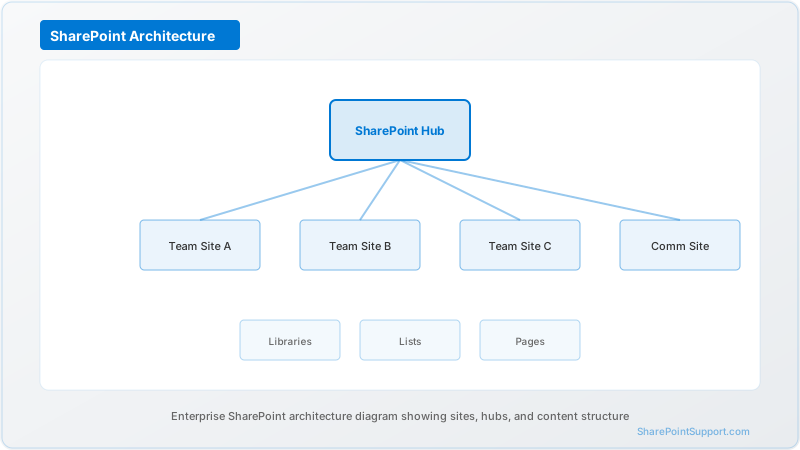
In our 25+ years of managing SharePoint environments for enterprise organizations in healthcare, financial services, and government, we have audited thousands of SharePoint permission structures. The most common finding is over-permissioned environments where too many users have too much access. This guide covers permission levels, inheritance, groups, auditing, and the best practices that keep your environment secure. For the full 10-point security model, Copilot-readiness audit, and scripting reference, pair this fundamentals guide with our SharePoint permissions and security complete guide.
SharePoint Permission Levels
SharePoint provides built-in permission levels that combine individual permissions into functional roles. Full Control grants complete administrative access including the ability to change permissions and delete the site. Design allows editing pages and applying themes. Edit enables adding, editing, and deleting items and documents. Contribute allows adding and editing items but not deleting others' content. Read provides view-only access. View Only allows viewing in the browser without downloading. Limited Access provides access to specific items within a site.
Custom permission levels can be created by combining individual permissions. Use custom levels sparingly because they increase complexity without proportional benefit for most organizations.
How Permission Inheritance Works
SharePoint uses permission inheritance by default. Child objects inherit permissions from their parent in a cascading hierarchy from site collection to site to library to folder to individual item.
```
Site Collection (top-level permissions)
Site (inherits from site collection)
Library (inherits from site)
Folder (inherits from library)
Document (inherits from folder)
```
Breaking inheritance creates unique permissions at any level, disconnecting that object from the parent's permission structure. Each break creates management overhead and audit complexity. An environment with thousands of broken inheritance points becomes effectively unauditable.
The rule of thumb is to break inheritance as high as possible. Library-level or folder-level unique permissions are manageable. Item-level unique permissions should be a last resort reserved for genuinely exceptional circumstances.
Managing Permissions with Groups
Never Assign Permissions to Individuals
Always use SharePoint Groups or Azure AD Security Groups for permission assignments. Direct user assignments create unmanageable permission sprawl that is impossible to audit effectively.
Every site automatically gets three SharePoint groups: Owners with Full Control, Members with Edit access, and Visitors with Read access. These groups should be your starting point.
Azure AD Security Groups
For enterprise environments, use Azure AD Security Groups as members of SharePoint groups rather than adding individual users. This provides automatic access removal when users leave the organization, HR or manager-controlled group membership, auditable access through Azure AD logs, and scalable permission management across hundreds of sites.
```
SharePoint Group: Finance Site Members
Azure AD Group: Finance Department (all finance staff)
Azure AD Group: Finance Contractors Q2 2026
Azure AD Group: Finance External Auditors (time-bound)
```
Owner Group Size
Limit the Owners group to two people per site. Owners have Full Control including the ability to change permissions and delete the entire site. Excessive Owners create uncontrolled permission changes and increase security risk.
Permission Anti-Patterns to Avoid
The Everyone group should never have edit access to any site. The Everyone Except External Users group should be used cautiously and only for truly organization-wide read access. Sharing individual files with external users by breaking inheritance on hundreds of items creates an unmanageable permission structure. Granting site collection administrator rights to solve individual access problems gives far more access than needed.
Auditing Permissions
PowerShell Permission Reports
```powershell
Connect-PnPOnline -Url "https://tenant.sharepoint.com/sites/finance" -Interactive
# Report unique permissions (broken inheritance)
$lists = Get-PnPList
foreach ($list in $lists) {
$items = Get-PnPListItem -List $list -PageSize 500
foreach ($item in $items) {
if ($item.HasUniqueRoleAssignments) {
Write-Output "Unique permissions: $($list.Title) - $($item['FileRef'])"
}
}
}
```
Regular Permission Reviews
Conduct quarterly permission reviews on sites containing sensitive content. Verify that only authorized groups have access. Check for broken inheritance that may have been created by sharing operations. Remove stale guest accounts that no longer need access. Document findings and track remediation.
External Sharing Permissions
Configure external sharing at the tenant level and the site level. Tenant-level settings establish the maximum sharing capability. Site-level settings can be more restrictive but cannot exceed the tenant setting. For sensitive sites, disable external sharing entirely. For collaboration sites, allow sharing with authenticated external users but block anonymous links.
Conditional Access and Modern Security
Complement SharePoint permissions with Azure AD Conditional Access policies that enforce multi-factor authentication for sensitive sites, block access from unmanaged devices, restrict access by geographic location, and require device compliance before granting access. These policies add security layers that traditional SharePoint permissions cannot provide.
Permission Management for Teams-Connected Sites
Sites connected to Microsoft Teams should have their permissions managed through Teams rather than SharePoint. Adding or removing team members automatically updates SharePoint permissions through the Microsoft 365 Group. Direct SharePoint permission changes on Teams-connected sites can create inconsistencies between what Teams shows and what SharePoint enforces.
Preparing Permissions for Microsoft Copilot Deployment
Microsoft Copilot for Microsoft 365 surfaces content from any SharePoint site that a user has access to, which means that overly permissive permissions directly impact Copilot responses. If a user has access to confidential HR documents because of stale permissions from a previous role, Copilot may include information from those documents in its responses without the user explicitly requesting it. This makes permissions cleanup a critical prerequisite for Copilot deployment rather than an afterthought.
Before enabling Copilot, conduct a comprehensive permissions audit that identifies and remediates overshared content across your SharePoint environment. Focus on sites with sensitive content including HR, finance, legal, and executive communications. Remove direct user permissions that bypass group-based access. Verify that sharing links do not grant broader access than intended. And establish ongoing access review processes that prevent permissions drift from reoccurring after the initial cleanup.
Automating Permission Lifecycle Management
Manual permission management does not scale beyond a few dozen sites. Implement automation using Azure AD dynamic groups that adjust membership based on user attributes like department, job title, and location. Configure site provisioning templates that establish correct permission models automatically when new sites are created. Integrate SharePoint permissions with HR systems through Power Automate so that role changes and departures trigger automatic permission adjustments across all affected sites.
Our SharePoint consulting team conducts permission audits and designs secure access models for regulated industries. Contact us for a permission review and security hardening engagement.
Advanced Permission Scenarios
Time-Bound Access for External Auditors
External auditors need temporary access to specific SharePoint sites during audit periods. Rather than creating persistent guest accounts, implement time-bound access using Azure AD entitlement management access packages. Create an access package that grants Read access to the designated audit sites, requires approval from the compliance officer, automatically expires after the audit period (typically 30 to 90 days), and includes an access review at the midpoint of the access period.
This approach satisfies compliance requirements for controlled external access while automating the lifecycle management that prevents stale guest accounts from accumulating.
Cross-Functional Project Permissions
Projects that span multiple departments require permission structures that cross organizational boundaries. Create project-specific Azure AD security groups that include members from each contributing department. Add these groups to the project SharePoint site with Edit permissions. When the project concludes, remove the group from the site or disable the group entirely. This approach is cleaner than adding individual users from multiple departments directly.
Information Barriers for Compliance
Organizations subject to ethical wall requirements, such as financial institutions with investment banking and research divisions, need information barriers that prevent specific groups from accessing each other's SharePoint content. Configure information barrier policies in the Microsoft Purview compliance portal that define which user segments can and cannot communicate or collaborate. These policies are enforced at the SharePoint site level, preventing barrier-violating access even if someone attempts to grant it.
Permission Automation with Power Automate
Automated Access Request Workflows
Build self-service access request workflows using Power Automate. Users submit access requests through a Microsoft Form or SharePoint list. The flow routes the request to the site owner for approval. Upon approval, the flow automatically adds the user to the appropriate SharePoint group. The flow logs the access grant in an audit list and schedules a review reminder. This automation reduces the burden on IT while maintaining governance.
Automated Permission Reviews
Configure periodic permission review flows that run quarterly on sensitive sites. The flow exports current site permissions, compares them against the approved access list maintained in a governance SharePoint list, identifies discrepancies such as users who have left the organization or changed roles, and generates a review report for the site owner. The site owner reviews and remediates discrepancies, and the flow logs the completion of the review.
SharePoint Advanced Management for Permissions
SharePoint Advanced Management (part of Microsoft Syntex) provides additional permission governance capabilities including site access reviews that prompt site owners to review and re-certify permissions on a defined schedule, restricted access control for SharePoint sites that limits access to users within specific Azure AD security groups, and data access governance reports that identify sites with the most external sharing, sites with the widest internal sharing, and sites where permissions have been recently modified.
These capabilities address the scale challenges of permission management in organizations with thousands of SharePoint sites where manual auditing is impractical.
Permission Documentation and Knowledge Management
Maintain a permissions documentation site that records the intended permission structure for each critical site, the Azure AD groups used for access management, the business justification for any broken inheritance, the review schedule and last review date, and the escalation path for permission-related issues. This documentation serves as the single source of truth for permission management and is essential for auditors, new administrators, and incident responders who need to understand the intended access model quickly.
Enterprise Implementation Best Practices
In our 25+ years of enterprise SharePoint consulting, we have audited and remediated permission structures for organizations with millions of unique permission assignments, and the pattern is remarkably consistent: permission complexity grows exponentially while visibility into who has access to what decreases inversely. Proactive permission management is essential for security, compliance, and operational efficiency.
- Default to Inheritance, Break Sparingly: SharePoint's permission inheritance model is your most powerful governance tool. Configure site-level permissions correctly and let inheritance flow through libraries, folders, and items. Every broken inheritance point creates a management burden that compounds over time. When inheritance must be broken, document the business justification and assign an owner responsible for maintaining those unique permissions.
- Use Security Groups Exclusively for Permission Assignment: Never assign permissions to individual user accounts. Create Azure AD security groups that reflect organizational roles and responsibilities, and assign permissions to these groups. Group-based permissions reduce administrative overhead by orders of magnitude, simplify access reviews, and ensure that organizational changes such as departures and role changes automatically adjust SharePoint access.
- Implement Regular Access Reviews: Schedule quarterly access reviews for all sites containing sensitive or regulated content. Use the SharePoint Admin Agent or third-party tools to generate access reports that site owners can review and certify. Access reviews are not merely a best practice but a regulatory requirement for organizations subject to HIPAA, SOC 2, and most financial services regulations.
- Audit External Sharing Continuously: External sharing is the highest-risk permission scenario. Configure alerts for all external sharing events, review sharing reports weekly, and implement automatic expiration for external sharing links. Require business justification for external sharing to sites containing sensitive content and route sharing requests through approval workflows for regulated content.
- Deploy Privileged Access Management for Administrators: SharePoint administrators with full tenant access represent a significant insider risk. Implement just-in-time access through Azure AD Privileged Identity Management so that administrative permissions are activated only when needed, for limited durations, and with full audit logging.
Governance and Compliance Considerations
Permission management in SharePoint has direct compliance implications because access control effectiveness determines whether your organization satisfies regulatory requirements for data protection, privacy, and information security across every regulated content repository.
For HIPAA-regulated organizations, SharePoint permissions must enforce minimum necessary access to protected health information. This means regular access reviews that verify each user's access to PHI is justified by a specific clinical or business role, comprehensive audit logging of all permission changes, and immediate access revocation when employees change roles or depart. Permission configurations must align with your HIPAA risk assessment findings.
Financial services organizations must demonstrate to SOC 2 auditors that access controls are designed effectively and operating consistently. Map your SharePoint permission model to SOC 2 trust service criteria, implement automated access certification campaigns that document reviewer attestation, and maintain evidence of prompt access revocation for terminated employees and contractors.
Government organizations must ensure that SharePoint permissions align with security clearance levels and need-to-know requirements. Implement access controls that prevent unauthorized access to controlled unclassified information and classified content, and maintain audit trails that satisfy NIST 800-53 access control requirements.
Regardless of your regulatory environment, implement a continuous permission monitoring program that identifies permission drift, excessive access accumulation, and orphaned permissions from organizational changes. Schedule formal access certification campaigns quarterly for sensitive content and annually for general content. Document your permission governance model and review it with your compliance team to ensure it addresses current regulatory expectations. Our SharePoint access governance specialists design permission architectures that satisfy auditors while maintaining operational efficiency.
Ready to gain complete visibility and control over your SharePoint permissions? Our access governance specialists have remediated permission structures for enterprises with millions of unique permission assignments. Contact our team for a permissions audit, and discover how our SharePoint consulting services can protect your sensitive content while maintaining operational efficiency.
Common Challenges and Solutions
Organizations implementing SharePoint Permissions Management consistently encounter obstacles that, if left unaddressed, undermine adoption and erode stakeholder confidence. Drawing on two decades of enterprise SharePoint consulting, these are the challenges we see most frequently and the proven approaches for overcoming them.
Challenge 1: Content Sprawl and Information Architecture Degradation
Over time, SharePoint Permissions Management environments accumulate redundant, outdated, and trivial content that degrades search relevance and confuses users. Without proactive content lifecycle management, the signal-to-noise ratio deteriorates and user trust in the platform erodes. The resolution requires a structured approach: establishing automated retention policies that flag content for review after defined periods of inactivity, combined with content owner accountability structures that assign clear responsibility for each site collection and library. Organizations that address this proactively report 40 to 60 percent fewer support tickets within the first 90 days of deployment. Establishing a dedicated governance committee with representatives from IT, compliance, and business stakeholders ensures ongoing alignment between technical configuration and organizational objectives.
Challenge 2: Compliance and Audit Readiness Gaps
SharePoint Permissions Management implementations in regulated industries often lack the audit trail depth and policy enforcement rigor required by frameworks such as HIPAA, SOC 2, and GDPR. Retroactive compliance remediation is significantly more expensive and disruptive than building compliance into the initial design. We recommend embedding compliance requirements into the information architecture from day one. Configure Microsoft Purview retention labels, DLP policies, and audit logging before deploying content, and validate compliance posture through regular internal audits. Tracking these metrics through SharePoint health dashboards provides early warning indicators that allow administrators to intervene before minor issues become systemic problems affecting enterprise-wide productivity.
Challenge 3: Inconsistent Governance Across Business Units
When different departments implement SharePoint Permissions Management independently, inconsistent naming conventions, metadata schemas, and security configurations create silos that undermine cross-functional collaboration and complicate compliance reporting. The most effective mitigation strategy involves centralizing governance policy definition while allowing controlled flexibility at the departmental level. A hub-and-spoke governance model balances enterprise consistency with departmental autonomy. Enterprises operating in regulated industries such as healthcare and financial services must pay particular attention to this challenge because compliance violations carry significant financial and reputational consequences. Regular audits conducted quarterly at minimum help organizations maintain alignment with evolving regulatory requirements and internal policy updates.
Challenge 4: Migration and Legacy Content Complexity
Organizations transitioning legacy content into SharePoint Permissions Management often underestimate the complexity of mapping old structures, metadata, and permissions to modern architectures. Failed migrations erode user confidence and create parallel systems that duplicate effort. Addressing this requires conducting thorough pre-migration content audits that classify and prioritize content based on business value. Invest in automated migration tools that preserve metadata fidelity and permission integrity while providing detailed validation reports. Organizations that invest in structured change management programs achieve adoption rates 35 percent higher than those relying on organic discovery alone. Executive sponsorship combined with department-level champions creates the organizational momentum necessary for sustained success.
Integration with Microsoft 365 Ecosystem
SharePoint Permissions Management does not operate in isolation. Its value multiplies when connected to the broader Microsoft 365 ecosystem, creating unified workflows that eliminate context switching and reduce manual data transfer between applications.
Microsoft Teams Integration: Configure Teams notifications that alert stakeholders when SharePoint Permissions Management content changes, ensuring that distributed teams stay informed about updates without relying on manual communication workflows. Teams channels automatically provision SharePoint document libraries, which means sharepoint permissions management configurations and content flow seamlessly between collaborative conversations and structured document management. Users can surface SharePoint content directly within Teams tabs, reducing the friction that typically causes adoption to stall.
Power Automate Workflows: Create event-driven automations that respond to SharePoint Permissions Management changes in real time, triggering downstream processes such as notifications, data transformations, and cross-system synchronization. Automated workflows triggered by SharePoint events such as document uploads, metadata changes, or approval completions eliminate repetitive manual tasks. Organizations typically automate 15 to 25 processes within the first quarter, saving an average of 8 hours per week per department. These automations also create audit trails that satisfy compliance requirements for regulated industries.
Power BI Analytics: Connect SharePoint Permissions Management list and library data to Power BI datasets for advanced analytics that transform raw operational data into strategic business intelligence accessible to decision makers across the organization. Connecting SharePoint data to Power BI dashboards provides real-time visibility into content usage patterns, adoption metrics, and operational KPIs. Decision makers gain actionable intelligence without requiring manual report generation, enabling faster response to emerging trends and potential issues.
Microsoft Purview and Compliance: Configure data loss prevention policies that monitor SharePoint Permissions Management content for sensitive information patterns, blocking or restricting sharing actions that could violate compliance requirements. Sensitivity labels, data loss prevention policies, and retention schedules configured in Microsoft Purview extend automatically to sharepoint permissions management content. This unified compliance framework ensures that governance policies apply consistently across the entire Microsoft 365 environment rather than requiring separate configuration for each workload. For organizations subject to HIPAA, SOC 2, or FedRAMP requirements, this integrated approach significantly reduces compliance management overhead.
Getting Started: Next Steps
Implementing SharePoint Permissions Management effectively requires more than technical configuration. It demands a strategic approach grounded in your organization's specific business requirements, compliance obligations, and growth trajectory. The difference between a deployment that delivers measurable ROI and one that becomes shelfware often comes down to the quality of upfront planning and expert guidance.
Begin with a focused assessment of your current SharePoint environment. Evaluate your existing information architecture, permission structures, content lifecycle policies, and user adoption patterns. Identify gaps between your current state and the target state required for successful sharepoint permissions management implementation. This assessment typically takes 2 to 4 weeks and produces a prioritized roadmap that aligns technical work with business outcomes.
Our SharePoint specialists have guided organizations across healthcare, financial services, government, and education through hundreds of successful implementations. We bring deep expertise in SharePoint architecture, governance frameworks, and compliance alignment that accelerates time to value while minimizing risk.
Ready to move forward? Contact our team for a complimentary consultation. We will assess your environment, identify quick wins, and develop a phased implementation plan tailored to your organization's needs and timeline. Whether you are starting from scratch or optimizing an existing deployment, our enterprise SharePoint consultants deliver the depth and accountability enterprise SharePoint work requires.
Written by the SharePoint Support Team
Senior SharePoint Consultants | 25+ Years Microsoft Ecosystem Experience
Our senior SharePoint consultants bring deep expertise spanning 500+ enterprise migrations and compliance implementations across HIPAA, SOC 2, and FedRAMP environments. We cover SharePoint Online, Microsoft 365, migrations, Copilot readiness, and large-scale governance.
Expert SharePoint Services
Frequently Asked Questions
What are the most common SharePoint security vulnerabilities?▼
How do we prevent data leaks through SharePoint external sharing?▼
What SharePoint security features are included with Microsoft 365 E5?▼
How do we audit who accessed sensitive documents in SharePoint?▼
How do we evaluate SharePoint against competing platforms?▼
Need Expert Help?
Our SharePoint consultants are ready to help you implement these strategies in your organization.
Continue Reading in Security
SharePoint External Sharing & Guest Access
Securely configure SharePoint external sharing and guest access for enterprise collaboration. Learn sharing policies, guest user management, conditional access, auditing external activity, and compliance controls.
SecuritySharePoint & Microsoft Entra ID (Azure AD) Integration Guide
Master the integration between SharePoint Online and Microsoft Entra ID (Azure AD). Learn how authentication, authorization, guest access, group management, conditional access, and identity governance work together for enterprise SharePoint security.
SecuritySharePoint Audit Log & Monitoring: Complete Compliance and Security Guide
Master SharePoint audit logging for compliance and security monitoring. Covers Microsoft Purview audit log, key events to monitor, KQL queries, compliance reporting, and real-time alerting configurations.
SecuritySharePoint Sensitivity Labels for Microsoft Purview
Configure Microsoft Purview sensitivity labels for SharePoint. Covers label taxonomy design, encryption settings, auto-labeling, DLP integration, container labels for Teams and SharePoint sites, and end-user adoption.
SecuritySharePoint HIPAA Compliance Checklist: 25 Points Every Healthcare Org Must Verify
SharePoint Online supports HIPAA compliance but it is not compliant by default. This 25-point checklist covers every configuration, policy, and governance requirement.
SecurityFix These 10 SharePoint Permission Mistakes Now
Every SharePoint environment we audit has these 10 permission errors causing data leaks. Free security checklist to lock down access before Copilot exposes it.