The 20-Point SharePoint Security Hardening Checklist
After 25 years in the Microsoft ecosystem and hundreds of security assessments, I can tell you that most SharePoint breaches are not sophisticated attacks. They are configuration failures — default settings that should have been changed, sharing controls that were never restricted, and audit logging that was never enabled.
This checklist covers every attack surface in a SharePoint Online environment. If you implement all 20 points, you will be ahead of 95% of enterprises I have audited. For the companion reference on the permission layer that controls who can reach every hardened surface, pair this checklist with our SharePoint permissions and security complete guide.
---
Authentication & Identity (Points 1-5)
1. Enforce MFA for All SharePoint Access
No exceptions. Not even for the CEO. Conditional Access policy in Microsoft Entra ID: require MFA for all users accessing SharePoint Online, from any device, from any location. Phishing-resistant MFA (FIDO2 keys or Microsoft Authenticator number matching) preferred over SMS.
2. Block Legacy Authentication Protocols
Legacy auth (Basic Auth, IMAP, POP3, ActiveSync without modern auth) bypasses MFA. Conditional Access policy: block legacy authentication for all users. This prevents credential-stuffing attacks against SharePoint-connected services.
3. Configure Conditional Access for Device Compliance
Require managed devices (enrolled in Intune) for full SharePoint access. Unmanaged devices get browser-only access with no download capability. This prevents data exfiltration to personal devices.
4. Implement Session Controls
SharePoint Admin Center > Access Control > Idle session sign-out: enable with 30-minute timeout. For sensitive sites, use Conditional Access App Control through Defender for Cloud Apps to enforce real-time session monitoring.
5. Deploy Privileged Access Management for SharePoint Admins
SharePoint Global Admins and Site Collection Admins have access to everything. Use Privileged Identity Management (PIM) in Microsoft Entra ID to require just-in-time activation of admin roles. Admin access should be time-limited (1-4 hours) and require approval.
---
Sharing & External Access (Points 6-10)
6. Set Organization-Wide Sharing to "Least Permissive"
SharePoint Admin Center > Sharing: set the organization-wide default to "Only people in your organization." Individual sites can be opened to external sharing when business justification exists, but the default must be restrictive.
7. Disable "Anyone" Links Organization-Wide
"Anyone" links allow access without authentication. Disable them completely. If anonymous sharing is needed for specific scenarios (public file downloads), use a dedicated site with restricted content.
8. Set Default Link Type to "Specific People"
When users share documents, the default should create a link that only specific named recipients can access — not "People in your organization" which grants access to all employees.
9. Require Guest Access Expiration
SharePoint Admin Center > Sharing > Guest access: set expiration to 30 days (or 90 days for long-term partnerships). After expiration, guests must be re-invited. This prevents stale guest access accumulating indefinitely.
10. Block Sharing with Specific Domains
If your organization should never share content with certain domains (competitors, sanctioned entities), add them to the sharing block list. SharePoint Admin Center > Sharing > domain filtering.
---
Data Protection (Points 11-15)
11. Deploy DLP Policies for Sensitive Content
Microsoft Purview DLP policies should scan all SharePoint content for: SSN, credit card numbers, health records (PHI patterns), financial data, source code, and any organization-specific sensitive patterns. Block sharing of detected sensitive content with external users. Alert compliance team on matches.
12. Apply Sensitivity Labels to All Sites and Documents
Every SharePoint site should have a default sensitivity label. Every document library containing sensitive content should require a label before documents can be saved. Sensitivity labels should control: encryption, access restrictions, visual markings, and sharing limitations.
13. Enable Microsoft Purview Audit Logging
Verify audit logging is ON (it is off by default on some tenants). Configure 1-year retention (E5) or purchase audit log retention add-on. Enable enhanced audit events for SharePoint: MailItemsAccessed, SearchQueryInitiatedSharePoint, FileAccessedExtended.
14. Deploy Microsoft Defender for Cloud Apps
Connect SharePoint Online to Defender for Cloud Apps for real-time monitoring. Configure policies for: mass download detection (potential data exfiltration), access from anonymous proxies/VPNs, impossible travel (access from two countries within 1 hour), and ransomware activity detection (rapid file encryption patterns).
15. Encrypt Sensitive Content with Sensitivity Labels
Sensitivity labels with encryption ensure that even if a document is downloaded or shared outside the organization, only authorized users can open it. The encryption follows the document regardless of where it goes.
---
Copilot Security (Points 16-17)
16. Audit Permissions Before Copilot Deployment
Copilot searches everything a user can access. Before deployment, run a full permission audit across all SharePoint sites. Remediate: "Everyone" grants, overshared sites, stale guest access, and sites with no sensitivity labels. Copilot amplifies every permission mistake.
17. Configure Copilot-Specific DLP Policies
Create DLP policies that specifically address Copilot scenarios: prevent Copilot from surfacing content labeled "Highly Confidential" in AI-generated responses, restrict Copilot access to sites below a certain sensitivity threshold, and monitor Copilot query logs for access to sensitive content.
---
Monitoring & Incident Response (Points 18-20)
18. Configure Real-Time Alerts for High-Risk Events
Set up alerts in Microsoft Purview and Defender for Cloud Apps for: external sharing of documents labeled Confidential or above, admin role activations, DLP policy overrides by users, bulk file operations (download/delete/move over 100 files in 1 hour), and new device/location access patterns.
19. Establish SharePoint Incident Response Procedures
Pre-define response procedures for common SharePoint security incidents: unauthorized data sharing (containment: revoke sharing, apply hold, investigate scope), compromised admin account (containment: disable account, revoke sessions, audit all admin actions in last 72 hours), ransomware detection (containment: isolate affected site, restore from versioning or backup), and data exfiltration (containment: block user, preserve audit logs, assess data scope for breach notification).
20. Conduct Annual SharePoint Security Assessment
Hire an independent assessor (not your day-to-day SharePoint consultant) to evaluate your SharePoint security posture annually. The assessment should cover all 20 points on this checklist plus: penetration testing of custom SPFx solutions, review of Power Automate flows for data leakage paths, and evaluation of third-party app permissions.
---
Security Hardening Priority Matrix
| Priority | Points | Timeline | Impact |
|----------|--------|----------|--------|
| Critical (do today) | 1, 2, 6, 7, 13 | This week | Blocks the most common attack vectors |
| High (do this month) | 3, 8, 9, 11, 12 | Within 30 days | Protects data and controls sharing |
| Important (this quarter) | 4, 5, 10, 14, 15 | Within 90 days | Advanced protection and monitoring |
| Copilot-specific | 16, 17 | Before Copilot deployment | Prevents AI-amplified data exposure |
| Ongoing | 18, 19, 20 | Continuous | Detection, response, and assessment |
---
Frequently Asked Questions
Is SharePoint Online secure by default?
No. SharePoint Online provides strong infrastructure security (Microsoft manages physical security, network security, and platform patches), but application-level security is your responsibility. Sharing defaults are permissive, audit logging may not be enabled, DLP is not configured, and sensitivity labels must be created and applied by your organization.
What is the biggest SharePoint security risk in 2026?
Overshared permissions amplified by Microsoft Copilot. Before Copilot, a user with accidental access to a sensitive document would only see it if they navigated to the specific library. With Copilot, that same user can ask a natural language question and Copilot will surface the sensitive content proactively.
How do I know if my SharePoint environment has been compromised?
Check Microsoft Purview audit logs for: unusual file access patterns, bulk downloads, sharing events to unknown external domains, admin role changes you did not authorize, and new OAuth app registrations. If you do not have audit logging enabled, you cannot detect compromise — enable it immediately (Point 13).
Should I use a third-party security tool for SharePoint?
Microsoft's native tools (Purview, Defender for Cloud Apps, Entra ID) cover 90% of security needs. Third-party tools add value for: advanced permission reporting and cleanup (ShareGate, Netwrix), user behavior analytics (Varonis, Exabeam), and backup/recovery beyond Microsoft's native capabilities.
How often should I audit SharePoint security?
Quarterly permission reviews, monthly sharing reports, real-time monitoring for high-risk events, and annual comprehensive security assessments. The cadence should increase if your organization is in a regulated industry or has experienced a security incident.
What compliance frameworks require SharePoint security hardening?
All major frameworks: SOC 2 (access controls, monitoring, incident response), HIPAA (PHI protection, audit trails, BAA), FedRAMP (NIST 800-53 controls), ISO 27001 (information security management), PCI DSS (cardholder data protection), and GDPR (data protection and privacy). The specific controls required vary by framework, but this 20-point checklist covers the overlap.
Need expert guidance? Contact our team to discuss your requirements, or explore our SharePoint security services to learn how we can help your organization.
Enterprise Implementation Best Practices
In our 25+ years of enterprise SharePoint consulting, we have guided hundreds of organizations through complex SharePoint initiatives spanning every industry and organizational scale. The implementation patterns that consistently deliver successful outcomes share common characteristics regardless of the specific feature or capability being deployed.
- Conduct a Thorough Requirements and Readiness Assessment: Before beginning any SharePoint implementation, invest time in understanding both the business requirements and the technical readiness of your environment. Assess your current content architecture, permission structures, integration dependencies, and user readiness. This assessment typically reveals 20 to 30 percent more complexity than initial stakeholder estimates suggest.
- Deploy in Controlled Phases with Pilot Groups: Start with a pilot group of 50 to 100 representative users from different departments and roles. Define measurable success criteria for each phase and collect structured feedback through surveys and interviews. Phased deployment reduces risk, builds organizational confidence, and generates the internal success stories that accelerate broader adoption.
- Invest in Change Management and Training: Technology implementations fail when organizations underinvest in helping people adapt to new tools and processes. Develop role-specific training that demonstrates how the new capability helps users accomplish their actual daily tasks. Create champion networks, host office hours, and celebrate early wins to build momentum across the organization.
- Automate Governance and Compliance Controls: Manual governance does not scale beyond a few dozen users or sites. Implement automated policy enforcement using Power Automate workflows, sensitivity labels, retention policies, and SharePoint administrative tools that ensure consistent compliance without creating bottlenecks or relying on individual user behavior.
- Establish Monitoring, Metrics, and Continuous Improvement: Define key performance indicators before deployment and track them systematically. Monitor adoption rates, user satisfaction, performance metrics, and business outcome improvements. Review these metrics monthly with stakeholders and use them to drive iterative improvements rather than treating the initial deployment as the finished state.
Governance and Compliance Considerations
Governance frameworks must satisfy the compliance requirements specific to your industry while remaining practical enough for daily operation. The most effective governance frameworks are those designed with regulatory compliance as a core requirement rather than an afterthought.
For HIPAA-regulated healthcare organizations, your governance framework must include specific controls for protected health information including access logging, minimum necessary access enforcement, encryption requirements, and business associate agreement tracking for any external sharing. Sensitivity labels should automatically apply encryption to documents containing PHI, and your retention policies must align with HIPAA's six-year minimum retention requirement.
Financial services organizations operating under SOC 2 need governance controls that demonstrate security, availability, processing integrity, confidentiality, and privacy of customer data. Your governance framework should map directly to SOC 2 trust service criteria, with automated evidence collection for audit readiness. SharePoint audit logs, access reviews, and change management records all serve as SOC 2 evidence.
Government agencies and contractors subject to FedRAMP or CMMC must implement governance controls satisfying federal security requirements including FIPS 140-2 compliant encryption, strict access controls based on security clearance levels, and comprehensive audit trails meeting NIST 800-53 control families.
Regardless of your specific regulatory environment, your governance framework should include data classification policies, retention schedules complying with applicable regulations, incident response procedures, and regular compliance assessments verifying controls function as designed. Working with experienced SharePoint governance consultants who understand your regulatory landscape ensures your framework addresses compliance from day one.
Ready to transform your SharePoint environment into a strategic business asset? Our specialists have guided hundreds of enterprises through successful SharePoint implementations across healthcare, financial services, government, and other regulated industries. Contact our team for a comprehensive assessment, and discover how our SharePoint consulting services can deliver the outcomes your organization needs.
Common Challenges and Solutions
Organizations implementing SharePoint consistently encounter obstacles that, if left unaddressed, undermine adoption and erode stakeholder confidence. Drawing on two decades of enterprise SharePoint consulting, these are the challenges we see most frequently and the proven approaches for overcoming them.
Challenge 1: Content Sprawl and Information Architecture Degradation
Over time, SharePoint environments accumulate redundant, outdated, and trivial content that degrades search relevance and confuses users. Without proactive content lifecycle management, the signal-to-noise ratio deteriorates and user trust in the platform erodes. The resolution requires a structured approach: establishing automated retention policies that flag content for review after defined periods of inactivity, combined with content owner accountability structures that assign clear responsibility for each site collection and library. Organizations that address this proactively report 40 to 60 percent fewer support tickets within the first 90 days of deployment. Establishing a dedicated governance committee with representatives from IT, compliance, and business stakeholders ensures ongoing alignment between technical configuration and organizational objectives.
Challenge 2: Compliance and Audit Readiness Gaps
SharePoint implementations in regulated industries often lack the audit trail depth and policy enforcement rigor required by frameworks such as HIPAA, SOC 2, and GDPR. Retroactive compliance remediation is significantly more expensive and disruptive than building compliance into the initial design. We recommend embedding compliance requirements into the information architecture from day one. Configure Microsoft Purview retention labels, DLP policies, and audit logging before deploying content, and validate compliance posture through regular internal audits. Tracking these metrics through SharePoint health dashboards provides early warning indicators that allow administrators to intervene before minor issues become systemic problems affecting enterprise-wide productivity.
Challenge 3: Inconsistent Governance Across Business Units
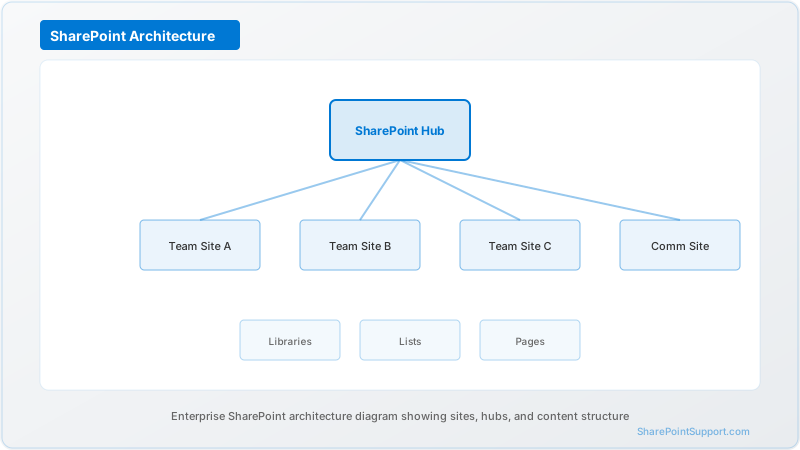
When different departments implement SharePoint independently, inconsistent naming conventions, metadata schemas, and security configurations create silos that undermine cross-functional collaboration and complicate compliance reporting. The most effective mitigation strategy involves centralizing governance policy definition while allowing controlled flexibility at the departmental level. A hub-and-spoke governance model balances enterprise consistency with departmental autonomy. Enterprises operating in regulated industries such as healthcare and financial services must pay particular attention to this challenge because compliance violations carry significant financial and reputational consequences. Regular audits conducted quarterly at minimum help organizations maintain alignment with evolving regulatory requirements and internal policy updates.
Challenge 4: Migration and Legacy Content Complexity
Organizations transitioning legacy content into SharePoint often underestimate the complexity of mapping old structures, metadata, and permissions to modern architectures. Failed migrations erode user confidence and create parallel systems that duplicate effort. Addressing this requires conducting thorough pre-migration content audits that classify and prioritize content based on business value. Invest in automated migration tools that preserve metadata fidelity and permission integrity while providing detailed validation reports. Organizations that invest in structured change management programs achieve adoption rates 35 percent higher than those relying on organic discovery alone. Executive sponsorship combined with department-level champions creates the organizational momentum necessary for sustained success.
Integration with Microsoft 365 Ecosystem
SharePoint does not operate in isolation. Its value multiplies when connected to the broader Microsoft 365 ecosystem, creating unified workflows that eliminate context switching and reduce manual data transfer between applications.
Microsoft Teams Integration: Configure Teams notifications that alert stakeholders when SharePoint content changes, ensuring that distributed teams stay informed about updates without relying on manual communication workflows. Teams channels automatically provision SharePoint document libraries, which means sharepoint configurations and content flow seamlessly between collaborative conversations and structured document management. Users can surface SharePoint content directly within Teams tabs, reducing the friction that typically causes adoption to stall.
Power Automate Workflows: Create event-driven automations that respond to SharePoint changes in real time, triggering downstream processes such as notifications, data transformations, and cross-system synchronization. Automated workflows triggered by SharePoint events such as document uploads, metadata changes, or approval completions eliminate repetitive manual tasks. Organizations typically automate 15 to 25 processes within the first quarter, saving an average of 8 hours per week per department. These automations also create audit trails that satisfy compliance requirements for regulated industries.
Power BI Analytics: Connect SharePoint list and library data to Power BI datasets for advanced analytics that transform raw operational data into strategic business intelligence accessible to decision makers across the organization. Connecting SharePoint data to Power BI dashboards provides real-time visibility into content usage patterns, adoption metrics, and operational KPIs. Decision makers gain actionable intelligence without requiring manual report generation, enabling faster response to emerging trends and potential issues.
Microsoft Purview and Compliance: Configure data loss prevention policies that monitor SharePoint content for sensitive information patterns, blocking or restricting sharing actions that could violate compliance requirements. Sensitivity labels, data loss prevention policies, and retention schedules configured in Microsoft Purview extend automatically to sharepoint content. This unified compliance framework ensures that governance policies apply consistently across the entire Microsoft 365 environment rather than requiring separate configuration for each workload. For organizations subject to HIPAA, SOC 2, or FedRAMP requirements, this integrated approach significantly reduces compliance management overhead.
Getting Started: Next Steps
Implementing SharePoint effectively requires more than technical configuration. It demands a strategic approach grounded in your organization's specific business requirements, compliance obligations, and growth trajectory. The difference between a deployment that delivers measurable ROI and one that becomes shelfware often comes down to the quality of upfront planning and expert guidance.
Begin with a focused assessment of your current SharePoint environment. Evaluate your existing information architecture, permission structures, content lifecycle policies, and user adoption patterns. Identify gaps between your current state and the target state required for successful sharepoint implementation. This assessment typically takes 2 to 4 weeks and produces a prioritized roadmap that aligns technical work with business outcomes.
Our SharePoint specialists have guided organizations across healthcare, financial services, government, and education through hundreds of successful implementations. We bring deep expertise in SharePoint architecture, governance frameworks, and compliance alignment that accelerates time to value while minimizing risk.
Ready to move forward? Contact our team for a complimentary consultation. We will assess your environment, identify quick wins, and develop a phased implementation plan tailored to your organization's needs and timeline. Whether you are starting from scratch or optimizing an existing deployment, our enterprise SharePoint consultants deliver the expertise and accountability that Fortune 500 organizations demand.
Written by the SharePoint Support Team
Senior SharePoint Consultants | 25+ Years Microsoft Ecosystem Experience
Our senior SharePoint consultants bring deep expertise spanning 500+ enterprise migrations and compliance implementations across HIPAA, SOC 2, and FedRAMP environments. We cover SharePoint Online, Microsoft 365, migrations, Copilot readiness, and large-scale governance.
Expert SharePoint Services
Frequently Asked Questions
What are the most common SharePoint security vulnerabilities?▼
How do we prevent data leaks through SharePoint external sharing?▼
What SharePoint security features are included with Microsoft 365 E5?▼
How do we audit who accessed sensitive documents in SharePoint?▼
How do we evaluate SharePoint against competing platforms?▼
Need Expert Help?
Our SharePoint consultants are ready to help you implement these strategies in your organization.
Continue Reading in Security
SharePoint Security Hardening: Protect Your Enterprise...
Comprehensive security guide covering permissions, external sharing, sensitivity labels, and advanced threat protection.
SecuritySharePoint Backup and Recovery: Enterprise Protection Guide
Protect your SharePoint data with comprehensive backup and recovery strategies. Learn about native tools, third-party solutions, and disaster recovery planning.
SecuritySharePoint External Sharing: Secure Collaboration Guide
Enable secure external collaboration in SharePoint while maintaining governance and compliance. Learn sharing policies, guest access, and security best practices.
SecuritySharePoint Extranet Setup Guide: Secure External...
Complete guide to setting up a SharePoint extranet for clients, vendors, and partners. Covers architecture options, security controls, permissions, and governance for B2B collaboration.
SecuritySharePoint Permissions Management
Master SharePoint permissions with this enterprise guide. Covers permission levels, inheritance, groups, unique permissions, broken inheritance risks, auditing, and modern best practices.
SecuritySharePoint External Sharing & Guest Access
Securely configure SharePoint external sharing and guest access for enterprise collaboration. Learn sharing policies, guest user management, conditional access, auditing external activity, and compliance controls.