What Is SPFx and Why It Matters for SharePoint Customization
The SharePoint Framework (SPFx) is Microsoft's modern, client-side development model for building custom web parts, extensions, and solutions that run directly within SharePoint Online pages. SPFx replaces legacy approaches like SharePoint Add-ins and sandbox solutions with a standards-based toolchain using TypeScript, React, and Node.js, delivering superior performance and a seamless user experience.
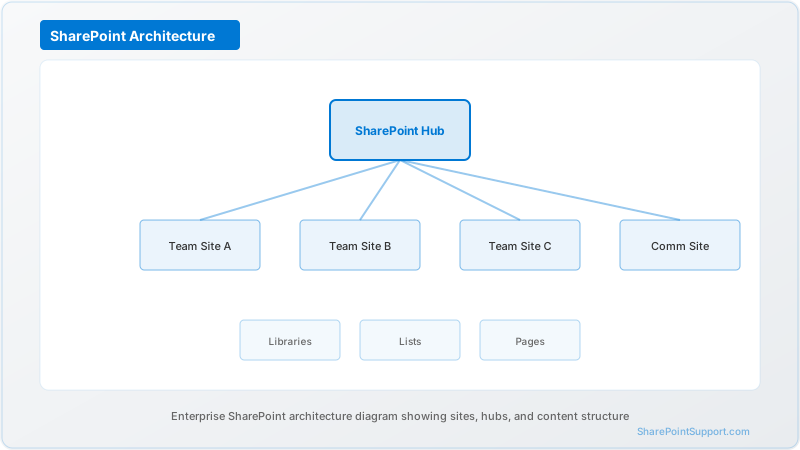
In our 25+ years of SharePoint consulting and custom development, we have seen the evolution from server-side web parts through add-ins to the current SPFx model. Organizations that invest in SPFx development gain capabilities that no out-of-the-box configuration can match, from custom data visualizations to deep integrations with line-of-business systems.
Why SPFx Over Legacy Approaches
Performance and Integration Advantages
SPFx web parts run in the page context rather than in iframes, which means they load faster, share styling with the rest of the page, and can interact with other web parts on the same page. Compared to SharePoint Add-ins, SPFx provides better performance, a seamless visual experience, full access to the page DOM, and compatibility with both modern and classic pages.
When SPFx Is the Right Choice
SPFx is the right choice when you need custom data visualizations that go beyond what Power BI embedded can offer, integration with external REST APIs or GraphQL endpoints, line-of-business application embedding with full SharePoint context, or enhanced user experiences that the standard web part gallery cannot deliver.
For simpler needs, consider alternatives first. Power Apps handles basic forms and simple applications. Power Automate covers workflow automation. JSON column formatting provides lightweight visual customizations without code deployment. Reserve SPFx for scenarios where these low-code tools fall short.
Setting Up Your Development Environment
Prerequisites and Installation
SPFx development requires Node.js (LTS version 18.x recommended), a code editor such as Visual Studio Code, and the Yeoman generator for SharePoint.
```bash
# Install the Yeoman generator globally
npm install -g yo @microsoft/generator-sharepoint
# Verify installation
yo --version
```
Install the recommended VS Code extensions for SPFx development: the SPFx Snippets extension, TypeScript support, ESLint integration, and React developer tools. These extensions dramatically improve productivity during development.
Creating Your First SPFx Project
```bash
mkdir my-webpart && cd my-webpart
yo @microsoft/sharepoint
# Solution name: my-webpart
# Target: SharePoint Online only
# Component type: WebPart
# Framework: React
```
The generator scaffolds a complete project with TypeScript configuration, build pipeline, deployment manifests, and a sample React component ready for customization.
Understanding the SPFx Project Structure
The generated project follows a well-defined structure. The src/webparts directory contains your web part classes, React components, and SCSS modules. The config directory holds build and deployment configuration files. The teams directory supports Teams tab integration.
Key files include the main web part class (HelloWorldWebPart.ts) which handles the property pane configuration and React component rendering, the React component file (HelloWorld.tsx) which contains your UI implementation and business logic, and package-solution.json which defines your solution identity, API permissions, and deployment settings.
Development Workflow and Testing
Local Development with the Workbench
```bash
gulp serve
# Opens local workbench at https://localhost:4321/temp/workbench.html
```
The local workbench provides a sandboxed environment for testing your web part without deploying to SharePoint. For testing with real SharePoint data, use the hosted workbench on your tenant at /_layouts/15/workbench.aspx with gulp serve --nobrowser.
Working with SharePoint Data
SPFx provides two primary methods for accessing SharePoint data. The built-in SPHttpClient offers direct REST API access with automatic authentication handling. The PnPjs library provides a fluent, strongly-typed alternative that simplifies common operations.
```typescript
// Using PnPjs for simplified data access
import { spfi, SPFx } from "@pnp/sp";
import "@pnp/sp/webs";
import "@pnp/sp/lists";
const sp = spfi().using(SPFx(this.context));
const items = await sp.web.lists.getByTitle("Tasks").items();
```
Property Pane Configuration
The property pane allows end users to configure your web part without editing code. Define properties in your web part interface and render them using built-in controls like text fields, dropdowns, checkboxes, and sliders. Group related properties into sections for a clean configuration experience.
For advanced scenarios, implement dynamic data connections that allow your web part to consume data from other web parts on the page. This enables dashboard-style pages where filtering in one web part updates data displayed in others.
Building and Deploying to Production
Packaging Your Solution
```bash
gulp bundle --ship
gulp package-solution --ship
# Output: sharepoint/solution/my-webpart.sppkg
```
Upload the .sppkg file to your tenant app catalog or a site collection app catalog for site-scoped deployment. Approve any API permission requests in the SharePoint admin center before the web part can access external services.
CDN Configuration for Performance
For production deployments, host your web part assets on a CDN. The Office 365 CDN is the simplest option and integrates natively with SharePoint. Azure CDN provides more control over caching policies and geographic distribution. Configure the CDN origin in your write-manifests.json before building.
Security Best Practices for SPFx
Never store secrets, API keys, or connection strings in your SPFx code. Client-side code is visible to anyone who can view the page source. Use Azure AD app registrations with the principle of least privilege for API access. Validate all user inputs to prevent cross-site scripting attacks. Implement proper error boundaries in React components to prevent crashes from exposing sensitive information.
Performance Optimization Techniques
Minimize your bundle size by tree-shaking unused imports and splitting code into lazy-loaded chunks. Cache API responses appropriately using session storage or the SPFx cache utilities. Avoid redundant re-renders in React components by implementing shouldComponentUpdate or using React.memo for functional components.
Testing and CI/CD Pipeline
Implement automated testing with Jest for unit tests and Playwright for end-to-end testing against the hosted workbench. Set up a CI/CD pipeline using Azure DevOps or GitHub Actions to automate building, testing, packaging, and deploying your SPFx solution. This ensures consistent quality and reduces deployment friction.
SPFx Architecture Patterns for Enterprise Scale
Enterprise SPFx solutions require architectural patterns that go beyond simple single-web-part implementations. Component libraries allow you to share common UI elements, utility functions, and service classes across multiple web parts within a solution, reducing code duplication and ensuring visual consistency. Library components, a dedicated SPFx component type, let you publish shared code as a separate package that multiple solutions can reference, which is essential for large organizations maintaining dozens of web parts across different development teams.
Service-oriented architecture within SPFx separates data access logic from UI rendering, making your components easier to test and maintain. Create service classes that encapsulate all API calls, caching logic, and data transformation, then inject these services into your React components through the SPFx service scope or React context providers. This separation means you can unit test your business logic independently of the UI framework and swap data sources without modifying component code.
For web parts that need to communicate with each other on the same page, use the SPFx dynamic data framework rather than direct DOM manipulation or global variables. Dynamic data provides a clean, supported mechanism for web part-to-web-part communication where one web part publishes data and others subscribe to changes. This pattern is common in dashboard scenarios where a filter web part controls the data displayed by multiple visualization web parts.
State management becomes increasingly important as web part complexity grows. For simple web parts, React component state and props are sufficient. For complex web parts with multiple data sources, user interactions, and real-time updates, consider implementing a state management pattern using React Context, useReducer hooks, or a lightweight state management library. Avoid heavyweight state management frameworks like Redux unless the complexity genuinely warrants it, as they add significant bundle size and learning curve for minimal benefit in most SPFx scenarios.
Versioning, Upgrades, and Long-Term Maintenance
SPFx solutions require ongoing maintenance as Microsoft updates the framework, browser engines evolve, and Node.js versions change. Plan for framework upgrades by monitoring the SPFx release notes and scheduling upgrade sprints at least annually. The Office 365 CLI and PnP CLI provide upgrade guidance commands that identify the specific changes needed to move from one SPFx version to another, making the upgrade process more predictable.
Semantic versioning of your web part packages helps administrators track deployed versions and plan upgrades. Maintain a changelog that documents what changed in each version, why it changed, and any migration steps required for administrators or end users. Include version information in your web part property pane so that site owners can verify which version is deployed on their sites.
Long-term maintenance also includes dependency management. Regularly audit your npm dependencies for security vulnerabilities using npm audit, update patch and minor versions to stay current on security fixes, and plan major dependency upgrades as dedicated work items rather than attempting them alongside feature development.
When to Engage Professional SPFx Developers
Organizations without in-house TypeScript and React expertise should consider engaging professional SharePoint developers for SPFx projects. Poorly built web parts can degrade page performance, create security vulnerabilities, and become maintenance burdens. Our SharePoint consulting team builds production-grade SPFx solutions with comprehensive testing, documentation, and ongoing support. Contact us to discuss your custom development requirements.
Advanced SPFx Development Patterns
Dynamic Data and Connected Web Parts
SPFx supports dynamic data connections between web parts on the same page. A filter web part can publish selected values that other web parts consume and react to, creating dashboard-style interactive pages. Implement the IDynamicDataCallables interface in your source web part and the IDynamicDataPropertyDefinition interface in your consumer web part to establish these connections.
This pattern is particularly powerful for building analytical dashboards where a date range selector filters data displayed in multiple chart web parts simultaneously, or for building master-detail interfaces where selecting an item in a list web part displays its details in an adjacent detail web part.
Microsoft Graph Integration
SPFx web parts can access Microsoft Graph APIs to retrieve organizational data including user profiles, group memberships, calendar events, Teams information, and SharePoint site analytics. Use the MSGraphClientV3 factory available through the SPFx context to make authenticated Graph calls without managing tokens manually.
```typescript
const graphClient = await this.context.msGraphClientFactory.getClient('3');
const me = await graphClient.api('/me').get();
const myTeams = await graphClient.api('/me/joinedTeams').get();
```
Application Customizers for Tenant-Wide Branding
SPFx Application Customizers enable tenant-wide customizations that appear on every page. Common use cases include global notification banners for emergency alerts or maintenance windows, custom headers with megamenu navigation, analytics tracking scripts, and custom footers with dynamic content pulled from SharePoint lists. Deploy Application Customizers through tenant-wide extensions in the app catalog for automatic activation across all sites.
Version Management and CI/CD
Implement semantic versioning for your SPFx solutions to track breaking changes, new features, and bug fixes. Maintain a changelog that documents each release. Configure automated build and deployment pipelines using Azure DevOps or GitHub Actions that execute the gulp bundle and gulp package-solution commands, run unit tests with Jest, deploy to a staging app catalog for testing, and promote to production after approval.
```yaml
# Azure DevOps pipeline example
steps:
- task: NodeTool@0
inputs:
versionSpec: '18.x'
- script: npm install
- script: gulp bundle --ship
- script: gulp package-solution --ship
- script: npm test
```
Monitoring and Telemetry
Instrument your SPFx web parts with Application Insights telemetry to track usage patterns, performance metrics, and errors in production. Use the @microsoft/applicationinsights-web package to capture page views, custom events, and exceptions. This telemetry enables data-driven decisions about feature development and helps identify performance bottlenecks before users report them.
Migrating Legacy Web Parts to SPFx
Organizations with legacy SharePoint Add-ins or sandbox solutions should plan migration to SPFx before Microsoft fully deprecates these platforms. Inventory all legacy components, assess their complexity, and prioritize migration based on business criticality and user impact. Simple Add-ins that display data from a single list translate directly to SPFx web parts. Complex Add-ins with server-side logic may require redesigning the architecture to use Azure Functions as a backend with SPFx as the client-side presentation layer.
Enterprise Implementation Best Practices
In our 25+ years of enterprise SharePoint consulting, we have built hundreds of custom SharePoint solutions using the SharePoint Framework, and the development practices that produce maintainable, performant, and secure solutions differ markedly from practices that create technical debt. SPFx development requires enterprise software engineering discipline, not just functional code.
- Establish a Development Environment Standard: Every developer on your team should work with a consistent development environment including Node.js version, Yeoman generator version, and toolchain configuration. Use a shared development tenant with representative data rather than developing against production. Document your environment setup in a runbook that enables new developers to become productive within hours rather than days.
- Implement Automated Testing From the Start: SPFx solutions that ship without automated tests become unmaintainable as complexity grows. Implement unit tests for all business logic using Jest, integration tests for SharePoint API interactions using mock frameworks, and end-to-end tests for critical user workflows. Target 80 percent code coverage as a minimum standard for production deployment approval.
- Follow the PnP Patterns and Practices: The Microsoft 365 Patterns and Practices community provides battle-tested libraries, controls, and architectural patterns that dramatically reduce development time and improve solution quality. Use PnP JS for SharePoint API interactions, PnP React controls for consistent UI components, and PnP provisioning templates for environment configuration.
- Design for Performance and Accessibility: Every SPFx web part must meet performance budgets and accessibility standards. Implement lazy loading for heavy components, minimize bundle sizes through tree shaking and code splitting, and test against WCAG 2.1 AA accessibility standards. Performance and accessibility are not post-development optimizations but architectural requirements that inform design decisions.
- Implement CI/CD Pipelines for Deployment: Manual deployment of SPFx solutions to production environments is error-prone and unauditable. Implement continuous integration pipelines that run tests and quality checks on every commit, and continuous deployment pipelines that package and deploy approved solutions to the app catalog through a governed release process.
Governance and Compliance Considerations
Custom SharePoint Framework development introduces compliance obligations related to code security, data handling, application lifecycle management, and the governance of custom solutions deployed across your tenant.
For HIPAA-regulated organizations, SPFx solutions that access or display protected health information must implement the same security controls as native SharePoint components including access logging, encryption compliance, and minimum necessary data retrieval. Custom web parts must not cache PHI in browser local storage, must not transmit PHI to unauthorized external services, and must maintain audit trails for all data access operations.
Financial services organizations must subject SPFx solutions to the same change management, testing, and operational controls required for other business applications under SOC 2. Implement code review processes that include security assessment, maintain deployment audit trails, and ensure that custom solutions do not create data handling pathways that fall outside your compliance control environment.
Government organizations must ensure that custom code complies with applicable security frameworks, has undergone appropriate security review, and does not introduce dependencies on unauthorized external services or data storage locations.
Establish a custom solution governance framework that requires security code review before production deployment, mandates automated testing including security scanning, defines data handling standards for custom solutions, and assigns ongoing maintenance responsibility with defined SLAs. Include custom SharePoint solutions in your annual penetration testing scope and your regular compliance assessments. Our SharePoint development specialists build enterprise-grade solutions with security and compliance integrated into every phase of the development lifecycle.
Ready to build custom SharePoint solutions with enterprise-grade quality? Our development specialists have delivered hundreds of SPFx solutions for organizations with demanding requirements for performance, security, and maintainability. Contact our team for a development consultation, and discover how our SharePoint consulting services can extend your platform with custom capabilities.
Common Challenges and Solutions
Organizations implementing SPFx Web Part Development consistently encounter obstacles that, if left unaddressed, undermine adoption and erode stakeholder confidence. Drawing on two decades of enterprise SharePoint consulting, these are the challenges we see most frequently and the proven approaches for overcoming them.
Challenge 1: Content Sprawl and Information Architecture Degradation
Over time, SPFx Web Part Development environments accumulate redundant, outdated, and trivial content that degrades search relevance and confuses users. Without proactive content lifecycle management, the signal-to-noise ratio deteriorates and user trust in the platform erodes. The resolution requires a structured approach: establishing automated retention policies that flag content for review after defined periods of inactivity, combined with content owner accountability structures that assign clear responsibility for each site collection and library. Organizations that address this proactively report 40 to 60 percent fewer support tickets within the first 90 days of deployment. Establishing a dedicated governance committee with representatives from IT, compliance, and business stakeholders ensures ongoing alignment between technical configuration and organizational objectives.
Challenge 2: Compliance and Audit Readiness Gaps
SPFx Web Part Development implementations in regulated industries often lack the audit trail depth and policy enforcement rigor required by frameworks such as HIPAA, SOC 2, and GDPR. Retroactive compliance remediation is significantly more expensive and disruptive than building compliance into the initial design. We recommend embedding compliance requirements into the information architecture from day one. Configure Microsoft Purview retention labels, DLP policies, and audit logging before deploying content, and validate compliance posture through regular internal audits. Tracking these metrics through SharePoint health dashboards provides early warning indicators that allow administrators to intervene before minor issues become systemic problems affecting enterprise-wide productivity.
Challenge 3: Inconsistent Governance Across Business Units
When different departments implement SPFx Web Part Development independently, inconsistent naming conventions, metadata schemas, and security configurations create silos that undermine cross-functional collaboration and complicate compliance reporting. The most effective mitigation strategy involves centralizing governance policy definition while allowing controlled flexibility at the departmental level. A hub-and-spoke governance model balances enterprise consistency with departmental autonomy. Enterprises operating in regulated industries such as healthcare and financial services must pay particular attention to this challenge because compliance violations carry significant financial and reputational consequences. Regular audits conducted quarterly at minimum help organizations maintain alignment with evolving regulatory requirements and internal policy updates.
Challenge 4: Migration and Legacy Content Complexity
Organizations transitioning legacy content into SPFx Web Part Development often underestimate the complexity of mapping old structures, metadata, and permissions to modern architectures. Failed migrations erode user confidence and create parallel systems that duplicate effort. Addressing this requires conducting thorough pre-migration content audits that classify and prioritize content based on business value. Invest in automated migration tools that preserve metadata fidelity and permission integrity while providing detailed validation reports. Organizations that invest in structured change management programs achieve adoption rates 35 percent higher than those relying on organic discovery alone. Executive sponsorship combined with department-level champions creates the organizational momentum necessary for sustained success.
Integration with Microsoft 365 Ecosystem
SPFx Web Part Development does not operate in isolation. Its value multiplies when connected to the broader Microsoft 365 ecosystem, creating unified workflows that eliminate context switching and reduce manual data transfer between applications.
Microsoft Teams Integration: Embed SPFx Web Part Development dashboards and document libraries as Teams tabs to create unified workspaces where conversations and structured content management coexist within a single interface. Teams channels automatically provision SharePoint document libraries, which means spfx web part development configurations and content flow seamlessly between collaborative conversations and structured document management. Users can surface SharePoint content directly within Teams tabs, reducing the friction that typically causes adoption to stall.
Power Automate Workflows: Implement scheduled flows that perform routine SPFx Web Part Development maintenance tasks including permission reports, content audits, and usage analytics without requiring manual intervention. Automated workflows triggered by SharePoint events such as document uploads, metadata changes, or approval completions eliminate repetitive manual tasks. Organizations typically automate 15 to 25 processes within the first quarter, saving an average of 8 hours per week per department. These automations also create audit trails that satisfy compliance requirements for regulated industries.
Power BI Analytics: Build executive dashboards that aggregate SPFx Web Part Development metrics alongside other business KPIs, providing a holistic view of digital workplace effectiveness and investment returns. Connecting SharePoint data to Power BI dashboards provides real-time visibility into content usage patterns, adoption metrics, and operational KPIs. Decision makers gain actionable intelligence without requiring manual report generation, enabling faster response to emerging trends and potential issues.
Microsoft Purview and Compliance: Implement retention policies that automatically manage SPFx Web Part Development content lifecycle, preserving business-critical records for required periods while disposing of transient content to reduce storage costs and compliance exposure. Sensitivity labels, data loss prevention policies, and retention schedules configured in Microsoft Purview extend automatically to spfx web part development content. This unified compliance framework ensures that governance policies apply consistently across the entire Microsoft 365 environment rather than requiring separate configuration for each workload. For organizations subject to HIPAA, SOC 2, or FedRAMP requirements, this integrated approach significantly reduces compliance management overhead.
Getting Started: Next Steps
Implementing SPFx Web Part Development effectively requires more than technical configuration. It demands a strategic approach grounded in your organization's specific business requirements, compliance obligations, and growth trajectory. The difference between a deployment that delivers measurable ROI and one that becomes shelfware often comes down to the quality of upfront planning and expert guidance.
Begin with a focused assessment of your current SharePoint environment. Evaluate your existing information architecture, permission structures, content lifecycle policies, and user adoption patterns. Identify gaps between your current state and the target state required for successful spfx web part development implementation. This assessment typically takes 2 to 4 weeks and produces a prioritized roadmap that aligns technical work with business outcomes.
Our SharePoint specialists have guided organizations across healthcare, financial services, government, and education through hundreds of successful implementations. We bring deep expertise in SharePoint architecture, governance frameworks, and compliance alignment that accelerates time to value while minimizing risk.
Ready to move forward? Contact our team for a complimentary consultation. We will assess your environment, identify quick wins, and develop a phased implementation plan tailored to your organization's needs and timeline. Whether you are starting from scratch or optimizing an existing deployment, our enterprise SharePoint consultants deliver the depth and accountability enterprise SharePoint work requires.
Written by the SharePoint Support Team
Senior SharePoint Consultants | 25+ Years Microsoft Ecosystem Experience
Our senior SharePoint consultants bring deep expertise spanning 500+ enterprise migrations and compliance implementations across HIPAA, SOC 2, and FedRAMP environments. We cover SharePoint Online, Microsoft 365, migrations, Copilot readiness, and large-scale governance.
Expert SharePoint Services
Frequently Asked Questions
What is the SharePoint Framework (SPFx) and when should we use it?▼
Should we use Power Apps or SPFx for custom SharePoint solutions?▼
How do we maintain custom SharePoint solutions long-term?▼
What testing strategies should we use for SharePoint custom solutions?▼
What is SharePoint and why do enterprises use it?▼
Need Expert Help?
Our SharePoint consultants are ready to help you implement these strategies in your organization.
Continue Reading in Development
Power Apps Custom Forms for SharePoint
Transform SharePoint list forms with Power Apps to create dynamic, user-friendly experiences with validation, conditional logic, and custom layouts.
DevelopmentSharePoint SPFx Development Guide
Enterprise guide to SharePoint Framework (SPFx) development in 2026 covering project setup, web part architecture, API integration, deployment pipelines, and performance best practices.
DevelopmentSharePoint Custom Forms with Power Apps: Complete Guide
Build custom SharePoint forms using Power Apps. Covers form customization, conditional visibility, validation, cascading dropdowns, and mobile-responsive design.
DevelopmentSharePoint Embedded for SaaS: A Technical and Business Guide for 2026
SharePoint Embedded lets SaaS vendors ship enterprise-grade content storage without building it from scratch. A complete technical and business walkthrough for product teams.
DevelopmentSPFx + React 18 + Fluent UI v9: Modern Patterns
The SPFx stack has modernized significantly. A practical guide to building SharePoint Framework extensions with React 18, Fluent UI v9, TypeScript 5, and current performance patterns.
DevelopmentSharePoint Copilot Apps: The SPFx Web Part Migration Guide
SharePoint Copilot Apps enter public preview in July 2026 alongside SPFx v1.24. If you own a portfolio of SPFx web parts, here is the migration decision matrix and a code-shape example.