The Storage Triangle Most People Get Wrong
Microsoft Teams, SharePoint Online, and OneDrive for Business are the three workloads that store the vast majority of user-generated content in modern enterprises. The three are tightly integrated, and the integration obscures the fact that they each have distinct storage models, distinct permission models, and distinct quota systems. Teams, SharePoint, and OneDrive storage looks like one system to end users, and it looks like three different systems to administrators.
The confusion causes real problems. Teams channels unexpectedly consume SharePoint storage. OneDrive content gets accidentally left behind when employees depart. Channel files appear in SharePoint but disappear from Teams when retention rules fire. Quotas behave differently in each workload, producing storage alerts that administrators cannot reconcile.
This guide lays out a unified reference for how the three systems actually store content, how the permissions and quotas work, and the architecture decisions that prevent the common failure modes.
The Physical Storage Reality
At the physical layer, all three workloads store files in SharePoint document libraries. The Teams you see, the OneDrive you see, and the SharePoint site you see are all presentation layers over SharePoint document libraries underneath. Understanding this is the foundation of the architecture.
Teams Standard Channel Storage
Every Microsoft Team has an associated SharePoint site. Each standard channel has a folder in the Team's default document library. Files shared in a standard channel are stored in that folder. The permissions mirror the Team membership.
Teams Private Channel Storage
Private channels are different. Each private channel has its own dedicated SharePoint site (not just a folder within the Team's main site). The site has its own URL, its own storage quota, and its own permissions scoped to the private channel members.
Teams Shared Channel Storage
Shared channels (Teams Connect) also have their own dedicated SharePoint site. The permissions include members of the owning Team plus externally shared members from other tenants.
OneDrive Storage
OneDrive for Business is literally a personal SharePoint site collection with a single document library called Documents. Each user gets their own OneDrive site collection under the my.sharepoint.com subdomain. Files shared in Teams chats (one-to-one or group chats that are not channel messages) are uploaded to the sender's OneDrive and shared via link.
SharePoint Site Storage
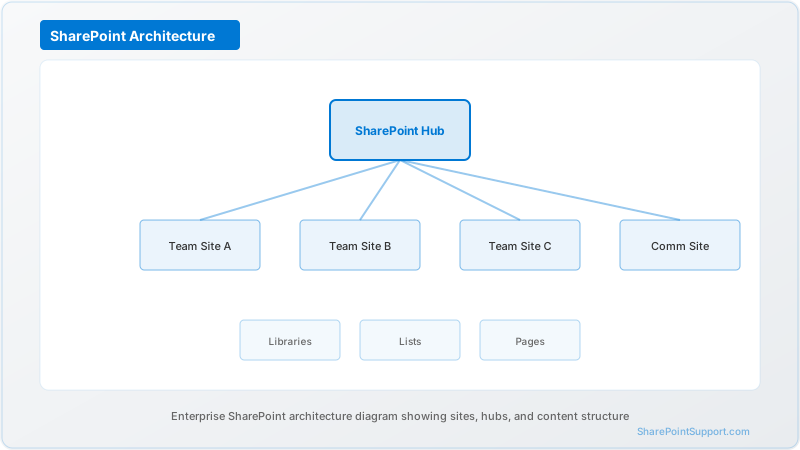
Standalone SharePoint sites have their own storage and quota. Communication Sites, Team Sites not connected to a Microsoft Team, and hub sites all store content in their own SharePoint site collections.
The Quota Model
Each workload has distinct quota semantics that administrators frequently misunderstand.
Tenant Storage Quota
The tenant has a base storage allocation of 1 TB plus 10 GB per licensed user plus any additional storage purchased. This pool is shared across all SharePoint sites including Team sites, communication sites, and channel sites. OneDrive is separate and does not count against the tenant SharePoint pool.
SharePoint Site Storage Quotas
Each SharePoint site has a storage quota assigned. The default is "managed by the tenant" which pulls from the shared pool, but administrators can assign specific quotas per site. Teams private channels and shared channels have their own SharePoint sites with their own quotas.
OneDrive Storage Per User
OneDrive storage is per-user. The default for Microsoft 365 E3 and E5 is 1 TB per user, and it can be increased to 5 TB or beyond for users who need more. OneDrive storage does not count against the tenant SharePoint pool. Departed users' OneDrive content is retained based on the OneDrive retention policy.
Mailbox and Chat Storage
Teams channel messages are stored in the Teams service and backed by Azure Cosmos DB, not SharePoint. Teams chat messages are stored in Exchange user mailboxes, not SharePoint. This is why some retention policies that target SharePoint do not affect Teams messages and vice versa.
The Permission Model Interactions
Permissions are where the architecture decisions have the most downstream impact.
Teams Permissions
Teams membership is stored in Azure AD as a Microsoft 365 group. The group is the security principal that grants access to the associated SharePoint site. Team owners are group owners; Team members are group members. Adding someone to a Team automatically grants them access to the SharePoint site, and vice versa.
Private Channel Permissions
Private channel members are a subset of Team members. The private channel's dedicated SharePoint site has permissions that mirror the private channel membership, which is independent of the parent Team's membership. This is why files in a private channel are invisible to other Team members.
Shared Channel Permissions
Shared channel membership can include users from multiple tenants (Teams Connect). The permission model uses Azure AD B2B Direct Connect for cross-tenant access. Each shared channel's SharePoint site has permissions that span the participating tenants.
OneDrive Permissions
OneDrive content is owned by the individual user. The user can share content with specific people, generate anyone links, or grant access to groups. When content is shared via Teams chat, the underlying mechanism is an OneDrive share link with the chat recipients granted access.
SharePoint Site Permissions
SharePoint sites that are not associated with a Team have their own permission model using SharePoint groups, Azure AD groups, or direct user assignments. These sites are managed through the SharePoint admin center rather than the Teams admin center.
The Lifecycle Interactions
Content lifecycle events in one workload often trigger visible changes in another workload, and the interactions are a common source of surprises.
Team Deletion
When a Team is deleted, the associated Microsoft 365 group is deleted, and the SharePoint site enters a retention period (typically 30 days for the group and an additional period for the SharePoint site depending on the deletion policy). During the retention period the content is recoverable. After the retention period, the content is permanently deleted unless covered by a retention policy.
Channel Deletion
When a standard channel is deleted, the folder in the Team's SharePoint site is marked for deletion but retained for 30 days. Private and shared channel deletions delete the associated dedicated SharePoint site, also with a retention window.
User Departure
When a user leaves, their OneDrive content enters a retention period (default 30 days). If a secondary owner is assigned (typically the manager), the OneDrive can be accessed by the secondary owner during that window. After retention expires, the OneDrive is permanently deleted.
Files shared in Teams chats through the departed user's OneDrive become inaccessible when the OneDrive is deleted. This is a common source of user frustration after departures and is mitigated by retention policies that preserve OneDrive content for longer periods or by migrating chat-shared content to Teams channels where the content lives in Team SharePoint sites.
Retention Policy Interactions
Retention policies can target Teams messages, SharePoint sites, OneDrive, or Exchange separately. A policy that retains SharePoint content for 7 years does not automatically retain Teams chat messages for 7 years. Comprehensive retention requires separate policies for each workload, coordinated to meet the organization's overall compliance requirements.
Architecture Decisions That Matter
Five architecture decisions consistently shape the long-term outcome.
Decision 1: Default Storage for New Teams
Decide whether new Teams default to standard SharePoint sites (shared tenant pool) or explicit per-site quotas. Explicit quotas provide predictable storage but require active management. Most enterprises default to shared pool allocation and monitor the aggregate usage.
Decision 2: Private Channel Strategy
Private channels create dedicated SharePoint sites, which multiplies the number of site collections administrators manage. Enterprises with heavy private channel usage can end up with tens of thousands of site collections. Decide whether private channels are a first-class pattern (in which case invest in automation to manage them) or a restricted capability (in which case limit creation to designated roles).
Decision 3: External Access Pattern
Decide how external collaboration flows: through shared channels (Teams Connect), through external guest access to Teams, through SharePoint external sharing, through Power Pages portals, or through a combination. Each pattern has different governance implications.
Decision 4: OneDrive Retention for Departures
The default 30-day OneDrive retention after user departure is insufficient for most regulated industries. Extending retention to 90, 180, or 365 days with named secondary owners balances compliance needs against storage cost. Configure this as a policy, not per-user.
Decision 5: Content Migration Boundaries
Decide what content belongs in OneDrive (personal, transient), Teams (collaborative, active), and SharePoint sites (durable, shared widely). Publish these boundaries to end users and enforce them through retention and sensitivity label policies.
Reporting and Observability
Platform owners need visibility into the storage and permission state across all three workloads.
```powershell
# Combined storage report across SharePoint sites (including Teams sites)
Connect-SPOService -Url "https://contoso-admin.sharepoint.com"
$sizeGB = @{N='StorageUsageGB';E={[math]::Round($_.StorageUsageCurrent/1024,2)}}
$quotaGB = @{N='StorageQuotaGB';E={[math]::Round($_.StorageQuota/1024,2)}}
$teamsConnected = @{N='IsTeamsConnected';E={$_.Template -like '*GROUP*' -or $_.Template -like '*TEAMCHANNEL*'}}
$report = Get-SPOSite -Limit All | Select-Object Url, Template, Owner, $sizeGB, $quotaGB, $teamsConnected, LastContentModifiedDate
$report | Export-Csv -Path "D:\Reports\SiteStorage.csv" -NoTypeInformation
# Aggregate by template type
$totalUsage = @{N='TotalUsageGB';E={[math]::Round(($_.Group | Measure-Object StorageUsageGB -Sum).Sum,2)}}
$report | Group-Object Template | Select-Object Name, Count, $totalUsage | Sort-Object TotalUsageGB -Descending
``` Platform owners should also track OneDrive storage per user, Teams site storage trended over time, private channel site count, and external sharing event volumes.
Common Failure Modes
Three architectural patterns consistently cause problems.
Failure 1: Content sprawl across workloads. Users create content in OneDrive for personal work, which is correct, but then they use OneDrive for content that should be shared in Teams or SharePoint. The content becomes orphaned when users depart. The fix is publishing content placement guidelines and reinforcing them through training and retention policies.
Failure 2: Unpredictable storage growth. Teams usage grows, and SharePoint storage grows invisibly underneath. The tenant storage pool unexpectedly fills. The fix is monthly storage reporting that attributes growth to specific Teams, sites, and users, plus proactive capacity planning.
Failure 3: Permission drift. Teams permissions and SharePoint permissions fall out of sync when site owners make manual SharePoint permission changes without going through Team membership. The fix is enforcing the rule that Teams SharePoint sites should be managed through Team membership only, and running periodic audits for sites where manual permission changes have been made.
Getting Started
A structured platform assessment covers the current storage distribution, the permission model across workloads, the lifecycle policies in place, and the gaps between stated governance and actual practice. Our SharePoint specialists run these assessments for enterprises running Teams, SharePoint, and OneDrive at scale. Contact our team to scope a platform assessment, or review our SharePoint consulting services for the full architecture methodology.
Written by the SharePoint Support Team
Senior SharePoint Consultants | 25+ Years Microsoft Ecosystem Experience
Our senior SharePoint consultants bring deep expertise spanning 500+ enterprise migrations and compliance implementations across HIPAA, SOC 2, and FedRAMP environments. We cover SharePoint Online, Microsoft 365, migrations, Copilot readiness, and large-scale governance.
Expert SharePoint Services
Frequently Asked Questions
Where is Microsoft Teams content actually stored?▼
Do Teams private channels have their own SharePoint site?▼
Does OneDrive storage count against the tenant SharePoint storage pool?▼
What happens to content in Teams chats when a user leaves the organization?▼
How long is content retained after a Team is deleted?▼
Can we apply different storage quotas to Teams sites versus other SharePoint sites?▼
How do we track storage usage across Teams, SharePoint, and OneDrive?▼
Are private channels the right pattern for confidential collaboration?▼
Need Expert Help?
Our SharePoint consultants are ready to help you implement these strategies in your organization.
Continue Reading in Architecture
SharePoint Online Limits in 2026: What Actually Breaks at Scale
Everyone can recite the 5,000-item threshold. Almost nobody can tell you what genuinely fails first in a large tenant — and in 2026 the answer changed, because agents and Copilot now query your lists too.
ArchitectureSharePoint Hub Sites: Building Connected Experiences
Design an effective hub site architecture that connects related sites, shares navigation, and creates a cohesive experience across your SharePoint environment.
ArchitectureSharePoint Site Collections: Best Practices
Understand SharePoint site collection architecture with best practices for planning, creating, and managing site collections in your Microsoft 365 environment.
ArchitectureSharePoint Information Architecture Guide
Design a scalable SharePoint information architecture with hub sites, metadata taxonomy, navigation patterns, and governance frameworks that serve enterprise organizations for years.
ArchitectureSharePoint Hub Sites: Architecture Guide for 2026
Design and implement SharePoint hub sites that unify navigation, branding, search, and governance across your enterprise. Covers hub planning, association strategies, and real-world architecture patterns.
ArchitectureSharePoint Hub Sites at Scale: 500+ Sites
Hub sites work beautifully for 20 sites and collapse at 500. A proven architecture, governance, and automation model for large enterprises in 2026.