The Hard Deadline Nobody Can Extend
July 14, 2026 is the end of extended support for SharePoint Server 2016 and SharePoint Server 2019. After that date, Microsoft will not ship security patches, feature updates, or provide technical incident support for either platform. The deadline is not negotiable, it is not being pushed, and it applies equally to SharePoint Server Standard, SharePoint Server Enterprise, and Project Server deployments built on those SharePoint foundations.
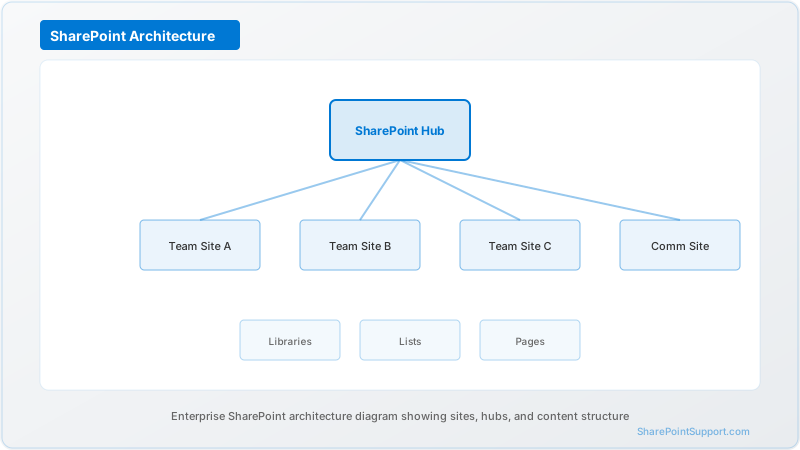
For organizations still running farms on 2016 or 2019, this is not a hypothetical risk. Once July 15, 2026 arrives, any new vulnerability discovered in the product remains unpatched forever on those versions. Threat actors routinely scan the internet for unpatched SharePoint servers within hours of a CVE being published, and the attack surface of an on-premises SharePoint farm is enormous when you combine IIS, .NET, the search service application, the user profile service, and all of the custom solutions typically layered on top.
This guide walks through what end of support really means, the options on the table, how to run a 90-day assessment, and the migration patterns that are succeeding in the last few months before the deadline.
What End of Extended Support Actually Means
Microsoft defines extended support as the phase where a product still receives security updates but no longer receives feature updates or design changes. When extended support ends, the product enters an unsupported state with no safety net. Specifically for SharePoint Server 2016 and 2019 after July 14, 2026:
- No security updates for newly discovered CVEs
- No cumulative updates or public updates
- No Microsoft technical support through Premier, Unified, or standard channels
- No compatibility updates for new Windows Server versions, SQL Server versions, or browser releases
- No compliance attestation for regulatory frameworks that require supported software
If your organization is regulated under HIPAA, SOC 2, PCI DSS, FedRAMP, or GDPR, running unsupported software is almost always a finding during audit. Auditors interpret unpatched platforms as an unacceptable risk to data confidentiality and integrity, and insurance carriers have started excluding ransomware claims tied to unsupported software.
The Cyber Insurance Angle
In the last three renewal cycles, we have seen cyber insurance carriers explicitly require supported versions of core business platforms. Policies written in 2026 and beyond commonly include endorsements that deny coverage for incidents traced to end-of-life software. A typical carrier letter reads: "Coverage excludes losses arising from or contributed to by the use of software that has reached end of support as defined by the software vendor." That clause turns a SharePoint ransomware event from a recoverable financial loss into a complete write-off.
Your Four Realistic Options
There are only four realistic paths forward, and each comes with a different cost profile, risk profile, and timeline.
Option 1: Migrate to SharePoint Online
This is the path Microsoft wants you on and is the most common destination. You move content, customizations, permissions, and workflows to SharePoint Online in Microsoft 365. Benefits include continuous updates, native Copilot integration, automatic scaling, and no farm to manage. Drawbacks include the need to remediate or rebuild farm-scoped solutions, handle classic-to-modern experience migration, and address sovereign data requirements if your data cannot leave specific geographic boundaries.
Option 2: Migrate to SharePoint Server Subscription Edition
Subscription Edition is the current on-premises version and will continue receiving updates as long as the subscription is active. This is the right choice for organizations that cannot move to the cloud for regulatory, contractual, or architectural reasons. Subscription Edition is installed side-by-side with 2016 or 2019 farms, content is migrated content-database-by-content-database, and licensing moves to a per-user, per-month subscription model rather than the traditional CAL model.
Option 3: Hybrid with SharePoint Server Subscription Edition
Some workloads stay on-premises for compliance reasons while collaboration workloads move to SharePoint Online. Hybrid search, hybrid OneDrive, hybrid taxonomy, and hybrid audit log sync connect the two environments. This is the pattern for government, defense, critical infrastructure, and some healthcare organizations with specific data-residency constraints.
Option 4: Migrate to a Non-SharePoint Platform
Some organizations use the forced migration as an opportunity to consolidate onto Microsoft Teams and OneDrive, Dropbox Business, Box, Google Workspace, or a dedicated DMS like iManage or NetDocuments. This path only makes sense when your SharePoint usage is mostly document storage and basic collaboration. If you have heavy customizations, workflows, or enterprise content types, replatforming to a non-SharePoint tool is significantly more expensive than migrating to SharePoint Online.
The 90-Day Assessment Framework
With the deadline this close, any organization still on 2016 or 2019 needs a compressed, high-signal assessment. Our 90-day framework breaks into three 30-day phases.
Phase 1, Days 1 to 30: Discover and Inventory
Run SharePoint Migration Manager or the SharePoint Migration Assessment Tool (SMAT) against the farm. SMAT produces a report of site collections, content databases, customizations, and known blockers. Pair that with a full crawl of farm solutions, sandbox solutions, add-ins, custom workflows, InfoPath forms, and classic publishing sites.
```powershell
# Run SMAT assessment against the farm
.\SMAT.exe -Servers "spwfe01.contoso.local,spwfe02.contoso.local" -Output "D:\Assessment\SMAT_Results"
# Inventory farm solutions
Get-SPSolution | Select-Object DisplayName, Deployed, DeploymentState, SolutionId |
Export-Csv -Path "D:\Assessment\FarmSolutions.csv" -NoTypeInformation
# Inventory custom workflows
Get-SPSite -Limit All | ForEach-Object {
$site = $_
$site.AllWebs | ForEach-Object {
$web = $_
$web.WorkflowAssociations | Where-Object { $_.BaseTemplate -eq 'Workflow' } |
Select-Object @{N='SiteUrl';E={$site.Url}}, @{N='WebUrl';E={$web.Url}}, Name, Enabled
}
} | Export-Csv -Path "D:\Assessment\CustomWorkflows.csv" -NoTypeInformation
# Content database sizes
Get-SPContentDatabase | Select-Object Name, WebApplication, @{N='SizeGB';E={[math]::Round($_.DiskSizeRequired/1GB,2)}}, CurrentSiteCount |
Sort-Object SizeGB -Descending |
Export-Csv -Path "D:\Assessment\ContentDatabases.csv" -NoTypeInformation
```
Phase 2, Days 31 to 60: Decision and Design
Using the inventory, classify each workload into one of the four migration paths. Build the target architecture, decide on migration tooling (Migration Manager, SharePoint Migration Tool, ShareGate, AvePoint Fly, or Quest Content Matrix), and size target storage. For organizations heading to SharePoint Online, run a pilot migration of a single site collection to validate tooling, permission mapping, and content fidelity.
Phase 3, Days 61 to 90: Pilot and Ramp
Migrate a representative 10 percent of content in parallel with fixing your top blockers. Establish the cutover cadence, communication plan, and rollback procedures. At the end of Phase 3, you should have momentum, a proven runbook, and enough data to forecast the cutover dates for the remaining 90 percent.
The Biggest Technical Blockers
Organizations that hit the deadline are usually blocked by a small number of technical patterns. Knowing these in advance lets you plan remediation early.
Full-Trust Farm Solutions
Full-trust farm solutions deployed as WSP packages do not run in SharePoint Online. They must be remediated to SharePoint Framework (SPFx) web parts and extensions, Power Apps, Power Automate, or Azure Functions. The remediation effort depends on how tightly coupled the solutions are to server-side object model APIs. Solutions that only render a UI component are straightforward to port, while solutions that run scheduled jobs against the farm require more substantial rework.
SharePoint Designer Workflows
SharePoint 2010 and 2013 workflows are deprecated and do not run in SharePoint Online in the long term. Power Automate is the supported replacement, but not every workflow pattern maps cleanly. State machines, loops with long delays, and workflows that interact with InfoPath forms typically need the most redesign work.
InfoPath Forms
InfoPath reached end of support and cannot be used in SharePoint Online. Power Apps is the successor for form scenarios. Forms that rely on InfoPath-specific features such as code-behind, managed code, or web service data sources require a full redesign in Power Apps rather than a mechanical conversion.
Classic Publishing Sites
Classic publishing sites with custom master pages and page layouts do not map cleanly to modern SharePoint. Microsoft provides the SharePoint Modernization Scanner and the page transformation engine, but heavily branded classic sites usually end up redesigned from scratch in the modern experience with hub sites, site templates, and custom SPFx extensions for branding.
Business Connectivity Services
BCS connections to SQL, Oracle, SAP, and line-of-business systems do not exist in SharePoint Online in the same form. Microsoft Graph connectors, Power Platform custom connectors, and Azure Logic Apps replace BCS, typically with better performance and easier governance.
Cost Forecasting for the Last-Minute Migration
Migration projects launched within six months of the deadline carry a premium because experienced SharePoint migration specialists are booked out. Realistic cost ranges based on the last 18 months of enterprise projects:
- Small farm, single tenant, under 500 GB, minimal customization: $75,000 to $150,000
- Mid-sized farm, 500 GB to 5 TB, moderate customization, hybrid identity: $250,000 to $650,000
- Large enterprise, 5 TB to 25 TB, heavy customization, regulated industry: $800,000 to $2.5 million
- Multi-farm, global organization, 25 TB+, complex compliance: $2.5 million to $6 million or more
These numbers assume migration tooling licensing, consulting hours, internal project management, and change management. They do not include the new licensing cost of SharePoint Online or Subscription Edition, training, or ongoing managed services.
What to Do Next
If you are still on SharePoint Server 2016 or 2019, the window is now measured in weeks for discovery and months for execution. The first three concrete actions to take this week:
- Run SMAT against your farm and publish the findings to your IT leadership team.
- Get a licensing quote for your target state so the procurement cycle does not become the critical path.
- Engage migration specialists for a scoped assessment. The best firms are booking 12 weeks out, so contact them now even if you are not ready to start.
The organizations that will be clean on July 15, 2026 are the ones who treat the deadline like a regulatory cutover, assign an executive sponsor, and start this quarter. Our migration specialists work exclusively on SharePoint modernization projects and can run an accelerated assessment in under 30 days. Contact our team to scope a zero-obligation assessment, and review our SharePoint migration services for the full methodology.
Written by the SharePoint Support Team
Senior SharePoint Consultants | 25+ Years Microsoft Ecosystem Experience
Our senior SharePoint consultants bring deep expertise spanning 500+ enterprise migrations and compliance implementations across HIPAA, SOC 2, and FedRAMP environments. We cover SharePoint Online, Microsoft 365, migrations, Copilot readiness, and large-scale governance.
Expert SharePoint Services
Frequently Asked Questions
When exactly does SharePoint Server 2016 and 2019 reach end of extended support?▼
Can we pay Microsoft for extended security updates after July 14, 2026?▼
What is the fastest migration path from SharePoint 2016 to SharePoint Online?▼
Does SharePoint Server Subscription Edition have a lifecycle deadline?▼
What happens if we run SharePoint 2019 after July 14, 2026?▼
Can we lift and shift a SharePoint 2019 farm to Azure and extend its life?▼
How do we handle custom full-trust farm solutions during migration?▼
What migration tools do enterprise teams use in 2026?▼
Need Expert Help?
Our SharePoint consultants are ready to help you implement these strategies in your organization.
Continue Reading in Migration
SharePoint Migration Best Practices: 15 Expert...
Learn the proven migration strategies used by leading organizations to migrate to SharePoint Online without disruption.
MigrationTenant-to-Tenant Migration: Complete Planning Guide for M&A
Master the complexities of SharePoint tenant-to-tenant migrations during mergers, acquisitions, and divestitures with our comprehensive planning guide.
MigrationWorkflow Migration: SharePoint 2013 to Power Automate
Navigate the transition from legacy SharePoint 2013 workflows to Power Automate with this comprehensive migration guide covering assessment, planning, and implementation strategies.
MigrationMigrating from Google Workspace to SharePoint
Step-by-step guide for migrating from Google Drive, Docs, and Sites to SharePoint Online. Includes mapping, tools, and best practices.
MigrationSharePoint 2019 End of Life: Migration Guides (October 2026)
SharePoint Server 2019 reaches end of support on October 14, 2026. This guide covers your migration options, timeline, risks of staying on unsupported infrastructure, and how to plan a zero-downtime move to SharePoint Online.
MigrationSharePoint Migration Cost Guide: What Does It Really...
Comprehensive breakdown of SharePoint migration costs — from DIY approaches to full-service professional migrations. Includes cost factors, pricing ranges, ROI analysis, and how to avoid budget surprises.