SharePoint Admin Center: The Complete Administrator Guide for 2026
The SharePoint Admin Center is the command hub for every Microsoft 365 administrator managing SharePoint Online. Whether you are overseeing 500 users or 50,000, understanding every section of the admin center is non-negotiable for maintaining a secure, well-governed SharePoint environment.
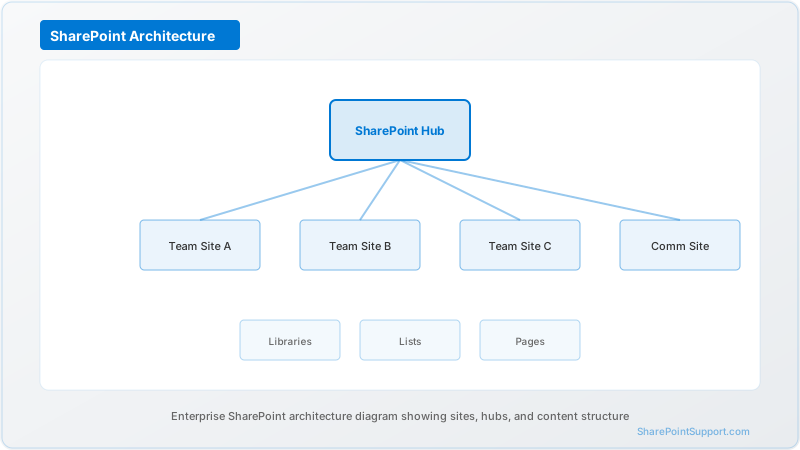
This guide covers every major area of the SharePoint Admin Center as it exists in 2026, including features added over the past 12 months.
---
Accessing the Admin Center
Navigate to the SharePoint Admin Center through the Microsoft 365 admin center at admin.microsoft.com, then select SharePoint under Admin centers. Direct access is available at your tenant admin URL following the pattern tenantname-admin.sharepoint.com. You must have the SharePoint Administrator role or Global Administrator role to access the admin center.
Admin Roles
Global Administrator has full access to all admin centers including SharePoint. Use this role sparingly and only for accounts that need cross-service administration.
SharePoint Administrator has full access to the SharePoint Admin Center without access to other Microsoft 365 admin centers. This is the appropriate role for dedicated SharePoint administrators.
Site Administrator (assigned per site) has full control over specific sites but no access to the admin center. Use this for departmental IT staff who manage their own sites.
---
Home Dashboard
The home page displays key metrics at a glance: total sites, storage used versus available, external sharing status, and recent admin activities. The message center panel shows Microsoft announcements about upcoming changes, new features, and deprecations.
Review the home dashboard daily for storage alerts, sharing policy changes by Microsoft, and new feature rollouts that might affect your governance policies.
---
Active Sites Management
The Active sites page is where you spend most of your time. It lists every site in your tenant with columns for URL, template, external sharing, storage used, hub association, sensitivity label, and last activity date.
Key Operations
Creating sites: Click Create to provision new team sites or communication sites. Set the URL, owner, storage quota, and external sharing policy during creation.
Managing individual sites: Select a site to view its properties panel. From here you can change site owners, adjust storage quotas, modify external sharing settings, view site permissions, check hub association, and apply sensitivity labels.
Bulk operations: Select multiple sites to apply bulk changes including sharing policy updates, storage quota adjustments, and hub associations.
Site Filters
Use the built-in filters to quickly find sites by template type (Team, Communication, Channel), external sharing status, hub association, sensitivity label, storage usage range, and creation date.
Custom Views
Create custom column views to show the information most relevant to your governance needs. We recommend a governance view showing URL, external sharing, sensitivity label, storage used, and last activity date.
---
Policies Section
Sharing Policies
The sharing section controls tenant-wide sharing defaults and per-site overrides.
Tenant-level sharing options:
- Anyone allows sharing with anonymous links that do not require sign-in
- New and existing external users requires external users to sign in with a Microsoft account or verify their email
- Existing external users only allows sharing with people already in your Azure AD directory
- Only people in your organization disables all external sharing
We recommend setting the tenant default to Existing external users and opening broader sharing only on specific sites that require it.
Per-site sharing overrides: Individual sites can be set to a more restrictive sharing level than the tenant default but never more permissive. This ensures governance compliance while allowing flexibility.
Access Control Policies
Configure conditional access policies that restrict SharePoint access based on network location (block access from untrusted networks), device compliance (require managed devices for full access), session timeout (force re-authentication after a period of inactivity), and app restrictions (limit which applications can access SharePoint data).
```powershell
# Require managed devices for a specific site
Set-SPOSite -Identity https://contoso.sharepoint.com/sites/Finance -ConditionalAccessPolicy AllowLimitedAccess
```
---
Settings Section
Default Admin Experience
Choose between modern and classic admin center experiences. The modern experience is the default and recommended option. Classic features are gradually being migrated to the modern interface.
Notifications
Configure email notifications for site storage warnings, sharing policy violations, and lifecycle management actions. Ensure at least two administrators receive critical notifications.
Site Creation Settings
Control who can create new sites and what templates are available. Options include allowing all users to create sites (not recommended for enterprise), restricting site creation to administrators only, and allowing site creation but only through an approval workflow.
For enterprises, we recommend restricting self-service site creation and routing requests through a governance-approved provisioning process using Power Automate or a custom SPFx solution.
OneDrive Settings
While OneDrive has its own admin center, key settings are accessible from the SharePoint admin center including default storage limit per user, file sync restrictions, and retention settings for departed users.
---
Content Services
Term Store
Manage the enterprise taxonomy through the Term Store management tool. Create term groups, term sets, and terms. Assign term store administrators and group managers. Import terms from CSV files for bulk creation.
Content Type Gallery
The content type gallery shows all content types published from the content type hub. Monitor content type syndication status and troubleshoot publication failures.
---
Migration Section
The migration section provides access to Migration Manager, which coordinates migrations from file shares, SharePoint Server, Google Drive, Box, Dropbox, and other sources. Set up migration agents, configure migration tasks, and monitor migration progress from this section.
---
Reports and Analytics
Usage Reports
View SharePoint usage metrics including total active sites, total files stored, total storage consumed, active users over 7 and 30 and 90 day periods, and pages visited.
Site Usage Details
Drill into individual site metrics to see file activity (uploads, downloads, views, edits), unique visitors, storage growth trends, and external sharing activity.
Sharing Reports
Monitor external sharing across the tenant. Identify sites with the most external sharing, track sharing trends, and audit sharing link creation.
---
Advanced Management Features
Restricted Access Control
Available with SharePoint Advanced Management or E5 licenses. Restrict site access to members of specific security groups, even if broader permissions are set. This adds a second layer of access control beyond standard SharePoint permissions.
Data Access Governance
Monitor and report on sites with oversharing risks. Data access governance reports identify sites with a large number of external users, sites with active anonymous sharing links, sites where sensitive content is broadly shared, and sites where permissions are misaligned with sensitivity labels.
Site Lifecycle Management
Configure automated policies for inactive site detection. Set the inactivity threshold (for example, 180 days with no activity), configure notification cadence (email site owners monthly until they confirm or the site is archived), and define the action for unconfirmed sites (archive, read-only, or delete).
Change History
The admin center records a log of administrative actions. Review change history to audit who made configuration changes, when changes occurred, and what settings were modified. This is essential for compliance audits and troubleshooting.
---
PowerShell Companion Commands
While the admin center provides a graphical interface, PowerShell offers scripting and automation capabilities that complement admin center operations.
```powershell
# Connect to SharePoint Online Management Shell
Connect-SPOService -Url https://contoso-admin.sharepoint.com
# Get tenant settings
Get-SPOTenant | Format-List
# Update tenant sharing policy
Set-SPOTenant -SharingCapability ExistingExternalUserSharingOnly
# Get all sites with external sharing enabled
Get-SPOSite -Limit All | Where-Object { $_.SharingCapability -ne "Disabled" } | Select-Object Url, SharingCapability
# Set idle session timeout
Set-SPOBrowserIdleSignOut -Enabled $true -SignOutAfter "01:00:00" -WarnAfter "00:50:00"
```
---
Daily, Weekly, and Monthly Admin Tasks
Daily
- Check the home dashboard for storage alerts and Microsoft messages
- Review sharing activity reports for unusual patterns
- Monitor migration progress if migrations are active
Weekly
- Review new site creation requests
- Audit external sharing links created in the past week
- Check site health metrics for performance issues
Monthly
- Run comprehensive storage reports
- Review and update site collection administrators
- Audit sensitivity label assignments
- Review term store for requested changes
- Update documentation for any configuration changes
---
Frequently Asked Questions
Can multiple administrators access the admin center simultaneously?
Yes. Multiple SharePoint administrators can use the admin center at the same time. Changes made by one administrator are visible to others after a page refresh.
How do I delegate admin tasks without giving full admin access?
Use the site administrator role for site-level delegation. For tenant-level tasks, use custom Azure AD roles with specific permissions or PowerShell scripts that run under a service account with controlled scope.
Are admin center changes audited?
Yes. Administrative actions are logged in the Microsoft 365 unified audit log. Search for SharePoint admin activities in the compliance center under Audit.
---
For help optimizing your SharePoint administration practices, contact our team for a governance and administration assessment. We help organizations build efficient admin workflows that scale from hundreds to tens of thousands of users. Explore our SharePoint administration services to learn more.
Enterprise Implementation Best Practices
In our 25+ years of enterprise SharePoint consulting, we have managed SharePoint environments ranging from single-tenant deployments with a few hundred users to multi-geo configurations serving 200,000 users across dozens of countries. The administrative practices that maintain environment health and user satisfaction at enterprise scale require automation, delegation, and proactive monitoring rather than reactive firefighting.
- Implement a Delegated Administration Model: Central IT cannot effectively manage thousands of SharePoint sites. Delegate site-level administration to trained business owners who understand their content and users, while retaining tenant-level controls for security policies, compliance settings, and infrastructure management. Define clear boundaries between delegated and centralized responsibilities in your governance framework.
- Automate Routine Administrative Tasks: Site provisioning, permission audits, storage reporting, inactive site identification, and compliance checks should all run on automated schedules rather than manual effort. Build a library of PowerShell scripts and Power Automate flows that execute routine administrative tasks consistently and produce audit logs that demonstrate compliance with your governance policies.
- Establish Proactive Monitoring and Alerting: Configure monitoring for storage consumption trends, permission changes on sensitive sites, external sharing activity, large file uploads, bulk deletion events, and authentication anomalies. Proactive monitoring catches issues before they impact users or create compliance exposure.
- Maintain a Configuration Management Database: Document every non-default configuration setting across your SharePoint tenant including sharing policies, conditional access rules, sensitivity labels, retention policies, DLP rules, and custom site designs. This documentation is essential for troubleshooting, audit responses, disaster recovery, and onboarding new administrators.
- Plan for Platform Updates and Feature Releases: Microsoft deploys SharePoint updates continuously. Subscribe to the Microsoft 365 roadmap and message center, evaluate new features in a test tenant before they reach production, and communicate relevant changes to your user community. Organizations that manage platform changes proactively maintain user trust and avoid disruption.
Governance and Compliance Considerations
SharePoint administration carries direct compliance responsibility because administrative actions affect security controls, data protection, retention enforcement, and audit capabilities across the entire tenant. Administrative governance must ensure that powerful administrative privileges are controlled, audited, and exercised consistently with regulatory requirements.
For HIPAA-regulated organizations, SharePoint administrators with tenant-level access can view, modify, or delete protected health information across the environment. Implement privileged access management through Azure AD PIM to ensure administrative access is activated only when needed, for limited durations, with mandatory justification, and with complete audit logging. Administrative access to PHI-containing sites should trigger additional monitoring and review.
Financial services organizations must demonstrate to SOC 2 auditors that administrative access is controlled, monitored, and regularly reviewed. Implement separation of duties that prevents a single administrator from making changes without peer review, configure administrative audit logging that captures all configuration changes, and conduct quarterly administrative access reviews.
Government organizations must ensure that administrative access complies with security clearance requirements and that administrative actions on systems processing classified content are logged and monitored according to applicable security frameworks.
Maintain comprehensive documentation of all administrative configurations, delegations, and policy settings across your SharePoint tenant. This documentation serves as both operational reference and audit evidence. Implement change management processes that require documentation, approval, and testing before administrative changes are applied to production. Our SharePoint administration specialists design administrative governance frameworks that satisfy regulatory requirements while enabling efficient tenant management at enterprise scale.
Ready to optimize your SharePoint administration for enterprise scale? Our administration specialists have managed environments serving hundreds of thousands of users across complex multi-geo configurations. Contact our team for an administrative assessment, and explore how our SharePoint consulting services can streamline your tenant management operations.
Common Challenges and Solutions
Organizations implementing SharePoint Admin Center consistently encounter obstacles that, if left unaddressed, undermine adoption and erode stakeholder confidence. Drawing on two decades of enterprise SharePoint consulting, these are the challenges we see most frequently and the proven approaches for overcoming them.
Challenge 1: Content Sprawl and Information Architecture Degradation
Over time, SharePoint Admin Center environments accumulate redundant, outdated, and trivial content that degrades search relevance and confuses users. Without proactive content lifecycle management, the signal-to-noise ratio deteriorates and user trust in the platform erodes. The resolution requires a structured approach: establishing automated retention policies that flag content for review after defined periods of inactivity, combined with content owner accountability structures that assign clear responsibility for each site collection and library. Organizations that address this proactively report 40 to 60 percent fewer support tickets within the first 90 days of deployment. Establishing a dedicated governance committee with representatives from IT, compliance, and business stakeholders ensures ongoing alignment between technical configuration and organizational objectives.
Challenge 2: Compliance and Audit Readiness Gaps
SharePoint Admin Center implementations in regulated industries often lack the audit trail depth and policy enforcement rigor required by frameworks such as HIPAA, SOC 2, and GDPR. Retroactive compliance remediation is significantly more expensive and disruptive than building compliance into the initial design. We recommend embedding compliance requirements into the information architecture from day one. Configure Microsoft Purview retention labels, DLP policies, and audit logging before deploying content, and validate compliance posture through regular internal audits. Tracking these metrics through SharePoint health dashboards provides early warning indicators that allow administrators to intervene before minor issues become systemic problems affecting enterprise-wide productivity.
Challenge 3: Inconsistent Governance Across Business Units
When different departments implement SharePoint Admin Center independently, inconsistent naming conventions, metadata schemas, and security configurations create silos that undermine cross-functional collaboration and complicate compliance reporting. The most effective mitigation strategy involves centralizing governance policy definition while allowing controlled flexibility at the departmental level. A hub-and-spoke governance model balances enterprise consistency with departmental autonomy. Enterprises operating in regulated industries such as healthcare and financial services must pay particular attention to this challenge because compliance violations carry significant financial and reputational consequences. Regular audits conducted quarterly at minimum help organizations maintain alignment with evolving regulatory requirements and internal policy updates.
Challenge 4: Migration and Legacy Content Complexity
Organizations transitioning legacy content into SharePoint Admin Center often underestimate the complexity of mapping old structures, metadata, and permissions to modern architectures. Failed migrations erode user confidence and create parallel systems that duplicate effort. Addressing this requires conducting thorough pre-migration content audits that classify and prioritize content based on business value. Invest in automated migration tools that preserve metadata fidelity and permission integrity while providing detailed validation reports. Organizations that invest in structured change management programs achieve adoption rates 35 percent higher than those relying on organic discovery alone. Executive sponsorship combined with department-level champions creates the organizational momentum necessary for sustained success.
Integration with Microsoft 365 Ecosystem
SharePoint Admin Center does not operate in isolation. Its value multiplies when connected to the broader Microsoft 365 ecosystem, creating unified workflows that eliminate context switching and reduce manual data transfer between applications.
Microsoft Teams Integration: Embed SharePoint Admin Center dashboards and document libraries as Teams tabs to create unified workspaces where conversations and structured content management coexist within a single interface. Teams channels automatically provision SharePoint document libraries, which means sharepoint admin center configurations and content flow seamlessly between collaborative conversations and structured document management. Users can surface SharePoint content directly within Teams tabs, reducing the friction that typically causes adoption to stall.
Power Automate Workflows: Implement scheduled flows that perform routine SharePoint Admin Center maintenance tasks including permission reports, content audits, and usage analytics without requiring manual intervention. Automated workflows triggered by SharePoint events such as document uploads, metadata changes, or approval completions eliminate repetitive manual tasks. Organizations typically automate 15 to 25 processes within the first quarter, saving an average of 8 hours per week per department. These automations also create audit trails that satisfy compliance requirements for regulated industries.
Power BI Analytics: Build executive dashboards that aggregate SharePoint Admin Center metrics alongside other business KPIs, providing a holistic view of digital workplace effectiveness and investment returns. Connecting SharePoint data to Power BI dashboards provides real-time visibility into content usage patterns, adoption metrics, and operational KPIs. Decision makers gain actionable intelligence without requiring manual report generation, enabling faster response to emerging trends and potential issues.
Microsoft Purview and Compliance: Implement retention policies that automatically manage SharePoint Admin Center content lifecycle, preserving business-critical records for required periods while disposing of transient content to reduce storage costs and compliance exposure. Sensitivity labels, data loss prevention policies, and retention schedules configured in Microsoft Purview extend automatically to sharepoint admin center content. This unified compliance framework ensures that governance policies apply consistently across the entire Microsoft 365 environment rather than requiring separate configuration for each workload. For organizations subject to HIPAA, SOC 2, or FedRAMP requirements, this integrated approach significantly reduces compliance management overhead.
Getting Started: Next Steps
Implementing SharePoint Admin Center effectively requires more than technical configuration. It demands a strategic approach grounded in your organization's specific business requirements, compliance obligations, and growth trajectory. The difference between a deployment that delivers measurable ROI and one that becomes shelfware often comes down to the quality of upfront planning and expert guidance.
Begin with a focused assessment of your current SharePoint environment. Evaluate your existing information architecture, permission structures, content lifecycle policies, and user adoption patterns. Identify gaps between your current state and the target state required for successful sharepoint admin center implementation. This assessment typically takes 2 to 4 weeks and produces a prioritized roadmap that aligns technical work with business outcomes.
Our SharePoint specialists have guided organizations across healthcare, financial services, government, and education through hundreds of successful implementations. We bring deep expertise in SharePoint architecture, governance frameworks, and compliance alignment that accelerates time to value while minimizing risk.
Ready to move forward? Contact our team for a complimentary consultation. We will assess your environment, identify quick wins, and develop a phased implementation plan tailored to your organization's needs and timeline. Whether you are starting from scratch or optimizing an existing deployment, our enterprise SharePoint consultants deliver the depth and accountability enterprise SharePoint work requires.
Written by the SharePoint Support Team
Senior SharePoint Consultants | 25+ Years Microsoft Ecosystem Experience
Our senior SharePoint consultants bring deep expertise spanning 500+ enterprise migrations and compliance implementations across HIPAA, SOC 2, and FedRAMP environments. We cover SharePoint Online, Microsoft 365, migrations, Copilot readiness, and large-scale governance.
Expert SharePoint Services
Frequently Asked Questions
What are the most important daily tasks for a SharePoint administrator?▼
How do we manage SharePoint Online storage costs effectively?▼
What PowerShell modules are needed for SharePoint Online administration?▼
How do we set up a SharePoint disaster recovery plan?▼
Need Expert Help?
Our SharePoint consultants are ready to help you implement these strategies in your organization.
Continue Reading in Administration
SharePoint Online Storage Management: Administrator Guide 2026
Optimize SharePoint Online storage usage, understand tenant storage pools, manage site quotas, identify version history bloat, reclaim wasted space, and implement storage governance policies to control costs and prevent read-only site incidents.
AdministrationM365 SharePoint Licensing: Cost and Features 2026
Compare Microsoft 365 licensing plans for SharePoint. Covers Business vs Enterprise, SharePoint Plan 1 vs Plan 2, E3 vs E5, Copilot licensing, and right-sizing your investment.
AdministrationSharePoint Site Collection Administration: Complete Guide
Master SharePoint site collection administration. Covers site creation, quota management, feature activation, permissions, PowerShell management, and health monitoring.
AdministrationSharePoint Disaster Recovery Guide
Design and implement a comprehensive disaster recovery and business continuity plan for SharePoint Online covering backup strategies, data protection, recovery procedures, and resilience testing.
AdministrationSharePoint Search Optimization Guide 2026
Optimize SharePoint search for enterprise findability. Covers Microsoft Search configuration, managed properties, result sources, verticals, bookmarks, acronyms, and AI-powered search features.
AdministrationSharePoint Version History Management Guide
Master SharePoint version history for document recovery, audit trails, and storage management. Covers configuration, best practices, and automatic trimming.