Does SharePoint Online Need a Disaster Recovery Plan?
Yes — while Microsoft guarantees infrastructure-level resilience for SharePoint Online, your organization is responsible for protecting against data loss from user errors, malicious deletion, ransomware, compliance violations, and configuration mistakes. In our 25+ years managing enterprise SharePoint environments, we have recovered organizations from scenarios ranging from accidental bulk deletion of 50,000 documents to ransomware encryption of entire site collections, and the organizations with disaster recovery plans recovered in hours while those without took weeks.
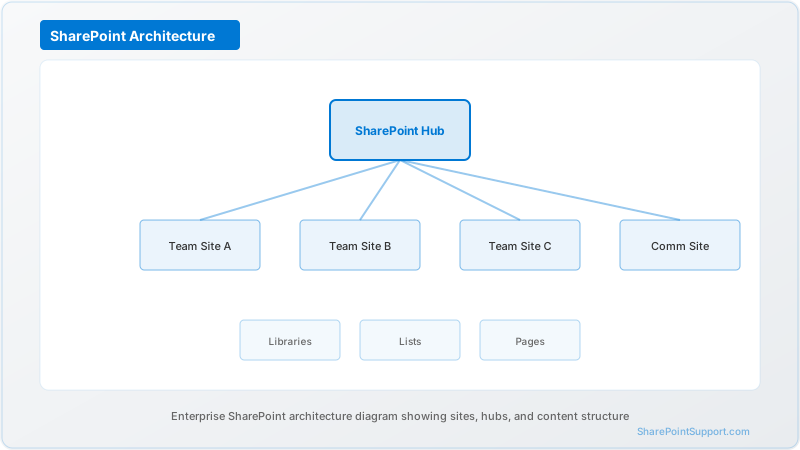
Microsoft's shared responsibility model is clear: Microsoft is responsible for infrastructure availability (data centers, networking, platform uptime) while customers are responsible for data protection (backup, recovery, access control, configuration management). Relying solely on Microsoft's native retention features leaves significant gaps that a proper DR plan addresses.
Understanding Microsoft's Built-In Protection
Before designing your DR strategy, understand what Microsoft already provides:
Recycle Bin (Two-Stage)
When a user deletes content in SharePoint, it moves to the site Recycle Bin (first stage) where it remains for 93 days. If deleted from the first-stage Recycle Bin, it moves to the site collection Recycle Bin (second stage) for the remainder of the 93-day window. After 93 days, content is permanently deleted.
Limitation: The 93-day window is fixed and cannot be extended. Content deleted more than 93 days ago is unrecoverable through native tools.
Version History
SharePoint maintains version history for documents, allowing recovery of previous versions. By default, SharePoint Online stores up to 500 major versions.
Limitation: Version history protects against content changes but not against deletion. If a document is deleted, all its versions go to the Recycle Bin. If the Recycle Bin expires, versions are lost.
Site Collection Restore
SharePoint administrators can restore a deleted site collection for up to 93 days after deletion.
Limitation: Same 93-day window. Also, the entire site collection is restored — you cannot selectively restore individual items from this mechanism.
Microsoft 365 Backup (New in 2025-2026)
Microsoft has launched Microsoft 365 Backup, a first-party backup service that provides longer retention and faster restoration than the native Recycle Bin. It supports point-in-time restoration for SharePoint sites, OneDrive accounts, and Exchange mailboxes.
Limitation: As of 2026, Microsoft 365 Backup charges per GB stored, making it expensive at scale. Restoration granularity and speed may not meet enterprise RPO/RTO requirements for all scenarios.
Defining RTO and RPO
Every DR plan starts with two metrics:
Recovery Time Objective (RTO)
How quickly must SharePoint be operational after an incident? Typical enterprise targets:
- Critical sites (executive portal, compliance library): 1-4 hours
- Important sites (project sites, department hubs): 4-24 hours
- Standard sites (team collaboration): 24-72 hours
Recovery Point Objective (RPO)
How much data loss is acceptable? This determines backup frequency:
- Zero RPO: Real-time replication (expensive, rarely needed for SharePoint)
- 4-hour RPO: Backup every 4 hours (appropriate for critical content)
- 24-hour RPO: Daily backup (appropriate for most content)
- Weekly RPO: Weekly backup (appropriate for archival content)
Map every SharePoint site to an RTO/RPO tier based on its business criticality. Do not apply the same tier to everything — it is either wasteful (over-protecting low-value content) or inadequate (under-protecting critical content).
Third-Party Backup Solutions
For enterprise-grade SharePoint DR, third-party backup solutions fill the gaps in Microsoft's native protection.
Leading SharePoint Backup Tools (2026)
AvePoint Cloud Backup: The market leader for Microsoft 365 backup. Provides automated backups of SharePoint, OneDrive, Exchange, Teams, and Power Platform. Supports granular restore (individual items, folders, sites) and point-in-time recovery. Stores backups in your choice of Azure, AWS, or AvePoint's cloud.
Veeam Backup for Microsoft 365: Enterprise-grade backup with strong integration into existing Veeam infrastructure. Supports backup to on-premises storage, Azure, AWS, or S3-compatible storage. Excellent for organizations already using Veeam for server backup.
Druva inSync: Cloud-native backup with automated data protection policies. Strong compliance features including legal hold, e-discovery integration, and automated retention. Good for highly regulated environments.
Commvault Metallic: Part of Commvault's broader data protection platform. Strong enterprise features including deduplication, compression, and integration with on-premises Commvault infrastructure.
Key Selection Criteria
When evaluating backup tools, prioritize:
- Backup frequency: Can it backup as frequently as your RPO requires?
- Granularity: Can you restore a single item, not just an entire site?
- Speed: How fast can you restore 100 GB of content? 1 TB?
- Metadata fidelity: Does the backup preserve metadata, permissions, and version history?
- Storage location: Where is backup data stored? Does it meet your data residency requirements?
- Cost model: Per-user, per-GB, or flat fee? How does cost scale with data growth?
- Compliance: Does the backup tool support legal hold, e-discovery, and audit requirements?
Designing Your DR Plan
Backup Architecture
Design a layered backup architecture:
Layer 1 — Microsoft native (free): Recycle Bin (93 days), version history (500 versions), site collection restore (93 days). This covers accidental single-item deletion with immediate recovery.
Layer 2 — Microsoft 365 Backup (Microsoft native, paid): Point-in-time restoration beyond 93 days. Covers scenarios where native retention has expired.
Layer 3 — Third-party backup (paid): Full backup with granular restore, custom retention, off-platform storage. Covers catastrophic scenarios (ransomware, tenant compromise, Microsoft service issues) and long-term retention requirements.
Backup Scope
Not all content needs the same backup treatment:
- Critical content (backup daily, retain 7 years): Compliance libraries, financial records, contracts, HR documents, executive sites
- Important content (backup daily, retain 1 year): Active project sites, department hubs, team collaboration sites
- Standard content (backup weekly, retain 90 days): Community sites, training materials, archived projects
Recovery Procedures
Document step-by-step recovery procedures for each scenario:
Scenario 1: User accidentally deletes a document. Recovery: Check site Recycle Bin → restore from Recycle Bin. Time: 5 minutes. Responsibility: Site owner or helpdesk.
Scenario 2: User accidentally deletes a site. Recovery: SharePoint admin restores site collection from admin center. Time: 30-60 minutes. Responsibility: SharePoint administrator.
Scenario 3: Ransomware encrypts document library content. Recovery: Identify infection timeline → restore affected libraries to pre-infection point-in-time from third-party backup. Time: 2-8 hours depending on library size. Responsibility: SharePoint admin + security team.
Scenario 4: Departed employee maliciously deletes content before leaving. Recovery: Identify deleted content from audit logs → restore from third-party backup (may be beyond 93-day Recycle Bin window). Time: 4-24 hours. Responsibility: SharePoint admin + HR.
Scenario 5: Microsoft 365 regional outage. Recovery: Wait for Microsoft to restore service (no customer action possible for infrastructure outages). Mitigation: Maintain local copies of business-critical documents for continuity during outage.
Ransomware Protection and Response
Ransomware targeting SharePoint is increasing in sophistication. Modern ransomware can encrypt documents through synced OneDrive clients, compromised user accounts, or malicious apps with SharePoint API access.
Prevention
- Enable Microsoft Defender for Office 365 (Plan 2 minimum)
- Configure Safe Attachments policies for SharePoint, OneDrive, and Teams
- Enable ransomware detection alerts in Microsoft 365 Defender
- Restrict app registrations that request Files.ReadWrite.All permissions
- Disable legacy authentication protocols
- Enforce MFA for all users, especially administrators
Detection
- Monitor for unusual file modification patterns (thousands of files modified in minutes)
- Alert on mass file type changes (all .docx files becoming .encrypted)
- Watch for new app registrations with broad SharePoint permissions
- Track impossible travel sign-ins to accounts with SharePoint access
Response
When ransomware is detected:
- Immediately disable the compromised account
- Revoke all active sessions and app tokens
- Identify the infection timeline using audit logs
- Assess the scope of encrypted content
- Restore affected content from backup to the pre-infection point-in-time
- Investigate the attack vector and close the vulnerability
- Communicate with affected users and stakeholders
Testing Your DR Plan
A DR plan that has never been tested is a hope, not a plan. Conduct regular DR testing:
Monthly: Recovery Spot Checks
Randomly select 5-10 documents and restore them from backup. Verify metadata, permissions, and version history are intact. This validates that backups are running and restorable.
Quarterly: Scenario Testing
Execute a full recovery scenario: simulate a site deletion, perform the documented recovery procedure, and measure actual recovery time against your RTO target. Involve the actual people who would perform the recovery, not just the person who wrote the procedure.
Annually: Full DR Exercise
Simulate a major incident (ransomware or mass deletion) and execute the full DR response plan. Include communication procedures, escalation paths, and executive notification. Document lessons learned and update the DR plan accordingly.
Compliance Considerations
Regulated industries have specific requirements for data protection that impact your DR strategy.
HIPAA: Requires backup and recovery procedures for electronic protected health information (ePHI). Backup data must be encrypted and access-controlled. Recovery procedures must be tested regularly.
SOX: Requires preservation of financial records and audit trails. Backup retention must align with regulatory retention periods (typically 7 years).
GDPR: Backup systems must support data subject access requests and right to erasure. Ensure your backup solution can locate and delete specific individual's data across all backup copies.
Our SharePoint support services include DR plan design, backup solution implementation, and regular DR testing as part of our managed services offering. Our consulting team can conduct a DR readiness assessment and design a strategy aligned with your RTO/RPO requirements and compliance obligations.
For organizations planning a migration to SharePoint Online, we include DR planning as a standard deliverable to ensure your new environment is protected from day one. Contact us for a disaster recovery assessment.
Frequently Asked Questions
Does Microsoft back up my SharePoint data?
Microsoft maintains infrastructure-level backups for service continuity, but these are not customer-accessible backups. You cannot request a point-in-time restore from Microsoft's infrastructure backups (except through the 93-day Recycle Bin and site restore features). Microsoft's shared responsibility model explicitly states that data protection is the customer's responsibility.
How much does third-party SharePoint backup cost?
Typical pricing ranges from $2-5 per user per month for comprehensive Microsoft 365 backup (SharePoint, OneDrive, Exchange, Teams). For a 5,000-user organization, budget $10,000-$25,000 per year. Storage costs may be additional depending on the provider and data volume.
Can I backup SharePoint to on-premises storage?
Yes. Veeam and Commvault both support backing up SharePoint Online to on-premises storage. This provides an air-gapped copy that is immune to cloud-based attacks. However, on-premises storage requires infrastructure investment and management.
How long should I retain SharePoint backups?
Align backup retention with your regulatory requirements and data classification. Critical compliance content may require 7-10 year backup retention. Standard business content typically needs 1-3 years. Transient content may only need 90 days. Applying a single retention period to all backups wastes storage and money.
What is the difference between backup and archival?
Backup creates a recoverable copy of active content for disaster recovery. Archival moves inactive content to cheaper storage while maintaining access. Both are part of a comprehensive data protection strategy, but they serve different purposes. Backup protects against data loss; archival reduces costs and improves active environment performance.
Can ransomware affect SharePoint Online?
Yes. Ransomware can encrypt SharePoint documents through compromised user accounts (syncing encrypted files via OneDrive client), malicious Azure AD app registrations with write permissions, and compromised admin accounts. The attack surface is different from on-premises, but the risk is real and increasing.
How do I test my DR plan without disrupting production?
Use a dedicated test site collection with representative content. Simulate incidents (delete the site, modify files to simulate encryption) and practice recovery procedures. Most third-party backup tools support restore to a different location, allowing you to verify backup integrity without touching production content.
Does Microsoft 365 Backup replace third-party backup?
For some organizations, yes — particularly those with straightforward backup requirements and standard retention needs. However, third-party tools still offer advantages in backup frequency flexibility, storage location choice, broader platform coverage, and mature reporting/compliance features. Evaluate both options against your specific requirements.
Enterprise Implementation Best Practices
In our 25+ years of enterprise SharePoint consulting, we have helped organizations recover from data loss events ranging from accidental deletions affecting individual documents to catastrophic incidents impacting entire site collections. The organizations that recover quickly and completely share one trait: they invested in backup and recovery planning before the incident occurred.
- Understand Microsoft's Shared Responsibility Model: Microsoft guarantees infrastructure availability but does not guarantee granular data recovery that meets every organization's requirements. Native recycle bins provide 93-day recovery windows, and version history preserves document changes, but neither addresses scenarios such as malicious deletion, corruption propagation across versions, or the need to restore content to a point-in-time state beyond the retention window.
- Implement a Third-Party Backup Solution: For enterprise organizations with compliance requirements, native capabilities are insufficient. Deploy a third-party backup solution that provides granular item-level recovery, point-in-time restoration, long-term retention beyond Microsoft's native windows, and the ability to restore to alternative locations. Test restoration procedures quarterly to verify backup integrity.
- Configure Retention Policies as a Compliance Safety Net: Microsoft 365 retention policies preserve content regardless of user deletion actions, providing a compliance-focused backup layer. Configure retention policies for regulated content that align with your industry requirements including HIPAA's six-year minimum, SEC's seven-year requirement for financial records, and your organization's litigation hold obligations.
- Document and Test Recovery Procedures: A backup without tested recovery procedures is a false sense of security. Document step-by-step recovery procedures for common scenarios including individual document recovery, library restoration, site collection recovery, and full tenant restoration. Test each procedure quarterly and update documentation based on platform changes and lessons learned.
- Implement Preventive Controls to Reduce Recovery Need: The best recovery strategy is prevention. Configure recycle bin retention maximums, enable versioning on all document libraries, restrict bulk deletion capabilities to administrators, implement alerts for mass deletion events, and train users on proper content management practices that reduce accidental data loss.
Governance and Compliance Considerations
Backup and disaster recovery strategies for SharePoint carry significant compliance implications because regulatory frameworks mandate specific data protection, retention, and recovery capabilities that native platform features alone may not satisfy.
For HIPAA-regulated organizations, backup solutions must protect the confidentiality and integrity of protected health information throughout the backup lifecycle including storage, transmission, and restoration. Backup data containing PHI must be encrypted to HIPAA standards, stored in locations that satisfy your data residency requirements, and accessible only to authorized personnel. Your backup retention periods must align with HIPAA's six-year minimum retention requirement for covered records.
Financial services organizations must ensure backup capabilities satisfy SEC and FINRA requirements for business continuity and records preservation. Backup solutions must support immutable retention for records subject to SEC Rule 17a-4, provide granular recovery capabilities that can restore individual records for regulatory examinations, and maintain audit trails documenting backup integrity verification.
Government organizations must verify that backup solutions comply with FedRAMP authorization requirements, store backup data within authorized boundaries, and implement encryption that meets FIPS 140-2 standards.
Document your backup and recovery procedures as part of your business continuity plan and test recovery procedures at least quarterly to verify backup integrity and recovery time compliance. Maintain evidence of successful recovery tests for audit purposes. Include your SharePoint backup solution in your annual risk assessment and update your recovery procedures when platform changes affect backup capabilities. Our SharePoint backup and recovery specialists design data protection architectures that satisfy the most demanding regulatory requirements while providing the granular recovery capabilities enterprises need.
Ready to ensure your SharePoint data is protected against every disaster scenario? Our backup and recovery specialists have designed data protection strategies for enterprises with the most demanding recovery requirements. Contact our team for a backup assessment, and explore how our SharePoint consulting services can safeguard your business-critical content.
Common Challenges and Solutions
Organizations implementing SharePoint Disaster Recovery consistently encounter obstacles that, if left unaddressed, undermine adoption and erode stakeholder confidence. Drawing on two decades of enterprise SharePoint consulting, these are the challenges we see most frequently and the proven approaches for overcoming them.
Challenge 1: Content Sprawl and Information Architecture Degradation
Over time, SharePoint Disaster Recovery environments accumulate redundant, outdated, and trivial content that degrades search relevance and confuses users. Without proactive content lifecycle management, the signal-to-noise ratio deteriorates and user trust in the platform erodes. The resolution requires a structured approach: establishing automated retention policies that flag content for review after defined periods of inactivity, combined with content owner accountability structures that assign clear responsibility for each site collection and library. Organizations that address this proactively report 40 to 60 percent fewer support tickets within the first 90 days of deployment. Establishing a dedicated governance committee with representatives from IT, compliance, and business stakeholders ensures ongoing alignment between technical configuration and organizational objectives.
Challenge 2: Compliance and Audit Readiness Gaps
SharePoint Disaster Recovery implementations in regulated industries often lack the audit trail depth and policy enforcement rigor required by frameworks such as HIPAA, SOC 2, and GDPR. Retroactive compliance remediation is significantly more expensive and disruptive than building compliance into the initial design. We recommend embedding compliance requirements into the information architecture from day one. Configure Microsoft Purview retention labels, DLP policies, and audit logging before deploying content, and validate compliance posture through regular internal audits. Tracking these metrics through SharePoint health dashboards provides early warning indicators that allow administrators to intervene before minor issues become systemic problems affecting enterprise-wide productivity.
Challenge 3: Inconsistent Governance Across Business Units
When different departments implement SharePoint Disaster Recovery independently, inconsistent naming conventions, metadata schemas, and security configurations create silos that undermine cross-functional collaboration and complicate compliance reporting. The most effective mitigation strategy involves centralizing governance policy definition while allowing controlled flexibility at the departmental level. A hub-and-spoke governance model balances enterprise consistency with departmental autonomy. Enterprises operating in regulated industries such as healthcare and financial services must pay particular attention to this challenge because compliance violations carry significant financial and reputational consequences. Regular audits conducted quarterly at minimum help organizations maintain alignment with evolving regulatory requirements and internal policy updates.
Challenge 4: Migration and Legacy Content Complexity
Organizations transitioning legacy content into SharePoint Disaster Recovery often underestimate the complexity of mapping old structures, metadata, and permissions to modern architectures. Failed migrations erode user confidence and create parallel systems that duplicate effort. Addressing this requires conducting thorough pre-migration content audits that classify and prioritize content based on business value. Invest in automated migration tools that preserve metadata fidelity and permission integrity while providing detailed validation reports. Organizations that invest in structured change management programs achieve adoption rates 35 percent higher than those relying on organic discovery alone. Executive sponsorship combined with department-level champions creates the organizational momentum necessary for sustained success.
Integration with Microsoft 365 Ecosystem
SharePoint Disaster Recovery does not operate in isolation. Its value multiplies when connected to the broader Microsoft 365 ecosystem, creating unified workflows that eliminate context switching and reduce manual data transfer between applications.
Microsoft Teams Integration: SharePoint Disaster Recovery content surfaces directly in Teams channels through embedded tabs and adaptive cards, giving team members instant access to relevant documents and dashboards without leaving their collaborative workspace. Teams channels automatically provision SharePoint document libraries, which means sharepoint disaster recovery configurations and content flow seamlessly between collaborative conversations and structured document management. Users can surface SharePoint content directly within Teams tabs, reducing the friction that typically causes adoption to stall.
Power Automate Workflows: Build approval workflows that route SharePoint Disaster Recovery content through structured review chains, automatically notifying approvers and escalating overdue items to maintain process velocity. Automated workflows triggered by SharePoint events such as document uploads, metadata changes, or approval completions eliminate repetitive manual tasks. Organizations typically automate 15 to 25 processes within the first quarter, saving an average of 8 hours per week per department. These automations also create audit trails that satisfy compliance requirements for regulated industries.
Power BI Analytics: Visualize SharePoint Disaster Recovery usage patterns and adoption metrics through Power BI dashboards that update automatically, giving leadership real-time visibility into platform health and user engagement. Connecting SharePoint data to Power BI dashboards provides real-time visibility into content usage patterns, adoption metrics, and operational KPIs. Decision makers gain actionable intelligence without requiring manual report generation, enabling faster response to emerging trends and potential issues.
Microsoft Purview and Compliance: Apply sensitivity labels to SharePoint Disaster Recovery content automatically based on classification rules, ensuring that confidential and regulated information receives appropriate protection throughout its lifecycle. Sensitivity labels, data loss prevention policies, and retention schedules configured in Microsoft Purview extend automatically to sharepoint disaster recovery content. This unified compliance framework ensures that governance policies apply consistently across the entire Microsoft 365 environment rather than requiring separate configuration for each workload. For organizations subject to HIPAA, SOC 2, or FedRAMP requirements, this integrated approach significantly reduces compliance management overhead.
Getting Started: Next Steps
Implementing SharePoint Disaster Recovery effectively requires more than technical configuration. It demands a strategic approach grounded in your organization's specific business requirements, compliance obligations, and growth trajectory. The difference between a deployment that delivers measurable ROI and one that becomes shelfware often comes down to the quality of upfront planning and expert guidance.
Begin with a focused assessment of your current SharePoint environment. Evaluate your existing information architecture, permission structures, content lifecycle policies, and user adoption patterns. Identify gaps between your current state and the target state required for successful sharepoint disaster recovery implementation. This assessment typically takes 2 to 4 weeks and produces a prioritized roadmap that aligns technical work with business outcomes.
Our SharePoint specialists have guided organizations across healthcare, financial services, government, and education through hundreds of successful implementations. We bring deep expertise in SharePoint architecture, governance frameworks, and compliance alignment that accelerates time to value while minimizing risk.
Ready to move forward? Contact our team for a complimentary consultation. We will assess your environment, identify quick wins, and develop a phased implementation plan tailored to your organization's needs and timeline. Whether you are starting from scratch or optimizing an existing deployment, our enterprise SharePoint consultants deliver the expertise and accountability that Fortune 500 organizations demand.
Written by the SharePoint Support Team
Senior SharePoint Consultants | 25+ Years Microsoft Ecosystem Experience
Our senior SharePoint consultants bring deep expertise spanning 500+ enterprise migrations and compliance implementations across HIPAA, SOC 2, and FedRAMP environments. We cover SharePoint Online, Microsoft 365, migrations, Copilot readiness, and large-scale governance.
Expert SharePoint Services
Frequently Asked Questions
Does Microsoft back up SharePoint Online data?▼
What is the best disaster recovery strategy for SharePoint?▼
How long does it take to recover a SharePoint environment after a disaster?▼
What RPO and RTO should I set for SharePoint?▼
What third-party backup solutions work best for SharePoint Online?▼
Need Expert Help?
Our SharePoint consultants are ready to help you implement these strategies in your organization.
Continue Reading in Administration
SharePoint Admin Center: Administration Guide
Master the SharePoint Admin Center with this guide covering site management, policies, settings, and monitoring capabilities for tenant administrators.
AdministrationSharePoint Storage Management: M365 Guide
Master SharePoint storage management with strategies for monitoring usage, optimizing quotas, archiving content, and planning capacity for your Microsoft 365 tenant.
AdministrationRecycle Bin Management: Data Recovery Best Practices
Master SharePoint recycle bin management for reliable data recovery. Learn first-stage and second-stage recycle bins, retention policies, PowerShell recovery commands, and enterprise backup strategies.
AdministrationSharePoint vs OneDrive: When to Use Each (And When You...
Clear guide to when to use SharePoint vs OneDrive in Microsoft 365. Explains the key differences, ideal use cases for each, how they work together, and the most common mistakes organizations make.
AdministrationSharePoint Admin Center: Complete Guide for 2026
Master the SharePoint Admin Center with this comprehensive guide covering site management, settings, policies, external sharing, storage quotas, and modern admin features.
AdministrationSharePoint Online Storage Management: Administrator...
Optimize SharePoint Online storage usage, understand tenant storage pools, manage site quotas, identify version history bloat, reclaim wasted space, and implement storage governance policies to control costs and prevent read-only site incidents.