SharePoint as the Foundation for Enterprise Digital Transformation
Digital transformation means different things to different organizations, but for most enterprises that operate within the Microsoft ecosystem, it fundamentally includes modernizing how people collaborate on documents and projects, how organizations manage and govern their information assets, how employees find the knowledge they need to do their work, and how teams work effectively across departmental and organizational boundaries. SharePoint Online, deeply integrated with Microsoft Teams for real-time collaboration, the Power Platform for workflow automation and custom applications, Microsoft 365 Copilot for AI-powered productivity, and Azure for cloud infrastructure and advanced services, sits at the center of most Microsoft-ecosystem digital transformation programs because it provides the content management, governance, and information architecture layer that connects all of these capabilities into a coherent digital workplace.
However, digital transformation is not a technology deployment project. It is a multi-year organizational change program that requires sustained executive sponsorship, deliberate change management, phased implementation that demonstrates value incrementally, and continuous measurement of adoption and business outcomes. Organizations that treat SharePoint deployment as a simple IT infrastructure project rather than a business transformation initiative consistently underperform on adoption metrics and fail to realize the productivity, compliance, and cost savings that the platform is capable of delivering. This guide provides a structured roadmap for enterprise organizations undertaking SharePoint-centered digital transformation, whether starting from legacy SharePoint on-premises environments, Windows file shares, Google Workspace, or a fragmented mix of collaboration tools.
Phase 0: Assessment and Current State Analysis
No transformation succeeds without an honest assessment of where you are today.
Digital Workplace Maturity Assessment
Rate your organization on a 1-5 scale across these dimensions:
| Dimension | 1 (Ad Hoc) | 3 (Managed) | 5 (Optimized) |
|-----------|-----------|------------|--------------|
| Document Management | Files on shared drives, no metadata | SharePoint with basic libraries | Managed metadata, content types, auto-classification |
| Collaboration | Email attachments | Teams + SharePoint | Integrated workflows, co-authoring, real-time sync |
| Knowledge Management | Tribal knowledge, siloed | Informal wikis | AI-searchable knowledge base, Copilot-ready |
| Process Automation | Manual, paper-based | Some email-based workflows | Power Automate, automated approval chains |
| Governance | No policies | Basic policies, unenforced | Automated governance, lifecycle management |
| Security | Basic permissions | MFA, conditional access | Zero Trust, sensitivity labels, DLP, Defender |
| Analytics | None | Basic usage reports | Power BI dashboards, Viva Insights, adoption metrics |
Technical Inventory
Catalog your current environment:
```powershell
# Inventory SharePoint Online environment
Connect-PnPOnline -Url "https://contoso-admin.sharepoint.com" -Interactive
# All sites
$sites = Get-PnPTenantSite
Write-Output "Total sites: $($sites.Count)"
# Storage usage
$totalStorage = ($sites | Measure-Object StorageUsageCurrent -Sum).Sum
Write-Output "Total storage used: $([Math]::Round($totalStorage/1024, 2)) GB"
# Sites with external sharing
$externalSites = $sites | Where-Object SharingCapability -ne "Disabled"
Write-Output "Sites with external sharing enabled: $($externalSites.Count)"
# Inactive sites (no activity in 90+ days)
$inactiveSites = $sites | Where-Object {
$_.LastContentModifiedDate -lt (Get-Date).AddDays(-90)
}
Write-Output "Inactive sites (90+ days): $($inactiveSites.Count)"
```
Stakeholder Interviews
Conduct 30-minute interviews with:
- IT leadership (current pain points, technical debt, security concerns)
- HR leadership (employee experience, onboarding, training needs)
- Department heads (team collaboration, document access, process inefficiencies)
- End users (sample from each department — what doesn't work, what they wish they had)
- Compliance/Legal (record retention, eDiscovery requirements, regulatory obligations)
Phase 1: Foundation (Months 1-3)
Information Architecture Design
Before provisioning sites, design the target architecture:
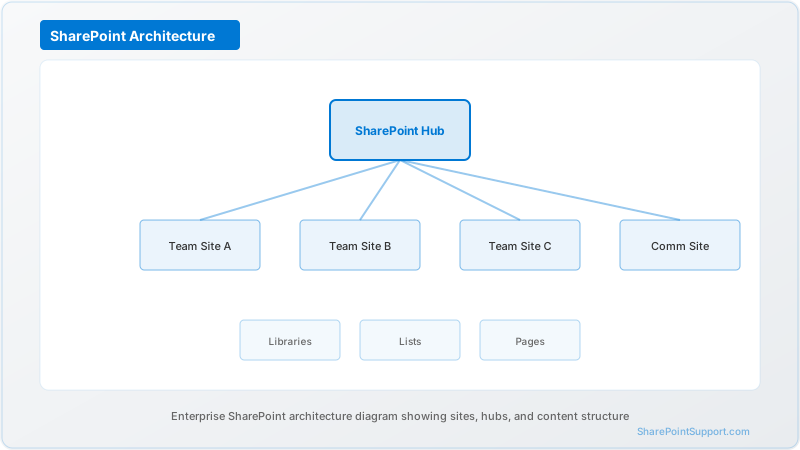
Hub site topology: Define the 3-5 primary hub sites that will organize your environment (e.g., Corporate Hub, HR Hub, Operations Hub, Project Hub, Customer-Facing Hub).
Naming conventions: Establish site URL and display name conventions before provisioning begins. Example:
```
Site URLs: /sites/[dept]-[function] (e.g., /sites/hr-benefits, /sites/finance-ap)
Site Names: [Department] - [Function] (e.g., "Human Resources - Benefits Administration")
```
Content type design: Define 10-15 enterprise content types that will be published from the Content Type Hub.
Metadata taxonomy: Create the Term Store structure with 5-8 top-level term sets (Department, Document Type, Project, Geography, Retention).
Security and Compliance Baseline
Implement before any user content is migrated:
- Conditional Access policy: Require MFA + managed devices for all SharePoint access
- External sharing policy: Limit to allowed domains only at tenant level
- Sensitivity labels: Deploy 4-5 labels (Public, Internal, Confidential, Restricted, [Industry-specific])
- DLP policies: Activate for SSN, credit card, and industry-specific PII detection
- Audit logging: Verify enabled, configure retention policy per compliance requirements
Governance Framework
Publish the SharePoint Governance document before launch. Key sections:
- Site creation process (no self-service — use request form)
- Naming conventions
- External sharing rules
- Retention and archival policy
- Site owner responsibilities
- Support and escalation process
Phase 2: Core Platform (Months 3-6)
Intranet Launch
The corporate intranet is typically the highest-visibility SharePoint deliverable. Phased approach:
Month 3: Corporate home page (Communication Site) — news, quick links, search, executive messages
Month 4: IT hub (IT helpdesk, knowledge base, status page) and HR hub (policies, benefits, org chart)
Month 5: Department sites (Communications, Finance, Operations) using standard templates
Month 6: Remaining department sites + completion of all hub associations
Microsoft Teams + SharePoint Integration
If Teams is already deployed, integrate with SharePoint:
- Audit existing Teams → identify associated SharePoint sites (often chaotic from organic growth)
- Establish Teams governance: mandatory naming conventions for new Teams going forward
- Pin SharePoint tabs to key Teams channels for document access within Teams
- Configure Teams channel meeting notes to save to SharePoint
Document Migration
Migrate from file shares, legacy SharePoint, or other platforms:
Priority 1 (migrate first): Active project files, current year HR documents, current year financial files
Priority 2 (migrate second): Reference materials, prior year files, policy documents
Priority 3 (archive or delete): Files older than 3 years with no access in 12+ months
Migration tool: ShareGate for SharePoint-to-SharePoint, SPMT for file shares.
Phase 3: Automation and Process Optimization (Months 6-9)
Power Automate Workflow Deployment
Identify and automate the top 5 manual processes consuming the most employee time. Common high-ROI workflows:
- Document approval: Replace email chains with structured approval flow (SharePoint trigger → manager approval → notification → status update)
- New employee onboarding: SharePoint task list auto-created on HR system → employee ID event
- Contract review/execution: Legal team approval chain with deadline escalation
- Policy acknowledgment: Notify all employees when policy updated, track read acknowledgments
- IT change requests: SharePoint form → CAB approval → automated ticket creation in ITSM
Each workflow should have:
- Clear trigger (SharePoint item created/modified, scheduled, manual button)
- Approval steps with SLA and escalation
- Audit trail (SharePoint list tracking status)
- User-facing notification (Teams adaptive card + email)
Power Apps for Department Self-Service
Build 2-3 Power Apps that replace paper forms or complex SharePoint forms:
- IT Asset Request App: Employee requests equipment → manager approval → IT fulfillment → asset tracking in SharePoint list
- Incident Report App: Submit safety incidents from mobile → auto-routes to safety team → SharePoint record with attachments
- Vendor Onboarding App: New vendor submits information → procurement review → legal review → approval → SharePoint vendor directory entry
SharePoint Search Optimization
At this phase, search quality becomes critical as content volume grows:
- Map crawled properties to managed properties for top metadata fields
- Configure 5-8 result sources (HR Documents, IT Knowledge Base, Projects, Contracts)
- Set up promoted results (best bets) for 20 most common search queries
- Configure people search — ensure Azure AD profiles are complete (photo, department, skills)
- Test search quality with representative users and tune based on feedback
Phase 4: Advanced Capabilities (Months 9-12)
Microsoft 365 Copilot Deployment
By month 9, if governance prerequisites are met (permissions audited, oversharing resolved, stale content removed), proceed with Copilot:
Month 9: Copilot pilot — 50-100 power users and champions
Month 10: Evaluate pilot metrics, gather prompt library submissions, tune SharePoint agents
Month 11: Expand to 25% of licensed users + department-specific agents
Month 12: Full rollout with prompt library published, adoption program active
SharePoint Syntex / Microsoft 365 Syntex
Microsoft Syntex (formerly SharePoint Syntex) uses AI to automatically:
- Extract metadata from documents (invoice number, vendor name, contract value)
- Classify documents by type automatically
- Apply sensitivity labels based on content
- Process structured forms (PDF, TIFF) into SharePoint list items
High-value Syntex use cases:
- Invoice processing: Extract vendor, amount, date from AP invoices → SharePoint list → approval workflow
- Contract management: Extract parties, dates, values from contracts → contract registry
- HR document processing: Extract data from I-9s, benefit forms → HR system update
Power BI + SharePoint Analytics
Embed Power BI dashboards in SharePoint pages for:
- SharePoint adoption dashboard (site visits, users, search queries)
- Department-specific operational dashboards (surfaced where the work happens)
- Project status dashboards embedded in project hub pages
Viva Suite Integration
For organizations focused on employee experience:
- Viva Connections: Mobile-first SharePoint intranet in Teams app for frontline workers
- Viva Engage: Social community layer replacing Yammer (community of practice, recognition, leadership Q&A)
- Viva Learning: Learning management integration (LinkedIn Learning, external LMS) surfaced in SharePoint
- Viva Insights: Productivity and wellbeing analytics for individuals and managers
Change Management: The Difference Between Success and Failure
Technology is 40% of digital transformation. People and process are 60%. Organizations that invest in change management see 3-5x higher adoption rates.
Change Management Framework for SharePoint
Awareness (Months 1-2):
- Executive sponsor communication: Why are we doing this?
- Town halls and department briefings
- "What's changing for you" guides per department
Knowledge (Months 3-5):
- Role-based training (not one-size-fits-all): Administrators, power users, general employees
- Lunch-and-learn sessions per department
- Video tutorials (3-5 minute "How to do X in SharePoint" series)
Ability (Months 4-8):
- Hands-on workshops (small groups, department-specific scenarios)
- SharePoint Champions program: 1 champion per 50-100 employees
- Help desk first-call resolution training for SharePoint questions
Reinforcement (Months 6-12):
- Monthly adoption report shared with leadership
- Champion recognition (acknowledge top adopters)
- Continuous improvement: monthly feedback survey, quarterly platform updates
ROI Measurement Framework
Document the business case with measurable KPIs:
Productivity ROI Metrics
| Metric | Baseline | 6-Month Target | 12-Month Target |
|--------|---------|----------------|----------------|
| Time to find a document | 15 min avg | 8 min | 3 min (Copilot) |
| Document approval cycle time | 5 days avg | 2 days | 1 day (automated) |
| Onboarding time to productivity | 90 days | 75 days | 60 days |
| IT helpdesk tickets (file access) | 200/month | 120/month | 60/month |
Compliance ROI Metrics
| Metric | Baseline | Target |
|--------|---------|--------|
| Audit evidence retrieval time | 5 days | 2 hours |
| Policy compliance rate (read acknowledgment) | 40% | 95% |
| eDiscovery response time | 30 days | 3 days |
| Data loss events | Track and reduce | Zero |
Cost ROI Metrics
| Item | Current Cost | Target Cost | Savings |
|------|-------------|-------------|---------|
| Legacy file share infrastructure | $X/year | $0 | $X |
| Legacy DMS licenses | $60-120/user/year | $0 | Full license cost |
| Email storage (attachments) | $Y/year | Reduced | Partial |
| Physical document storage | $Z/month | Reduced | Partial |
Executive Alignment and Governance
SharePoint digital transformation requires sustained executive sponsorship, not just a one-time kickoff.
Executive Steering Committee
Form a quarterly steering committee with:
- CIO/IT leadership (platform ownership)
- CHRO (employee experience outcomes)
- CLO or General Counsel (compliance requirements)
- CFO (ROI measurement, cost tracking)
- Business unit leaders (1-2 rotating)
Quarterly agenda: adoption metrics review, roadmap update, budget review, risk assessment.
Digital Workplace Advisory Group
Monthly meeting of department champions and IT:
- What's working, what's not
- Upcoming feature rollouts
- Training needs identified
- Escalations and blockers
This group is your change management engine and early warning system for adoption issues.
The Long-Term View: Digital Transformation as Continuous Improvement
SharePoint digital transformation is a multi-year journey, not a one-time project. Organizations that succeed treat it as a continuous improvement program that measures adoption against defined baselines, gathers user feedback through regular surveys and champion network meetings, adds new capabilities incrementally as the organization's maturity increases, and maintains executive alignment through quarterly steering committee reviews that connect platform investments to business outcomes.
The organizations that achieve the greatest return on their SharePoint investment are those that view the platform not as a static deployment but as an evolving digital workplace that adapts to changing business needs, incorporates new Microsoft 365 capabilities as they are released, and progressively replaces legacy tools and manual processes with modern, governed, automated alternatives. Each phase of the transformation builds on the previous phase, creating a compounding effect where early governance and architecture investments enable later productivity and AI capabilities that would not be possible without the solid foundation.
If your organization is planning a SharePoint-centered digital transformation, our SharePoint consulting services provide end-to-end support including current state assessment, architecture design, migration execution, governance framework creation, change management programs, and ongoing optimization. Contact our team to discuss your digital transformation goals and get a customized roadmap tailored to your organization's starting point, priorities, and timeline.
Enterprise Implementation Best Practices
In our 25+ years of enterprise SharePoint consulting, we have guided hundreds of organizations through complex SharePoint initiatives spanning every industry and organizational scale. The implementation patterns that consistently deliver successful outcomes share common characteristics regardless of the specific feature or capability being deployed.
- Conduct a Thorough Requirements and Readiness Assessment: Before beginning any SharePoint implementation, invest time in understanding both the business requirements and the technical readiness of your environment. Assess your current content architecture, permission structures, integration dependencies, and user readiness. This assessment typically reveals 20 to 30 percent more complexity than initial stakeholder estimates suggest.
- Deploy in Controlled Phases with Pilot Groups: Start with a pilot group of 50 to 100 representative users from different departments and roles. Define measurable success criteria for each phase and collect structured feedback through surveys and interviews. Phased deployment reduces risk, builds organizational confidence, and generates the internal success stories that accelerate broader adoption.
- Invest in Change Management and Training: Technology implementations fail when organizations underinvest in helping people adapt to new tools and processes. Develop role-specific training that demonstrates how the new capability helps users accomplish their actual daily tasks. Create champion networks, host office hours, and celebrate early wins to build momentum across the organization.
- Automate Governance and Compliance Controls: Manual governance does not scale beyond a few dozen users or sites. Implement automated policy enforcement using Power Automate workflows, sensitivity labels, retention policies, and SharePoint administrative tools that ensure consistent compliance without creating bottlenecks or relying on individual user behavior.
- Establish Monitoring, Metrics, and Continuous Improvement: Define key performance indicators before deployment and track them systematically. Monitor adoption rates, user satisfaction, performance metrics, and business outcome improvements. Review these metrics monthly with stakeholders and use them to drive iterative improvements rather than treating the initial deployment as the finished state.
Governance and Compliance Considerations
Governance frameworks must satisfy the compliance requirements specific to your industry while remaining practical enough for daily operation. The most effective governance frameworks are those designed with regulatory compliance as a core requirement rather than an afterthought.
For HIPAA-regulated healthcare organizations, your governance framework must include specific controls for protected health information including access logging, minimum necessary access enforcement, encryption requirements, and business associate agreement tracking for any external sharing. Sensitivity labels should automatically apply encryption to documents containing PHI, and your retention policies must align with HIPAA's six-year minimum retention requirement.
Financial services organizations operating under SOC 2 need governance controls that demonstrate security, availability, processing integrity, confidentiality, and privacy of customer data. Your governance framework should map directly to SOC 2 trust service criteria, with automated evidence collection for audit readiness. SharePoint audit logs, access reviews, and change management records all serve as SOC 2 evidence.
Government agencies and contractors subject to FedRAMP or CMMC must implement governance controls satisfying federal security requirements including FIPS 140-2 compliant encryption, strict access controls based on security clearance levels, and comprehensive audit trails meeting NIST 800-53 control families.
Regardless of your specific regulatory environment, your governance framework should include data classification policies, retention schedules complying with applicable regulations, incident response procedures, and regular compliance assessments verifying controls function as designed. Working with experienced SharePoint governance consultants who understand your regulatory landscape ensures your framework addresses compliance from day one.
Ready to transform your SharePoint environment into a strategic business asset? Our specialists have guided hundreds of enterprises through successful SharePoint implementations across healthcare, financial services, government, and other regulated industries. Contact our team for a comprehensive assessment, and discover how our SharePoint consulting services can deliver the outcomes your organization needs.
Common Challenges and Solutions
Organizations implementing SharePoint Digital Transformation Roadmap consistently encounter obstacles that, if left unaddressed, undermine adoption and erode stakeholder confidence. Drawing on two decades of enterprise SharePoint consulting, these are the challenges we see most frequently and the proven approaches for overcoming them.
Challenge 1: Content Sprawl and Information Architecture Degradation
Over time, SharePoint Digital Transformation Roadmap environments accumulate redundant, outdated, and trivial content that degrades search relevance and confuses users. Without proactive content lifecycle management, the signal-to-noise ratio deteriorates and user trust in the platform erodes. The resolution requires a structured approach: establishing automated retention policies that flag content for review after defined periods of inactivity, combined with content owner accountability structures that assign clear responsibility for each site collection and library. Organizations that address this proactively report 40 to 60 percent fewer support tickets within the first 90 days of deployment. Establishing a dedicated governance committee with representatives from IT, compliance, and business stakeholders ensures ongoing alignment between technical configuration and organizational objectives.
Challenge 2: Compliance and Audit Readiness Gaps
SharePoint Digital Transformation Roadmap implementations in regulated industries often lack the audit trail depth and policy enforcement rigor required by frameworks such as HIPAA, SOC 2, and GDPR. Retroactive compliance remediation is significantly more expensive and disruptive than building compliance into the initial design. We recommend embedding compliance requirements into the information architecture from day one. Configure Microsoft Purview retention labels, DLP policies, and audit logging before deploying content, and validate compliance posture through regular internal audits. Tracking these metrics through SharePoint health dashboards provides early warning indicators that allow administrators to intervene before minor issues become systemic problems affecting enterprise-wide productivity.
Challenge 3: Inconsistent Governance Across Business Units
When different departments implement SharePoint Digital Transformation Roadmap independently, inconsistent naming conventions, metadata schemas, and security configurations create silos that undermine cross-functional collaboration and complicate compliance reporting. The most effective mitigation strategy involves centralizing governance policy definition while allowing controlled flexibility at the departmental level. A hub-and-spoke governance model balances enterprise consistency with departmental autonomy. Enterprises operating in regulated industries such as healthcare and financial services must pay particular attention to this challenge because compliance violations carry significant financial and reputational consequences. Regular audits conducted quarterly at minimum help organizations maintain alignment with evolving regulatory requirements and internal policy updates.
Challenge 4: Migration and Legacy Content Complexity
Organizations transitioning legacy content into SharePoint Digital Transformation Roadmap often underestimate the complexity of mapping old structures, metadata, and permissions to modern architectures. Failed migrations erode user confidence and create parallel systems that duplicate effort. Addressing this requires conducting thorough pre-migration content audits that classify and prioritize content based on business value. Invest in automated migration tools that preserve metadata fidelity and permission integrity while providing detailed validation reports. Organizations that invest in structured change management programs achieve adoption rates 35 percent higher than those relying on organic discovery alone. Executive sponsorship combined with department-level champions creates the organizational momentum necessary for sustained success.
Integration with Microsoft 365 Ecosystem
SharePoint Digital Transformation Roadmap does not operate in isolation. Its value multiplies when connected to the broader Microsoft 365 ecosystem, creating unified workflows that eliminate context switching and reduce manual data transfer between applications.
Microsoft Teams Integration: Embed SharePoint Digital Transformation Roadmap dashboards and document libraries as Teams tabs to create unified workspaces where conversations and structured content management coexist within a single interface. Teams channels automatically provision SharePoint document libraries, which means sharepoint digital transformation roadmap configurations and content flow seamlessly between collaborative conversations and structured document management. Users can surface SharePoint content directly within Teams tabs, reducing the friction that typically causes adoption to stall.
Power Automate Workflows: Implement scheduled flows that perform routine SharePoint Digital Transformation Roadmap maintenance tasks including permission reports, content audits, and usage analytics without requiring manual intervention. Automated workflows triggered by SharePoint events such as document uploads, metadata changes, or approval completions eliminate repetitive manual tasks. Organizations typically automate 15 to 25 processes within the first quarter, saving an average of 8 hours per week per department. These automations also create audit trails that satisfy compliance requirements for regulated industries.
Power BI Analytics: Build executive dashboards that aggregate SharePoint Digital Transformation Roadmap metrics alongside other business KPIs, providing a holistic view of digital workplace effectiveness and investment returns. Connecting SharePoint data to Power BI dashboards provides real-time visibility into content usage patterns, adoption metrics, and operational KPIs. Decision makers gain actionable intelligence without requiring manual report generation, enabling faster response to emerging trends and potential issues.
Microsoft Purview and Compliance: Implement retention policies that automatically manage SharePoint Digital Transformation Roadmap content lifecycle, preserving business-critical records for required periods while disposing of transient content to reduce storage costs and compliance exposure. Sensitivity labels, data loss prevention policies, and retention schedules configured in Microsoft Purview extend automatically to sharepoint digital transformation roadmap content. This unified compliance framework ensures that governance policies apply consistently across the entire Microsoft 365 environment rather than requiring separate configuration for each workload. For organizations subject to HIPAA, SOC 2, or FedRAMP requirements, this integrated approach significantly reduces compliance management overhead.
Getting Started: Next Steps
Implementing SharePoint Digital Transformation Roadmap effectively requires more than technical configuration. It demands a strategic approach grounded in your organization's specific business requirements, compliance obligations, and growth trajectory. The difference between a deployment that delivers measurable ROI and one that becomes shelfware often comes down to the quality of upfront planning and expert guidance.
Begin with a focused assessment of your current SharePoint environment. Evaluate your existing information architecture, permission structures, content lifecycle policies, and user adoption patterns. Identify gaps between your current state and the target state required for successful sharepoint digital transformation roadmap implementation. This assessment typically takes 2 to 4 weeks and produces a prioritized roadmap that aligns technical work with business outcomes.
Our SharePoint specialists have guided organizations across healthcare, financial services, government, and education through hundreds of successful implementations. We bring deep expertise in SharePoint architecture, governance frameworks, and compliance alignment that accelerates time to value while minimizing risk.
Ready to move forward? Contact our team for a complimentary consultation. We will assess your environment, identify quick wins, and develop a phased implementation plan tailored to your organization's needs and timeline. Whether you are starting from scratch or optimizing an existing deployment, our enterprise SharePoint consultants deliver the depth and accountability enterprise SharePoint work requires.
Written by the SharePoint Support Team
Senior SharePoint Consultants | 25+ Years Microsoft Ecosystem Experience
Our senior SharePoint consultants bring deep expertise spanning 500+ enterprise migrations and compliance implementations across HIPAA, SOC 2, and FedRAMP environments. We cover SharePoint Online, Microsoft 365, migrations, Copilot readiness, and large-scale governance.
Expert SharePoint Services
Frequently Asked Questions
How do we build executive support for a SharePoint investment?▼
What does a SharePoint digital transformation roadmap look like?▼
How do we measure SharePoint user adoption across the organization?▼
What is the average ROI timeline for enterprise SharePoint deployments?▼
Need Expert Help?
Our SharePoint consultants are ready to help you implement these strategies in your organization.
Continue Reading in Strategy
SharePoint Training Program Design Guide
Design and implement an effective SharePoint training program for your enterprise, covering role-based curricula, delivery methods, adoption metrics, and ongoing enablement strategies for 2026.
StrategySharePoint Online vs On-Premises: Which Is Right?
Objective comparison of SharePoint Online and On-Premises for 2026 covering TCO, security, compliance, hybrid options, and decision criteria.
StrategySharePoint Online to Premium: Migration Framework
When does upgrading to SharePoint Premium (formerly Syntex) actually pay off? A decision framework covering licensing, AI readiness, governance, and ROI for 2026.
StrategySharePoint Premium Pricing 2026: Is Pay-As-You-Go Worth It?
Real 2026 cost math for SharePoint Premium (formerly Syntex): feature-by-feature pricing, ROI at 10K/100K/1M pages per month, and the buy vs build vs Copilot decision tree.
StrategySharePoint Consulting RFP: 45-Question Template
A 45-question RFP template for buying SharePoint consulting or managed services in 2026 — with what a strong answer looks like versus a red flag, organized across 8 evaluation categories.
StrategyChoosing a SharePoint Support Provider: 20-Question Vendor Scorecard
A 20-question vendor scorecard for evaluating SharePoint support providers in 2026, with 0-5 scoring rubrics, red flag guidance, and total score interpretation.