What SharePoint Embedded Actually Is
SharePoint Embedded is a SaaS developer platform that lets independent software vendors (ISVs) and enterprises embed Microsoft 365 content storage directly into their applications. Instead of building file storage, versioning, permissions, search, and compliance features from scratch, developers call SharePoint Embedded APIs and get enterprise-grade content management as a service.
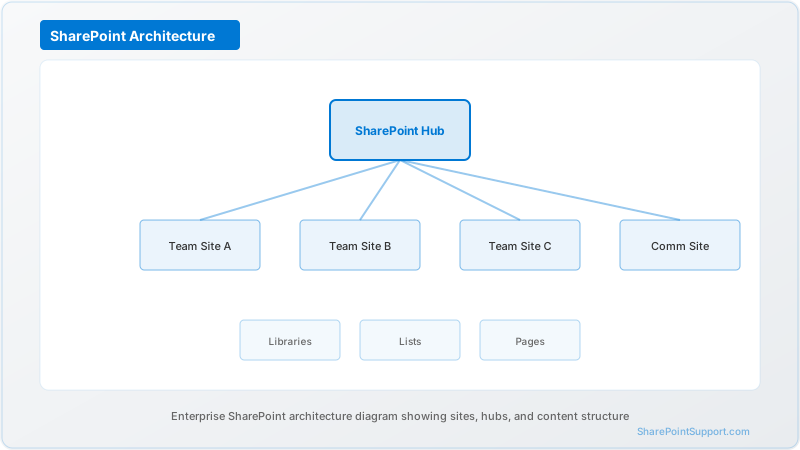
The key architectural insight is that SharePoint Embedded is not the same as SharePoint Online. Customers never see SharePoint sites, pages, or the SharePoint user interface. Instead, content sits in dedicated storage partitions inside Microsoft 365 tenants, accessible only through the ISV's application. The end user sees the ISV's user experience, while the ISV gets Microsoft's storage, search, e-discovery, retention, and compliance capabilities automatically.
This guide walks through the technical architecture, the business model, and the decision framework for when SharePoint Embedded is the right choice for a SaaS product.
The Architecture at a High Level
SharePoint Embedded introduces several new concepts that do not map to classic SharePoint.
Consuming Tenant and Owning Tenant
The consuming tenant is the Microsoft 365 tenant of the end customer. This is where the content physically lives, and it is subject to that tenant's compliance, retention, and governance policies. The owning tenant is the ISV's tenant, which hosts the application registration, billing, and policy configuration. The split between consuming and owning is what lets customer data remain in the customer's tenant while the ISV retains control over the application.
File Storage Container Types
File Storage Container Types are the ISV-defined schema that governs how storage is organized. An ISV registers a Container Type with Microsoft, specifies the billing model (pay-as-you-go metered to Azure), and then creates containers against that type. Each container is a content partition owned by the application.
Containers
Containers are the actual storage units. Each container holds files, folders, and associated metadata. Permissions are managed at the container level using Microsoft Entra identities. Containers are searchable, can have retention labels, and can be subject to eDiscovery through the consuming tenant's compliance tools.
Application Identity
SharePoint Embedded applications authenticate using Microsoft Entra application identities, typically with certificate-based authentication. The application acts with its own permissions, independent of any individual user. This separation is critical because it lets the application manage content lifecycle operations that would be awkward or impossible for a user identity.
The Business Model
The SharePoint Embedded business model changes the economics of building SaaS products that need content storage.
What the ISV Pays
ISVs pay Microsoft for storage and API consumption on a pay-as-you-go basis through Azure. The metering covers storage at rest, API calls, egress, and premium features. A typical mid-sized ISV with 10,000 active customers and moderate content volume might spend $25,000 to $150,000 per year on SharePoint Embedded consumption, with the exact number depending on document volume, retention patterns, and search usage.
What the Customer Gets
Customers get enterprise content storage that inherits their tenant's compliance posture. The content sits in their Microsoft 365 tenant, is subject to their data residency and sovereignty requirements, and is covered by their Microsoft 365 compliance and audit posture. This is a significantly different value proposition from ISV-hosted storage in the ISV's cloud account.
What the ISV Gets
ISVs get out-of-the-box content management features that would take 18 to 36 engineering months to build from scratch. Features like versioning, full-text search, virus scanning, eDiscovery, retention, and file preview are included. ISVs also get a compelling enterprise sales story because their product automatically passes most Microsoft-aligned procurement reviews.
When SharePoint Embedded Is the Right Choice
Based on deployments over the last two years, SharePoint Embedded is the right choice in four scenarios.
Scenario 1: Microsoft 365-Aligned Enterprise SaaS
Enterprise SaaS products sold into organizations that are already committed to Microsoft 365. Legal case management, contract lifecycle management, professional services automation, clinical document management, and loan origination are all fitting examples. Customers appreciate that content stays in their tenant, and ISVs avoid the cost of building and operating enterprise-grade storage.
Scenario 2: Compliance-Heavy Workloads
SaaS products that handle regulated data and need to meet HIPAA, FedRAMP, GDPR, SOC 2, or equivalent compliance requirements. SharePoint Embedded inherits the customer's Microsoft 365 compliance posture, which dramatically reduces the compliance burden on the ISV. Instead of proving compliance for the ISV's own cloud, the ISV relies on Microsoft's existing attestations.
Scenario 3: Document-Heavy Verticals
SaaS products where documents are a primary artifact. Real estate, insurance, legal, finance, and healthcare all fit this pattern. The combination of ISV workflow logic and Microsoft storage produces a stronger product than either component alone.
Scenario 4: ISVs Wanting to Reduce Storage Infrastructure
ISVs currently operating their own S3, Azure Blob, or Google Cloud Storage backends who want to reduce infrastructure complexity. Moving to SharePoint Embedded eliminates the need to operate storage infrastructure, handle compliance certifications for storage, and build customer-facing compliance tooling.
When SharePoint Embedded Is Not the Right Choice
SharePoint Embedded is not a fit for every product. The patterns where it does not work:
- Consumer SaaS products where end users do not have Microsoft 365 tenants
- Products requiring sub-100ms latency for individual file operations
- Products with simple, low-volume content needs where pay-as-you-go is more expensive than a small cloud storage bucket
- Products requiring deep integration with non-Microsoft ecosystems as the primary experience
- Products with aggressive data portability requirements that conflict with Microsoft's storage model
The Technical Build
A working SharePoint Embedded integration has five core components.
1. Application Registration
Register an application in Microsoft Entra ID, configure the necessary API permissions (FileStorageContainer.Selected, Sites.Selected, and optionally FileStorage.Selected), and generate a certificate for authentication. The application will act with application permissions rather than delegated user permissions.
2. Container Type Registration
Register a Container Type with Microsoft through the admin portal. The Container Type includes the application ID, the billing classification (standard or trial), and the default permissions. Container Type registration is a one-time operation per ISV application.
3. Consuming Tenant Onboarding
Each consuming tenant runs an onboarding PowerShell script that grants the ISV application permission to create containers in that tenant. This is typically done by the customer's global administrator during initial setup.
```powershell
# Customer-side onboarding script
# Run by customer's Global Administrator to authorize the ISV application
Install-Module -Name Microsoft.Online.SharePoint.PowerShell -Scope CurrentUser
Connect-SPOService -Url "https://customer-admin.sharepoint.com"
$containerTypeId = "a1b2c3d4-1234-5678-9abc-def012345678" # ISV-provided
$applicationId = "b2c3d4e5-2345-6789-abcd-ef0123456789" # ISV-provided
# Register the Container Type in the consuming tenant
Register-SPOContainerTypeConsumingApplication -ContainerTypeId $containerTypeId -AppId $applicationId -DelegatedPermission FullControl -ApplicationPermission FullControl
```
4. Container Lifecycle Operations
The application creates containers on demand, typically one container per customer workspace, project, or case. Containers can be activated, updated, deactivated, and permanently deleted through Microsoft Graph APIs.
```typescript
// Create a new container for a customer workspace
async function createWorkspaceContainer(workspaceId: string, displayName: string): Promise
const graphClient = getAuthenticatedGraphClient();
const response = await graphClient.api('/storage/fileStorage/containers').post({
displayName: displayName,
description: `Container for workspace ${workspaceId}`,
containerTypeId: CONTAINER_TYPE_ID,
});
// Activate the container so it can accept files
await graphClient.api(`/storage/fileStorage/containers/${response.id}/activate`).post({});
return response;
}
// Upload a file into a container
async function uploadFileToContainer(containerId: string, fileName: string, fileContent: ArrayBuffer): Promise
const graphClient = getAuthenticatedGraphClient();
return await graphClient
.api(`/storage/fileStorage/containers/${containerId}/drive/root:/${fileName}:/content`)
.put(fileContent);
}
```
5. File Operations via Microsoft Graph
Once containers exist, file operations use standard Microsoft Graph driveItem APIs. Upload, download, preview, search, share, and move operations all work through the same API surface that standard OneDrive and SharePoint use.
Governance and Compliance Considerations
Because SharePoint Embedded content lives in the customer's Microsoft 365 tenant, it inherits that tenant's governance and compliance posture. This creates both opportunity and responsibility.
The opportunity: ISVs get Microsoft 365 compliance for free. Customer content in SharePoint Embedded is automatically covered by the customer's existing Microsoft 365 compliance attestations, including FedRAMP, HIPAA BAA, SOC, and ISO certifications.
The responsibility: ISVs must design their applications to work correctly when customers apply strict governance policies. This includes retention labels that may block deletion, sensitivity labels that may restrict sharing, and DLP policies that may block uploads of certain content.
The Go-to-Market Story
ISVs that ship SharePoint Embedded-based products typically compete on three go-to-market angles.
First, customer data stays in the customer's Microsoft 365 tenant. This is a powerful story for enterprise security and compliance reviews. Customers do not have to approve new data residency exceptions, and the ISV does not have to build separate compliance stories for each geography.
Second, the product inherits the customer's existing compliance posture. A regulated customer with existing Microsoft 365 FedRAMP High authorization gets an ISV product that is automatically deployable in that environment, assuming the ISV application itself meets FedRAMP controls.
Third, the ISV product integrates naturally with the rest of the Microsoft 365 ecosystem. Documents created in the ISV product can be found through Microsoft Search, processed by Copilot, subject to the customer's existing retention rules, and surfaced in the customer's existing content insights.
Getting Started
SharePoint Embedded has a steep initial learning curve because the identity model, container concept, and billing are all new. The fastest path to production typically follows this timeline.
Weeks 1 to 4: Register the application, register a Container Type in trial mode, build a proof of concept that creates containers and uploads files. Validate the identity and permission model end to end.
Weeks 5 to 12: Build the production-grade container lifecycle management, integrate into the existing ISV product, and design the customer onboarding flow. Test with 3 to 5 friendly customer tenants.
Weeks 13 to 24: Move the Container Type to billable status, build the customer-facing billing model (if the ISV passes Microsoft costs through), and run a beta program with 20 to 50 customer tenants. Instrument telemetry for every container and API operation.
Weeks 25+: General availability, with ongoing investment in governance integration, retention-aware workflows, and sensitivity-label-aware features.
Our SharePoint specialists have supported ISVs building on SharePoint Embedded from initial architecture through production rollout. Contact our team to discuss a SharePoint Embedded readiness engagement, or explore our SharePoint consulting services for the full technical and go-to-market playbook.
Written by the SharePoint Support Team
Senior SharePoint Consultants | 25+ Years Microsoft Ecosystem Experience
Our senior SharePoint consultants bring deep expertise spanning 500+ enterprise migrations and compliance implementations across HIPAA, SOC 2, and FedRAMP environments. We cover SharePoint Online, Microsoft 365, migrations, Copilot readiness, and large-scale governance.
Expert SharePoint Services
Frequently Asked Questions
What is SharePoint Embedded?▼
How is SharePoint Embedded different from regular SharePoint Online?▼
Who pays for SharePoint Embedded storage and API usage?▼
Does SharePoint Embedded require customers to have Microsoft 365 licenses?▼
What permissions does a SharePoint Embedded application need?▼
Can SharePoint Embedded content be searched by Microsoft 365 Copilot?▼
How does compliance work with SharePoint Embedded?▼
Is SharePoint Embedded suitable for consumer applications?▼
Need Expert Help?
Our SharePoint consultants are ready to help you implement these strategies in your organization.
Continue Reading in Development
SPFx Web Part Development: Getting Started Guide
Build custom SharePoint web parts using the SharePoint Framework (SPFx). Learn setup, development patterns, and deployment best practices.
DevelopmentPower Apps Custom Forms for SharePoint
Transform SharePoint list forms with Power Apps to create dynamic, user-friendly experiences with validation, conditional logic, and custom layouts.
DevelopmentSharePoint SPFx Development Guide
Enterprise guide to SharePoint Framework (SPFx) development in 2026 covering project setup, web part architecture, API integration, deployment pipelines, and performance best practices.
DevelopmentSharePoint Custom Forms with Power Apps: Complete Guide
Build custom SharePoint forms using Power Apps. Covers form customization, conditional visibility, validation, cascading dropdowns, and mobile-responsive design.
DevelopmentSPFx + React 18 + Fluent UI v9: Modern Patterns
The SPFx stack has modernized significantly. A practical guide to building SharePoint Framework extensions with React 18, Fluent UI v9, TypeScript 5, and current performance patterns.
DevelopmentSharePoint Copilot Apps: The SPFx Web Part Migration Guide
SharePoint Copilot Apps enter public preview in July 2026 alongside SPFx v1.24. If you own a portfolio of SPFx web parts, here is the migration decision matrix and a code-shape example.