Financial Services: The Highest-Stakes SharePoint Deployment
Financial services organizations — broker-dealers, investment advisors, banks, insurance companies, and wealth management firms — operate under some of the strictest document retention and compliance requirements in any regulated industry. SharePoint Online deployments in financial services must address:
- SEC Rule 17a-4: Electronic records preservation requirements for broker-dealers
- FINRA Rule 4370: Business continuity and records preservation
- SOC 2 Type II: Trust service principles (security, availability, confidentiality)
- Gramm-Leach-Bliley Act (GLBA): Protection of customer financial information
- GDPR/CCPA: Privacy regulations for customer data
This guide covers the specific configurations required for SharePoint Online to meet these regulatory obligations.
SEC Rule 17a-4: WORM Records Requirements
SEC Rule 17a-4(f) requires broker-dealers to preserve electronic records in a non-rewriteable, non-erasable format (WORM — Write Once Read Many). This is one of the most stringent records requirements in financial services.
What SEC 17a-4 Requires
- Preservation period: 3-6 years depending on record type (generally 3 years accessible, 6 years total)
- WORM storage: Records cannot be altered or deleted during the retention period
- Index and access: Records must be indexed and accessible to regulators on demand
- Independent access: Third-party access to records (for firms using cloud storage)
- Automatic preservation: System must prevent manual deletion during retention period
Microsoft 365 / SharePoint 17a-4 Compliance
Microsoft provides an attestation letter from Cohasset Associates confirming Microsoft 365 meets SEC 17a-4(f) requirements when configured with:
- Microsoft Purview Regulatory Records: Apply "Regulatory Record" label — immutable, even admins cannot delete
- Azure Immutable Blob Storage: For archive/backup copies
- Microsoft 365 Audit log retention: Long-term audit retention (E5 + 10-year add-on)
```powershell
# Create regulatory record label (most restrictive — cannot be removed by anyone)
Connect-IPPSSession
New-ComplianceRetentionLabel `
-Name "SEC 17a-4 - Broker-Dealer Records - 6 Years" `
-RetentionAction KeepAndDelete `
-RetentionDuration 2190 ` # 6 years in days
-RetentionDurationDisplayHint Years `
-IsRecordLabel $true `
-IsRegulatoryLabel $true ` # Cannot be removed even by admins
-Notes "SEC Rule 17a-4(f): 6-year retention for broker-dealer records. Regulatory record - immutable."
```
WORM-Compliant Archive with Azure Immutable Storage
For a belt-and-suspenders approach, archive SharePoint content to Azure Blob Storage with immutability policies:
```powershell
# Configure Azure Blob Storage immutability policy
$resourceGroup = "compliance-rg"
$storageAccount = "finservrecords"
$container = "sec-17a4-archive"
# Create storage account with immutable storage support
New-AzStorageAccount -ResourceGroupName $resourceGroup `
-Name $storageAccount `
-Location "East US" `
-SkuName Standard_GRS `
-Kind StorageV2
# Set immutability policy on container (WORM)
Set-AzStorageBlobImmutabilityPolicy `
-BlobContainerName $container `
-Context (New-AzStorageContext -StorageAccountName $storageAccount -StorageAccountKey $key) `
-ImmutabilityPeriod 2190 ` # 6 years in days
-State "Unlocked" # Lock after testing, cannot be reversed
```
FINRA Rule 4370: Business Continuity Records
FINRA Rule 4370 requires member firms to maintain a Business Continuity Plan (BCP) and preserve records needed to resume operations during a disruption.
SharePoint BCP Requirements
- BCP documents must be accessible from a location outside the primary office (cloud = compliant)
- Employee emergency contact information must be current and accessible
- Critical customer account records must be accessible within 4 hours of a disruption
SharePoint Online (being cloud-based and geographically redundant) satisfies the accessibility requirements, but firms must document this in their BCP.
```
FINRA 4370 SharePoint Evidence Package (prepare for examination):
├── Business Continuity Plan document (SharePoint Communication Site)
├── Emergency contact directory (SharePoint list, accessible from any device)
├── Critical records inventory (SharePoint library - confirms records are in cloud)
├── Recovery procedures (SharePoint page with step-by-step access instructions)
└── Annual BCP review documentation (version history = audit trail)
```
SOC 2 Type II Controls for SharePoint
SOC 2 audits assess Trust Service Criteria (TSC). For SharePoint in scope, the most relevant criteria:
CC6: Logical Access Controls
CC6.1 — The entity implements logical access security software, infrastructure, and architectures over protected information:
- Evidence: SharePoint conditional access policies, MFA enforcement, Defender for Cloud Apps policies
- Configuration: `Set-SPOTenant -ConditionalAccessPolicy AllowLimitedAccess`
CC6.2 — Prior to issuing system credentials and allowing access:
- Evidence: SharePoint access request workflow (formal request → manager approval → IT provisioning)
- Configuration: Power Automate access request workflow with approval chain
CC6.3 — The entity authorizes, modifies, or removes access based on roles:
- Evidence: Azure AD group-based access reviews (Identity Governance), quarterly access review reports
- Configuration: Azure AD Access Reviews on SharePoint site security groups
```powershell
# Create quarterly access review for SharePoint site security groups
Connect-MgGraph -Scopes "AccessReview.ReadWrite.All"
New-MgIdentityGovernanceAccessReviewDefinition `
-DisplayName "Quarterly SharePoint Access Review - Finance Site" `
-DescriptionForAdmins "Review access to Finance SharePoint site" `
-Scope @{
"@odata.type" = "#microsoft.graph.accessReviewQueryScope"
Query = "/groups/{finance-sharepoint-group-id}/members"
} `
-Reviewers @(
@{Query = "/users/{finance-director-id}"; "@odata.type" = "#microsoft.graph.accessReviewReviewerScope"}
) `
-Settings @{
MailNotificationsEnabled = $true
ReminderNotificationsEnabled = $true
JustificationRequiredOnApproval = $true
AutoApplyDecisionsEnabled = $true
DefaultDecision = "Deny" # If reviewer doesn't respond, access is removed
InstanceDurationInDays = 14
Recurrence = @{
Range = @{Type = "numbered"; NumberOfOccurrences = 4}
Pattern = @{Type = "absoluteMonthly"; Interval = 3} # Quarterly
}
}
```
CC6.6 — The entity implements logical access security measures to protect against threats:
- Evidence: Microsoft Defender for Cloud Apps session policies for SharePoint, DLP policies
- Configuration: Defender for Cloud Apps conditional access app control for SharePoint
CC7: System Monitoring
CC7.2 — The entity monitors system components:
- Evidence: Alert policies active for SharePoint security events, monthly alert review documentation
- Configuration: See Audit Log guide for alert policy setup
```powershell
# Create SOC 2 required alerts for SharePoint
# Privileged access alert
New-ProtectionAlert `
-Name "SharePoint Admin Role Assigned" `
-Category DataAdministration `
-Severity High `
-Operation SiteCollectionAdminAdded `
-NotifyUser "[email protected]", "[email protected]"
# Bulk download alert (potential data exfiltration)
New-ProtectionAlert `
-Name "SharePoint Bulk Download - Potential Exfiltration" `
-Category ThreatManagement `
-Severity High `
-Operation FileDownloaded `
-Threshold 50 `
-TimeWindow 60 `
-NotifyUser "[email protected]"
```
GLBA Safeguards Rule for SharePoint
The Gramm-Leach-Bliley Act Safeguards Rule (16 CFR 314) requires financial institutions to implement security programs protecting "customer information."
For SharePoint, customer information (NPI — Non-Public Personal Information) includes:
- Customer names + financial account data
- SSNs + financial information
- Any personally identifiable information combined with financial information
SharePoint GLBA Configuration Checklist
- [ ] NPI-containing SharePoint sites identified and inventoried
- [ ] Sensitivity label "GLBA - Customer NPI" applied to NPI libraries
- [ ] DLP policy: detect SSN + financial account combinations, block external sharing
- [ ] Access restricted to employees with business need (minimum necessary)
- [ ] External sharing disabled for all NPI sites
- [ ] Audit logging with 6-year retention on NPI site access
- [ ] Conditional Access: NPI sites require managed device + MFA
- [ ] Annual risk assessment documents NPI in SharePoint
GLBA Customer NPI DLP Policy
```powershell
# GLBA NPI detection DLP policy for SharePoint
Connect-IPPSSession
New-DlpCompliancePolicy `
-Name "GLBA Customer NPI Protection" `
-SharePointLocation All `
-OneDriveLocation All
New-DlpComplianceRule `
-Policy "GLBA Customer NPI Protection" `
-Name "Block External Sharing of NPI" `
-ContentContainsSensitiveInformation @(
@{Name = "U.S. Social Security Number (SSN)"; minCount = "1"},
@{Name = "Credit Card Number"; minCount = "1"},
@{Name = "U.S. Bank Account Number"; minCount = "1"}
) `
-BlockAccess $true `
-BlockAccessScope PerUser `
-GenerateAlert $true `
-AlertProperties @{AggregationType = "PerPolicy"} `
-NotifyUser Owner `
-NotifyEmailMessage "GLBA NPI Detected: External sharing blocked per GLBA Safeguards Rule policy."
```
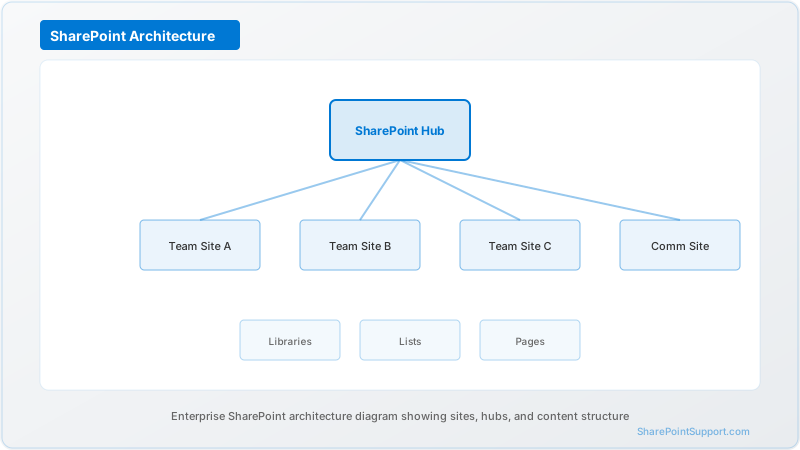
Financial Firm SharePoint Site Architecture
```
Financial Services SharePoint Environment
├── Corporate Hub
│ ├── Executive Communications (Comms Site)
│ ├── Corporate Policies (Team Site - restricted)
│ └── Board Materials (Team Site - executive only)
├── Compliance Hub
│ ├── Regulatory Filings (Team Site - SEC/FINRA records)
│ ├── Audit Documentation (Team Site - audit team only)
│ ├── Incident Reports (Team Site - compliance + legal)
│ └── AML/KYC Documentation (Team Site - compliance only)
├── Operations Hub
│ ├── Trade Operations (Team Site)
│ ├── Settlement Records (Team Site - WORM)
│ └── Client Account Records (Team Site - NPI protected)
├── HR Hub
│ ├── Employee Records (Team Site - HR only)
│ └── Benefits Administration (Team Site - HR only)
└── Client Portals Hub (external sharing enabled per site)
└── [Client Name] Portal (Communication Site - client external access)
```
Examination Readiness
Financial regulators (SEC, FINRA, OCC, CFPB) expect firms to produce records quickly during examination. Prepare:
- Records inventory: Maintain a catalog of all SharePoint sites with regulatory records, organized by rule/requirement
- Search capability: Verify compliance team can run Purview Content Search across all SharePoint locations within 2 hours
- Export procedure: Document step-by-step export process (format, timeframe, who executes)
- Legal hold procedure: Test that Legal Hold can be applied to a SharePoint site within 4 hours of request
- Mock examination drill: Conduct annual drill where compliance team simulates a FINRA examination request
Conclusion
SharePoint Online for financial services is viable for even the most regulated broker-dealers and investment advisors when configured with Microsoft Purview Regulatory Records, WORM-compliant archival, SOC 2 controls, and GLBA NPI protection. The key is configuring these controls proactively, before a regulatory examination or audit finds gaps.
Our team has deployed SOC 2 and SEC/FINRA compliant SharePoint environments for broker-dealers, investment advisors, private equity firms, and regional banks. Contact us for a financial services compliance assessment.
Need expert guidance? Contact our team to discuss your requirements, or explore our compliance consulting services to learn how we can help your organization.
Enterprise Implementation Best Practices
In our 25+ years of enterprise SharePoint consulting, we have designed governance frameworks for organizations spanning healthcare systems with 50,000 employees to financial services firms managing billions in assets. The governance implementations that succeed share a common trait: they balance control with enablement rather than defaulting to restriction.
- Start with a Governance Charter and Executive Sponsorship: Governance without executive backing fails. Secure a C-level sponsor who understands that governance protects the organization and enables productivity rather than restricting it. Document a governance charter that defines scope, authority, roles, decision-making processes, and escalation paths. This charter serves as the constitutional foundation for all governance decisions.
- Adopt a Tiered Governance Model: Not all sites require the same level of control. Classify your SharePoint sites into tiers based on data sensitivity and business criticality. Tier 1 sites containing regulated data require strict controls including mandatory sensitivity labels, restricted sharing, and quarterly access reviews. Tier 2 sites need moderate controls. Tier 3 sites for team collaboration operate with lighter governance to encourage adoption.
- Automate Policy Enforcement at Scale: Manual governance does not scale beyond a few dozen sites. Use Power Automate workflows to enforce naming conventions, trigger access reviews, notify site owners of policy violations, and manage content lifecycle automatically. Automation reduces IT workload while ensuring consistent policy application across thousands of sites.
- Create Self-Service Guardrails: Rather than requiring IT approval for every action, implement guardrails that guide users toward compliant behavior. Pre-approved site templates, managed metadata term sets, and sensitivity label recommendations allow business users to work independently while staying within governance boundaries.
- Establish a Governance Review Cadence: Review governance policies quarterly to account for new Microsoft 365 features, changing compliance requirements, and organizational growth. Conduct a comprehensive governance audit annually that includes permission analysis, storage utilization review, inactive site cleanup, and policy effectiveness measurement.
Governance and Compliance Considerations
Governance frameworks must satisfy the compliance requirements specific to your industry while remaining practical enough for daily operation. The most effective governance frameworks are those designed with regulatory compliance as a core requirement rather than an afterthought.
For HIPAA-regulated healthcare organizations, your governance framework must include specific controls for protected health information including access logging, minimum necessary access enforcement, encryption requirements, and business associate agreement tracking for any external sharing. Sensitivity labels should automatically apply encryption to documents containing PHI, and your retention policies must align with HIPAA's six-year minimum retention requirement.
Financial services organizations operating under SOC 2 need governance controls that demonstrate security, availability, processing integrity, confidentiality, and privacy of customer data. Your governance framework should map directly to SOC 2 trust service criteria, with automated evidence collection for audit readiness. SharePoint audit logs, access reviews, and change management records all serve as SOC 2 evidence.
Government agencies and contractors subject to FedRAMP or CMMC must implement governance controls satisfying federal security requirements including FIPS 140-2 compliant encryption, strict access controls based on security clearance levels, and comprehensive audit trails meeting NIST 800-53 control families.
Regardless of your specific regulatory environment, your governance framework should include data classification policies, retention schedules complying with applicable regulations, incident response procedures, and regular compliance assessments verifying controls function as designed. Working with experienced SharePoint governance consultants who understand your regulatory landscape ensures your framework addresses compliance from day one.
Ready to build a governance framework that protects your organization while enabling productivity? Our governance specialists have helped hundreds of enterprises design SharePoint governance programs that satisfy auditors and empower users. Contact our team for a complimentary governance assessment, and discover how our SharePoint consulting services can transform your compliance posture.
Common Challenges and Solutions
Organizations implementing SharePoint Financial Services consistently encounter obstacles that, if left unaddressed, undermine adoption and erode stakeholder confidence. Drawing on two decades of enterprise SharePoint consulting, these are the challenges we see most frequently and the proven approaches for overcoming them.
Challenge 1: Content Sprawl and Information Architecture Degradation
Over time, SharePoint Financial Services environments accumulate redundant, outdated, and trivial content that degrades search relevance and confuses users. Without proactive content lifecycle management, the signal-to-noise ratio deteriorates and user trust in the platform erodes. The resolution requires a structured approach: establishing automated retention policies that flag content for review after defined periods of inactivity, combined with content owner accountability structures that assign clear responsibility for each site collection and library. Organizations that address this proactively report 40 to 60 percent fewer support tickets within the first 90 days of deployment. Establishing a dedicated governance committee with representatives from IT, compliance, and business stakeholders ensures ongoing alignment between technical configuration and organizational objectives.
Challenge 2: Compliance and Audit Readiness Gaps
SharePoint Financial Services implementations in regulated industries often lack the audit trail depth and policy enforcement rigor required by frameworks such as HIPAA, SOC 2, and GDPR. Retroactive compliance remediation is significantly more expensive and disruptive than building compliance into the initial design. We recommend embedding compliance requirements into the information architecture from day one. Configure Microsoft Purview retention labels, DLP policies, and audit logging before deploying content, and validate compliance posture through regular internal audits. Tracking these metrics through SharePoint health dashboards provides early warning indicators that allow administrators to intervene before minor issues become systemic problems affecting enterprise-wide productivity.
Challenge 3: Inconsistent Governance Across Business Units
When different departments implement SharePoint Financial Services independently, inconsistent naming conventions, metadata schemas, and security configurations create silos that undermine cross-functional collaboration and complicate compliance reporting. The most effective mitigation strategy involves centralizing governance policy definition while allowing controlled flexibility at the departmental level. A hub-and-spoke governance model balances enterprise consistency with departmental autonomy. Enterprises operating in regulated industries such as healthcare and financial services must pay particular attention to this challenge because compliance violations carry significant financial and reputational consequences. Regular audits conducted quarterly at minimum help organizations maintain alignment with evolving regulatory requirements and internal policy updates.
Challenge 4: Migration and Legacy Content Complexity
Organizations transitioning legacy content into SharePoint Financial Services often underestimate the complexity of mapping old structures, metadata, and permissions to modern architectures. Failed migrations erode user confidence and create parallel systems that duplicate effort. Addressing this requires conducting thorough pre-migration content audits that classify and prioritize content based on business value. Invest in automated migration tools that preserve metadata fidelity and permission integrity while providing detailed validation reports. Organizations that invest in structured change management programs achieve adoption rates 35 percent higher than those relying on organic discovery alone. Executive sponsorship combined with department-level champions creates the organizational momentum necessary for sustained success.
Integration with Microsoft 365 Ecosystem
SharePoint Financial Services does not operate in isolation. Its value multiplies when connected to the broader Microsoft 365 ecosystem, creating unified workflows that eliminate context switching and reduce manual data transfer between applications.
Microsoft Teams Integration: Embed SharePoint Financial Services dashboards and document libraries as Teams tabs to create unified workspaces where conversations and structured content management coexist within a single interface. Teams channels automatically provision SharePoint document libraries, which means sharepoint financial services configurations and content flow seamlessly between collaborative conversations and structured document management. Users can surface SharePoint content directly within Teams tabs, reducing the friction that typically causes adoption to stall.
Power Automate Workflows: Implement scheduled flows that perform routine SharePoint Financial Services maintenance tasks including permission reports, content audits, and usage analytics without requiring manual intervention. Automated workflows triggered by SharePoint events such as document uploads, metadata changes, or approval completions eliminate repetitive manual tasks. Organizations typically automate 15 to 25 processes within the first quarter, saving an average of 8 hours per week per department. These automations also create audit trails that satisfy compliance requirements for regulated industries.
Power BI Analytics: Build executive dashboards that aggregate SharePoint Financial Services metrics alongside other business KPIs, providing a holistic view of digital workplace effectiveness and investment returns. Connecting SharePoint data to Power BI dashboards provides real-time visibility into content usage patterns, adoption metrics, and operational KPIs. Decision makers gain actionable intelligence without requiring manual report generation, enabling faster response to emerging trends and potential issues.
Microsoft Purview and Compliance: Implement retention policies that automatically manage SharePoint Financial Services content lifecycle, preserving business-critical records for required periods while disposing of transient content to reduce storage costs and compliance exposure. Sensitivity labels, data loss prevention policies, and retention schedules configured in Microsoft Purview extend automatically to sharepoint financial services content. This unified compliance framework ensures that governance policies apply consistently across the entire Microsoft 365 environment rather than requiring separate configuration for each workload. For organizations subject to HIPAA, SOC 2, or FedRAMP requirements, this integrated approach significantly reduces compliance management overhead.
Getting Started: Next Steps
Implementing SharePoint Financial Services effectively requires more than technical configuration. It demands a strategic approach grounded in your organization's specific business requirements, compliance obligations, and growth trajectory. The difference between a deployment that delivers measurable ROI and one that becomes shelfware often comes down to the quality of upfront planning and expert guidance.
Begin with a focused assessment of your current SharePoint environment. Evaluate your existing information architecture, permission structures, content lifecycle policies, and user adoption patterns. Identify gaps between your current state and the target state required for successful sharepoint financial services implementation. This assessment typically takes 2 to 4 weeks and produces a prioritized roadmap that aligns technical work with business outcomes.
Our SharePoint specialists have guided organizations across healthcare, financial services, government, and education through hundreds of successful implementations. We bring deep expertise in SharePoint architecture, governance frameworks, and compliance alignment that accelerates time to value while minimizing risk.
Ready to move forward? Contact our team for a complimentary consultation. We will assess your environment, identify quick wins, and develop a phased implementation plan tailored to your organization's needs and timeline. Whether you are starting from scratch or optimizing an existing deployment, our enterprise SharePoint consultants deliver the depth and accountability enterprise SharePoint work requires.
Written by the SharePoint Support Team
Senior SharePoint Consultants | 25+ Years Microsoft Ecosystem Experience
Our senior SharePoint consultants bring deep expertise spanning 500+ enterprise migrations and compliance implementations across HIPAA, SOC 2, and FedRAMP environments. We cover SharePoint Online, Microsoft 365, migrations, Copilot readiness, and large-scale governance.
Expert SharePoint Services
Frequently Asked Questions
Is SharePoint Online HIPAA compliant out of the box?▼
What compliance certifications does SharePoint Online hold?▼
How do we implement retention policies for regulatory compliance in SharePoint?▼
Can SharePoint meet FedRAMP requirements for government agencies?▼
What industry-specific SharePoint configurations are required for regulated organizations?▼
Need Expert Help?
Our SharePoint consultants are ready to help you implement these strategies in your organization.
Continue Reading in Industry
SharePoint for Government: FedRAMP, GCC High, and Microsoft 365 Government Deployment Guide
Deploy SharePoint in U.S. federal and state government environments. Covers Microsoft 365 GCC vs GCC High vs DoD, FedRAMP authorization, FISMA compliance, CUI handling, and ITAR/DFARS requirements.
IndustrySharePoint for Healthcare: HIPAA Compliance, ePHI Protection & Implementation Guide
Deploy SharePoint in healthcare environments with HIPAA compliance. Covers ePHI protection, audit controls, access management, DLP for PHI, Business Associate Agreements, and SharePoint for clinical use cases.
FeaturesMicrosoft Teams Channel Files & SharePoint: Best Practices
Master the Teams-SharePoint file relationship for enterprise use. Covers channel file organization, SharePoint document library structure, permission management, co-authoring, and governance for Teams files.
AI & CopilotMicrosoft Copilot for SharePoint Deployment
Step-by-step enterprise deployment guide for Microsoft Copilot in SharePoint — from licensing and prerequisites to governance, security, and measuring ROI.
GovernanceSharePoint Copilot Readiness: Data Governance Framework
A comprehensive data governance framework to prepare your SharePoint environment for Microsoft Copilot — covering permissions, content quality, sensitivity labels, and compliance.
AutomationPower Automate + SharePoint: 30 Workflow Automation Ideas
30 production-ready Power Automate workflows for SharePoint — from document approvals and metadata tagging to compliance monitoring and employee onboarding.