SharePoint for Remote Teams: Best Practices for Distributed Workforce
Remote and hybrid work fundamentally changed how employees interact with SharePoint. Teams that once relied on hallway conversations and shared physical file cabinets now depend on SharePoint as their primary collaboration hub. Getting this right is the difference between a productive remote team and a frustrated one.
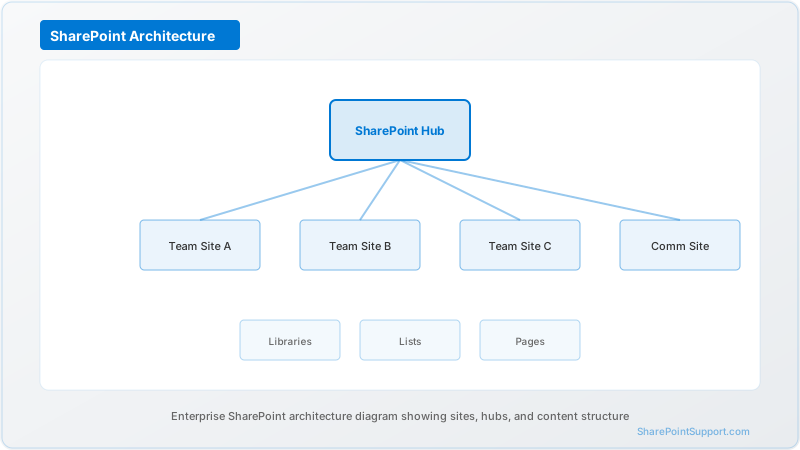
This guide covers practical SharePoint configurations and best practices for distributed workforces.
---
Structuring SharePoint for Remote Teams
Team Site vs. Communication Site for Remote Work
Team site (for collaboration):
- Created with every Microsoft Teams team
- Team members create, edit, and share documents here
- Files tab in Teams connects directly to the team site
- Internal to the team — not visible to the whole organization
Communication site (for broadcasting to remote workers):
- Company-wide announcements, policies, resources
- HR portal, IT help desk, benefits information
- News and leadership communications
- Accessible to all employees including remote workers
Best practice: Remote workers need both — team sites for their collaborative work, and a well-designed communication site (intranet) for company-wide information.
The Remote Worker's SharePoint Stack
A well-configured remote worker experience:
- Viva Connections (in Teams): The "home page" for company news, tools, and resources — accessible in Teams without visiting SharePoint directly
- Team site (via Teams Files): Files tab in each Teams channel links to the SharePoint document library — remote workers rarely need to leave Teams for document collaboration
- SharePoint for browser: For content search across the organization, finding policies, using forms
- OneDrive: Personal file storage and "sharing with specific people" scenarios
---
Document Collaboration for Remote Teams
Co-Authoring in SharePoint
SharePoint Online supports real-time co-authoring for Word, Excel, and PowerPoint:
- Two or more users can edit the same document simultaneously
- Changes appear in real time (or within seconds)
- No "file locked" errors (which plagued SharePoint on-premises)
Requirements: Files must be stored in SharePoint (not downloaded to desktop). Users must use Office apps connected to Microsoft 365 (not legacy Office 2016).
Best practice for remote teams: Train users to avoid downloading files. All editing should happen in the browser (Office on the web) or desktop Office apps connected to SharePoint — not downloaded copies.
Version History as Remote Work Safety Net
Remote work increases the risk of uncoordinated changes and accidental overwrites. Version history is essential:
- Configure 50-100 versions for active collaboration libraries
- Train users: if they overwrite your changes, you can restore the previous version yourself
- Alert users before deleting any document (Recycle Bin gives 93 days to recover)
Async Communication in Documents
Remote teams often can't synchronize schedules for real-time collaboration. Enable async document collaboration:
- @mention in documents: Type @ in a Word/Excel document to mention a colleague — they receive a notification
- Comments on documents: Leave comments that persist for async review
- SharePoint page comments: Enable comments on SharePoint pages for discussion without meetings
- Version notes: When checking in a document, leave a version note for async reviewers
---
Teams + SharePoint Integration for Remote Workers
The Teams + SharePoint integration is the most important configuration for remote worker productivity.
Files Tab Configuration
Every Teams channel has a Files tab backed by a SharePoint document library. Optimize it:
- Add shortcuts to frequently accessed document libraries (Add tab → SharePoint Pages)
- Create channel-specific folders in the default Documents library
- Configure column views: add Project, Status, Owner columns to the library view visible in Teams
Teams Meetings + SharePoint
Before meetings:
- Store meeting agenda in Teams channel SharePoint library → share link in calendar invite
- Meeting documents pre-loaded in channel for async review
After meetings:
- Meeting notes stored in Teams channel SharePoint library
- Action items tracked in Teams channel via shared OneNote or Microsoft Lists embedded in a tab
- Meeting recordings automatically saved to SharePoint (configure in Teams admin)
Teams Wiki vs. SharePoint Pages
Teams has a built-in Wiki (being retired) — avoid it for remote teams. Instead:
- Create a SharePoint communication site for team knowledge base
- Add as a tab in Teams channel: Add tab → Website → [SharePoint page URL]
- SharePoint pages are searchable, versionable, and accessible to people outside the Teams team
---
Remote Work Governance
Access From Anywhere
Remote workers access SharePoint from home networks, coffee shops, and personal devices. Governance requirements:
Conditional Access policy for unmanaged devices:
- Users on personal devices (not enrolled in Intune) → Web-only access
- No file download, no printing, no sync to local device
- Protects corporate data if personal device is compromised
Network-based restrictions (optional):
- If your organization requires VPN for SharePoint: Configure Named Locations in Entra ID
- Require VPN/corporate network for access to highest-sensitivity sites
- Allow unrestricted access to standard collaboration sites
OneDrive Sync for Remote Workers
OneDrive sync client allows SharePoint libraries to sync to local desktop — providing offline access.
Configure selective sync for remote workers:
- Libraries under 300GB can be synced
- Selective sync: choose which folders to sync (not entire library)
- Remote workers should sync "working documents" folder for offline access during travel or low-connectivity situations
Caution: Syncing large libraries to laptops creates data residency risks (sensitive data on unencrypted personal devices). Configure Information Protection policies in Purview to restrict syncing of sensitive-labeled content.
External Collaboration for Remote Teams
Remote teams frequently need to collaborate with external clients, vendors, and contractors:
For external collaboration, configure:
- Guest access policy: New and existing guests (with domain restriction to approved partner organizations)
- Specific people links: Default link type for sharing (not "Anyone" links)
- Guest link expiration: 30 days for time-limited collaborations
- Guest access review: Monthly review of active guest accounts
---
Measuring Remote Worker SharePoint Engagement
SharePoint Usage Analytics
SharePoint Admin Center → Reports → Usage:
- Unique users per site (are remote workers accessing the intranet?)
- File activity (are remote workers actually using SharePoint for documents?)
- Pages viewed (are news and communication pages reaching remote workers?)
Engagement benchmark for remote-heavy organizations:
- 80%+ of remote employees accessing SharePoint at least monthly
- Average 5+ page views per session (indicates engagement, not just landing page visits)
- 60%+ of company news viewed by remote employees within 7 days of publishing
Employee Experience Survey Questions
Include in your periodic employee survey:
- "I can easily find the documents and information I need to do my job" (target: 75%+ agree)
- "I feel connected to company news and updates even working remotely" (target: 70%+ agree)
- "The tools I use for file collaboration work reliably" (target: 80%+ agree)
---
Common Remote Work SharePoint Issues
Issue 1: "I can't find anything"
Solution: Configure search (ensure libraries have metadata), train on search operators, add prominent Quick Links web parts on team sites.
Issue 2: Duplicate copies of documents
Solution: Strict "no download" policy, co-authoring training, remove old documents regularly.
Issue 3: Remote workers not reading company news
Solution: Viva Connections in Teams → news appears in Teams without navigating to SharePoint; news digest email subscription.
Issue 4: Guest collaboration not working
Solution: Check conditional access policies — guest users often hit MFA requirements their identity provider doesn't support.
Issue 5: Sync conflicts from poor connectivity
Solution: Configure sync pause on low-bandwidth; use web browser for document editing when connectivity is poor.
---
Conclusion
SharePoint for remote teams isn't just about turning on collaboration features — it requires deliberate configuration of governance, access controls, Teams integration, and communication flows. Organizations that invest in this configuration see significantly better remote worker productivity, engagement, and security posture.
Our team has deployed SharePoint environments optimized for remote and hybrid workforces across industries. Contact us if you're facing specific remote work challenges with SharePoint.
Enterprise Implementation Best Practices for Remote and Hybrid Work
In our 25+ years managing enterprise SharePoint environments, the shift to remote and hybrid work has fundamentally changed how organizations must configure their collaboration platforms. Remote-optimized SharePoint deployments require deliberate design choices that in-office environments can overlook.
Configure Conditional Access policies that secure remote access without creating friction. Require MFA for all remote access, allow managed devices to access sensitive content while restricting unmanaged devices to browser-only access with download restrictions, and implement session timeout policies that balance security with usability. For HIPAA-regulated healthcare organizations with remote clinical staff, configure device compliance requirements that verify encryption, antivirus currency, and OS patch level before granting access to PHI libraries.
Establish asynchronous collaboration standards that reduce meeting dependency. Configure SharePoint pages as project status dashboards that team members update asynchronously. Use Loop components for collaborative document editing that maintains context across time zones. Implement structured communication channels through Teams channels linked to SharePoint sites so that decisions and discussions are documented and searchable rather than lost in email threads.
Monitor remote worker engagement through SharePoint analytics, Viva Insights metrics, and regular pulse surveys. Track content creation and collaboration activity to identify teams or individuals who may be disengaging. Ensure that SharePoint support coverage includes remote worker assistance during extended hours to accommodate distributed time zones. Contact our team for a remote work optimization assessment and discover how our SharePoint consulting services can enhance your distributed workforce's productivity.
Common Challenges and Solutions
Organizations implementing SharePoint Remote Teams consistently encounter obstacles that, if left unaddressed, undermine adoption and erode stakeholder confidence. Drawing on two decades of enterprise SharePoint consulting, these are the challenges we see most frequently and the proven approaches for overcoming them.
Challenge 1: Content Sprawl and Information Architecture Degradation
Over time, SharePoint Remote Teams environments accumulate redundant, outdated, and trivial content that degrades search relevance and confuses users. Without proactive content lifecycle management, the signal-to-noise ratio deteriorates and user trust in the platform erodes. The resolution requires a structured approach: establishing automated retention policies that flag content for review after defined periods of inactivity, combined with content owner accountability structures that assign clear responsibility for each site collection and library. Organizations that address this proactively report 40 to 60 percent fewer support tickets within the first 90 days of deployment. Establishing a dedicated governance committee with representatives from IT, compliance, and business stakeholders ensures ongoing alignment between technical configuration and organizational objectives.
Challenge 2: Compliance and Audit Readiness Gaps
SharePoint Remote Teams implementations in regulated industries often lack the audit trail depth and policy enforcement rigor required by frameworks such as HIPAA, SOC 2, and GDPR. Retroactive compliance remediation is significantly more expensive and disruptive than building compliance into the initial design. We recommend embedding compliance requirements into the information architecture from day one. Configure Microsoft Purview retention labels, DLP policies, and audit logging before deploying content, and validate compliance posture through regular internal audits. Tracking these metrics through SharePoint health dashboards provides early warning indicators that allow administrators to intervene before minor issues become systemic problems affecting enterprise-wide productivity.
Challenge 3: Inconsistent Governance Across Business Units
When different departments implement SharePoint Remote Teams independently, inconsistent naming conventions, metadata schemas, and security configurations create silos that undermine cross-functional collaboration and complicate compliance reporting. The most effective mitigation strategy involves centralizing governance policy definition while allowing controlled flexibility at the departmental level. A hub-and-spoke governance model balances enterprise consistency with departmental autonomy. Enterprises operating in regulated industries such as healthcare and financial services must pay particular attention to this challenge because compliance violations carry significant financial and reputational consequences. Regular audits conducted quarterly at minimum help organizations maintain alignment with evolving regulatory requirements and internal policy updates.
Challenge 4: Migration and Legacy Content Complexity
Organizations transitioning legacy content into SharePoint Remote Teams often underestimate the complexity of mapping old structures, metadata, and permissions to modern architectures. Failed migrations erode user confidence and create parallel systems that duplicate effort. Addressing this requires conducting thorough pre-migration content audits that classify and prioritize content based on business value. Invest in automated migration tools that preserve metadata fidelity and permission integrity while providing detailed validation reports. Organizations that invest in structured change management programs achieve adoption rates 35 percent higher than those relying on organic discovery alone. Executive sponsorship combined with department-level champions creates the organizational momentum necessary for sustained success.
Integration with Microsoft 365 Ecosystem
SharePoint Remote Teams does not operate in isolation. Its value multiplies when connected to the broader Microsoft 365 ecosystem, creating unified workflows that eliminate context switching and reduce manual data transfer between applications.
Microsoft Teams Integration: SharePoint Remote Teams content surfaces directly in Teams channels through embedded tabs and adaptive cards, giving team members instant access to relevant documents and dashboards without leaving their collaborative workspace. Teams channels automatically provision SharePoint document libraries, which means sharepoint remote teams configurations and content flow seamlessly between collaborative conversations and structured document management. Users can surface SharePoint content directly within Teams tabs, reducing the friction that typically causes adoption to stall.
Power Automate Workflows: Build approval workflows that route SharePoint Remote Teams content through structured review chains, automatically notifying approvers and escalating overdue items to maintain process velocity. Automated workflows triggered by SharePoint events such as document uploads, metadata changes, or approval completions eliminate repetitive manual tasks. Organizations typically automate 15 to 25 processes within the first quarter, saving an average of 8 hours per week per department. These automations also create audit trails that satisfy compliance requirements for regulated industries.
Power BI Analytics: Visualize SharePoint Remote Teams usage patterns and adoption metrics through Power BI dashboards that update automatically, giving leadership real-time visibility into platform health and user engagement. Connecting SharePoint data to Power BI dashboards provides real-time visibility into content usage patterns, adoption metrics, and operational KPIs. Decision makers gain actionable intelligence without requiring manual report generation, enabling faster response to emerging trends and potential issues.
Microsoft Purview and Compliance: Apply sensitivity labels to SharePoint Remote Teams content automatically based on classification rules, ensuring that confidential and regulated information receives appropriate protection throughout its lifecycle. Sensitivity labels, data loss prevention policies, and retention schedules configured in Microsoft Purview extend automatically to sharepoint remote teams content. This unified compliance framework ensures that governance policies apply consistently across the entire Microsoft 365 environment rather than requiring separate configuration for each workload. For organizations subject to HIPAA, SOC 2, or FedRAMP requirements, this integrated approach significantly reduces compliance management overhead.
Getting Started: Next Steps
Implementing SharePoint Remote Teams effectively requires more than technical configuration. It demands a strategic approach grounded in your organization's specific business requirements, compliance obligations, and growth trajectory. The difference between a deployment that delivers measurable ROI and one that becomes shelfware often comes down to the quality of upfront planning and expert guidance.
Begin with a focused assessment of your current SharePoint environment. Evaluate your existing information architecture, permission structures, content lifecycle policies, and user adoption patterns. Identify gaps between your current state and the target state required for successful sharepoint remote teams implementation. This assessment typically takes 2 to 4 weeks and produces a prioritized roadmap that aligns technical work with business outcomes.
Our SharePoint specialists have guided organizations across healthcare, financial services, government, and education through hundreds of successful implementations. We bring deep expertise in SharePoint architecture, governance frameworks, and compliance alignment that accelerates time to value while minimizing risk.
Ready to move forward? Contact our team for a complimentary consultation. We will assess your environment, identify quick wins, and develop a phased implementation plan tailored to your organization's needs and timeline. Whether you are starting from scratch or optimizing an existing deployment, our enterprise SharePoint consultants deliver the depth and accountability enterprise SharePoint work requires.
Written by the SharePoint Support Team
Senior SharePoint Consultants | 25+ Years Microsoft Ecosystem Experience
Our senior SharePoint consultants bring deep expertise spanning 500+ enterprise migrations and compliance implementations across HIPAA, SOC 2, and FedRAMP environments. We cover SharePoint Online, Microsoft 365, migrations, Copilot readiness, and large-scale governance.
Expert SharePoint Services
Frequently Asked Questions
How does SharePoint integrate with Microsoft Teams?▼
What are the benefits of integrating Power BI with SharePoint?▼
How do we manage permissions across integrated Microsoft 365 services?▼
Can SharePoint integrate with non-Microsoft applications?▼
How do we evaluate SharePoint against competing platforms?▼
Need Expert Help?
Our SharePoint consultants are ready to help you implement these strategies in your organization.
Continue Reading in Strategy
SharePoint Information Architecture: Design Guide Success
Design a SharePoint information architecture that scales. Covers site topology, hub sites, content types, navigation, metadata taxonomy, and governance principles for enterprise deployments.
StrategySharePoint Digital Transformation Roadmap
Build a SharePoint-centered digital transformation roadmap for your enterprise. Covers assessment, maturity model, phased implementation, change management, ROI measurement, and executive alignment strategies.
StrategySharePoint Training Program Design Guide
Design and implement an effective SharePoint training program for your enterprise, covering role-based curricula, delivery methods, adoption metrics, and ongoing enablement strategies for 2026.
StrategySharePoint Online vs On-Premises: Which Is Right?
Objective comparison of SharePoint Online and On-Premises for 2026 covering TCO, security, compliance, hybrid options, and decision criteria.
StrategySharePoint Online to Premium: Migration Framework
When does upgrading to SharePoint Premium (formerly Syntex) actually pay off? A decision framework covering licensing, AI readiness, governance, and ROI for 2026.
StrategySharePoint Premium Pricing 2026: Is Pay-As-You-Go Worth It?
Real 2026 cost math for SharePoint Premium (formerly Syntex): feature-by-feature pricing, ROI at 10K/100K/1M pages per month, and the buy vs build vs Copilot decision tree.