Where Hub Site Design Breaks at Scale
Hub sites are one of the most useful modern SharePoint capabilities. They let administrators group sites, share navigation, inherit branding, and roll up news and content across business units. For small to mid-sized organizations with 20 to 50 sites, the default hub site design works beautifully with minimal engineering.
For enterprises with 500, 2,000, or 10,000 sites, the default approach collapses. The 2,000-hub-per-tenant limit becomes real. Navigation becomes an unmaintainable mess. Hub associations drift. Permission boundaries blur. Performance degrades. The patterns that worked at 50 sites become liabilities at 500.
This guide is about the architecture patterns that actually work at enterprise scale. It is written for SharePoint architects, platform owners, and IT leaders who are designing for 500 to 10,000 sites and need a model that scales without falling over. If you are designing your first hub architecture or need to review the fundamentals, start with our SharePoint hub sites complete guide before diving into the at-scale patterns here.
The Core Constraints to Design Around
Before designing anything, you need to understand the technical constraints that shape the solution space.
The 2,000 Hub Limit
A single Microsoft 365 tenant supports a maximum of 2,000 hub sites. Every hub counts, including pilot hubs, test hubs, and unused hubs that were never decommissioned. In most enterprises this limit is comfortable, but organizations with thousands of project-based or short-lived sites can approach it faster than expected.
Hub Nesting
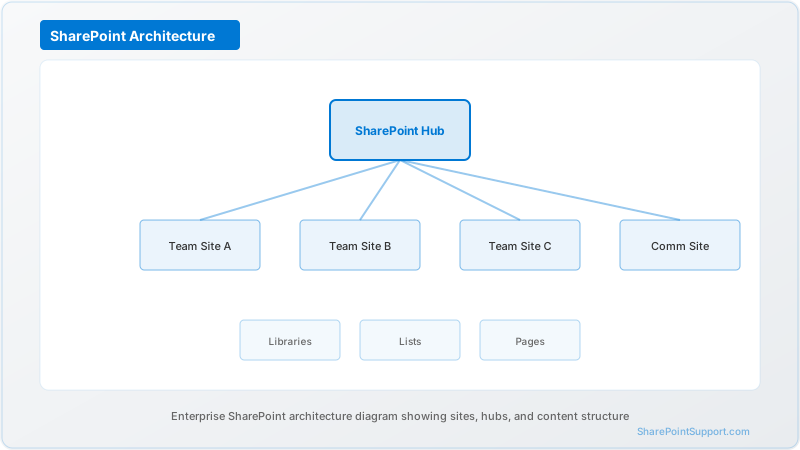
A site can only be associated with one hub at a time. However, hubs can be nested. One hub can be associated with another hub, creating a tree of hubs that share navigation and branding cascades. Hub nesting is the primary scalability mechanism for large enterprises.
Navigation Limits
Hub navigation supports up to 500 links in the megamenu layout and up to 100 in the cascading layout. Three levels of navigation depth are supported. Any attempt to represent an entire large organization in a single flat hub navigation will run into these limits and, more importantly, become unusable for employees long before the technical limit is hit.
Search Scope
Hub search is scoped to the hub and its associated sites. Queries that need to span hubs rely on tenant search. This affects how discoverability is designed across hub boundaries.
The Four Scalable Architecture Patterns
Four architecture patterns have emerged as the go-to designs for large enterprises.
Pattern 1: Functional Pyramid
The functional pyramid organizes hubs by business function. A single enterprise hub sits at the top, connected to functional hubs for HR, Finance, IT, Legal, Operations, and so on. Each functional hub has a small number of child hubs for major sub-functions. Operational sites live under the functional hubs.
This pattern works when the organization has clear functional boundaries and the functional leaders are willing to own hub-level governance. The pattern struggles when functional boundaries are fuzzy or when matrix structures mean sites legitimately belong to multiple functional hubs.
Pattern 2: Geographic Pyramid
The geographic pyramid organizes hubs by geographic entity. A global hub sits at the top, connected to regional hubs (Americas, EMEA, APAC), which are connected to country hubs, which are connected to site hubs. This pattern is common in multinational organizations with strong regional operating models.
The pattern works when the organization thinks geographically and when regional leaders have operational autonomy. It struggles when global functions (for example, a single HR function operating worldwide) do not map cleanly to regions.
Pattern 3: Hybrid Functional-Geographic
The hybrid functional-geographic pattern uses one primary hierarchy for the main navigation and the other as a cross-cutting discoverability layer. For example, navigation follows business function, while a geographic dimension is represented through site metadata, hub association audiences, and cross-hub news rollups.
This pattern is the most common in large enterprises because most organizations have both dimensions. The complexity is worth the cost because it matches how employees actually think about their work.
Pattern 4: Lifecycle Tiered
The lifecycle tiered pattern creates hubs that align with content lifecycle. Strategic content sits in permanent hubs. Project content sits in time-limited hubs that are decommissioned when the project ends. Personal or experimental content sits outside the hub structure entirely.
This pattern is powerful for organizations with heavy project-based work because it creates natural content retirement events and prevents the uncontrolled growth of permanent hubs.
Governance Model for Hub Sprawl Prevention
The single biggest risk in large-scale hub environments is hub sprawl. Unused, duplicate, or zombie hubs accumulate until the architecture becomes unmaintainable. A working governance model has five components.
1. Hub Registration Process
Every new hub goes through a registration process that documents the purpose, owner, target audience, success metrics, and retirement criteria. Registration creates an entry in a hub catalog that is reviewed quarterly.
2. Hub Owner Accountability
Each hub has a named primary owner and a secondary owner. Owners are responsible for navigation maintenance, content quality, access reviews, and making the decommission decision when the hub is no longer valuable.
3. Quarterly Hub Reviews
Every hub above a minimum threshold is reviewed quarterly. The review covers active user counts, content freshness, navigation accuracy, and continued business relevance. Hubs that fail the review are either remediated or decommissioned.
4. Automated Health Checks
A scheduled PowerShell job runs weekly to surface hubs with zero new content in 90 days, hubs with broken navigation links, hubs with owner accounts that no longer exist, and hubs approaching capacity limits. The output feeds a hub health dashboard that hub owners and platform administrators monitor.
```powershell
# Weekly hub health assessment
Connect-SPOService -Url "https://contoso-admin.sharepoint.com"
$allHubs = Get-SPOHubSite
$results = @()
foreach ($hub in $allHubs) {
$hubSite = Get-SPOSite -Identity $hub.SiteUrl
$associatedSiteCount = (Get-SPOSite -Limit All | Where-Object { $_.HubSiteId -eq $hub.ID }).Count
$results += [PSCustomObject]@{
HubTitle = $hub.Title
HubUrl = $hub.SiteUrl
PrimaryOwner = $hubSite.Owner
AssociatedSites = $associatedSiteCount
LastContentModified = $hubSite.LastContentModifiedDate
StorageUsageGB = [math]::Round($hubSite.StorageUsageCurrent / 1024, 2)
DaysSinceContentChange = (New-TimeSpan -Start $hubSite.LastContentModifiedDate -End (Get-Date)).Days
HealthFlag = if ((New-TimeSpan -Start $hubSite.LastContentModifiedDate -End (Get-Date)).Days -gt 90 -and $associatedSiteCount -lt 3) { "Review" } else { "OK" }
}
}
$results | Export-Csv -Path "D:\HubHealth\HubHealth_$(Get-Date -Format 'yyyyMMdd').csv" -NoTypeInformation
$results | Where-Object { $_.HealthFlag -eq "Review" } | Format-Table -AutoSize
```
5. Decommission Playbook
Decommissioning a hub is a specific process that includes reassociating child sites to another hub (or disassociating them), redirecting navigation links, archiving the hub's content, and formally unregistering the hub. Without a decommission playbook, retired hubs linger as zombies that erode the architecture.
Navigation Design at Scale
Hub navigation is the user experience of the architecture. At 500+ sites, navigation design matters more than any other single factor.
Audience Targeting
Every navigation link should be audience-targeted. A global employee does not need to see links only relevant to a specific region, function, or role. Audience targeting reduces cognitive load and makes the navigation feel personal rather than overwhelming.
Megamenu Structure
Use the megamenu layout for navigation with more than 8 top-level items. The megamenu supports up to 500 links across three levels of nesting. Plan the structure around user tasks, not internal org structure.
Search-First Wayfinding
In environments with 1,000+ sites, navigation cannot represent every destination. Design the experience around search as the primary wayfinding mechanism, with navigation serving as structured paths for the top 50 to 100 destinations.
Cross-Hub News Rollups
Use the News web part with site filters and audience targeting to create cross-hub news rollups on the top-level enterprise hub. This creates organizational coherence without requiring users to navigate to each functional hub to find relevant news.
Provisioning Automation
At 500+ sites, manual site provisioning is not viable. Automation is a non-negotiable requirement.
The standard automation pattern uses a request form (Microsoft Forms or a Power Apps canvas app), routes requests through Power Automate for approval and validation, provisions the site using PnP PowerShell or Microsoft Graph, applies the appropriate hub association, and publishes a confirmation to the requester. The entire workflow takes less than 10 minutes from request to ready-to-use site.
```powershell
# Provisioning automation called from Power Automate
param(
[string]$SiteTitle,
[string]$SiteAlias,
[string]$OwnerEmail,
[string]$BusinessFunction,
[string]$Region,
[string]$Classification
)
Connect-PnPOnline -Url "https://contoso-admin.sharepoint.com" -Interactive
# Determine target hub based on business function
$targetHubUrl = switch ($BusinessFunction) {
"Finance" { "https://contoso.sharepoint.com/sites/finance-hub" }
"HR" { "https://contoso.sharepoint.com/sites/hr-hub" }
"IT" { "https://contoso.sharepoint.com/sites/it-hub" }
default { "https://contoso.sharepoint.com/sites/enterprise-hub" }
}
# Create the site
$newSiteUrl = New-PnPSite -Type TeamSite -Title $SiteTitle -Alias $SiteAlias -Owner $OwnerEmail -Wait
# Apply site template with classification and metadata
$templateParams = @{Classification=$Classification; Region=$Region}
Invoke-PnPSiteTemplate -Url $newSiteUrl -Path "D:\Templates\BusinessUnitSite.pnp" -Parameters $templateParams
# Associate with target hub
Add-PnPHubSiteAssociation -Site $newSiteUrl -HubSite $targetHubUrl
Write-Output "Provisioned: $newSiteUrl associated with $targetHubUrl"
```
Performance Considerations
At scale, performance becomes a first-class architectural concern.
Navigation Caching
The hub navigation is cached at the page level. Large megamenus with many links require careful performance testing. Navigation that loads in 1.5 seconds for 50 sites can take 4 to 6 seconds at 500 sites if it is poorly designed.
News Rollup Performance
The News web part aggregates news across associated sites. At scale, the web part should filter by a specific hub, time range, and audience to keep query load manageable. Unbounded queries across 500 sites produce slow page loads.
Search Query Optimization
Hub search queries should use specific managed properties rather than free-text search whenever possible. Well-indexed queries return in under 200ms. Free-text queries can take 2 to 5 seconds at scale.
Reporting and Observability
Large hub environments need dedicated observability. The standard reporting set:
- Hub catalog with owner, purpose, associated site count, last activity
- Hub health report with navigation errors, broken links, and orphaned hubs
- Hub traffic report with weekly active users per hub
- Cross-hub audience analysis showing which hubs are popular across which business units
- Hub capacity forecast projecting when the tenant will approach the 2,000 hub limit
These reports typically run on a weekly cadence and feed a Power BI dashboard that platform owners monitor.
The Strategic Takeaway
Hub site architecture at 500+ sites is not a more complex version of hub design at 50 sites. It is a different discipline that requires explicit design decisions around hierarchy, governance, navigation, automation, and observability. The organizations that scale cleanly treat the hub architecture as a product with owners, metrics, and a roadmap, rather than as a one-time configuration exercise.
Our SharePoint specialists have designed and operated hub architectures for enterprises with 2,000+ sites across healthcare, finance, and professional services. Contact our team to scope a hub architecture engagement, or review our SharePoint consulting services for the full methodology.
Written by the SharePoint Support Team
Senior SharePoint Consultants | 25+ Years Microsoft Ecosystem Experience
Our senior SharePoint consultants bring deep expertise spanning 500+ enterprise migrations and compliance implementations across HIPAA, SOC 2, and FedRAMP environments. We cover SharePoint Online, Microsoft 365, migrations, Copilot readiness, and large-scale governance.
Expert SharePoint Services
Frequently Asked Questions
What is the maximum number of hub sites in a Microsoft 365 tenant?▼
Can a SharePoint site be associated with multiple hubs?▼
How many levels of hub nesting does SharePoint support?▼
What is the navigation link limit for hub sites?▼
How do we prevent hub sprawl in a large enterprise?▼
Should we organize hubs by business function or by geography?▼
How do we handle hub navigation performance at scale?▼
Can we automate SharePoint site provisioning at scale?▼
Need Expert Help?
Our SharePoint consultants are ready to help you implement these strategies in your organization.
Continue Reading in Architecture
SharePoint Online Limits in 2026: What Actually Breaks at Scale
Everyone can recite the 5,000-item threshold. Almost nobody can tell you what genuinely fails first in a large tenant — and in 2026 the answer changed, because agents and Copilot now query your lists too.
ArchitectureSharePoint Hub Sites: Building Connected Experiences
Design an effective hub site architecture that connects related sites, shares navigation, and creates a cohesive experience across your SharePoint environment.
ArchitectureSharePoint Site Collections: Best Practices
Understand SharePoint site collection architecture with best practices for planning, creating, and managing site collections in your Microsoft 365 environment.
ArchitectureSharePoint Information Architecture Guide
Design a scalable SharePoint information architecture with hub sites, metadata taxonomy, navigation patterns, and governance frameworks that serve enterprise organizations for years.
ArchitectureSharePoint Hub Sites: Architecture Guide for 2026
Design and implement SharePoint hub sites that unify navigation, branding, search, and governance across your enterprise. Covers hub planning, association strategies, and real-world architecture patterns.
ArchitecturePower Pages vs SharePoint Sites: When to Use Each
Power Pages and SharePoint Communication Sites both publish content, but they solve different problems. A decision framework for choosing the right platform.