SharePoint Migration Checklist for IT Managers: 80-Point Pre-Migration Guide
Migration failures are almost always preventable. In 25+ years of SharePoint migrations, the difference between a smooth migration and a disaster comes down to preparation. This 80-point checklist covers every critical step from initial discovery through post-migration validation.
---
Phase 1: Discovery & Inventory (Pre-Planning)
Current State Analysis
- [ ] 1. Document all source systems (SharePoint on-premises version, file shares, Google Drive, Box)
- [ ] 2. Run SharePoint Inventory Tool or AvePoint assessment — capture all site collections, sizes, and document counts
- [ ] 3. Identify sites with custom code, custom web parts, or InfoPath forms
- [ ] 4. Document all third-party SharePoint add-ins and their migration paths
- [ ] 5. Identify SharePoint workflows (SharePoint Designer, Nintex, K2) and modernization requirements
- [ ] 6. Capture all site collection administrators and site owners
- [ ] 7. Document external users with access to SharePoint sites
- [ ] 8. Identify any sites under legal hold or regulatory retention requirements
- [ ] 9. Assess content age — documents not accessed in 3+ years may be candidates for archival vs. migration
- [ ] 10. Calculate total data volume (GB) for migration timeline planning
Target State Planning
- [ ] 11. Map source structure to SharePoint Online information architecture
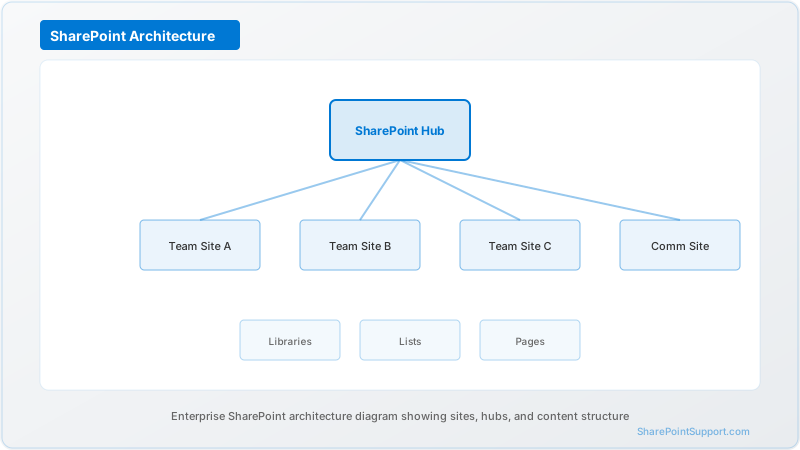
- [ ] 12. Design hub site architecture for target environment
- [ ] 13. Identify content types and metadata to be created in target
- [ ] 14. Plan managed metadata / term store structure
- [ ] 15. Define naming conventions for sites, libraries, and URLs
- [ ] 16. Confirm Microsoft 365 licenses are provisioned for all users
- [ ] 17. Verify SharePoint Online storage quota is sufficient for migrated content
- [ ] 18. Decide on migration approach: big bang vs. phased vs. hybrid (parallel operation)
---
Phase 2: Pre-Migration Preparation
Governance & Policy
- [ ] 19. Establish site provisioning policy for SharePoint Online (who can create sites)
- [ ] 20. Define external sharing policy before migration (don't import sharing settings from legacy)
- [ ] 21. Configure sensitivity labels in Microsoft Purview before migrating sensitive content
- [ ] 22. Set up retention labels and policies in Purview before migration
- [ ] 23. Document data loss prevention (DLP) policies required in target
- [ ] 24. Define and communicate data classification standards to stakeholders
Technical Preparation
- [ ] 25. Provision all target site collections and hub sites before migration begins
- [ ] 26. Configure SharePoint permissions model (Groups, members, visitors) on all target sites
- [ ] 27. Test authentication (MFA, Conditional Access) for all user populations including field workers
- [ ] 28. Confirm network bandwidth is sufficient — assess peak migration impact on business operations
- [ ] 29. Schedule maintenance windows and communicate to affected users
- [ ] 30. Set up migration tooling (SPMT, ShareGate, Metalogix, or Mover)
- [ ] 31. Create service account for migration tool with required permissions
- [ ] 32. Test migration tool connectivity to source and destination
- [ ] 33. Run a pilot migration on 10-50GB of non-critical content to validate tooling
Content Cleanup (Critical — Often Skipped)
- [ ] 34. Delete or archive content not accessed in 5+ years (reduces migration volume)
- [ ] 35. Remove duplicate files identified by inventory tooling
- [ ] 36. Resolve broken links and orphaned content
- [ ] 37. Empty Recycle Bins in source environment (reduces migration volume)
- [ ] 38. Archive or delete SharePoint Designer workflows that will not be migrated
- [ ] 39. Complete any in-progress content edits before scheduling cutover
---
Phase 3: Migration Execution
Pilot Migration
- [ ] 40. Select pilot group: 50-100 users from diverse departments and roles
- [ ] 41. Migrate pilot content to target SharePoint Online
- [ ] 42. Validate file count, file sizes, and metadata preservation in target
- [ ] 43. Test pilot user access — verify permissions migrated correctly
- [ ] 44. Test search: key documents should be findable via search
- [ ] 45. Test Office app integration: Word/Excel files should open from SharePoint
- [ ] 46. Test OneDrive sync client connectivity
- [ ] 47. Test SharePoint mobile app access
- [ ] 48. Collect pilot user feedback — identify usability issues before broad rollout
- [ ] 49. Identify and resolve any blockers discovered in pilot
Pre-Cutover Activities
- [ ] 50. Communicate migration schedule to all affected users (2 weeks minimum advance notice)
- [ ] 51. Create user guides and training materials for SharePoint Online
- [ ] 52. Schedule training sessions — live and recorded
- [ ] 53. Set up IT helpdesk ticketing category for migration issues
- [ ] 54. Verify IT support team is trained on common SharePoint Online issues
- [ ] 55. Confirm rollback plan: what happens if migration fails (read-only source access, timeline)
- [ ] 56. Brief senior stakeholders on go-live date and expected disruption window
Migration Execution
- [ ] 57. Start migration during off-peak hours (nights/weekends for large volumes)
- [ ] 58. Monitor migration progress in real time — track items migrated, errors, and warnings
- [ ] 59. Log all migration errors for post-migration remediation
- [ ] 60. For large migrations: migrate in batches by department or site type
- [ ] 61. Verify item counts after each batch before proceeding to next
- [ ] 62. For content under legal hold: verify preservation in target before cutting over
- [ ] 63. Send "your content is being migrated" notification to users at migration start
- [ ] 64. Configure SharePoint Online permissions matching source permissions before cutover
---
Phase 4: Cutover & Post-Migration
Cutover Checklist
- [ ] 65. Final delta migration: capture any changes made during migration window
- [ ] 66. Set source environment to read-only to prevent new changes
- [ ] 67. Validate final item counts in target match source (within acceptable variance)
- [ ] 68. Update all internal links (intranet, HR portals, email signatures) to new SharePoint Online URLs
- [ ] 69. Update SharePoint URL references in any applications, scripts, or integrations
- [ ] 70. Redirect source SharePoint on-premises URL to SharePoint Online (or decommission)
- [ ] 71. Communicate "migration complete" to all users with new URL and login instructions
Post-Migration Validation
- [ ] 72. Verify search indexes are built (allow 24-48 hours after migration for full search index)
- [ ] 73. Spot-check critical documents in each migrated library — verify content integrity
- [ ] 74. Verify permissions: test access with 5-10 representative user accounts from different groups
- [ ] 75. Verify external user access if external sharing was migrated
- [ ] 76. Test all Power Automate flows connected to migrated content
- [ ] 77. Verify Teams channels connected to SharePoint sites are functioning
- [ ] 78. Test OneDrive sync for 10+ users across different OS versions
30-Day Post-Migration
- [ ] 79. Monitor support ticket volume — track and resolve top migration-related issues
- [ ] 80. Conduct 30-day adoption check: what % of users have accessed SharePoint Online; identify non-adopters for targeted outreach
---
Migration Red Flags to Watch For
Before migration:
- Source environment has not been cleaned up (bloated with outdated content)
- No business owner assigned to approve migration completion
- Permissions have never been reviewed (over-permissioned environment will migrate over-permissioned)
During migration:
- Error rate > 1% (investigate before proceeding)
- Item counts diverging significantly between source and destination
- Migration tool throttling causing significantly slower-than-expected throughput
After migration:
- Users cannot find content they expect (search not indexed, permissions wrong)
- "Access Denied" errors reported in volume (permissions migration incomplete)
- High support ticket volume for first 2 weeks (plan for this — staff accordingly)
---
Migration Tools Quick Reference
| Tool | Best For | Pricing |
|------|---------|---------|
| Microsoft SPMT | Basic SP on-premises and file share migrations | Free |
| ShareGate | Mid-market, user-friendly, good reporting | ~$8K/year |
| Metalogix (Quest) | Enterprise, complex permissions, large scale | Enterprise pricing |
| AvePoint | Enterprise governance + migration | Enterprise pricing |
| Mover (Microsoft) | Cloud-to-cloud (Google Drive, Box, Dropbox) | Free (included with M365) |
---
Conclusion
A SharePoint migration without a checklist is a migration waiting to fail. This 80-point guide covers the critical path — but every migration has unique requirements. Use this as your starting framework and add organization-specific steps for your compliance requirements, custom integrations, and user populations.
Our team has completed 500+ SharePoint migrations ranging from 500 users to 50,000 users. If you're planning a migration, start with our free SharePoint Assessment to identify risks and build a migration plan specific to your environment.
Need expert guidance? Contact our team to discuss your requirements, or explore our SharePoint migration services to learn how we can help your organization.
Post-Migration Optimization Checklist
After completing the migration, IT managers should focus on optimization to ensure the new environment delivers maximum value.
Conduct a 30-day post-migration review with department leads to identify any content gaps or functionality issues. Monitor SharePoint Online usage analytics to track adoption rates by department and identify teams that need additional training or support. Review storage consumption patterns and implement retention policies to prevent uncontrolled growth.
Configure Microsoft Purview sensitivity labels to classify and protect migrated content according to your organization's data governance framework. Enable audit logging for compliance tracking and set up automated alerts for unusual access patterns. These post-migration steps transform a successful technical migration into a long-term platform success story.
Enterprise Implementation Best Practices
In our 25+ years of enterprise SharePoint consulting, we have managed hundreds of large-scale migrations for organizations ranging from mid-market firms to Fortune 500 enterprises, and the patterns of success and failure are remarkably consistent. Migration projects that skip proper planning inevitably encounter data loss, broken permissions, and extended downtime that erodes user trust.
- Conduct a Comprehensive Pre-Migration Assessment: Before moving a single document, inventory your entire source environment including site structures, custom solutions, workflows, permissions, and integrations. Map every content type, metadata schema, and business process that depends on the current environment. This assessment typically reveals 20 to 30 percent more complexity than stakeholders initially estimate, and discovering these issues before migration prevents costly mid-project scope changes.
- Establish a Pilot Migration Program: Select two to three representative sites that cover your most common scenarios including document libraries with complex metadata, sites with custom permissions, and libraries with active workflows. Migrate these pilot sites first, validate every aspect of the migration output, and document lessons learned. Pilot migrations consistently reduce overall project timelines by 25 to 40 percent because they expose environment-specific issues early.
- Implement a Parallel Run Period: Maintain both source and target environments for 30 to 60 days after migration. This parallel period allows users to verify their content, report discrepancies, and build confidence in the new environment. Configure the source environment as read-only during this period to prevent data divergence while preserving rollback capability.
- Plan for Identity and Permission Mapping: Permission migration is the most error-prone aspect of any SharePoint migration. Build comprehensive identity mapping tables that account for renamed accounts, merged departments, and external users. Validate permission inheritance chains and explicit permission assignments on a representative sample before executing the full migration.
- Automate Pre and Post Migration Validation: Build automated validation scripts that compare source and target environments across document counts, metadata values, version histories, and permission assignments. Manual validation is impractical at enterprise scale and inevitably misses discrepancies that automated checks catch consistently.
Governance and Compliance Considerations
Migration projects create unique compliance challenges because they involve moving data across environments where governance controls, retention policies, and access permissions may differ significantly. Organizations subject to regulatory requirements must maintain chain of custody documentation throughout the migration process.
For HIPAA-regulated healthcare organizations, every document containing protected health information must maintain its access controls, audit trail, and encryption status throughout the migration. Document the permission mapping for PHI-containing libraries, verify that sensitivity labels transfer correctly, and confirm that retention policies remain enforced in the target environment without gaps during the transition period.
Financial services organizations must ensure that migration does not disrupt SEC and FINRA recordkeeping compliance. Verify that version histories transfer completely, that immutable records maintain their declaration status, and that litigation hold content remains preserved throughout the migration. Document the migration process as part of your records management audit trail.
Government organizations subject to FedRAMP or CMMC must confirm that migration activities comply with authorized boundary requirements and that content classifications transfer accurately. Maintain migration logs that satisfy NIST 800-53 audit requirements and verify that access controls align with security clearance levels in the target environment.
Regardless of your regulatory framework, implement a post-migration compliance validation process that verifies retention policy application, permission accuracy, sensitivity label assignment, and audit logging activation across all migrated content. Working with experienced SharePoint consultants who understand your regulatory landscape ensures compliance continuity throughout the migration lifecycle.
Ready to execute a migration that preserves every document, permission, and compliance control? Our migration specialists have completed hundreds of enterprise SharePoint migrations with zero data loss across healthcare, financial services, and government sectors. Contact our team for a comprehensive migration assessment, and explore how our SharePoint consulting services can deliver a seamless transition that meets your timeline, budget, and compliance requirements.
Common Challenges and Solutions
Organizations implementing SharePoint Migration Checklist IT Managers consistently encounter obstacles that, if left unaddressed, undermine adoption and erode stakeholder confidence. Drawing on two decades of enterprise SharePoint consulting, these are the challenges we see most frequently and the proven approaches for overcoming them.
Challenge 1: Content Sprawl and Information Architecture Degradation
Over time, SharePoint Migration Checklist IT Managers environments accumulate redundant, outdated, and trivial content that degrades search relevance and confuses users. Without proactive content lifecycle management, the signal-to-noise ratio deteriorates and user trust in the platform erodes. The resolution requires a structured approach: establishing automated retention policies that flag content for review after defined periods of inactivity, combined with content owner accountability structures that assign clear responsibility for each site collection and library. Organizations that address this proactively report 40 to 60 percent fewer support tickets within the first 90 days of deployment. Establishing a dedicated governance committee with representatives from IT, compliance, and business stakeholders ensures ongoing alignment between technical configuration and organizational objectives.
Challenge 2: Compliance and Audit Readiness Gaps
SharePoint Migration Checklist IT Managers implementations in regulated industries often lack the audit trail depth and policy enforcement rigor required by frameworks such as HIPAA, SOC 2, and GDPR. Retroactive compliance remediation is significantly more expensive and disruptive than building compliance into the initial design. We recommend embedding compliance requirements into the information architecture from day one. Configure Microsoft Purview retention labels, DLP policies, and audit logging before deploying content, and validate compliance posture through regular internal audits. Tracking these metrics through SharePoint health dashboards provides early warning indicators that allow administrators to intervene before minor issues become systemic problems affecting enterprise-wide productivity.
Challenge 3: Inconsistent Governance Across Business Units
When different departments implement SharePoint Migration Checklist IT Managers independently, inconsistent naming conventions, metadata schemas, and security configurations create silos that undermine cross-functional collaboration and complicate compliance reporting. The most effective mitigation strategy involves centralizing governance policy definition while allowing controlled flexibility at the departmental level. A hub-and-spoke governance model balances enterprise consistency with departmental autonomy. Enterprises operating in regulated industries such as healthcare and financial services must pay particular attention to this challenge because compliance violations carry significant financial and reputational consequences. Regular audits conducted quarterly at minimum help organizations maintain alignment with evolving regulatory requirements and internal policy updates.
Challenge 4: Migration and Legacy Content Complexity
Organizations transitioning legacy content into SharePoint Migration Checklist IT Managers often underestimate the complexity of mapping old structures, metadata, and permissions to modern architectures. Failed migrations erode user confidence and create parallel systems that duplicate effort. Addressing this requires conducting thorough pre-migration content audits that classify and prioritize content based on business value. Invest in automated migration tools that preserve metadata fidelity and permission integrity while providing detailed validation reports. Organizations that invest in structured change management programs achieve adoption rates 35 percent higher than those relying on organic discovery alone. Executive sponsorship combined with department-level champions creates the organizational momentum necessary for sustained success.
Integration with Microsoft 365 Ecosystem
SharePoint Migration Checklist IT Managers does not operate in isolation. Its value multiplies when connected to the broader Microsoft 365 ecosystem, creating unified workflows that eliminate context switching and reduce manual data transfer between applications.
Microsoft Teams Integration: Embed SharePoint Migration Checklist IT Managers dashboards and document libraries as Teams tabs to create unified workspaces where conversations and structured content management coexist within a single interface. Teams channels automatically provision SharePoint document libraries, which means sharepoint migration checklist it managers configurations and content flow seamlessly between collaborative conversations and structured document management. Users can surface SharePoint content directly within Teams tabs, reducing the friction that typically causes adoption to stall.
Power Automate Workflows: Implement scheduled flows that perform routine SharePoint Migration Checklist IT Managers maintenance tasks including permission reports, content audits, and usage analytics without requiring manual intervention. Automated workflows triggered by SharePoint events such as document uploads, metadata changes, or approval completions eliminate repetitive manual tasks. Organizations typically automate 15 to 25 processes within the first quarter, saving an average of 8 hours per week per department. These automations also create audit trails that satisfy compliance requirements for regulated industries.
Power BI Analytics: Build executive dashboards that aggregate SharePoint Migration Checklist IT Managers metrics alongside other business KPIs, providing a holistic view of digital workplace effectiveness and investment returns. Connecting SharePoint data to Power BI dashboards provides real-time visibility into content usage patterns, adoption metrics, and operational KPIs. Decision makers gain actionable intelligence without requiring manual report generation, enabling faster response to emerging trends and potential issues.
Microsoft Purview and Compliance: Implement retention policies that automatically manage SharePoint Migration Checklist IT Managers content lifecycle, preserving business-critical records for required periods while disposing of transient content to reduce storage costs and compliance exposure. Sensitivity labels, data loss prevention policies, and retention schedules configured in Microsoft Purview extend automatically to sharepoint migration checklist it managers content. This unified compliance framework ensures that governance policies apply consistently across the entire Microsoft 365 environment rather than requiring separate configuration for each workload. For organizations subject to HIPAA, SOC 2, or FedRAMP requirements, this integrated approach significantly reduces compliance management overhead.
Getting Started: Next Steps
Implementing SharePoint Migration Checklist IT Managers effectively requires more than technical configuration. It demands a strategic approach grounded in your organization's specific business requirements, compliance obligations, and growth trajectory. The difference between a deployment that delivers measurable ROI and one that becomes shelfware often comes down to the quality of upfront planning and expert guidance.
Begin with a focused assessment of your current SharePoint environment. Evaluate your existing information architecture, permission structures, content lifecycle policies, and user adoption patterns. Identify gaps between your current state and the target state required for successful sharepoint migration checklist it managers implementation. This assessment typically takes 2 to 4 weeks and produces a prioritized roadmap that aligns technical work with business outcomes.
Our SharePoint specialists have guided organizations across healthcare, financial services, government, and education through hundreds of successful implementations. We bring deep expertise in SharePoint architecture, governance frameworks, and compliance alignment that accelerates time to value while minimizing risk.
Ready to move forward? Contact our team for a complimentary consultation. We will assess your environment, identify quick wins, and develop a phased implementation plan tailored to your organization's needs and timeline. Whether you are starting from scratch or optimizing an existing deployment, our enterprise SharePoint consultants deliver the depth and accountability enterprise SharePoint work requires.
Written by the SharePoint Support Team
Senior SharePoint Consultants | 25+ Years Microsoft Ecosystem Experience
Our senior SharePoint consultants bring deep expertise spanning 500+ enterprise migrations and compliance implementations across HIPAA, SOC 2, and FedRAMP environments. We cover SharePoint Online, Microsoft 365, migrations, Copilot readiness, and large-scale governance.
Expert SharePoint Services
Frequently Asked Questions
How long does a typical SharePoint migration take for an enterprise?▼
What are the biggest risks during a SharePoint migration?▼
Should we migrate SharePoint on-premises to SharePoint Online or stay on-prem?▼
What migration tools do enterprise SharePoint consultants recommend?▼
How do we ensure zero data loss during SharePoint migration?▼
Need Expert Help?
Our SharePoint consultants are ready to help you implement these strategies in your organization.
Continue Reading in Migration
SharePoint Tenant-to-Tenant Migration for M&A: The Enterprise Playbook
Mergers and acquisitions create the most complex SharePoint migrations. Two tenants, two identity systems, millions of documents, and a deal deadline. Here is how to execute without losing data or your mind.
MigrationBest SharePoint Migration Tools Compared (2026)
An unbiased comparison of the top SharePoint migration tools in 2026, including ShareGate, AvePoint, Quest, BitTitan, and Microsoft native tools, with real-world performance benchmarks.
MigrationGoogle Workspace to Microsoft 365 Migration
Complete guide to migrating from Google Workspace to Microsoft 365, covering Gmail to Exchange, Google Drive to OneDrive/SharePoint, and Google Meet to Teams with minimal user disruption.
MigrationTenant-to-Tenant Migration: Complete M365 Guide
Step-by-step guide to Microsoft 365 tenant-to-tenant migration for M&A scenarios covering identity, coexistence, SharePoint, Teams, and cutover.
MigrationSharePoint 2019 to Online Migration Guide for 2026
Migrate from SharePoint Server 2019 to SharePoint Online with this step-by-step enterprise guide. Covers assessment, tool selection, identity mapping, content migration, and cutover planning.
MigrationSharePoint 2016 and 2019 End of Support: The July 14, 2026 Countdown
SharePoint Server 2016 and 2019 reach end of extended support on July 14, 2026. A complete assessment, risk, and migration playbook for IT leaders running out of runway.