
How Teams Channel Files Work in SharePoint
Every file uploaded to a Microsoft Teams channel is stored in a SharePoint document library, making SharePoint the backbone of all Teams-based file collaboration. Understanding this relationship is critical for IT administrators who need to govern file access, enforce retention policies, and maintain compliance across the enterprise.
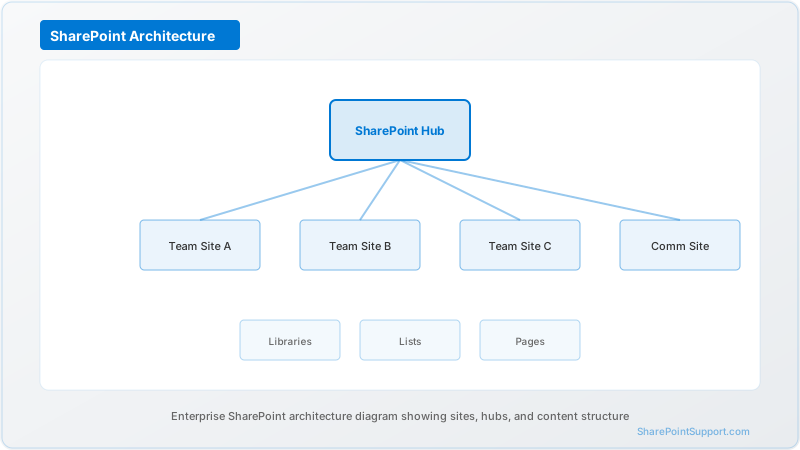
In our 25+ years of deploying SharePoint and Microsoft 365 environments for Fortune 500 organizations, we have seen countless Teams rollouts fail because administrators treated Teams files as a separate system rather than as SharePoint content. This guide provides the architectural knowledge and best practices you need to manage Teams channel files effectively.
The Teams-SharePoint Architecture Explained
When a Microsoft 365 Group-connected Team is created, several resources are provisioned automatically. A SharePoint team site is created under /sites/TeamName. A default document library called Shared Documents is created within that site. Each standard channel in the team maps to a folder within this library.
```
Teams Structure to SharePoint Mapping:
Marketing Team (Teams)
Site: /sites/MarketingTeam (SharePoint)
Documents Library:
General/ (General channel files)
Campaigns/ (Campaigns channel files)
Brand-Assets/ (Brand Assets channel files)
```
Private channels behave differently. Each private channel creates its own separate SharePoint site collection with independent permissions. Shared channels for cross-tenant collaboration also receive their own site collections. This architectural distinction has major implications for governance, storage management, and compliance monitoring.
Organizing Files Across Channels
The most common mistake organizations make is recreating deep folder hierarchies inside Teams channels. Users accustomed to network file shares build nested structures six or seven levels deep, making content impossible to find through search and defeating the purpose of modern collaboration.
Instead, adopt a metadata-first approach. Use shallow folder structures with no more than two levels. Apply managed metadata columns to classify documents by project, content type, fiscal year, and department. Train users to rely on SharePoint search and filtered views rather than memorizing folder paths. This approach scales far better than traditional folder hierarchies.
Channel Structure Guidelines
Design channels around work streams rather than organizational hierarchies. A marketing team might have channels for Content Calendar, Active Campaigns, Brand and Creative, Analytics, and a private channel for Agency Contracts. Each channel should represent a distinct work area with its own set of documents. Avoid creating channels for individual projects unless the project is large enough to warrant its own document set.
Permission Management for Teams Files
Teams permissions and SharePoint permissions are linked through the Microsoft 365 Group. Team Owners receive Full Control on the SharePoint site. Team Members receive Edit permissions. Team Guests receive limited Edit permissions based on tenant sharing policies.
A critical warning: modifying SharePoint permissions directly on a Teams-connected site can create inconsistencies between what Teams displays and what SharePoint actually enforces. Always manage access through Teams whenever possible. Reserve direct SharePoint permission changes for specific scenarios like granting view-only access to non-team members or applying sensitivity labels to restricted documents.
Private Channel Permission Isolation
Private channels are fully permission-isolated from the parent team. Members of the parent team cannot access private channel files unless they are explicitly added to the private channel. This isolation is enforced at the SharePoint site collection level, providing genuine security boundaries for sensitive content.
```powershell
# Audit private channel membership
Connect-PnPOnline -Url "https://contoso.sharepoint.com/sites/Team-PrivateChannel" -Interactive
Get-PnPGroupMember -Group "Members" | Select-Object LoginName, Title
```
Co-Authoring Best Practices in Teams
Real-time co-authoring in Word, Excel, and PowerPoint files stored in Teams channel libraries is one of the platform's most powerful capabilities. Files must be in modern formats (.docx, .xlsx, .pptx) and users need Microsoft 365 Apps or Office for the Web.
Disable the Require Check-Out setting on Teams-connected libraries because it breaks co-authoring. Keep version history enabled at a reasonable limit such as 50 to 100 major versions. Understand that co-authoring generates auto-saves every 30 seconds, which creates versions rapidly. Configure version limits proactively to prevent storage bloat.
When two users edit the same paragraph or cell simultaneously, SharePoint creates a co-authoring conflict branch that the document owner must resolve. Training users on conflict resolution reduces frustration and support tickets.
Version History and Storage Governance
Without governance, Teams channel libraries accumulate massive amounts of version history. A 5 MB PowerPoint deck edited 200 times consumes 1 GB in version storage alone. Multiply this across thousands of documents and you have a serious storage problem.
```powershell
# Set version limits on Teams-connected library
Connect-PnPOnline -Url "https://contoso.sharepoint.com/sites/MarketingTeam" -Interactive
Set-PnPList -Identity "Shared Documents" -EnableVersioning $true -MajorVersions 50 -EnableMinorVersions $false
```
Implement file naming conventions across all channels. A format like ContentType-Topic-Date works well (for example Report-Q3-Revenue-20260930.xlsx). Use metadata columns instead of encoding classification information in file names. Enforce conventions through training and periodic audits.
Managing Teams Meeting Recordings
Teams meeting recordings store to OneDrive for one-on-one meetings and to the channel SharePoint library for channel meetings. Stream Classic is deprecated and all new recordings go to OneDrive or SharePoint. Implement retention policies to automatically delete recordings after a defined period such as 90 days to prevent unbounded storage growth.
Migrating File Shares to Teams Channels
When migrating from Windows file shares to Teams plus SharePoint, plan the mapping carefully. Top-level folders may map to channels while deeper structures should be flattened and replaced with metadata. Use ShareGate or Microsoft SPMT for migration, preserving file creation dates and modification timestamps for audit trail integrity.
Map NTFS permissions to Microsoft 365 Groups. Convert Active Directory security groups to Azure AD groups and add them to the appropriate Teams. Validate permissions after migration by testing access with representative users from each group.
Governance Framework for Teams Files
Establish a governance framework that covers file lifecycle management, storage quotas per site, version history limits, external sharing policies, and sensitivity label requirements. Document these policies and communicate them to all team owners. Use our SharePoint consulting services to design a governance framework tailored to your organization's compliance requirements.
Loop Components and the Future of Teams Files
Microsoft Loop components are live, collaborative elements that can be inserted into Teams chats and channel posts. Loop components in channel conversations are stored in the channel SharePoint library and are subject to the same retention and eDiscovery policies as regular documents. Govern Loop components as part of your overall Teams file strategy.
External Sharing and Guest Access for Teams Files
External sharing through Teams introduces additional governance complexity because guests added to a Team automatically receive access to the underlying SharePoint site and all its document libraries. Organizations must configure tenant-level sharing policies that align with their security requirements, setting appropriate defaults for whether guests can share items they do not own, whether sharing links default to organization-only or anyone, and whether guest access expires after a defined period. For Teams that handle sensitive or regulated content, consider disabling guest access entirely and using separate SharePoint libraries with controlled external sharing for the specific documents that need to be shared outside the organization.
Guest lifecycle management is another critical consideration. When a project involving external collaborators ends, the guest accounts and their associated permissions should be reviewed and removed promptly. Azure AD access reviews can automate this process by requiring team owners to periodically confirm that each guest still needs access, automatically removing guests who are not confirmed. Without this governance, guest accounts accumulate over time and create an expanding attack surface that increases the risk of unauthorized data access.
Compliance Considerations for Teams Files in Regulated Industries
Organizations in healthcare, financial services, and government face additional requirements for Teams file management. HIPAA-regulated organizations must ensure that Teams containing patient health information have appropriate sensitivity labels, DLP policies preventing unauthorized sharing, and audit logging configured to capture all file access events. Financial services firms subject to SEC and FINRA regulations must preserve Teams files and conversations for specified retention periods and make them available for regulatory examinations. Government agencies must ensure that Teams file storage complies with data residency requirements and that classified information is handled according to the appropriate security frameworks.
Microsoft Purview retention policies can be applied to Teams channel messages and the underlying SharePoint document libraries to ensure that content is preserved for the required retention period regardless of user actions. eDiscovery searches can span both Teams conversations and SharePoint files to produce complete records for legal and regulatory inquiries. Organizations should work with their compliance teams to map regulatory requirements to specific Teams and SharePoint governance configurations before deploying Teams for sensitive workloads.
When to Engage Expert Support
Organizations with more than 500 Teams and complex compliance requirements benefit from professional governance design. Our team has implemented Teams governance frameworks for healthcare systems, financial institutions, and government agencies where regulatory compliance demands rigorous file management. Contact us to discuss your Teams and SharePoint governance strategy, or explore our SharePoint consulting services for comprehensive platform guidance.
Advanced File Governance Strategies for Teams at Scale
Organizations managing hundreds or thousands of Teams need automated governance that scales beyond manual oversight. Implement Power Automate flows that detect and flag files exceeding size thresholds in Teams channel libraries, alerting site owners when individual files surpass 100 MB or when total channel storage exceeds predefined limits. These proactive alerts prevent storage crises before they impact productivity.
Sensitivity Labels on Teams Files
Apply Microsoft Purview sensitivity labels to Teams channel libraries to enforce classification and protection policies automatically. Configure container-level labels on the underlying SharePoint sites to control external sharing, unmanaged device access, and privacy settings for the entire team. Item-level labels on individual documents enforce encryption and access restrictions regardless of how the file is shared or where it travels.
Information Barriers for Regulated Industries
Financial services and legal organizations may need information barriers that prevent specific Teams from sharing files with each other. Information barriers are enforced at the SharePoint level, preventing users in conflicting segments from accessing each other's Teams files even if they attempt to share directly through SharePoint.
Backup and Recovery Considerations for Teams Files
Teams files stored in SharePoint benefit from SharePoint's native protection mechanisms including the two-stage Recycle Bin with 93-day retention, Microsoft Purview retention policies for long-term preservation, and eDiscovery holds for legal and compliance requirements. However, organizations with recovery point objectives shorter than the Recycle Bin retention window should consider third-party backup solutions that provide point-in-time recovery for Teams file content.
Test your recovery procedures regularly. Simulate accidental deletion scenarios and verify that administrators can restore files, folders, and entire channel document libraries within your defined recovery time objectives. Document recovery procedures and ensure that backup administrators understand the Teams-to-SharePoint mapping so they can locate and restore the correct content.
Compliance and eDiscovery for Teams Files
All files stored in Teams channels are subject to Microsoft 365 compliance features including eDiscovery search, legal holds, and content search. When an eDiscovery case involves Teams content, the search automatically includes files stored in the associated SharePoint sites. Legal holds placed on a Team preserve all channel files, preventing deletion even if users attempt to remove content.
For organizations in regulated industries, configure audit logging for Teams file activities including access, download, modification, sharing, and deletion events. Use the unified audit log in Microsoft Purview to track file interactions across all Teams and their underlying SharePoint sites. Create automated alert policies for high-risk events such as bulk downloads, external sharing of sensitive files, or access from unusual locations.
Planning for Teams Premium File Features
Microsoft Teams Premium introduces additional capabilities that affect file governance including intelligent meeting recaps with content references, custom meeting templates with file sharing restrictions, and advanced collaboration features. Plan your governance framework to accommodate these evolving capabilities by establishing flexible policies that can adapt as Teams Premium features become generally available.
Organizations should also prepare for Microsoft Loop integration with Teams files, which introduces collaborative components that are stored in SharePoint and subject to the same governance, retention, and compliance policies as traditional files. Establishing governance for Loop components now prevents proliferation of ungoverned content as adoption increases.
Enterprise Implementation Best Practices
In our 25+ years of enterprise SharePoint consulting, we have helped hundreds of organizations design Teams and SharePoint integration architectures that enhance collaboration without creating unmanaged sprawl. The relationship between Teams and SharePoint is powerful but requires deliberate governance to prevent the content fragmentation that undermines enterprise search, compliance, and knowledge management.
- Define a Teams Provisioning Strategy: Uncontrolled team creation leads to duplicate teams, inconsistent naming, orphaned content, and sprawl that overwhelms users and administrators alike. Implement a managed provisioning process using approval workflows, naming conventions, expiration policies, and classification labels. This governance does not prevent agility but channels it productively through guardrails that maintain organizational coherence.
- Architect Channel Strategy for Content Findability: Design your Teams channel structure with long-term content management in mind. Every Teams channel creates a SharePoint folder, and poorly planned channels create folder structures that become impossible to navigate. Establish channel naming standards, limit channel creation to team owners, and provide guidance on when to create channels versus conversations.
- Configure SharePoint Sites Behind Teams Deliberately: Every team has a backing SharePoint site with a document library, and this site can be configured with the same metadata, content types, views, and automation as any SharePoint site. Take advantage of this capability by adding custom metadata columns, configuring default views, and implementing Power Automate workflows that enhance the file management experience within Teams.
- Plan for Content Lifecycle and Archival: Teams conversations and files accumulate rapidly. Implement retention policies that archive or delete content according to your compliance requirements. Configure team expiration policies that prompt owners to certify team relevance annually and archive inactive teams automatically to prevent content sprawl.
- Train Users on the Teams-SharePoint Relationship: Most users do not understand that Teams files live in SharePoint. This knowledge gap leads to duplicate files, permission confusion, and missed content. Invest in training that explains the relationship and shows users how to leverage SharePoint features like metadata, views, and search directly from within Teams.
Governance and Compliance Considerations
The integration between Microsoft Teams and SharePoint creates governance and compliance challenges because content flows between two platforms with different user experiences but shared underlying storage and security models. Organizations must ensure their compliance framework addresses content governance consistently regardless of whether users interact through Teams or SharePoint.
For HIPAA-regulated organizations, Teams channels that discuss patient cases or share clinical documents create PHI exposure in SharePoint libraries that may not have been configured with healthcare-specific controls. Audit every team that handles patient information, apply sensitivity labels to the backing SharePoint site, configure DLP policies that detect PHI in Teams messages and files, and ensure retention policies satisfy the six-year HIPAA minimum.
Financial services organizations must consider that Teams conversations may contain material non-public information, client communications, and investment recommendations subject to SEC and FINRA supervision requirements. Configure communication compliance policies that monitor Teams conversations for regulatory violations, retain all Teams content according to recordkeeping requirements, and implement supervisory review workflows.
Government organizations must ensure that Teams channels used for sensitive discussions have backing SharePoint sites configured with appropriate security classifications, access controls, and audit logging that satisfies NIST 800-53 requirements.
Implement a unified governance framework that applies consistent policies across Teams and SharePoint including data classification, retention, DLP, sharing controls, and audit logging. Train compliance officers on how Teams and SharePoint interact so they can effectively monitor and investigate potential compliance issues. Our SharePoint governance specialists help organizations design integrated compliance frameworks that address the unique challenges of the Teams-SharePoint relationship.
Ready to optimize your Teams and SharePoint integration for maximum collaboration and minimum sprawl? Our specialists have designed Teams governance frameworks for enterprises with thousands of active teams. Contact our team for a Teams governance assessment, and explore how our SharePoint consulting services can transform your collaboration environment.
Common Challenges and Solutions
Organizations implementing Microsoft Teams Channel Files & SharePoint consistently encounter obstacles that, if left unaddressed, undermine adoption and erode stakeholder confidence. Drawing on two decades of enterprise SharePoint consulting, these are the challenges we see most frequently and the proven approaches for overcoming them.
Challenge 1: Content Sprawl and Information Architecture Degradation
Over time, Microsoft Teams Channel Files & SharePoint environments accumulate redundant, outdated, and trivial content that degrades search relevance and confuses users. Without proactive content lifecycle management, the signal-to-noise ratio deteriorates and user trust in the platform erodes. The resolution requires a structured approach: establishing automated retention policies that flag content for review after defined periods of inactivity, combined with content owner accountability structures that assign clear responsibility for each site collection and library. Organizations that address this proactively report 40 to 60 percent fewer support tickets within the first 90 days of deployment. Establishing a dedicated governance committee with representatives from IT, compliance, and business stakeholders ensures ongoing alignment between technical configuration and organizational objectives.
Challenge 2: Compliance and Audit Readiness Gaps
Microsoft Teams Channel Files & SharePoint implementations in regulated industries often lack the audit trail depth and policy enforcement rigor required by frameworks such as HIPAA, SOC 2, and GDPR. Retroactive compliance remediation is significantly more expensive and disruptive than building compliance into the initial design. We recommend embedding compliance requirements into the information architecture from day one. Configure Microsoft Purview retention labels, DLP policies, and audit logging before deploying content, and validate compliance posture through regular internal audits. Tracking these metrics through SharePoint health dashboards provides early warning indicators that allow administrators to intervene before minor issues become systemic problems affecting enterprise-wide productivity.
Challenge 3: Inconsistent Governance Across Business Units
When different departments implement Microsoft Teams Channel Files & SharePoint independently, inconsistent naming conventions, metadata schemas, and security configurations create silos that undermine cross-functional collaboration and complicate compliance reporting. The most effective mitigation strategy involves centralizing governance policy definition while allowing controlled flexibility at the departmental level. A hub-and-spoke governance model balances enterprise consistency with departmental autonomy. Enterprises operating in regulated industries such as healthcare and financial services must pay particular attention to this challenge because compliance violations carry significant financial and reputational consequences. Regular audits conducted quarterly at minimum help organizations maintain alignment with evolving regulatory requirements and internal policy updates.
Challenge 4: Migration and Legacy Content Complexity
Organizations transitioning legacy content into Microsoft Teams Channel Files & SharePoint often underestimate the complexity of mapping old structures, metadata, and permissions to modern architectures. Failed migrations erode user confidence and create parallel systems that duplicate effort. Addressing this requires conducting thorough pre-migration content audits that classify and prioritize content based on business value. Invest in automated migration tools that preserve metadata fidelity and permission integrity while providing detailed validation reports. Organizations that invest in structured change management programs achieve adoption rates 35 percent higher than those relying on organic discovery alone. Executive sponsorship combined with department-level champions creates the organizational momentum necessary for sustained success.
Integration with Microsoft 365 Ecosystem
Microsoft Teams Channel Files & SharePoint does not operate in isolation. Its value multiplies when connected to the broader Microsoft 365 ecosystem, creating unified workflows that eliminate context switching and reduce manual data transfer between applications.
Microsoft Teams Integration: Configure Teams notifications that alert stakeholders when Microsoft Teams Channel Files & SharePoint content changes, ensuring that distributed teams stay informed about updates without relying on manual communication workflows. Teams channels automatically provision SharePoint document libraries, which means microsoft teams channel files & sharepoint configurations and content flow seamlessly between collaborative conversations and structured document management. Users can surface SharePoint content directly within Teams tabs, reducing the friction that typically causes adoption to stall.
Power Automate Workflows: Create event-driven automations that respond to Microsoft Teams Channel Files & SharePoint changes in real time, triggering downstream processes such as notifications, data transformations, and cross-system synchronization. Automated workflows triggered by SharePoint events such as document uploads, metadata changes, or approval completions eliminate repetitive manual tasks. Organizations typically automate 15 to 25 processes within the first quarter, saving an average of 8 hours per week per department. These automations also create audit trails that satisfy compliance requirements for regulated industries.
Power BI Analytics: Connect Microsoft Teams Channel Files & SharePoint list and library data to Power BI datasets for advanced analytics that transform raw operational data into strategic business intelligence accessible to decision makers across the organization. Connecting SharePoint data to Power BI dashboards provides real-time visibility into content usage patterns, adoption metrics, and operational KPIs. Decision makers gain actionable intelligence without requiring manual report generation, enabling faster response to emerging trends and potential issues.
Microsoft Purview and Compliance: Configure data loss prevention policies that monitor Microsoft Teams Channel Files & SharePoint content for sensitive information patterns, blocking or restricting sharing actions that could violate compliance requirements. Sensitivity labels, data loss prevention policies, and retention schedules configured in Microsoft Purview extend automatically to microsoft teams channel files & sharepoint content. This unified compliance framework ensures that governance policies apply consistently across the entire Microsoft 365 environment rather than requiring separate configuration for each workload. For organizations subject to HIPAA, SOC 2, or FedRAMP requirements, this integrated approach significantly reduces compliance management overhead.
Getting Started: Next Steps
Implementing Microsoft Teams Channel Files & SharePoint effectively requires more than technical configuration. It demands a strategic approach grounded in your organization's specific business requirements, compliance obligations, and growth trajectory. The difference between a deployment that delivers measurable ROI and one that becomes shelfware often comes down to the quality of upfront planning and expert guidance.
Begin with a focused assessment of your current SharePoint environment. Evaluate your existing information architecture, permission structures, content lifecycle policies, and user adoption patterns. Identify gaps between your current state and the target state required for successful microsoft teams channel files & sharepoint implementation. This assessment typically takes 2 to 4 weeks and produces a prioritized roadmap that aligns technical work with business outcomes.
Our SharePoint specialists have guided organizations across healthcare, financial services, government, and education through hundreds of successful implementations. We bring deep expertise in SharePoint architecture, governance frameworks, and compliance alignment that accelerates time to value while minimizing risk.
Ready to move forward? Contact our team for a complimentary consultation. We will assess your environment, identify quick wins, and develop a phased implementation plan tailored to your organization's needs and timeline. Whether you are starting from scratch or optimizing an existing deployment, our enterprise SharePoint consultants deliver the depth and accountability enterprise SharePoint work requires.
Written by the SharePoint Support Team
Senior SharePoint Consultants | 25+ Years Microsoft Ecosystem Experience
Our senior SharePoint consultants bring deep expertise spanning 500+ enterprise migrations and compliance implementations across HIPAA, SOC 2, and FedRAMP environments. We cover SharePoint Online, Microsoft 365, migrations, Copilot readiness, and large-scale governance.
Expert SharePoint Services
Frequently Asked Questions
What are the most common SharePoint security vulnerabilities?▼
How do we prevent data leaks through SharePoint external sharing?▼
What SharePoint security features are included with Microsoft 365 E5?▼
How do we audit who accessed sensitive documents in SharePoint?▼
How does SharePoint integrate with Microsoft Teams?▼
Need Expert Help?
Our SharePoint consultants are ready to help you implement these strategies in your organization.
Continue Reading in Features
Best SharePoint Site Templates & Design Examples
15 proven SharePoint site templates used by Fortune 500 companies. Includes department sites, project hubs, executive dashboards, and compliance portals — all using out-of-box features.
FeaturesNew SharePoint Experience 2026: What Changes
Microsoft is rolling out a completely redesigned SharePoint experience starting March 2026. New app bar, AI-powered tools, 31 new templates, and a unified Workflows experience. Here is what your enterprise needs to know.
FeaturesFix SharePoint Search: AI-Powered Findability Guide
The number one complaint about every SharePoint environment: people cannot find anything. AI-powered search in 2026 can fix this — but only if your content is structured correctly. Here is the playbook.
FeaturesSharePoint Premium: Advanced Features Worth the Investment
Discover the advanced capabilities of SharePoint Premium including AI-powered document processing, enhanced content services, and enterprise-grade compliance features that justify the investment.
FeaturesAudience Targeting in SharePoint: Personalized Content
Learn how to implement audience targeting in SharePoint to deliver personalized content experiences based on user groups, roles, and attributes.
FeaturesSharePoint for Project Management: The Guide for 2026
How enterprises use SharePoint for project management — from simple task tracking to complex PMO portals. Includes setup templates, integration with Planner and Teams, and when to use SharePoint vs dedicated PM tools.