10 Best SharePoint Intranet Design Companies for 2026
The bar for enterprise intranets in 2026 is high. Employees expect their company intranet to work like the consumer apps they use daily. Most SharePoint intranets fail not because of technology limitations but because the firm that built them treated it as a technology project instead of an employee experience project.
The 10 best SharePoint intranet design firms:
- SharePoint Support — Best for regulated-industry intranets with compliance requirements
- Netwoven — Best for digital workplace strategy and employee experience design
- LiveTiles — Best for out-of-the-box intranet accelerators
- Valo (now Staffbase) — Best for internal communications-focused intranets
- Powell Software — Best for Teams-integrated intranet experiences
- Slalom — Best for change management alongside intranet rollouts
- Unily — Best for multi-brand enterprise intranets
- Akumina — Best for highly customized intranet portals
- Brightstarr — Best for knowledge management intranets
- Avanade — Best for Fortune 500 global intranet deployments
---
What Makes an Enterprise Intranet Succeed
After designing intranets for organizations ranging from 500 to 50,000 employees, the success pattern is consistent. The intranets that achieve 70%+ monthly active user rates share five characteristics:
1. Personalized content delivery. Employees in Finance see different news than Engineering. SharePoint audience targeting and Viva Connections adaptive cards make this possible.
2. Mobile-first design. Over 40% of enterprise intranet traffic comes from mobile. If your intranet does not work on a phone, you have lost the frontline workforce.
3. Integrated with daily workflow. The intranet should surface inside Microsoft Teams via Viva Connections, not require a separate browser tab.
4. Fast. Pages must load in under 2 seconds. Every additional second reduces page views by 20%.
5. Governance from day one. Without publishing governance, content goes stale within 3 months.
---
1. SharePoint Support (sharepointsupport.com)
Best for: Organizations that need an intranet with built-in compliance controls
We approach intranet design as an intersection of employee experience and information governance. For healthcare organizations, the intranet serves clinical staff while ensuring PHI never surfaces outside controlled libraries. For financial services, it supports information barriers between divisions while providing shared corporate content.
Our methodology: Discovery (2 weeks), Information Architecture (2 weeks), Department Templates (3-4 weeks), Content Migration (2-8 weeks), Viva Connections, Training and Launch, Governance Framework.
Key differentiators:
- Compliance-aware design with sensitivity labels and DLP from day one
- Viva Connections and Viva Engage integration
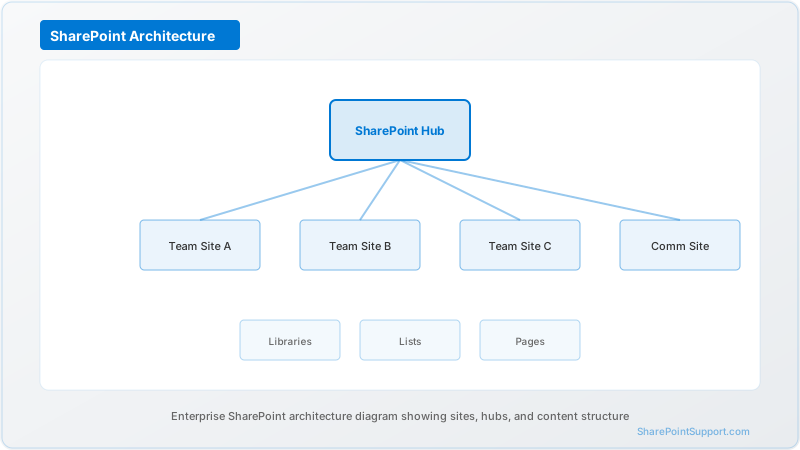
- Hub site architecture that scales from 500 to 50,000 users
- Multilingual support up to 42 languages
---
2-10: Additional Providers
Netwoven produces some of the most visually polished SharePoint intranets in the market with strong employee journey mapping.
LiveTiles offers pre-built templates that reduce launch time from months to weeks.
Valo (Staffbase) focuses on internal communications with news publishing and employee engagement.
Powell Software builds Teams-native intranet experiences where the intranet lives inside Teams.
Slalom combines technology implementation with change management to ensure actual adoption.
Unily is an employee experience platform for multi-brand enterprises needing different experiences per business unit.
Akumina provides highly customizable intranets with custom widgets and personalization engines.
Brightstarr specializes in knowledge management connecting employees with experts.
Avanade handles global deployments for Fortune 500 organizations with 50,000+ employees.
---
Frequently Asked Questions
How much does a SharePoint intranet cost?
Basic for 500 users: $15,000-$30,000. Custom for 1,000-5,000 users: $50,000-$150,000. Enterprise for 10,000+ users: $150,000-$500,000+.
How long does it take to build?
Template-based: 4-6 weeks. Custom mid-size: 3-4 months. Enterprise 10K+ users: 6-12 months (usually phased).
Should I use an accelerator or build custom?
Use an accelerator when you need to launch in under 8 weeks with standard requirements and budget under $50K. Build custom for compliance requirements, complex architecture, or deep LOB integration.
What is Viva Connections?
Microsoft's app that brings your SharePoint intranet into Teams. Provides personalized feed, dashboard cards, and curated resources. Essential for frontline workers and mobile users.
What is the biggest reason intranets fail?
Stale content. Every page needs an owner, review date, and automated reminder. Pages with no activity for 90 days should trigger owner notification. Pages with no owner should auto-archive.
Enterprise Implementation Best Practices
In our 25+ years managing enterprise SharePoint environments, we have designed and deployed intranets for organizations across healthcare, financial services, government, and manufacturing. The intranet projects that achieve high adoption share common implementation patterns regardless of which firm builds them.
- Hire for Employee Experience Not Just SharePoint Technical Skills: The number one predictor of intranet success is whether the design firm prioritizes employee experience research over technical implementation. A firm that starts with stakeholder interviews, employee journey mapping, and task analysis before opening SharePoint will deliver a better intranet than a firm that starts building pages on day one. Look for UX researchers, information architects, and change management specialists on the project team, not just SharePoint developers.
- Require a Content Strategy Before Design Begins: The most common reason intranets fail is stale content, and the root cause is launching without a content strategy. Before design begins, define who owns each content area, what the publishing cadence is, how content is reviewed and archived, and what happens when content owners leave the organization. The design firm should deliver a content operations plan alongside the technical implementation.
- Insist on Mobile-First Design and Testing: Over 40 percent of intranet traffic comes from mobile devices, and this percentage is higher for frontline workers who may access the intranet exclusively from phones and tablets. Require your design firm to demonstrate mobile-first design with testing on actual mobile devices, not just browser emulators. Viva Connections mobile experience should be a primary design target, not an afterthought.
- Validate Design Decisions with Real Users: Require at least two rounds of usability testing with actual employees during the design phase. Test with representatives from each major persona including executives, knowledge workers, frontline staff, and new employees. Usability testing consistently reveals navigation problems, content gaps, and terminology confusion that internal teams and design firms cannot identify without external validation through SharePoint consulting methodology.
- Plan for Day Two Operations from Day One: The intranet launch is the beginning, not the end. Ensure your design firm delivers operational documentation including content governance procedures, analytics monitoring plans, quarterly review processes, and escalation paths for content issues. Budget for ongoing support and optimization in your first year including monthly analytics reviews, quarterly content audits, and annual design refreshes.
Governance and Compliance Considerations
Intranet governance is essential for organizations in regulated industries where the intranet publishes policies, procedures, and compliance communications that employees are expected to follow.
For HIPAA-regulated healthcare organizations, the intranet may display privacy policies, HIPAA training materials, and clinical procedure documentation that must remain current and accurate. Configure content approval workflows requiring compliance officer review before publishing or updating any content in compliance-related sections. Maintain version history for all policy pages and implement audit logging that tracks who accessed compliance content for regulatory evidence.
Financial services organizations must ensure their intranet does not inadvertently distribute material non-public information across information barriers. Configure audience targeting to ensure that investment banking content is not visible to research division employees and vice versa. Test information barrier compliance through regular audits of targeted content visibility across restricted groups.
Accessibility compliance is a legal requirement for intranets. Ensure your design firm delivers an intranet that meets WCAG 2.1 AA standards and provides documentation of accessibility testing results. Include accessibility validation in your ongoing SharePoint support program to maintain compliance as content is added and updated.
Measuring Success and ROI
Intranet ROI is measured through employee engagement, content effectiveness, and operational efficiency metrics that demonstrate the platform is delivering value.
Track unique daily visitors as a percentage of total employees targeting 50 percent or higher within 6 months. Monitor page views per session targeting 3 or more as an indicator of engagement depth. Measure search effectiveness through the ratio of successful searches to total searches targeting 75 percent or higher. Track content freshness measured by the percentage of pages updated within their defined review cycle. Survey employee satisfaction with the intranet quarterly targeting continuous improvement toward 4.0 or higher. Monitor the reduction in all-company email volume as communications shift to the intranet. Track help desk tickets for finding information targeting a 30 percent reduction within the first year.
Build an intranet that employees actually use and value. Contact our team for an intranet strategy session and discover how our SharePoint consulting services can create an employee experience that drives engagement and productivity.
Common Challenges and Solutions
Organizations implementing SharePoint consistently encounter obstacles that, if left unaddressed, undermine adoption and erode stakeholder confidence. Drawing on two decades of enterprise SharePoint consulting, these are the challenges we see most frequently and the proven approaches for overcoming them.
Challenge 1: Content Sprawl and Information Architecture Degradation
Over time, SharePoint environments accumulate redundant, outdated, and trivial content that degrades search relevance and confuses users. Without proactive content lifecycle management, the signal-to-noise ratio deteriorates and user trust in the platform erodes. The resolution requires a structured approach: establishing automated retention policies that flag content for review after defined periods of inactivity, combined with content owner accountability structures that assign clear responsibility for each site collection and library. Organizations that address this proactively report 40 to 60 percent fewer support tickets within the first 90 days of deployment. Establishing a dedicated governance committee with representatives from IT, compliance, and business stakeholders ensures ongoing alignment between technical configuration and organizational objectives.
Challenge 2: Compliance and Audit Readiness Gaps
SharePoint implementations in regulated industries often lack the audit trail depth and policy enforcement rigor required by frameworks such as HIPAA, SOC 2, and GDPR. Retroactive compliance remediation is significantly more expensive and disruptive than building compliance into the initial design. We recommend embedding compliance requirements into the information architecture from day one. Configure Microsoft Purview retention labels, DLP policies, and audit logging before deploying content, and validate compliance posture through regular internal audits. Tracking these metrics through SharePoint health dashboards provides early warning indicators that allow administrators to intervene before minor issues become systemic problems affecting enterprise-wide productivity.
Challenge 3: Inconsistent Governance Across Business Units
When different departments implement SharePoint independently, inconsistent naming conventions, metadata schemas, and security configurations create silos that undermine cross-functional collaboration and complicate compliance reporting. The most effective mitigation strategy involves centralizing governance policy definition while allowing controlled flexibility at the departmental level. A hub-and-spoke governance model balances enterprise consistency with departmental autonomy. Enterprises operating in regulated industries such as healthcare and financial services must pay particular attention to this challenge because compliance violations carry significant financial and reputational consequences. Regular audits conducted quarterly at minimum help organizations maintain alignment with evolving regulatory requirements and internal policy updates.
Challenge 4: Migration and Legacy Content Complexity
Organizations transitioning legacy content into SharePoint often underestimate the complexity of mapping old structures, metadata, and permissions to modern architectures. Failed migrations erode user confidence and create parallel systems that duplicate effort. Addressing this requires conducting thorough pre-migration content audits that classify and prioritize content based on business value. Invest in automated migration tools that preserve metadata fidelity and permission integrity while providing detailed validation reports. Organizations that invest in structured change management programs achieve adoption rates 35 percent higher than those relying on organic discovery alone. Executive sponsorship combined with department-level champions creates the organizational momentum necessary for sustained success.
Integration with Microsoft 365 Ecosystem
SharePoint does not operate in isolation. Its value multiplies when connected to the broader Microsoft 365 ecosystem, creating unified workflows that eliminate context switching and reduce manual data transfer between applications.
Microsoft Teams Integration: Configure Teams notifications that alert stakeholders when SharePoint content changes, ensuring that distributed teams stay informed about updates without relying on manual communication workflows. Teams channels automatically provision SharePoint document libraries, which means sharepoint configurations and content flow seamlessly between collaborative conversations and structured document management. Users can surface SharePoint content directly within Teams tabs, reducing the friction that typically causes adoption to stall.
Power Automate Workflows: Create event-driven automations that respond to SharePoint changes in real time, triggering downstream processes such as notifications, data transformations, and cross-system synchronization. Automated workflows triggered by SharePoint events such as document uploads, metadata changes, or approval completions eliminate repetitive manual tasks. Organizations typically automate 15 to 25 processes within the first quarter, saving an average of 8 hours per week per department. These automations also create audit trails that satisfy compliance requirements for regulated industries.
Power BI Analytics: Connect SharePoint list and library data to Power BI datasets for advanced analytics that transform raw operational data into strategic business intelligence accessible to decision makers across the organization. Connecting SharePoint data to Power BI dashboards provides real-time visibility into content usage patterns, adoption metrics, and operational KPIs. Decision makers gain actionable intelligence without requiring manual report generation, enabling faster response to emerging trends and potential issues.
Microsoft Purview and Compliance: Configure data loss prevention policies that monitor SharePoint content for sensitive information patterns, blocking or restricting sharing actions that could violate compliance requirements. Sensitivity labels, data loss prevention policies, and retention schedules configured in Microsoft Purview extend automatically to sharepoint content. This unified compliance framework ensures that governance policies apply consistently across the entire Microsoft 365 environment rather than requiring separate configuration for each workload. For organizations subject to HIPAA, SOC 2, or FedRAMP requirements, this integrated approach significantly reduces compliance management overhead.
Getting Started: Next Steps
Implementing SharePoint effectively requires more than technical configuration. It demands a strategic approach grounded in your organization's specific business requirements, compliance obligations, and growth trajectory. The difference between a deployment that delivers measurable ROI and one that becomes shelfware often comes down to the quality of upfront planning and expert guidance.
Begin with a focused assessment of your current SharePoint environment. Evaluate your existing information architecture, permission structures, content lifecycle policies, and user adoption patterns. Identify gaps between your current state and the target state required for successful sharepoint implementation. This assessment typically takes 2 to 4 weeks and produces a prioritized roadmap that aligns technical work with business outcomes.
Our SharePoint specialists have guided organizations across healthcare, financial services, government, and education through hundreds of successful implementations. We bring deep expertise in SharePoint architecture, governance frameworks, and compliance alignment that accelerates time to value while minimizing risk.
Ready to move forward? Contact our team for a complimentary consultation. We will assess your environment, identify quick wins, and develop a phased implementation plan tailored to your organization's needs and timeline. Whether you are starting from scratch or optimizing an existing deployment, our enterprise SharePoint consultants deliver the expertise and accountability that Fortune 500 organizations demand.
Written by the SharePoint Support Team
Senior SharePoint Consultants | 25+ Years Microsoft Ecosystem Experience
Our senior SharePoint consultants bring deep expertise spanning 500+ enterprise migrations and compliance implementations across HIPAA, SOC 2, and FedRAMP environments. We cover SharePoint Online, Microsoft 365, migrations, Copilot readiness, and large-scale governance.
Expert SharePoint Services
Frequently Asked Questions
What makes a successful SharePoint intranet?▼
How much does a SharePoint intranet project typically cost?▼
Should we use Viva Connections or a custom SharePoint intranet?▼
How do we measure SharePoint intranet ROI?▼
How does SharePoint integrate with Microsoft Teams?▼
Need Expert Help?
Our SharePoint consultants are ready to help you implement these strategies in your organization.
Continue Reading in Comparison
OneDrive vs SharePoint: Choosing the Right Storage
Understand the key differences between OneDrive and SharePoint to make the right storage decisions for personal files vs team collaboration.
ComparisonSharePoint Online vs On-Prem: 5 Deal-Breakers
Before you migrate, read this. 5 critical factors that decide whether SharePoint Online or on-premises is right for your org. Free decision checklist included.
Comparison10 Best SharePoint Consulting Firms for Enterprise in 2026
We evaluated 40+ SharePoint consulting firms on Microsoft partnership tier, migration volume, compliance expertise, and client outcomes. Here are the 10 that consistently deliver for enterprises with 500+ users.
Comparison10 Best SharePoint Migration Services & Tools
Choosing the wrong migration partner is the most expensive SharePoint mistake an enterprise can make. We ranked the 10 best migration services based on completion volume, zero-data-loss track record, and compliance handling.
Comparison10 Best SharePoint Support Services for Enterprise in 2026
Your SharePoint environment is running 24/7. Your support should be too. We evaluated the top managed SharePoint support providers on SLA guarantees, response times, proactive monitoring, and compliance expertise.
ComparisonSharePoint Online vs On-Premises in 2026: The Decision...
Forget the generic comparison charts. This is the decision framework we use with enterprise clients based on 500+ migrations, not vendor marketing.