
The 10 Best SharePoint Managed Support Services for 2026
Most SharePoint support fails at the same point: you submit a ticket, wait 24-48 hours for a first response from someone who has never seen your environment, and spend another week educating them on your setup before they start solving the actual problem. Enterprise SharePoint environments with 1,000+ users, compliance obligations, and custom configurations need something fundamentally different.
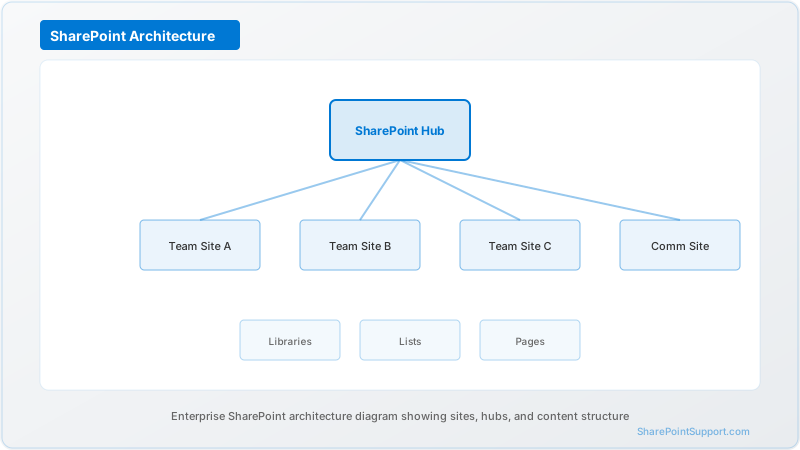
The top 10 SharePoint support providers for 2026:
- SharePoint Support (sharepointsupport.com) — Best for 24/7 support with compliance-grade SLAs
- Rackspace Technology — Best for combined Azure infrastructure + SharePoint support
- AvePoint — Best for governance-focused managed services
- Bamboo Solutions — Best for custom SharePoint development support
- Netwoven — Best for intranet and digital workplace support
- Catapult Systems — Best for mid-market managed services
- Perficient — Best for large enterprise multi-platform support
- Insight Direct — Best for Microsoft 365 bundled support packages
- Ciber (now HCL) — Best for global SharePoint support operations
- Binary Republik — Best for cost-effective offshore SharePoint support
---
Selection Methodology
| Criteria | Weight | What We Evaluated |
|----------|--------|-------------------|
| SLA Guarantees and Response Times | 30% | Contractual response and resolution times for P1-P4 incidents |
| 24/7 Availability | 20% | True 24/7 coverage vs. business-hours-only with after-hours escalation |
| Proactive Monitoring | 20% | Health monitoring, alerting, capacity planning, automated remediation |
| Compliance Expertise | 15% | HIPAA, SOC 2, FedRAMP audit support and documentation |
| Knowledge Transfer | 15% | Documentation quality, environment onboarding, training for internal IT |
---
1. SharePoint Support (sharepointsupport.com)
Best for: Organizations in regulated industries that need 24/7 coverage with guaranteed SLAs
We built our managed support practice specifically for enterprises where SharePoint downtime has compliance, financial, or patient-safety consequences. Our support model is not a help desk. It is a dedicated team of senior SharePoint architects who know your environment, your customizations, and your compliance requirements before the first ticket is opened.
Support tiers:
| Tier | Coverage | P1 Response | Monthly Starting |
|------|----------|-------------|-----------------|
| Essential | Business hours (8am-6pm CST) | 4 hours | $2,500 |
| Professional | Extended hours (7am-10pm CST) | 2 hours | $5,000 |
| Enterprise 24/7 | 24/7/365 including holidays | 15 minutes (P1) | Custom |
What is included in every tier:
- Dedicated SharePoint architect assigned to your account
- Monthly environment health reports with capacity planning
- Proactive monitoring with alerting
- Quarterly governance reviews and optimization recommendations
- Security patch assessment and deployment coordination
- End-user support portal with SLA dashboards
What makes this different: Your P1 goes to a senior architect who already knows your environment, not a Level 1 tech who reads from a script and escalates after 30 minutes.
---
2-10: Additional Providers
Rackspace Technology combines infrastructure monitoring with application-level SharePoint support. If your SharePoint performance depends on Azure VM health and SQL database performance, Rackspace monitors the full stack.
AvePoint layers managed services on top of their governance platform. Your support includes automated policy enforcement, lifecycle management, and compliance monitoring built into the tooling.
Bamboo Solutions excels at supporting custom SharePoint environments with non-standard web parts, workflows, and integrations that general support providers cannot troubleshoot.
Netwoven provides managed support with a digital workplace lens. Their support includes content governance, publishing workflow management, and user adoption tracking.
Catapult Systems offers right-sized managed services for mid-market organizations at practical price points.
Perficient handles multi-platform support for large enterprises running SharePoint alongside Salesforce, ServiceNow, and other enterprise applications.
Insight Direct bundles SharePoint support into broader Microsoft 365 managed services packages.
Ciber (HCL) provides global SharePoint support with follow-the-sun coverage.
Binary Republik offers cost-effective SharePoint support for organizations with constrained budgets and lower compliance requirements.
---
Frequently Asked Questions
How much does SharePoint managed support cost?
Business-hours support for mid-size environments: $2,000-$5,000/month. 24/7 support with guaranteed SLAs for enterprise: $5,000-$25,000/month depending on environment size and complexity.
Should I use Microsoft Premier Support or a third-party partner?
Microsoft Premier Support covers the platform. They cannot troubleshoot your specific content architecture, custom permissions, or business workflows. Use both: Microsoft for platform-level issues, a partner for environment-specific support.
What SLA should I expect for critical SharePoint issues?
For production-critical outages: demand a 15-minute to 1-hour response SLA with a 4-hour resolution target. Any provider offering only next business day for P1 issues is not providing enterprise support.
How do I evaluate SharePoint support quality before signing?
Three tests: (1) Ask for their onboarding process. (2) Ask for a sample monthly health report from an anonymized client. (3) Ask who specifically will handle your tickets.
Can SharePoint support providers help with compliance audits?
Some can, most cannot. Ask specifically whether their support includes audit-ready change logs, permission review documentation, and compliance reporting.
Enterprise Implementation Best Practices
In our 25+ years managing enterprise SharePoint environments, we have seen organizations waste hundreds of thousands of dollars on support contracts that look good on paper but fail when critical issues arise. The following practices ensure your support investment delivers real protection for your SharePoint environment.
- Conduct a Support Readiness Assessment Before Selecting a Provider: Before evaluating providers, document your environment's complexity including the number of sites, custom solutions, third-party integrations, compliance requirements, and user count. Map your critical business processes that depend on SharePoint and define the business impact of downtime for each. This assessment enables you to match your actual support needs to provider capabilities rather than buying generic coverage that misses your specific risks.
- Require Environment Onboarding with Documentation Review: The best support relationships start with a thorough onboarding process where the provider learns your environment architecture, reviews your governance documentation, understands your compliance requirements, and identifies potential risks. Providers who skip onboarding and promise immediate support are planning to troubleshoot reactively rather than support proactively. Demand a 30-day onboarding period with documented environment knowledge transfer.
- Negotiate SLAs That Match Your Business Criticality: Generic SLAs with 4-hour response times for all issues do not serve enterprise needs. Negotiate tiered SLAs that differentiate between priority levels. P1 production-down issues affecting all users should have 15-minute response and 4-hour resolution targets. P2 degraded functionality issues should have 1-hour response and 8-hour resolution. P3 non-critical issues can have next-business-day response. Include escalation procedures and penalty clauses for SLA misses.
- Require Monthly Health Reports with Actionable Recommendations: Support should be proactive, not just reactive. Require monthly environment health reports that cover storage consumption trends, permission sprawl indicators, performance metrics, security posture assessments, and upcoming Microsoft changes that affect your environment. Each report should include specific recommendations prioritized by business impact with estimated effort for each remediation through SharePoint support service delivery.
- Verify Compliance Support Capabilities: For organizations in healthcare, financial services, or government, verify that your support provider understands your regulatory requirements and can maintain compliance documentation as part of their service. Ask for specific examples of compliance-related support deliverables including audit log reviews, permission access reports, and policy configuration verification. A provider who cannot articulate their compliance support capabilities will not protect you during an audit.
Governance and Compliance Considerations
Managed SharePoint support directly impacts your compliance posture because support activities involve privileged access to your environment and your data.
Ensure your support contract includes confidentiality provisions that satisfy your regulatory requirements. For HIPAA-covered entities, your support provider may access environments containing PHI and should be treated as a business associate with a signed BAA. For financial services organizations, verify that the provider's personnel have undergone background checks consistent with your regulatory requirements and that their access to your environment is logged and auditable.
Support provider access should follow least-privilege principles. Grant support personnel the minimum access required to diagnose and resolve issues rather than standing global administrator access. Use privileged access management solutions that provide time-limited, scope-limited access for each support engagement with full audit logging. Review support access logs monthly to verify that access was appropriate and aligned with documented support tickets.
Change management for support activities must follow your organizational change control procedures. Every configuration change made by your support provider should be documented, approved through your change management process, tested in a non-production environment where possible, and verified after implementation. Support providers who make undocumented changes to production environments create compliance and operational risks that compound over time. Our SharePoint consulting team maintains full change documentation for every support engagement.
Measuring Success and ROI
Support contract ROI is measured through environment health metrics, incident resolution performance, and risk reduction indicators that demonstrate your support investment is protecting your SharePoint environment.
Track mean time to respond and mean time to resolve for each priority level comparing actual performance against contracted SLAs. Monitor the number of proactive issues identified and remediated by your support provider before they affected users. Measure environment health score trends from monthly reports targeting continuous improvement. Track the number of compliance audit findings related to SharePoint targeting zero findings attributable to support gaps. Calculate avoided downtime cost by multiplying prevented outage hours by your organization's hourly productivity cost. Survey key stakeholders quarterly on satisfaction with support responsiveness and quality targeting 4.5 or higher on a 5-point scale.
Invest in SharePoint support that protects your enterprise. Contact our team for a support assessment and discover how our SharePoint support services deliver the proactive, compliance-aware coverage your organization needs.
Common Challenges and Solutions
Organizations implementing SharePoint consistently encounter obstacles that, if left unaddressed, undermine adoption and erode stakeholder confidence. Drawing on two decades of enterprise SharePoint consulting, these are the challenges we see most frequently and the proven approaches for overcoming them.
Challenge 1: Content Sprawl and Information Architecture Degradation
Over time, SharePoint environments accumulate redundant, outdated, and trivial content that degrades search relevance and confuses users. Without proactive content lifecycle management, the signal-to-noise ratio deteriorates and user trust in the platform erodes. The resolution requires a structured approach: establishing automated retention policies that flag content for review after defined periods of inactivity, combined with content owner accountability structures that assign clear responsibility for each site collection and library. Organizations that address this proactively report 40 to 60 percent fewer support tickets within the first 90 days of deployment. Establishing a dedicated governance committee with representatives from IT, compliance, and business stakeholders ensures ongoing alignment between technical configuration and organizational objectives.
Challenge 2: Compliance and Audit Readiness Gaps
SharePoint implementations in regulated industries often lack the audit trail depth and policy enforcement rigor required by frameworks such as HIPAA, SOC 2, and GDPR. Retroactive compliance remediation is significantly more expensive and disruptive than building compliance into the initial design. We recommend embedding compliance requirements into the information architecture from day one. Configure Microsoft Purview retention labels, DLP policies, and audit logging before deploying content, and validate compliance posture through regular internal audits. Tracking these metrics through SharePoint health dashboards provides early warning indicators that allow administrators to intervene before minor issues become systemic problems affecting enterprise-wide productivity.
Challenge 3: Inconsistent Governance Across Business Units
When different departments implement SharePoint independently, inconsistent naming conventions, metadata schemas, and security configurations create silos that undermine cross-functional collaboration and complicate compliance reporting. The most effective mitigation strategy involves centralizing governance policy definition while allowing controlled flexibility at the departmental level. A hub-and-spoke governance model balances enterprise consistency with departmental autonomy. Enterprises operating in regulated industries such as healthcare and financial services must pay particular attention to this challenge because compliance violations carry significant financial and reputational consequences. Regular audits conducted quarterly at minimum help organizations maintain alignment with evolving regulatory requirements and internal policy updates.
Challenge 4: Migration and Legacy Content Complexity
Organizations transitioning legacy content into SharePoint often underestimate the complexity of mapping old structures, metadata, and permissions to modern architectures. Failed migrations erode user confidence and create parallel systems that duplicate effort. Addressing this requires conducting thorough pre-migration content audits that classify and prioritize content based on business value. Invest in automated migration tools that preserve metadata fidelity and permission integrity while providing detailed validation reports. Organizations that invest in structured change management programs achieve adoption rates 35 percent higher than those relying on organic discovery alone. Executive sponsorship combined with department-level champions creates the organizational momentum necessary for sustained success.
Integration with Microsoft 365 Ecosystem
SharePoint does not operate in isolation. Its value multiplies when connected to the broader Microsoft 365 ecosystem, creating unified workflows that eliminate context switching and reduce manual data transfer between applications.
Microsoft Teams Integration: Configure Teams notifications that alert stakeholders when SharePoint content changes, ensuring that distributed teams stay informed about updates without relying on manual communication workflows. Teams channels automatically provision SharePoint document libraries, which means sharepoint configurations and content flow seamlessly between collaborative conversations and structured document management. Users can surface SharePoint content directly within Teams tabs, reducing the friction that typically causes adoption to stall.
Power Automate Workflows: Create event-driven automations that respond to SharePoint changes in real time, triggering downstream processes such as notifications, data transformations, and cross-system synchronization. Automated workflows triggered by SharePoint events such as document uploads, metadata changes, or approval completions eliminate repetitive manual tasks. Organizations typically automate 15 to 25 processes within the first quarter, saving an average of 8 hours per week per department. These automations also create audit trails that satisfy compliance requirements for regulated industries.
Power BI Analytics: Connect SharePoint list and library data to Power BI datasets for advanced analytics that transform raw operational data into strategic business intelligence accessible to decision makers across the organization. Connecting SharePoint data to Power BI dashboards provides real-time visibility into content usage patterns, adoption metrics, and operational KPIs. Decision makers gain actionable intelligence without requiring manual report generation, enabling faster response to emerging trends and potential issues.
Microsoft Purview and Compliance: Configure data loss prevention policies that monitor SharePoint content for sensitive information patterns, blocking or restricting sharing actions that could violate compliance requirements. Sensitivity labels, data loss prevention policies, and retention schedules configured in Microsoft Purview extend automatically to sharepoint content. This unified compliance framework ensures that governance policies apply consistently across the entire Microsoft 365 environment rather than requiring separate configuration for each workload. For organizations subject to HIPAA, SOC 2, or FedRAMP requirements, this integrated approach significantly reduces compliance management overhead.
Getting Started: Next Steps
Implementing SharePoint effectively requires more than technical configuration. It demands a strategic approach grounded in your organization's specific business requirements, compliance obligations, and growth trajectory. The difference between a deployment that delivers measurable ROI and one that becomes shelfware often comes down to the quality of upfront planning and expert guidance.
Begin with a focused assessment of your current SharePoint environment. Evaluate your existing information architecture, permission structures, content lifecycle policies, and user adoption patterns. Identify gaps between your current state and the target state required for successful sharepoint implementation. This assessment typically takes 2 to 4 weeks and produces a prioritized roadmap that aligns technical work with business outcomes.
Our SharePoint specialists have guided organizations across healthcare, financial services, government, and education through hundreds of successful implementations. We bring deep expertise in SharePoint architecture, governance frameworks, and compliance alignment that accelerates time to value while minimizing risk.
Ready to move forward? Contact our team for a complimentary consultation. We will assess your environment, identify quick wins, and develop a phased implementation plan tailored to your organization's needs and timeline. Whether you are starting from scratch or optimizing an existing deployment, our enterprise SharePoint consultants deliver the expertise and accountability that Fortune 500 organizations demand.
Written by the SharePoint Support Team
Senior SharePoint Consultants | 25+ Years Microsoft Ecosystem Experience
Our senior SharePoint consultants bring deep expertise spanning 500+ enterprise migrations and compliance implementations across HIPAA, SOC 2, and FedRAMP environments. We cover SharePoint Online, Microsoft 365, migrations, Copilot readiness, and large-scale governance.
Expert SharePoint Services
Frequently Asked Questions
How do we evaluate SharePoint against competing platforms?▼
What are the key factors when choosing a SharePoint consulting partner?▼
Why do enterprises choose SharePoint over other collaboration platforms?▼
What is the total cost of ownership for SharePoint Online?▼
When should an organization hire SharePoint consultants versus building in-house?▼
Need Expert Help?
Our SharePoint consultants are ready to help you implement these strategies in your organization.
Continue Reading in Comparison
OneDrive vs SharePoint: Choosing the Right Storage
Understand the key differences between OneDrive and SharePoint to make the right storage decisions for personal files vs team collaboration.
ComparisonSharePoint Online vs On-Prem: 5 Deal-Breakers
Before you migrate, read this. 5 critical factors that decide whether SharePoint Online or on-premises is right for your org. Free decision checklist included.
Comparison10 Best SharePoint Consulting Firms for Enterprise in 2026
We evaluated 40+ SharePoint consulting firms on Microsoft partnership tier, migration volume, compliance expertise, and client outcomes. Here are the 10 that consistently deliver for enterprises with 500+ users.
Comparison10 Best SharePoint Migration Services & Tools
Choosing the wrong migration partner is the most expensive SharePoint mistake an enterprise can make. We ranked the 10 best migration services based on completion volume, zero-data-loss track record, and compliance handling.
ComparisonSharePoint Online vs On-Premises in 2026: The Decision...
Forget the generic comparison charts. This is the decision framework we use with enterprise clients based on 500+ migrations, not vendor marketing.
Comparison10 Best SharePoint Intranet Design Companies
A SharePoint intranet that nobody uses is worse than no intranet at all. We ranked the 10 best intranet design firms on employee adoption rates, UX quality, and Viva integration.