
Records Management in the AI Era
Records management in 2026 is no longer just about retention schedules and file plans. The explosion of AI-generated content, the proliferation of collaboration tools, and increasingly aggressive regulatory enforcement have made records management a board-level concern.
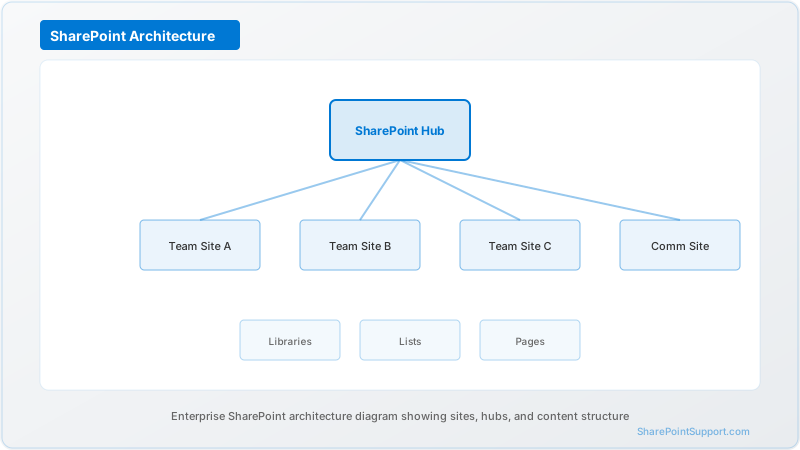
SharePoint, integrated with Microsoft Purview, is the foundation of enterprise records management for Microsoft 365 organizations. This guide covers the complete records management lifecycle — from policy design through AI-assisted classification to defensible disposition.
The SharePoint + Purview Records Management Stack
Microsoft Purview Compliance Portal includes Records Management (File Plan, Retention Labels, Retention Policies, Disposition Reviews, Events), Data Lifecycle Management (Retention Policies, Adaptive Scopes), and Information Protection (Sensitivity Labels, DLP Policies). SharePoint Online provides Document Libraries (records repositories), Preservation Hold Library (immutable copies), Content Type Hub (record content types), and Microsoft Graph API (programmatic access).
Designing Your File Plan
The file plan is the backbone of records management. It defines what records you keep, how long you keep them, and what happens when retention expires.
File Plan Structure
| Category | Record Type | Retention Period | Trigger | Disposition |
|----------|------------|-----------------|---------|-------------|
| Finance | Tax Returns | 7 years | Tax year end | Destroy |
| Finance | Invoices | 7 years | Invoice date | Destroy |
| Finance | Audit Reports | Permanent | N/A | Archive |
| HR | Employee Records | Employment + 7 years | Termination date | Destroy |
| HR | Benefits Elections | 6 years | Plan year end | Destroy |
| HR | I-9 Forms | Employment + 3 years | Termination date | Destroy |
| Legal | Contracts | Contract term + 6 years | Contract end | Review |
| Legal | Litigation Hold | Until released | Case closure | Review |
| Legal | Board Minutes | Permanent | N/A | Archive |
| Operations | Policies | Until superseded + 3 years | Superseded date | Review |
| Operations | Project Records | Project end + 5 years | Project closure | Destroy |
| IT | System Logs | 1 year | Log date | Destroy |
| IT | Security Incidents | 5 years | Incident date | Review |
| Healthcare | Patient Records | Last encounter + 10 years | Last encounter | Review |
| Healthcare | Clinical Trial Data | 15 years | Study completion | Archive |
Regulatory Requirements by Industry
Healthcare (HIPAA): Medical records minimum 6 years (state law may require longer). HIPAA audit logs 6 years. Insurance claims 10 years. Patient consent forms duration of treatment + 6 years.
Financial Services (SOX, SEC): Financial statements permanent. Audit workpapers 7 years. Trading records 6 years (FINRA). Client communications 3 years (SEC Rule 17a-4).
Government (NARA, State Archives): Federal records per NARA disposition schedule. State records per state archives requirements. FOIA request records 6 years after closure.
Implementing Retention Labels
Create the Retention Label Structure
# Create retention labels using PowerShell
Connect-IPPSSession
# Financial records - 7 year retention
New-ComplianceTag -Name "Finance - Tax Records" -Comment "Tax returns and supporting documentation" -RetentionAction Delete -RetentionDuration 2555 -RetentionType CreationAgeInDays -ReviewerEmail "[email protected]" -IsRecordLabel $true -Regulatory $false
# HR records - employment + 7 years (event-based)
New-ComplianceTag -Name "HR - Employee Record" -Comment "Employee records retained from termination date" -RetentionAction Delete -RetentionDuration 2555 -RetentionType EventAgeInDays -EventType "Employee Termination" -ReviewerEmail "[email protected]" -IsRecordLabel $true
# Legal - permanent retention
New-ComplianceTag -Name "Legal - Board Minutes" -Comment "Board meeting minutes - permanent retention" -RetentionAction KeepForever -IsRecordLabel $true -Regulatory $true
# Healthcare - patient records
New-ComplianceTag -Name "Healthcare - Patient Record" -Comment "Patient health information - HIPAA compliant retention" -RetentionAction Delete -RetentionDuration 3650 -RetentionType EventAgeInDays -EventType "Last Patient Encounter" -ReviewerEmail "[email protected]" -IsRecordLabel $true -Regulatory $true
Write-Host "Retention labels created successfully"
Publish Labels to SharePoint Sites
# Publish retention labels to specific SharePoint sites
New-RetentionCompliancePolicy -Name "Finance Records Policy" -SharePointLocation "https://contoso.sharepoint.com/sites/Finance" -Enabled $true
Set-RetentionCompliancePolicy -Identity "Finance Records Policy" -AddSharePointLocation "https://contoso.sharepoint.com/sites/Accounting"
Write-Host "Labels published to Finance sites"
Auto-Classification with AI
Trainable Classifiers
Microsoft Purview trainable classifiers use machine learning to automatically identify record types.
Built-in classifiers available: Financial statements, Resumes/CVs, Source code, Contracts/agreements, Business plans, Tax forms, Invoices, Healthcare/medical forms.
Custom classifiers for your organization:
- Seed content: Provide 50-500 example documents of the record type
- Training: Purview trains the classifier on your examples
- Testing: Validate with a separate test set
- Deployment: Apply to auto-labeling policies
Record Declaration and Immutability
Declaring Records in SharePoint
When a document is declared as a record in SharePoint:
- The document becomes immutable — no edits, no deletion
- Metadata can still be updated (depending on configuration)
- The document is preserved in place (or copied to Preservation Hold Library)
- Retention timer starts based on label configuration
- Audit trail captures the declaration event
Record Lock Levels
| Lock Level | Edit Content | Edit Metadata | Delete | Move |
|-----------|-------------|--------------|--------|------|
| No restriction | Yes | Yes | Yes | Yes |
| Record - Locked | No | Yes | No (until retention expires) | No |
| Regulatory Record | No | No | No (ever, until admin unlocks) | No |
Regulatory records are the strictest — even global admins cannot delete them until the regulatory record label is removed by a compliance admin.
Disposition Reviews
When retention expires, records with disposition review enabled don't auto-delete. Instead, a reviewer must approve destruction.
Disposition Workflow
Retention expires, then a Disposition Review is created in the Purview portal. The reviewer is notified by email. Reviewer options: Approve Disposition (record permanently deleted), Extend Retention (new retention period set), Relabel (apply different retention label), or Add Reviewers (escalate for additional review). Finally, a Disposition Certificate is generated as proof of destruction.
Event-Based Retention
Some records don't start their retention clock on creation date. Instead, retention begins when a business event occurs.
Common Event Triggers
| Event | Trigger | Records Affected |
|-------|---------|-----------------|
| Employee Termination | HR updates employee status | Employee records, I-9, benefits |
| Contract Expiration | Contract end date reached | Contract documents, amendments |
| Project Closure | PM marks project complete | Project deliverables, correspondence |
| Patent Expiration | Patent term ends | Patent applications, research docs |
| Product End of Life | Product retired | Design documents, test results |
| Legal Case Closure | Case settled/dismissed | Litigation hold documents |
| Patient Last Encounter | Patient has no visits for 1 year | Medical records, consent forms |
Automating Event-Based Retention
# Trigger retention event when employee is terminated
function Invoke-EmployeeTerminationEvent {
param(
[string]$EmployeeEmail,
[datetime]$TerminationDate
)
Connect-IPPSSession
New-ComplianceRetentionEvent -Name "Termination - $EmployeeEmail - $($TerminationDate.ToString('yyyy-MM-dd'))" -EventType "Employee Termination" -SharePointAssetIdQuery "EmployeeEmail:$EmployeeEmail" -EventDateTime $TerminationDate -Comment "Automated trigger from HR system"
Write-Host "Retention event created for $EmployeeEmail (termination: $TerminationDate)"
}
# Example usage
Invoke-EmployeeTerminationEvent -EmployeeEmail "[email protected]" -TerminationDate (Get-Date)
Records Management Governance Dashboard
Key Metrics to Monitor
| Metric | Target | Alert Threshold |
|--------|--------|----------------|
| Records with retention labels | 95%+ of eligible content | Less than 80%% |
| Pending disposition reviews | Resolved within 30 days | More than 30 days pending |
| Auto-classification accuracy | 90%+ | Less than 85%% |
| Litigation holds active | Reviewed quarterly | Holds older than 1 year |
| Orphaned records (no owner) | 0%% | More than 5%% |
Migration: Moving from Legacy Records Management
From SharePoint Records Center (Classic)
If you are still using the SharePoint 2010/2013 Records Center site template:
- Inventory existing records and their retention schedules
- Map old content types to Purview retention labels
- Create equivalent retention labels in Purview
- Migrate records to modern SharePoint libraries with labels applied
- Decommission the Records Center site after validation
- Verify all records have correct labels and retention dates
From Third-Party Systems
Migrating from systems like OpenText, Hyland, Iron Mountain, or Micro Focus:
- Export metadata mapping (record type to retention label)
- Migrate content to SharePoint using SPMT or ShareGate
- Apply retention labels during or after migration
- Validate record integrity (checksums, metadata completeness)
- Maintain chain of custody documentation
Common Mistakes in Records Management
1. Treating all documents as records — Not everything is a record. Over-declaring creates unnecessary retention burden and storage costs.
2. Using retention policies instead of labels — Policies are broad; labels are precise. Use labels for records management, policies for general data lifecycle.
3. Ignoring disposition — Creating retention labels without disposition reviews means records auto-delete without oversight.
4. No event-based triggers — Most HR, legal, and contract records need event-based retention, not date-based.
5. Forgetting about Teams/Exchange — Records exist in Teams chats, emails, and Planner tasks, not just SharePoint libraries.
Frequently Asked Questions
What is the difference between a retention label and a retention policy?
Retention labels are applied to individual items and give you granular control — different documents in the same library can have different retention periods. Retention policies apply to entire locations (all of SharePoint, specific sites, all Exchange mailboxes) and apply the same retention to everything in that location.
Can users delete records in SharePoint?
If a document has a record label, users cannot delete it until the retention period expires (and disposition is approved, if configured). Regulatory record labels prevent deletion even by administrators until the label is explicitly removed by a compliance admin.
How does records management work with Microsoft Copilot?
Copilot respects retention labels and sensitivity labels. It will not surface content that is under litigation hold to unauthorized users, and it honors the record's metadata for context. However, Copilot may reference content that is approaching disposition — ensure your disposition process accounts for AI-generated references.
Do records management features require additional licensing?
Basic retention policies are included in Microsoft 365 E3. Advanced features — record labels, regulatory records, disposition reviews, event-based retention, trainable classifiers, and adaptive scopes — require Microsoft 365 E5 Compliance or the standalone Information Governance add-on.
How do we handle records during a SharePoint migration?
During SharePoint migration, preserve record status, retention dates, and metadata. Use migration tools that support retention label mapping. After migration, validate that all records have correct labels and that retention timers were not reset.
Building Your Records Management Program
Records management is not a technology project — it is a governance program that uses technology. Start with policy, move to process, then implement technology.
- Policy: Define your retention schedule with legal, compliance, and business input
- Process: Design declaration, review, and disposition workflows
- Technology: Implement in SharePoint + Purview
- Training: Educate content owners on their responsibilities
- Monitoring: Continuous compliance reporting and remediation
Our team designs and implements enterprise records management programs for organizations in healthcare, financial services, and government. We bring 25+ years of experience in compliance-heavy environments where defensible disposition is not optional. Contact us to discuss your records management strategy.
Enterprise Implementation Best Practices
In our 25+ years of enterprise SharePoint consulting, we have implemented records management solutions for organizations subject to the most demanding regulatory retention requirements including HIPAA, SEC Rule 17a-4, FINRA, and various state and federal records retention mandates. Effective records management in SharePoint requires deliberate architecture that integrates classification, retention, disposition, and audit capabilities into a cohesive compliance framework.
- Define Your Records Retention Schedule Before Implementation: Work with legal, compliance, and business stakeholders to create a comprehensive retention schedule that maps every document type to its applicable retention requirement, retention trigger event, disposition action, and regulatory citation. This schedule is the foundation for all technical configuration and must be approved by legal counsel before implementation begins.
- Implement Retention Labels with Auto-Application: Manual records declaration is unreliable at enterprise scale. Configure retention labels that automatically apply based on content type, metadata values, sensitive information types, or SharePoint Premium classification results. Auto-application ensures consistent retention without relying on individual users to correctly classify documents as records.
- Configure Disposition Reviews for Regulated Content: Not all records can be automatically disposed when retention periods expire. Configure disposition review workflows for content categories that require human approval before deletion, particularly records subject to potential litigation holds, regulatory investigation preservation orders, or business value assessments.
- Implement In-Place Records Management: SharePoint's in-place records management capability allows documents to be declared as records without moving them to a separate records center. This approach preserves user access to records they need for ongoing business operations while applying the immutability and retention protections that compliance requires.
- Audit and Report on Records Management Compliance: Deploy dashboards that track retention label application rates, disposition review completion times, records with approaching retention deadlines, and unlabeled content volumes. Present these metrics quarterly to your compliance committee and use them to identify areas where records management practices need reinforcement or process improvement.
Governance and Compliance Considerations
Records management in SharePoint is inherently a compliance function, and every architectural and policy decision carries direct regulatory implications. The stakes are significant: improper records disposition can result in regulatory penalties, adverse legal outcomes from spoliation, and loss of organizational knowledge that cannot be recreated.
For HIPAA-regulated organizations, medical records and related documentation must be retained for a minimum of six years from creation or last effective date, and many states impose longer retention requirements. Configure retention labels that enforce the applicable retention period, prevent early deletion through record locking, and trigger disposition reviews that include compliance officer approval before any medical record is destroyed.
Financial services organizations must satisfy SEC Rule 17a-4 requirements for immutable retention of business communications, trade records, and client correspondence. Configure retention labels that enforce WORM-equivalent immutability, prevent modification or deletion during the retention period, and maintain audit trails that demonstrate unbroken chain of custody throughout the records lifecycle.
Government organizations must comply with Federal Records Act requirements and NARA-approved retention schedules that specify retention periods, transfer requirements, and disposition authorities for federal records.
Implement comprehensive records management reporting that tracks retention label coverage across your content estate, monitors approaching retention deadlines, documents disposition actions with approver information and regulatory justification, and identifies unmanaged content that falls outside your records management program. Present records compliance metrics to your governance committee quarterly. Our SharePoint records management specialists design retention architectures that satisfy the most demanding regulatory requirements while remaining operationally manageable.
Ready to implement a records management program that satisfies your most demanding regulatory requirements? Our records management specialists have designed retention architectures for organizations subject to HIPAA, SEC, FINRA, and federal records mandates. Contact our team for a records management assessment, and explore how our SharePoint consulting services can bring your content lifecycle under full compliance control.
Common Challenges and Solutions
Organizations implementing Enterprise Records Management SharePoint consistently encounter obstacles that, if left unaddressed, undermine adoption and erode stakeholder confidence. Drawing on two decades of enterprise SharePoint consulting, these are the challenges we see most frequently and the proven approaches for overcoming them.
Challenge 1: Inconsistent Governance Across Business Units
When different departments implement Enterprise Records Management SharePoint independently, inconsistent naming conventions, metadata schemas, and security configurations create silos that undermine cross-functional collaboration and complicate compliance reporting. The resolution requires a structured approach: centralizing governance policy definition while allowing controlled flexibility at the departmental level. A hub-and-spoke governance model balances enterprise consistency with departmental autonomy. Organizations that address this proactively report 40 to 60 percent fewer support tickets within the first 90 days of deployment. Establishing a dedicated governance committee with representatives from IT, compliance, and business stakeholders ensures ongoing alignment between technical configuration and organizational objectives.
Challenge 2: Migration and Legacy Content Complexity
Organizations transitioning legacy content into Enterprise Records Management SharePoint often underestimate the complexity of mapping old structures, metadata, and permissions to modern architectures. Failed migrations erode user confidence and create parallel systems that duplicate effort. We recommend conducting thorough pre-migration content audits that classify and prioritize content based on business value. Invest in automated migration tools that preserve metadata fidelity and permission integrity while providing detailed validation reports. Tracking these metrics through SharePoint health dashboards provides early warning indicators that allow administrators to intervene before minor issues become systemic problems affecting enterprise-wide productivity.
Challenge 3: Permission and Access Sprawl
As Enterprise Records Management SharePoint scales across departments, permission structures inevitably become more complex. Without active governance, permission inheritance breaks down, sharing links proliferate, and sensitive content becomes accessible to unintended audiences. The most effective mitigation strategy involves implementing quarterly access reviews using the SharePoint Admin Center combined with automated reports that flag permission anomalies. Establish a principle of least privilege as the default and require documented justification for elevated access grants. Enterprises operating in regulated industries such as healthcare and financial services must pay particular attention to this challenge because compliance violations carry significant financial and reputational consequences. Regular audits conducted quarterly at minimum help organizations maintain alignment with evolving regulatory requirements and internal policy updates.
Challenge 4: Performance and Scalability Bottlenecks
Large-scale Enterprise Records Management SharePoint deployments frequently encounter performance issues as content volumes grow beyond initial design parameters. Large lists, deeply nested folder structures, and poorly optimized custom solutions contribute to slow page loads and frustrated users. Addressing this requires conducting regular performance audits that identify bottlenecks before they impact user experience. Implement list view thresholds, indexed columns, and pagination strategies that maintain responsive performance at enterprise scale. Organizations that invest in structured change management programs achieve adoption rates 35 percent higher than those relying on organic discovery alone. Executive sponsorship combined with department-level champions creates the organizational momentum necessary for sustained success.
Integration with Microsoft 365 Ecosystem
Enterprise Records Management SharePoint does not operate in isolation. Its value multiplies when connected to the broader Microsoft 365 ecosystem, creating unified workflows that eliminate context switching and reduce manual data transfer between applications.
Microsoft Teams Integration: Embed Enterprise Records Management SharePoint dashboards and document libraries as Teams tabs to create unified workspaces where conversations and structured content management coexist within a single interface. Teams channels automatically provision SharePoint document libraries, which means enterprise records management sharepoint configurations and content flow seamlessly between collaborative conversations and structured document management. Users can surface SharePoint content directly within Teams tabs, reducing the friction that typically causes adoption to stall.
Power Automate Workflows: Implement scheduled flows that perform routine Enterprise Records Management SharePoint maintenance tasks including permission reports, content audits, and usage analytics without requiring manual intervention. Automated workflows triggered by SharePoint events such as document uploads, metadata changes, or approval completions eliminate repetitive manual tasks. Organizations typically automate 15 to 25 processes within the first quarter, saving an average of 8 hours per week per department. These automations also create audit trails that satisfy compliance requirements for regulated industries.
Power BI Analytics: Build executive dashboards that aggregate Enterprise Records Management SharePoint metrics alongside other business KPIs, providing a holistic view of digital workplace effectiveness and investment returns. Connecting SharePoint data to Power BI dashboards provides real-time visibility into content usage patterns, adoption metrics, and operational KPIs. Decision makers gain actionable intelligence without requiring manual report generation, enabling faster response to emerging trends and potential issues.
Microsoft Purview and Compliance: Implement retention policies that automatically manage Enterprise Records Management SharePoint content lifecycle, preserving business-critical records for required periods while disposing of transient content to reduce storage costs and compliance exposure. Sensitivity labels, data loss prevention policies, and retention schedules configured in Microsoft Purview extend automatically to enterprise records management sharepoint content. This unified compliance framework ensures that governance policies apply consistently across the entire Microsoft 365 environment rather than requiring separate configuration for each workload. For organizations subject to HIPAA, SOC 2, or FedRAMP requirements, this integrated approach significantly reduces compliance management overhead.
Getting Started: Next Steps
Implementing Enterprise Records Management SharePoint effectively requires more than technical configuration. It demands a strategic approach grounded in your organization's specific business requirements, compliance obligations, and growth trajectory. The difference between a deployment that delivers measurable ROI and one that becomes shelfware often comes down to the quality of upfront planning and expert guidance.
Begin with a focused assessment of your current SharePoint environment. Evaluate your existing information architecture, permission structures, content lifecycle policies, and user adoption patterns. Identify gaps between your current state and the target state required for successful enterprise records management sharepoint implementation. This assessment typically takes 2 to 4 weeks and produces a prioritized roadmap that aligns technical work with business outcomes.
Our SharePoint specialists have guided organizations across healthcare, financial services, government, and education through hundreds of successful implementations. We bring deep expertise in SharePoint architecture, governance frameworks, and compliance alignment that accelerates time to value while minimizing risk.
Ready to move forward? Contact our team for a complimentary consultation. We will assess your environment, identify quick wins, and develop a phased implementation plan tailored to your organization's needs and timeline. Whether you are starting from scratch or optimizing an existing deployment, our enterprise SharePoint consultants deliver the expertise and accountability that Fortune 500 organizations demand.
Written by the SharePoint Support Team
Senior SharePoint Consultants | 25+ Years Microsoft Ecosystem Experience
Our senior SharePoint consultants bring deep expertise spanning 500+ enterprise migrations and compliance implementations across HIPAA, SOC 2, and FedRAMP environments. We cover SharePoint Online, Microsoft 365, migrations, Copilot readiness, and large-scale governance.
Expert SharePoint Services
Frequently Asked Questions
What should a SharePoint governance framework include?▼
How do we enforce SharePoint governance without slowing down users?▼
Who should own SharePoint governance in an enterprise?▼
How often should we review and update our SharePoint governance policies?▼
Is SharePoint Online HIPAA compliant out of the box?▼
Need Expert Help?
Our SharePoint consultants are ready to help you implement these strategies in your organization.
Continue Reading in Governance
Your AI Agents Now Have Mailboxes. Your Permission Model Does Not Know That.
Copilot Studio agents can now hold their own Microsoft 365 accounts — mailbox, Teams presence, Office access, governed as first-class identities. Every SharePoint permission construct you own was designed for humans who get hired and leave. There is no HR process for an agent.
GovernanceBuilding an Enterprise SharePoint Governance Framework...
Create a governance framework that balances security with productivity, enabling self-service while maintaining control.
GovernanceMicrosoft 365 Archive: Guide to Long-term Content...
Develop a comprehensive archival strategy for Microsoft 365 that balances compliance requirements, storage costs, and content accessibility.
GovernanceInformation Architecture Planning for SharePoint Success
Master the art of SharePoint information architecture with proven planning frameworks, taxonomy design principles, and navigation strategies that scale across the enterprise.
GovernanceSharePoint Term Store and Taxonomy Guide
Master the SharePoint Term Store with this comprehensive guide covering taxonomy design, managed metadata implementation, and enterprise content classification strategies.
GovernanceSharePoint Site Templates: Enterprise Guide
Learn how to create, manage, and deploy SharePoint site templates to ensure consistent site provisioning, branding, and governance across your organization.