
Why Governance Matters More Than Ever
In 2025, SharePoint governance isn't just about policies—it's about enabling your organization to work efficiently while protecting sensitive information. With AI tools like Copilot accessing your content, governance has become critical.
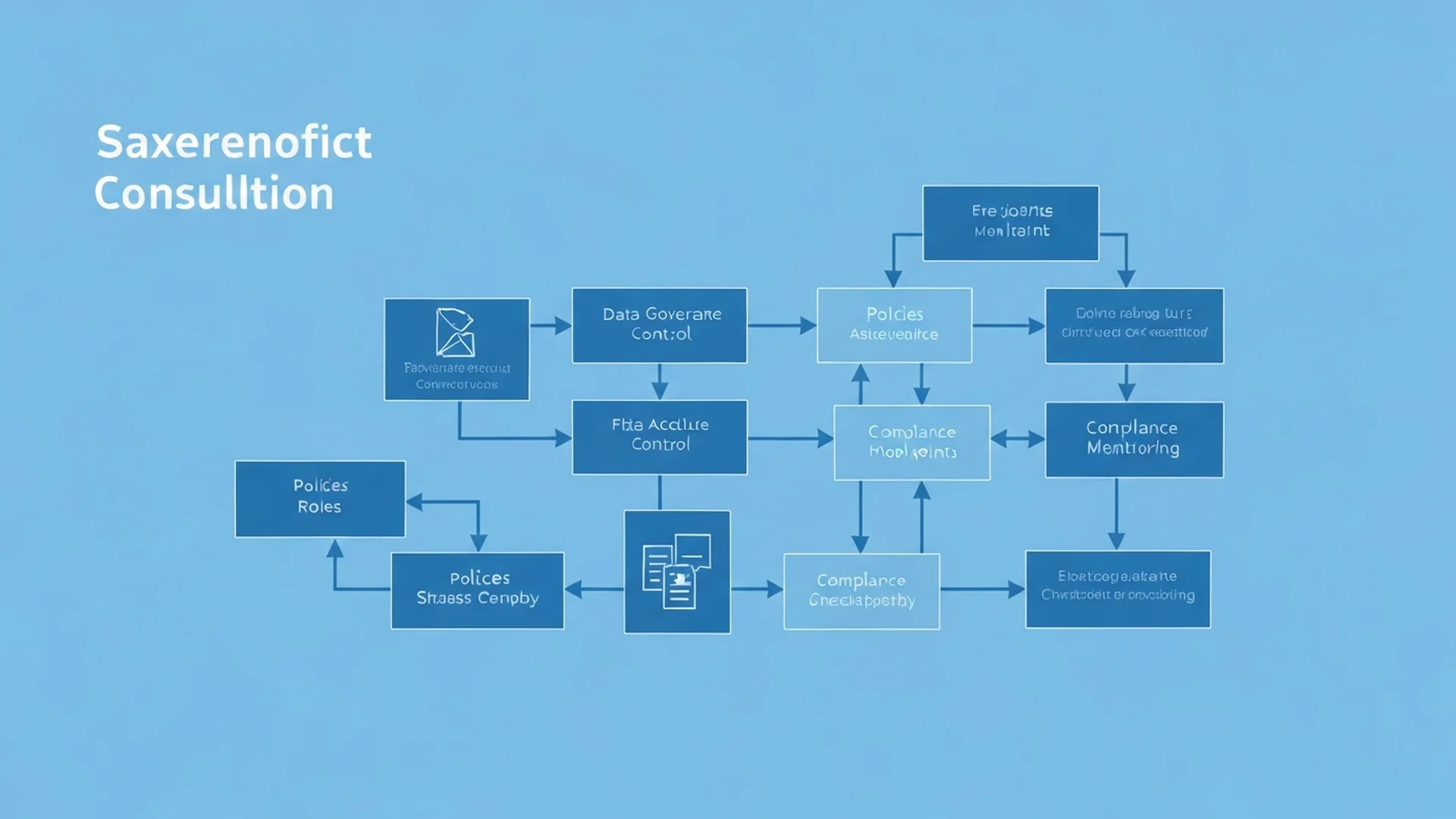
The Governance Triangle
Effective governance balances three key elements:
1. Security
- Data protection
- Access control
- Compliance requirements
- Audit trails
2. Productivity
- User experience
- Self-service capabilities
- Collaboration tools
- Search effectiveness
3. Manageability
- IT workload
- Automation
- Scalability
- Cost control
Core Governance Components
Site Provisioning
Implement controlled site creation:
- Approval Workflows: Require business justification
- Naming Conventions: Enforce consistent naming
- Templates: Pre-configured site templates
- Lifecycle Policies: Automatic review and archival
Information Architecture
Define your content structure:
- Hub Sites: Organize related sites
- Site Hierarchies: Clear organizational structure
- Metadata Taxonomy: Consistent tagging
- Navigation Standards: Intuitive wayfinding
Permission Model
Simplify access management:
- Group-Based Access: Avoid individual permissions
- Inheritance: Leverage permission inheritance
- External Sharing: Control guest access
- Sensitivity Labels: Classify and protect content
Content Lifecycle
Manage content from creation to deletion:
- Retention Policies: Automatic retention
- Disposition Reviews: Human oversight for critical content
- Archive Strategies: Move inactive content
- Deletion Workflows: Controlled content removal
Implementation Roadmap
Phase 1: Assessment (Weeks 1-4)
- Audit current environment
- Document existing practices
- Identify pain points
- Define requirements
Phase 2: Design (Weeks 5-8)
- Create governance framework
- Define policies and procedures
- Design implementation approach
- Develop training materials
Phase 3: Pilot (Weeks 9-12)
- Deploy to pilot group
- Gather feedback
- Refine policies
- Document learnings
Phase 4: Rollout (Weeks 13-20)
- Organization-wide deployment
- Training execution
- Communication campaign
- Support establishment
Phase 5: Optimization (Ongoing)
- Monitor compliance
- Gather feedback
- Continuous improvement
- Regular reviews
Automation Opportunities
Power Automate Workflows
- Site request approval
- Permission reviews
- Content classification
- Lifecycle notifications
SharePoint Premium Features
- Content understanding
- Document processing
- eSignature integration
- Advanced analytics
Measuring Success
Track these governance KPIs:
- Compliance Rate: Percentage of sites following policies
- Site Sprawl: Growth rate of new sites
- Permission Health: Oversharing incidents
- User Satisfaction: Governance friction scores
Common Pitfalls
- Over-Governing: Too many restrictions reduce adoption
- Under-Governing: Too few controls create chaos
- Ignoring Users: Not involving business users in design
- Static Policies: Not updating governance as needs change
Conclusion
Effective SharePoint governance enables your organization to harness the full power of Microsoft 365 while maintaining security and compliance. The key is finding the right balance for your specific needs.
Let our governance experts help you build a framework tailored to your organization.
Enterprise Implementation Best Practices
In our 25+ years managing enterprise SharePoint environments for Fortune 500 organizations, we have identified the governance practices that consistently separate high-performing deployments from chaotic ones. A governance framework is only as effective as its implementation, and the following best practices ensure your policies translate into real operational outcomes.
- Start with Executive Sponsorship: Governance without executive backing fails. Secure a C-level sponsor who understands that governance protects the organization and enables productivity rather than restricting it. This sponsor should chair a quarterly governance review board that includes representatives from IT, legal, compliance, and key business units.
- Establish a Governance Council: Form a cross-functional team of 8 to 12 members representing IT operations, information security, legal, compliance, and business stakeholders. This council owns the governance charter, reviews policy exceptions, and drives continuous improvement. Meeting monthly keeps governance responsive without overwhelming participants.
- Adopt a Tiered Governance Model: Not all sites require the same level of control. Classify your SharePoint sites into tiers based on data sensitivity and business criticality. Tier 1 sites containing regulated data such as HIPAA-protected health records or SOC 2-controlled financial information require strict controls including mandatory sensitivity labels, restricted sharing, and quarterly access reviews. Tier 2 sites for general business use need moderate controls. Tier 3 sites for team collaboration can operate with lighter governance to encourage adoption.
- Automate Policy Enforcement: Manual governance does not scale. Use Power Automate workflows to enforce naming conventions, trigger access reviews, notify site owners of policy violations, and manage content lifecycle automatically. Automation reduces IT workload while ensuring consistent policy application across thousands of sites.
- Create Self-Service Guardrails: Rather than requiring IT approval for every action, implement guardrails that guide users toward compliant behavior. Pre-approved site templates, managed metadata term sets, and sensitivity label recommendations allow business users to work independently while staying within governance boundaries.
- Document Everything in a Living Governance Portal: Publish your governance policies, procedures, and training materials on a dedicated SharePoint hub site. Include decision trees for common scenarios, request forms for exceptions, and a FAQ section addressing the most frequent governance questions. Keep this portal current as policies evolve.
Governance and Compliance Considerations
SharePoint governance directly impacts your organization's ability to meet regulatory requirements across healthcare, financial services, government, and other compliance-heavy industries. A well-designed governance framework is not merely a best practice but a regulatory necessity for organizations handling sensitive data.
For organizations subject to HIPAA, your SharePoint governance must include controls for protected health information including access logging, minimum necessary access enforcement, and business associate agreement tracking for any external sharing. Sensitivity labels should automatically apply encryption to documents containing PHI, and your retention policies must align with HIPAA's six-year minimum retention requirement for covered records.
Financial services organizations operating under SOC 2 requirements need governance controls that demonstrate the security, availability, processing integrity, confidentiality, and privacy of customer data. Your governance framework should map directly to SOC 2 trust service criteria, with automated evidence collection for audit readiness. SharePoint audit logs, access reviews, and change management records all serve as SOC 2 evidence.
Government agencies and contractors subject to FedRAMP or CMMC must implement governance controls that satisfy federal security requirements. This includes FIPS 140-2 compliant encryption for data at rest and in transit, strict access controls based on security clearance levels, and comprehensive audit trails that meet NIST 800-53 control families.
Regardless of your specific regulatory environment, your governance framework should include data classification policies that identify and protect sensitive content, retention schedules that comply with applicable regulations and litigation hold requirements, incident response procedures for unauthorized access or data breaches, and regular compliance assessments that verify governance controls are functioning as designed. Working with experienced SharePoint consultants who understand your regulatory landscape ensures your governance framework addresses compliance requirements from day one rather than retrofitting controls after an audit finding.
Measuring Success and ROI
Quantifying the return on investment of your SharePoint governance framework requires tracking both operational metrics and business outcomes. Organizations that implement comprehensive governance typically see a 40 to 60 percent reduction in help desk tickets related to permissions and access issues within the first six months.
Key metrics to track include policy compliance rate targeting 95 percent or higher across all site classifications, mean time to provision new sites which should decrease from weeks to hours with automated workflows, external sharing incidents which should trend toward zero unauthorized shares per quarter, storage optimization measured by percentage reduction in redundant and obsolete content, and user satisfaction scores from quarterly governance friction surveys targeting 4.0 or higher on a 5-point scale. Track the cost avoidance from preventing data breaches and compliance violations. A single HIPAA violation can cost $50,000 to $1.5 million per incident, making governance investment a fraction of potential penalty exposure.
Ready to build a governance framework that protects your organization while enabling productivity? Our governance specialists have helped hundreds of enterprises design and implement SharePoint governance programs that satisfy auditors and empower users. Contact our team for a complimentary governance assessment and discover how our SharePoint consulting services can transform your environment. Our SharePoint support team provides ongoing governance monitoring and optimization to ensure your framework remains effective as your organization evolves, Microsoft releases new capabilities, and regulatory requirements change. Governance is a continuous discipline, not a one-time project, and the organizations that treat it as such consistently outperform their peers in security posture, regulatory compliance, user satisfaction, and overall return on their Microsoft 365 investment across the entire enterprise and every business unit within it.
Common Challenges and Solutions
Organizations implementing Building Enterprise SharePoint Governance Framework consistently encounter obstacles that, if left unaddressed, undermine adoption and erode stakeholder confidence. Drawing on two decades of enterprise SharePoint consulting, these are the challenges we see most frequently and the proven approaches for overcoming them.
Challenge 1: Content Sprawl and Information Architecture Degradation
Over time, Building Enterprise SharePoint Governance Framework environments accumulate redundant, outdated, and trivial content that degrades search relevance and confuses users. Without proactive content lifecycle management, the signal-to-noise ratio deteriorates and user trust in the platform erodes. The resolution requires a structured approach: establishing automated retention policies that flag content for review after defined periods of inactivity, combined with content owner accountability structures that assign clear responsibility for each site collection and library. Organizations that address this proactively report 40 to 60 percent fewer support tickets within the first 90 days of deployment. Establishing a dedicated governance committee with representatives from IT, compliance, and business stakeholders ensures ongoing alignment between technical configuration and organizational objectives.
Challenge 2: Compliance and Audit Readiness Gaps
Building Enterprise SharePoint Governance Framework implementations in regulated industries often lack the audit trail depth and policy enforcement rigor required by frameworks such as HIPAA, SOC 2, and GDPR. Retroactive compliance remediation is significantly more expensive and disruptive than building compliance into the initial design. We recommend embedding compliance requirements into the information architecture from day one. Configure Microsoft Purview retention labels, DLP policies, and audit logging before deploying content, and validate compliance posture through regular internal audits. Tracking these metrics through SharePoint health dashboards provides early warning indicators that allow administrators to intervene before minor issues become systemic problems affecting enterprise-wide productivity.
Challenge 3: Inconsistent Governance Across Business Units
When different departments implement Building Enterprise SharePoint Governance Framework independently, inconsistent naming conventions, metadata schemas, and security configurations create silos that undermine cross-functional collaboration and complicate compliance reporting. The most effective mitigation strategy involves centralizing governance policy definition while allowing controlled flexibility at the departmental level. A hub-and-spoke governance model balances enterprise consistency with departmental autonomy. Enterprises operating in regulated industries such as healthcare and financial services must pay particular attention to this challenge because compliance violations carry significant financial and reputational consequences. Regular audits conducted quarterly at minimum help organizations maintain alignment with evolving regulatory requirements and internal policy updates.
Challenge 4: Migration and Legacy Content Complexity
Organizations transitioning legacy content into Building Enterprise SharePoint Governance Framework often underestimate the complexity of mapping old structures, metadata, and permissions to modern architectures. Failed migrations erode user confidence and create parallel systems that duplicate effort. Addressing this requires conducting thorough pre-migration content audits that classify and prioritize content based on business value. Invest in automated migration tools that preserve metadata fidelity and permission integrity while providing detailed validation reports. Organizations that invest in structured change management programs achieve adoption rates 35 percent higher than those relying on organic discovery alone. Executive sponsorship combined with department-level champions creates the organizational momentum necessary for sustained success.
Integration with Microsoft 365 Ecosystem
Building Enterprise SharePoint Governance Framework does not operate in isolation. Its value multiplies when connected to the broader Microsoft 365 ecosystem, creating unified workflows that eliminate context switching and reduce manual data transfer between applications.
Microsoft Teams Integration: Embed Building Enterprise SharePoint Governance Framework dashboards and document libraries as Teams tabs to create unified workspaces where conversations and structured content management coexist within a single interface. Teams channels automatically provision SharePoint document libraries, which means building enterprise sharepoint governance framework configurations and content flow seamlessly between collaborative conversations and structured document management. Users can surface SharePoint content directly within Teams tabs, reducing the friction that typically causes adoption to stall.
Power Automate Workflows: Implement scheduled flows that perform routine Building Enterprise SharePoint Governance Framework maintenance tasks including permission reports, content audits, and usage analytics without requiring manual intervention. Automated workflows triggered by SharePoint events such as document uploads, metadata changes, or approval completions eliminate repetitive manual tasks. Organizations typically automate 15 to 25 processes within the first quarter, saving an average of 8 hours per week per department. These automations also create audit trails that satisfy compliance requirements for regulated industries.
Power BI Analytics: Build executive dashboards that aggregate Building Enterprise SharePoint Governance Framework metrics alongside other business KPIs, providing a holistic view of digital workplace effectiveness and investment returns. Connecting SharePoint data to Power BI dashboards provides real-time visibility into content usage patterns, adoption metrics, and operational KPIs. Decision makers gain actionable intelligence without requiring manual report generation, enabling faster response to emerging trends and potential issues.
Microsoft Purview and Compliance: Implement retention policies that automatically manage Building Enterprise SharePoint Governance Framework content lifecycle, preserving business-critical records for required periods while disposing of transient content to reduce storage costs and compliance exposure. Sensitivity labels, data loss prevention policies, and retention schedules configured in Microsoft Purview extend automatically to building enterprise sharepoint governance framework content. This unified compliance framework ensures that governance policies apply consistently across the entire Microsoft 365 environment rather than requiring separate configuration for each workload. For organizations subject to HIPAA, SOC 2, or FedRAMP requirements, this integrated approach significantly reduces compliance management overhead.
Getting Started: Next Steps
Implementing Building Enterprise SharePoint Governance Framework effectively requires more than technical configuration. It demands a strategic approach grounded in your organization's specific business requirements, compliance obligations, and growth trajectory. The difference between a deployment that delivers measurable ROI and one that becomes shelfware often comes down to the quality of upfront planning and expert guidance.
Begin with a focused assessment of your current SharePoint environment. Evaluate your existing information architecture, permission structures, content lifecycle policies, and user adoption patterns. Identify gaps between your current state and the target state required for successful building enterprise sharepoint governance framework implementation. This assessment typically takes 2 to 4 weeks and produces a prioritized roadmap that aligns technical work with business outcomes.
Our SharePoint specialists have guided organizations across healthcare, financial services, government, and education through hundreds of successful implementations. We bring deep expertise in SharePoint architecture, governance frameworks, and compliance alignment that accelerates time to value while minimizing risk.
Ready to move forward? Contact our team for a complimentary consultation. We will assess your environment, identify quick wins, and develop a phased implementation plan tailored to your organization's needs and timeline. Whether you are starting from scratch or optimizing an existing deployment, our enterprise SharePoint consultants deliver the depth and accountability enterprise SharePoint work requires.
For the policy framework itself — the governance document, roles and decision rights rather than the rollout schedule — see the SharePoint governance framework.
Written by the SharePoint Support Team
Senior SharePoint Consultants | 25+ Years Microsoft Ecosystem Experience
Our senior SharePoint consultants bring deep expertise spanning 500+ enterprise migrations and compliance implementations across HIPAA, SOC 2, and FedRAMP environments. We cover SharePoint Online, Microsoft 365, migrations, Copilot readiness, and large-scale governance.
Expert SharePoint Services
Frequently Asked Questions
What should a SharePoint governance framework include?▼
How do we enforce SharePoint governance without slowing down users?▼
Who should own SharePoint governance in an enterprise?▼
How often should we review and update our SharePoint governance policies?▼
Need Expert Help?
Our SharePoint consultants are ready to help you implement these strategies in your organization.
Continue Reading in Governance
Microsoft 365 Archive: Complete Guide to Long-term Content Storage Strategy
Develop a comprehensive archival strategy for Microsoft 365 that balances compliance requirements, storage costs, and content accessibility.
GovernanceInformation Architecture Planning for SharePoint Success
Master the art of SharePoint information architecture with proven planning frameworks, taxonomy design principles, and navigation strategies that scale across the enterprise.
GovernanceSharePoint Term Store and Taxonomy Guide
Master the SharePoint Term Store with this comprehensive guide covering taxonomy design, managed metadata implementation, and enterprise content classification strategies.
GovernanceSharePoint Site Templates: Enterprise Guide
Learn how to create, manage, and deploy SharePoint site templates to ensure consistent site provisioning, branding, and governance across your organization.
GovernanceSharePoint ROI: Building the Business Case Investment
How to calculate SharePoint ROI for your organization. Includes real productivity metrics, cost savings data, compliance risk reduction, and a business case template for IT leaders to present to C-suite executives.
GovernanceSharePoint Governance Policy Template
Ready-to-use SharePoint governance policy template covering site creation, naming conventions, permissions, external sharing, content lifecycle, and Microsoft 365 Copilot governance.