How to Plan Information Architecture for SharePoint at Enterprise Scale
Information architecture planning for SharePoint defines how content is organized, classified, navigated, and governed across your entire tenant, establishing the structural foundation that determines whether users can find what they need or abandon SharePoint in frustration. A well-planned information architecture scales from dozens to thousands of sites while maintaining consistency, usability, and compliance.
In our 25+ years of designing SharePoint information architectures for Fortune 500 organizations, healthcare systems, and government agencies, we have learned that information architecture decisions made during the first months of deployment echo for years afterward. Fixing a bad information architecture after content has accumulated is an order of magnitude more expensive than designing it correctly from the start. This guide covers the principles, planning processes, and implementation strategies for enterprise SharePoint information architecture.
Core Principles of SharePoint Information Architecture
User-Centered Design
Information architecture must be designed around how users seek and organize information, not how IT departments categorize data. Conduct user research to understand the mental models, vocabulary, and information-seeking behaviors of your workforce. Card sorting exercises, where users group sample content into categories, reveal natural organization patterns that should inform your site and navigation structure.
Findability Over Organization
The primary goal of information architecture is findability. Users must be able to locate content quickly whether they browse through navigation, search by keyword, or filter by metadata. Invest in all three pathways rather than relying exclusively on hierarchical navigation.
Scalability
Design for ten times your current content volume. An architecture that works for 100 sites must accommodate 1000 sites without fundamental restructuring. Use patterns like hub sites, content types, and managed metadata that scale naturally rather than rigid hierarchies that break under growth. For the full hub site implementation playbook — including hub-of-hubs patterns, navigation inheritance, and compliance mapping — see our SharePoint hub sites complete guide.
Planning Process
Step 1: Content Inventory
Audit your existing content across all repositories including file shares, legacy SharePoint, network drives, and cloud storage. Classify content by type, ownership, sensitivity, access frequency, and regulatory requirements. This inventory informs the scope of your information architecture.
Step 2: User Research
Interview representatives from each department and role. Understand what content they create, what content they need from others, how they search for information, and what frustrations they experience with current systems. Map user journeys for the five most common information-seeking tasks.
Step 3: Taxonomy Design
Design the taxonomy that will classify content across the tenant. This includes managed metadata term sets for enterprise-wide classification, content types for standardized document categories, and site classification for governance and compliance labeling.
```
Enterprise Taxonomy:
Departments: (HR, Finance, IT, Operations, Sales, Marketing)
Document Types: (Policy, Contract, Report, Proposal, SOP, Form)
Projects: (managed list of active projects)
Regions: (NA, EMEA, APAC, LATAM)
Sensitivity: (Public, Internal, Confidential, Highly Confidential)
```
Step 4: Site Architecture Design
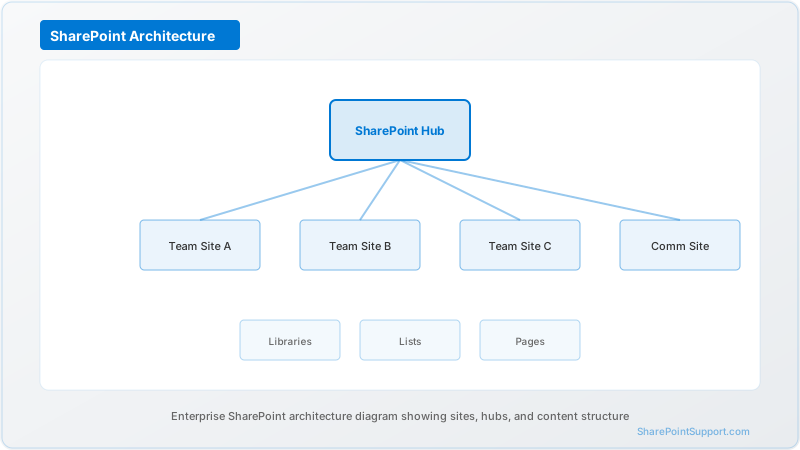
Design the hub site structure that organizes sites by business function. Define which sites will be communication sites for publishing content and which will be team sites for collaboration. Map the association between sites and hubs.
```
Intranet Hub (Communication Site)
HR Hub (Benefits, Policies, Onboarding)
IT Hub (Self-Service, Security, Tools)
Finance Hub (Policies, Reports, Tools)
Operations Hub (Facilities, Safety)
Projects Hub (Individual project team sites)
```
Step 5: Navigation Design
Design global navigation that appears across all hub-associated sites, hub-level navigation for sites within a specific business area, and local navigation for individual site content. Use audience targeting to show relevant navigation links to different user groups.
Metadata Strategy
Managed Metadata vs Choice Columns
Use managed metadata columns for enterprise-wide values that must be consistent across all sites. Use choice columns for values that are specific to a single list or library. Managed metadata provides type-ahead suggestions, synonyms, hierarchical terms, and centralized management through the Term Store.
Metadata Governance
Assign term store administrators responsible for maintaining the taxonomy. Establish a process for requesting new terms with review and approval. Audit metadata compliance quarterly to ensure content is tagged correctly.
Search Architecture
Managed Properties
Configure managed properties in the search schema to map your metadata columns to searchable and refinable properties. This enables users to filter search results by document type, department, project, and other classification dimensions.
Result Types and Bookmarks
Configure custom result types that display relevant metadata in search results for different content categories. Set up search bookmarks that link frequently searched terms directly to authoritative resources.
Governance Framework
Site Provisioning
Control site creation through provisioning workflows that enforce naming conventions, apply site designs with correct branding and content types, assign classification labels, and route requests through approval.
Content Lifecycle
Define lifecycle policies for content creation, review, archival, and deletion. Automate lifecycle management using retention policies, review reminders, and archival workflows. Without lifecycle governance, information architecture degrades as outdated content accumulates.
Ongoing Maintenance
Information architecture requires ongoing maintenance. Review and update the taxonomy as organizational needs evolve. Audit site structure quarterly to identify sprawl. Update navigation as new sites and content areas are added. Measure findability through search analytics and user feedback.
Hub Sites and Modern Site Topology
The hub site model is the foundation of modern SharePoint information architecture, replacing the legacy managed path and site collection hierarchy with a flexible association model where sites connect to hubs based on their organizational function rather than their position in a rigid tree structure. Hub sites provide shared navigation that appears across all associated sites, aggregated news and content rollup that surfaces information from across the hub, consistent branding and theming, and shared search scope that queries all associated sites simultaneously.
Design your hub topology around the primary organizational dimensions that users think in. A typical enterprise might have hubs for each major department such as HR, Finance, IT, and Operations, plus functional hubs for initiatives like Digital Transformation or Sustainability. Communication sites for publishing content and team sites for collaboration both associate with their relevant hub, creating a cohesive experience where users can navigate between related content regardless of whether it lives in a communication site or a team site.
Taxonomy Design as the Backbone of Findability
A well-designed taxonomy is the single most important investment in SharePoint information architecture because it determines how effectively users can find content through navigation, filtering, and search refinement. Design your taxonomy through a collaborative process that includes stakeholders from IT, communications, records management, and representative business units. Use card sorting exercises where participants organize sample documents into logical categories to discover the natural classification dimensions that align with how users think about their content.
Implement the taxonomy using the SharePoint Term Store, which provides centralized management of terms that can be used as metadata across all sites in the tenant. Create term sets for each classification dimension and configure them as managed metadata columns on content types. This approach ensures consistent terminology across the organization and enables powerful faceted navigation that lets users drill into large document collections using meaningful business attributes rather than memorized folder paths.
Our SharePoint consulting team designs enterprise information architectures that scale across thousands of sites. Contact us for an information architecture workshop and planning engagement.
Information Architecture Anti-Patterns to Avoid
The Org Chart Architecture
The most common mistake is mirroring the organizational hierarchy in the site structure. When departments reorganize, which happens frequently, the entire information architecture must be restructured. Instead, organize by function and business process, which are more stable than organizational reporting lines.
The Everything Site
Avoid creating single sites that attempt to house all content for a large department or business unit. These sites exceed storage limits, become ungovernable, and overwhelm users with irrelevant content. Break large content collections into focused sites organized by function, and associate them with a hub site for unified navigation and search.
The Abandoned Taxonomy
An information architecture plan that is not enforced degrades rapidly. Without governance, users create ad-hoc classifications that diverge from the planned taxonomy. Within 18 months, the actual state of the environment bears little resemblance to the original design. Prevent this by automating taxonomy enforcement through content types, mandatory metadata, and automated classification.
Advanced Information Architecture Techniques
Faceted Navigation Design
Design navigation that supports multiple entry points to the same content. A user looking for a contract might navigate by department, by vendor, by contract type, or by date range. Faceted navigation using metadata filters, managed metadata key filters, and search refiners enables all of these paths simultaneously without duplicating content or creating complex folder hierarchies.
Information Scent and Wayfinding
Apply information scent principles from usability research to your SharePoint navigation design. Every navigation label should clearly indicate what content lies behind it. Avoid jargon, abbreviations, and internal terminology that new employees would not understand. Use descriptive link text rather than generic labels like Resources or Documents. Test navigation labels with actual users using tree testing methods that ask users to find specific content using only the navigation structure.
Content Inventories and Audits
Conduct annual content audits that evaluate the accuracy, completeness, and relevance of content across your SharePoint environment. Use automated tools to identify pages with no views in the past six months, documents with no access in the past year, sites with no content updates in the past quarter, and broken links and orphaned content. Generate audit reports for site owners and set deadlines for remediation.
Information Architecture for AI and Copilot Readiness
Preparing for Microsoft Copilot
Microsoft Copilot for Microsoft 365 relies on well-organized SharePoint content to generate accurate and relevant responses. Organizations with poor information architecture will get poor Copilot results because Copilot cannot find and synthesize information that is buried in disorganized sites, mislabeled documents, or ungoverned content sprawl.
Prepare your information architecture for Copilot by ensuring consistent metadata across all libraries, accurate and descriptive document titles and page content, proper sensitivity labels that prevent Copilot from surfacing restricted information, and clean permission structures that ensure Copilot respects access boundaries.
AI-Driven Content Classification
Leverage SharePoint Premium (formerly Syntex) AI capabilities to automatically classify content according to your taxonomy. Train document understanding models that identify document types, extract metadata values, and apply content types automatically. This AI-driven classification scales to millions of documents and maintains classification accuracy over time as new content is added.
Measuring Information Architecture Effectiveness
Findability Metrics
Track the effectiveness of your information architecture through search analytics. Monitor search success rate measured as searches resulting in a click, time to find information from initial search to opening the target document, search refinement frequency indicating how often users must refine their initial query, and zero-result search queries that indicate content gaps or vocabulary mismatches.
User Satisfaction Surveys
Conduct annual information architecture satisfaction surveys that ask employees how easy it is to find the documents they need, whether the site structure matches their expectations, which content they have difficulty locating, and what improvements they would suggest. Combine quantitative survey data with qualitative interview findings to identify information architecture improvements.
Enterprise Implementation Best Practices
In our 25+ years of enterprise SharePoint consulting, we have designed governance frameworks for organizations spanning healthcare systems with 50,000 employees to financial services firms managing billions in assets. The governance implementations that succeed share a common trait: they balance control with enablement rather than defaulting to restriction.
- Start with a Governance Charter and Executive Sponsorship: Governance without executive backing fails. Secure a C-level sponsor who understands that governance protects the organization and enables productivity rather than restricting it. Document a governance charter that defines scope, authority, roles, decision-making processes, and escalation paths. This charter serves as the constitutional foundation for all governance decisions.
- Adopt a Tiered Governance Model: Not all sites require the same level of control. Classify your SharePoint sites into tiers based on data sensitivity and business criticality. Tier 1 sites containing regulated data require strict controls including mandatory sensitivity labels, restricted sharing, and quarterly access reviews. Tier 2 sites need moderate controls. Tier 3 sites for team collaboration operate with lighter governance to encourage adoption.
- Automate Policy Enforcement at Scale: Manual governance does not scale beyond a few dozen sites. Use Power Automate workflows to enforce naming conventions, trigger access reviews, notify site owners of policy violations, and manage content lifecycle automatically. Automation reduces IT workload while ensuring consistent policy application across thousands of sites.
- Create Self-Service Guardrails: Rather than requiring IT approval for every action, implement guardrails that guide users toward compliant behavior. Pre-approved site templates, managed metadata term sets, and sensitivity label recommendations allow business users to work independently while staying within governance boundaries.
- Establish a Governance Review Cadence: Review governance policies quarterly to account for new Microsoft 365 features, changing compliance requirements, and organizational growth. Conduct a comprehensive governance audit annually that includes permission analysis, storage utilization review, inactive site cleanup, and policy effectiveness measurement.
Governance and Compliance Considerations
Governance frameworks must satisfy the compliance requirements specific to your industry while remaining practical enough for daily operation. The most effective governance frameworks are those designed with regulatory compliance as a core requirement rather than an afterthought.
For HIPAA-regulated healthcare organizations, your governance framework must include specific controls for protected health information including access logging, minimum necessary access enforcement, encryption requirements, and business associate agreement tracking for any external sharing. Sensitivity labels should automatically apply encryption to documents containing PHI, and your retention policies must align with HIPAA's six-year minimum retention requirement.
Financial services organizations operating under SOC 2 need governance controls that demonstrate security, availability, processing integrity, confidentiality, and privacy of customer data. Your governance framework should map directly to SOC 2 trust service criteria, with automated evidence collection for audit readiness. SharePoint audit logs, access reviews, and change management records all serve as SOC 2 evidence.
Government agencies and contractors subject to FedRAMP or CMMC must implement governance controls satisfying federal security requirements including FIPS 140-2 compliant encryption, strict access controls based on security clearance levels, and comprehensive audit trails meeting NIST 800-53 control families.
Regardless of your specific regulatory environment, your governance framework should include data classification policies, retention schedules complying with applicable regulations, incident response procedures, and regular compliance assessments verifying controls function as designed. Working with experienced SharePoint governance consultants who understand your regulatory landscape ensures your framework addresses compliance from day one.
Ready to build a governance framework that protects your organization while enabling productivity? Our governance specialists have helped hundreds of enterprises design SharePoint governance programs that satisfy auditors and empower users. Contact our team for a complimentary governance assessment, and discover how our SharePoint consulting services can transform your compliance posture.
Common Challenges and Solutions
Organizations implementing Information Architecture Planning SharePoint Success consistently encounter obstacles that, if left unaddressed, undermine adoption and erode stakeholder confidence. Drawing on two decades of enterprise SharePoint consulting, these are the challenges we see most frequently and the proven approaches for overcoming them.
Challenge 1: Content Sprawl and Information Architecture Degradation
Over time, Information Architecture Planning SharePoint Success environments accumulate redundant, outdated, and trivial content that degrades search relevance and confuses users. Without proactive content lifecycle management, the signal-to-noise ratio deteriorates and user trust in the platform erodes. The resolution requires a structured approach: establishing automated retention policies that flag content for review after defined periods of inactivity, combined with content owner accountability structures that assign clear responsibility for each site collection and library. Organizations that address this proactively report 40 to 60 percent fewer support tickets within the first 90 days of deployment. Establishing a dedicated governance committee with representatives from IT, compliance, and business stakeholders ensures ongoing alignment between technical configuration and organizational objectives.
Challenge 2: Compliance and Audit Readiness Gaps
Information Architecture Planning SharePoint Success implementations in regulated industries often lack the audit trail depth and policy enforcement rigor required by frameworks such as HIPAA, SOC 2, and GDPR. Retroactive compliance remediation is significantly more expensive and disruptive than building compliance into the initial design. We recommend embedding compliance requirements into the information architecture from day one. Configure Microsoft Purview retention labels, DLP policies, and audit logging before deploying content, and validate compliance posture through regular internal audits. Tracking these metrics through SharePoint health dashboards provides early warning indicators that allow administrators to intervene before minor issues become systemic problems affecting enterprise-wide productivity.
Challenge 3: Inconsistent Governance Across Business Units
When different departments implement Information Architecture Planning SharePoint Success independently, inconsistent naming conventions, metadata schemas, and security configurations create silos that undermine cross-functional collaboration and complicate compliance reporting. The most effective mitigation strategy involves centralizing governance policy definition while allowing controlled flexibility at the departmental level. A hub-and-spoke governance model balances enterprise consistency with departmental autonomy. Enterprises operating in regulated industries such as healthcare and financial services must pay particular attention to this challenge because compliance violations carry significant financial and reputational consequences. Regular audits conducted quarterly at minimum help organizations maintain alignment with evolving regulatory requirements and internal policy updates.
Challenge 4: Migration and Legacy Content Complexity
Organizations transitioning legacy content into Information Architecture Planning SharePoint Success often underestimate the complexity of mapping old structures, metadata, and permissions to modern architectures. Failed migrations erode user confidence and create parallel systems that duplicate effort. Addressing this requires conducting thorough pre-migration content audits that classify and prioritize content based on business value. Invest in automated migration tools that preserve metadata fidelity and permission integrity while providing detailed validation reports. Organizations that invest in structured change management programs achieve adoption rates 35 percent higher than those relying on organic discovery alone. Executive sponsorship combined with department-level champions creates the organizational momentum necessary for sustained success.
Integration with Microsoft 365 Ecosystem
Information Architecture Planning SharePoint Success does not operate in isolation. Its value multiplies when connected to the broader Microsoft 365 ecosystem, creating unified workflows that eliminate context switching and reduce manual data transfer between applications.
Microsoft Teams Integration: Configure Teams notifications that alert stakeholders when Information Architecture Planning SharePoint Success content changes, ensuring that distributed teams stay informed about updates without relying on manual communication workflows. Teams channels automatically provision SharePoint document libraries, which means information architecture planning sharepoint success configurations and content flow seamlessly between collaborative conversations and structured document management. Users can surface SharePoint content directly within Teams tabs, reducing the friction that typically causes adoption to stall.
Power Automate Workflows: Create event-driven automations that respond to Information Architecture Planning SharePoint Success changes in real time, triggering downstream processes such as notifications, data transformations, and cross-system synchronization. Automated workflows triggered by SharePoint events such as document uploads, metadata changes, or approval completions eliminate repetitive manual tasks. Organizations typically automate 15 to 25 processes within the first quarter, saving an average of 8 hours per week per department. These automations also create audit trails that satisfy compliance requirements for regulated industries.
Power BI Analytics: Connect Information Architecture Planning SharePoint Success list and library data to Power BI datasets for advanced analytics that transform raw operational data into strategic business intelligence accessible to decision makers across the organization. Connecting SharePoint data to Power BI dashboards provides real-time visibility into content usage patterns, adoption metrics, and operational KPIs. Decision makers gain actionable intelligence without requiring manual report generation, enabling faster response to emerging trends and potential issues.
Microsoft Purview and Compliance: Configure data loss prevention policies that monitor Information Architecture Planning SharePoint Success content for sensitive information patterns, blocking or restricting sharing actions that could violate compliance requirements. Sensitivity labels, data loss prevention policies, and retention schedules configured in Microsoft Purview extend automatically to information architecture planning sharepoint success content. This unified compliance framework ensures that governance policies apply consistently across the entire Microsoft 365 environment rather than requiring separate configuration for each workload. For organizations subject to HIPAA, SOC 2, or FedRAMP requirements, this integrated approach significantly reduces compliance management overhead.
Getting Started: Next Steps
Implementing Information Architecture Planning SharePoint Success effectively requires more than technical configuration. It demands a strategic approach grounded in your organization's specific business requirements, compliance obligations, and growth trajectory. The difference between a deployment that delivers measurable ROI and one that becomes shelfware often comes down to the quality of upfront planning and expert guidance.
Begin with a focused assessment of your current SharePoint environment. Evaluate your existing information architecture, permission structures, content lifecycle policies, and user adoption patterns. Identify gaps between your current state and the target state required for successful information architecture planning sharepoint success implementation. This assessment typically takes 2 to 4 weeks and produces a prioritized roadmap that aligns technical work with business outcomes.
Our SharePoint specialists have guided organizations across healthcare, financial services, government, and education through hundreds of successful implementations. We bring deep expertise in SharePoint architecture, governance frameworks, and compliance alignment that accelerates time to value while minimizing risk.
Ready to move forward? Contact our team for a complimentary consultation. We will assess your environment, identify quick wins, and develop a phased implementation plan tailored to your organization's needs and timeline. Whether you are starting from scratch or optimizing an existing deployment, our enterprise SharePoint consultants deliver the depth and accountability enterprise SharePoint work requires.
Written by the SharePoint Support Team
Senior SharePoint Consultants | 25+ Years Microsoft Ecosystem Experience
Our senior SharePoint consultants bring deep expertise spanning 500+ enterprise migrations and compliance implementations across HIPAA, SOC 2, and FedRAMP environments. We cover SharePoint Online, Microsoft 365, migrations, Copilot readiness, and large-scale governance.
Expert SharePoint Services
Frequently Asked Questions
What should a SharePoint governance framework include?▼
How do we enforce SharePoint governance without slowing down users?▼
Who should own SharePoint governance in an enterprise?▼
How often should we review and update our SharePoint governance policies?▼
What is the recommended SharePoint site architecture for large enterprises?▼
Need Expert Help?
Our SharePoint consultants are ready to help you implement these strategies in your organization.
Continue Reading in Governance
SharePoint Term Store and Taxonomy Guide
Master the SharePoint Term Store with this comprehensive guide covering taxonomy design, managed metadata implementation, and enterprise content classification strategies.
GovernanceSharePoint Site Templates: Enterprise Guide
Learn how to create, manage, and deploy SharePoint site templates to ensure consistent site provisioning, branding, and governance across your organization.
GovernanceSharePoint ROI: Building the Business Case Investment
How to calculate SharePoint ROI for your organization. Includes real productivity metrics, cost savings data, compliance risk reduction, and a business case template for IT leaders to present to C-suite executives.
GovernanceSharePoint Governance Policy Template
Ready-to-use SharePoint governance policy template covering site creation, naming conventions, permissions, external sharing, content lifecycle, and Microsoft 365 Copilot governance.
GovernanceSharePoint Document Library Best Practices: Complete Setup Guide for 2026
Master SharePoint document library configuration. Covers metadata columns, content types, views, version history, retention labels, permissions, co-authoring, and performance optimization for enterprise libraries.
GovernanceSharePoint Metadata and Taxonomy Guide
Build a scalable enterprise metadata and taxonomy strategy for SharePoint. Learn managed metadata, term stores, content types, columns, and how to drive user adoption.