SharePoint Term Store and Taxonomy: The Definitive Enterprise Guide
The SharePoint Term Store is the enterprise taxonomy engine that transforms chaotic folder structures into intelligent, metadata-driven content discovery. In our 25+ years managing SharePoint for Fortune 500 companies, we have seen the Term Store reduce search time by 60 percent and eliminate the complaints that plague most enterprise SharePoint deployments when users cannot find anything.
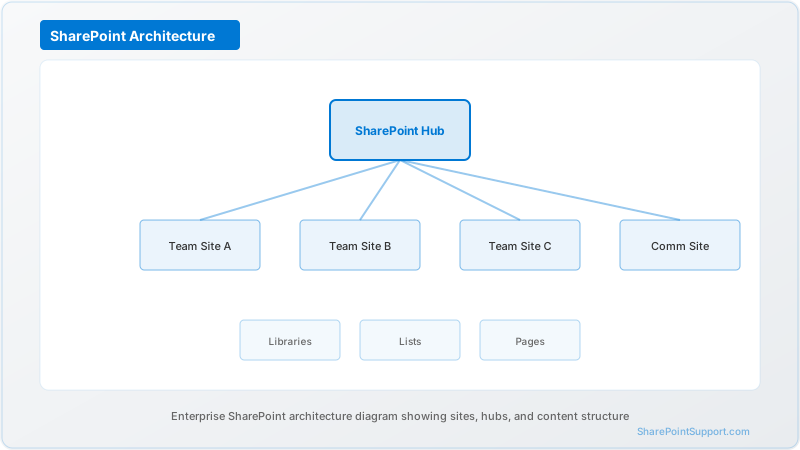
This guide covers Term Store fundamentals, taxonomy design principles, implementation steps, advanced patterns, and governance practices drawn from real enterprise deployments.
---
What Is the SharePoint Term Store?
The Term Store is a centralized metadata management service in SharePoint Online and SharePoint Server that lets you create, manage, and apply a standardized vocabulary across your entire Microsoft 365 tenant. Instead of relying on folder paths that only the creator understands, every document gets tagged with consistent, hierarchical terms that make it findable by anyone.
The Term Store lives in the SharePoint Admin Center under Content Services. It supports term groups which define security boundaries, term sets which are collections of related terms, and individual terms which are the actual labels applied to content. Terms can have synonyms, translations, and parent-child relationships, giving you the flexibility to model any organizational taxonomy.
Term Store Components Explained
Term Groups are the top-level containers that control who can manage terms. A term group has designated group managers who can create and modify term sets within that group. Use term groups to separate enterprise-wide terms managed by IT from departmental terms managed by business units.
Term Sets are collections of related terms that represent a single classification dimension. Examples include Department, Document Type, Region, Project, and Confidentiality Level. Each term set can be open (anyone can add terms) or closed (only designated contributors can modify it).
Terms are the individual values within a term set. Terms can have child terms creating a hierarchy, synonyms that map alternative labels to the same concept, and translations for multilingual organizations. Each term has a unique GUID that persists even when the term label changes.
---
Why Enterprise SharePoint Fails Without Proper Taxonomy
Without a managed taxonomy, SharePoint environments devolve into chaos within 18 to 24 months. We see the same pattern repeatedly across organizations of every size. Departments create their own naming conventions, site structures become nested six or seven levels deep, search returns irrelevant results because there are no consistent metadata tags, and users revert to emailing files because they cannot find what they need in SharePoint.
In a recent engagement with a 5,000-user healthcare organization, their SharePoint environment had 47,000 documents with zero metadata tags. Users spent an average of 8.2 minutes searching for each document. After implementing a Term Store taxonomy with 340 managed terms across 12 term sets, average search time dropped to 1.4 minutes, a 73 percent improvement that translated to thousands of hours of productivity saved annually.
The Cost of No Taxonomy
Calculate the business impact for your organization. If 2,000 knowledge workers each waste 20 minutes per day searching for documents, that equals 667 hours of lost productivity per day, or over 170,000 hours annually. At an average loaded cost of 75 dollars per hour, that represents 12.75 million dollars in annual productivity loss. A well-implemented taxonomy typically recovers 50 to 70 percent of that waste.
---
Designing Your Term Store Architecture
Start with Business Needs, Not Technology
The biggest mistake we see is IT teams building taxonomy in isolation. Your Term Store should reflect how business users think about content, not how IT wants to organize it. Conduct interviews with stakeholders from every department to understand how they categorize, search for, and share documents.
Create a taxonomy working group with representatives from major departments: Legal, HR, Finance, Operations, IT, Marketing, and any industry-specific functions. This group should meet weekly during the design phase and monthly once the taxonomy is deployed.
Use the MECE Principle
Terms should be Mutually Exclusive and Collectively Exhaustive within each term set. Every document should map to exactly one term per term set (mutually exclusive), and the terms should cover all possible values (collectively exhaustive). This prevents confusion and ensures consistent tagging.
Good example: A Document Type term set with Policy, Procedure, Template, Report, Contract, and Correspondence. Every document fits one category, and the categories cover all document types in the organization.
Bad example: A Document Type term set with Policy, Procedure, Template, Important Documents, and Old Files. The last two overlap with the first three and are subjective rather than objective classifications.
Plan for Hierarchy Depth
We recommend no more than four levels of hierarchy in any term set. Deeper hierarchies become difficult to navigate and maintain. If you need more granularity, consider splitting into multiple term sets rather than nesting deeper.
Recommended structure:
- Level 1: Broad category (Department)
- Level 2: Sub-category (Division)
- Level 3: Specific area (Team)
- Level 4: Specialized function (only if necessary)
---
Implementing Term Store in SharePoint Online
Step 1: Create Term Groups
Create one group for enterprise-wide terms managed by IT governance and separate groups for departmental terms managed by department leads. This balances central control with departmental flexibility.
Navigate to the SharePoint Admin Center, select Content services, then Term store. Create your enterprise term group first, then add departmental groups with appropriate managers assigned.
Step 2: Build Core Term Sets
Start with the term sets that provide the most value across the organization. Common enterprise term sets include Department or Business Unit covering HR, Finance, Legal, and Operations. Document Type covering Policy, Procedure, Template, Report, and Contract. Project or Initiative aligned with portfolio management. Region or Location for multi-site organizations. Confidentiality Level covering Public, Internal, Confidential, and Restricted.
Step 3: Configure Managed Metadata Columns
Create site columns of type Managed Metadata that connect to your term sets. Add these columns to content types so they appear automatically on every document library that uses those content types. This ensures consistent metadata capture without requiring users to remember which columns to fill in.
```powershell
# Create a managed metadata site column using PnP PowerShell
Add-PnPField -DisplayName "Document Type" -InternalName "DocType" -Type TaxonomyFieldType -Group "Enterprise Metadata" -TermSetPath "Enterprise|Document Type"
# Add the column to a content type
Add-PnPFieldToContentType -Field "DocType" -ContentType "Enterprise Document"
```
Step 4: Set Up Default Values and Required Fields
Make critical metadata columns required so users cannot upload documents without tagging them. Set smart defaults where possible. Documents uploaded to the HR department site should default to HR for the Department term. This reduces friction and improves tagging consistency.
Step 5: Deploy Content Types to Sites
Use the content type hub to publish content types with managed metadata columns across the entire tenant. When you update a published content type, the changes propagate to all sites automatically.
---
Advanced Term Store Patterns
Tagging Automation with SharePoint Premium
Microsoft 365 now supports AI-powered auto-classification through SharePoint Premium (formerly Syntex). SharePoint Premium models can automatically apply managed metadata based on document content, reducing the manual tagging burden on users. We have seen auto-classification achieve 85 to 92 percent accuracy on well-trained models.
Configure auto-classification by creating a document understanding model in the SharePoint Premium content center, training it on sample documents, and deploying it to specific libraries. The model processes new uploads and applies metadata automatically.
Cross-Site Navigation with Managed Metadata
Use the Term Store to drive consistent navigation across hub sites. By connecting hub navigation to term sets, you can ensure that every site in a hub family shares the same navigation structure. When you update the term set, navigation updates everywhere automatically.
Governance and Term Store Lifecycle
Assign term store administrators and term group managers. Establish a governance process for requesting new terms, retiring obsolete terms, and handling synonyms. Review your taxonomy quarterly to ensure it still reflects how the organization operates.
Create a Term Request list on your governance site where users can submit requests for new terms. Route these requests to the appropriate term group manager for approval. This prevents term sprawl while ensuring the taxonomy evolves with business needs.
---
Common Term Store Mistakes
Too many terms. We recommend starting with 200 to 500 managed terms. More than 1,000 creates cognitive overload for users and makes the taxonomy difficult to govern.
No training. Users need to understand why metadata matters and how to apply it. Build a 15-minute training module and include it in your new employee onboarding process.
Ignoring synonyms. If Sales calls it a proposal and Marketing calls it a pitch deck, add both as synonyms pointing to the same term. This eliminates inconsistency without forcing teams to change their vocabulary.
Not using default column values. Every library should have sensible defaults to minimize manual tagging effort. A library on the Finance site should default the Department column to Finance.
Skipping the pilot. Deploy the taxonomy to two or three sites first, gather feedback for 30 days, adjust, then roll out broadly. Trying to deploy to the entire organization at once leads to poor adoption and difficult corrections.
---
Measuring Taxonomy Success
Track these metrics to validate your taxonomy investment. Search success rate should increase by 30 percent or more within 90 days. Average time to find a document should decrease measurably. Percentage of documents with complete metadata should exceed 80 percent within six months. User satisfaction scores should improve in quarterly surveys. Support tickets related to finding content should decrease.
---
Frequently Asked Questions
Can I import terms from an existing taxonomy?
Yes. The Term Store supports CSV import for bulk term creation. Export your existing taxonomy to CSV format with columns for Term Set Name, Term Set Description, LCID, Available for Tagging, Term Description, Level 1 Term, Level 2 Term, and so on. Import via the Term Store management tool.
What happens to tagged documents when I rename a term?
Documents retain their association because the link is based on the term GUID, not the label. Renaming a term updates the display label everywhere the term appears. This is one of the key advantages of managed metadata over free-text columns.
Can external users see and use managed metadata?
External users can see metadata values on documents they have access to, but they cannot browse the term store or add new terms. Their tagging capability depends on the column configuration and their permission level.
---
For help designing and implementing a SharePoint taxonomy that transforms your content discovery, contact our team for a governance assessment. Our consultants specialize in enterprise SharePoint implementations where metadata strategy directly impacts organizational productivity and compliance.
Enterprise Implementation Best Practices
In our 25+ years of enterprise SharePoint consulting, we have designed metadata architectures for organizations managing millions of documents across hundreds of sites, and the metadata strategy consistently determines whether SharePoint becomes a powerful knowledge platform or an expensive file dump. Organizations that invest in metadata architecture before content migration achieve search satisfaction rates three to five times higher than those that do not.
- Design a Managed Term Store Strategy First: The term store is your metadata foundation. Design a taxonomy that reflects how your organization categorizes and retrieves information rather than replicating departmental silos. Establish term set owners responsible for maintaining vocabulary accuracy, adding new terms through a governed request process, and retiring obsolete terms that clutter the taxonomy.
- Implement Content Types Across Site Collections: Content types provide consistent metadata schemas that travel with documents regardless of their location. Define enterprise content types for your most common document categories and publish them from a content type hub. This approach ensures that a contract, proposal, or technical specification carries the same metadata schema whether it resides in the legal, sales, or engineering SharePoint environment.
- Automate Classification Where Possible: Manual metadata tagging is the weakest link in any metadata strategy because user compliance degrades over time. Deploy SharePoint Premium classifiers to automatically detect and tag document types, extract key metadata values, and apply retention labels based on content analysis. Automation maintains metadata quality at scale without burdening content authors.
- Configure Default Column Values and Validation: Set default metadata values at the folder and library level so that documents inherit appropriate classifications automatically. Implement column validation formulas that prevent incorrect values and provide clear error messages guiding users toward proper classification.
- Train Users on the Value of Metadata: Users who understand why metadata matters comply more consistently than users who view tagging as bureaucratic overhead. Show users how metadata powers search, drives automated workflows, enables compliance, and surfaces relevant content through dynamic views and content rollups. Connect metadata investment to tangible benefits they experience daily.
Governance and Compliance Considerations
Metadata architecture in SharePoint has direct compliance implications because classification accuracy determines whether retention policies, sensitivity labels, access controls, and discovery responses function correctly across your content estate.
For HIPAA-regulated organizations, metadata schemas must include classifications that identify content containing protected health information so that sensitivity labels, retention policies, and access controls can be automatically applied. Inaccurate or missing metadata on PHI-containing documents creates compliance gaps where regulated content may lack required encryption, retention, or access restrictions.
Financial services organizations must ensure metadata classifications support SEC recordkeeping requirements by accurately identifying business records, client communications, and financial documents subject to mandatory retention. Metadata errors that cause records to be classified incorrectly can result in premature deletion of regulated content or failure to produce responsive documents during regulatory examinations.
Government organizations must implement metadata schemas that support security classification markings, handling caveats, and dissemination controls required by applicable information security frameworks and executive orders.
Implement metadata quality monitoring that tracks classification completeness, accuracy, and consistency across your SharePoint environment. Configure reports that identify unclassified documents, documents with inconsistent metadata values, and libraries where metadata compliance falls below acceptable thresholds. Review metadata quality metrics quarterly with content owners and compliance officers, and address classification gaps before they create compliance exposure during audits or discovery requests. Our SharePoint metadata specialists design classification architectures that support compliance automation while remaining practical for content authors.
Ready to build a metadata architecture that powers intelligent content management? Our information architecture specialists have designed metadata strategies for organizations managing millions of documents across complex taxonomies. Contact our team for a metadata assessment, and discover how our SharePoint consulting services can transform your content findability and compliance posture.
Common Challenges and Solutions
Organizations implementing SharePoint Term Store Taxonomy consistently encounter obstacles that, if left unaddressed, undermine adoption and erode stakeholder confidence. Drawing on two decades of enterprise SharePoint consulting, these are the challenges we see most frequently and the proven approaches for overcoming them.
Challenge 1: Content Sprawl and Information Architecture Degradation
Over time, SharePoint Term Store Taxonomy environments accumulate redundant, outdated, and trivial content that degrades search relevance and confuses users. Without proactive content lifecycle management, the signal-to-noise ratio deteriorates and user trust in the platform erodes. The resolution requires a structured approach: establishing automated retention policies that flag content for review after defined periods of inactivity, combined with content owner accountability structures that assign clear responsibility for each site collection and library. Organizations that address this proactively report 40 to 60 percent fewer support tickets within the first 90 days of deployment. Establishing a dedicated governance committee with representatives from IT, compliance, and business stakeholders ensures ongoing alignment between technical configuration and organizational objectives.
Challenge 2: Compliance and Audit Readiness Gaps
SharePoint Term Store Taxonomy implementations in regulated industries often lack the audit trail depth and policy enforcement rigor required by frameworks such as HIPAA, SOC 2, and GDPR. Retroactive compliance remediation is significantly more expensive and disruptive than building compliance into the initial design. We recommend embedding compliance requirements into the information architecture from day one. Configure Microsoft Purview retention labels, DLP policies, and audit logging before deploying content, and validate compliance posture through regular internal audits. Tracking these metrics through SharePoint health dashboards provides early warning indicators that allow administrators to intervene before minor issues become systemic problems affecting enterprise-wide productivity.
Challenge 3: Inconsistent Governance Across Business Units
When different departments implement SharePoint Term Store Taxonomy independently, inconsistent naming conventions, metadata schemas, and security configurations create silos that undermine cross-functional collaboration and complicate compliance reporting. The most effective mitigation strategy involves centralizing governance policy definition while allowing controlled flexibility at the departmental level. A hub-and-spoke governance model balances enterprise consistency with departmental autonomy. Enterprises operating in regulated industries such as healthcare and financial services must pay particular attention to this challenge because compliance violations carry significant financial and reputational consequences. Regular audits conducted quarterly at minimum help organizations maintain alignment with evolving regulatory requirements and internal policy updates.
Challenge 4: Migration and Legacy Content Complexity
Organizations transitioning legacy content into SharePoint Term Store Taxonomy often underestimate the complexity of mapping old structures, metadata, and permissions to modern architectures. Failed migrations erode user confidence and create parallel systems that duplicate effort. Addressing this requires conducting thorough pre-migration content audits that classify and prioritize content based on business value. Invest in automated migration tools that preserve metadata fidelity and permission integrity while providing detailed validation reports. Organizations that invest in structured change management programs achieve adoption rates 35 percent higher than those relying on organic discovery alone. Executive sponsorship combined with department-level champions creates the organizational momentum necessary for sustained success.
Integration with Microsoft 365 Ecosystem
SharePoint Term Store Taxonomy does not operate in isolation. Its value multiplies when connected to the broader Microsoft 365 ecosystem, creating unified workflows that eliminate context switching and reduce manual data transfer between applications.
Microsoft Teams Integration: SharePoint Term Store Taxonomy content surfaces directly in Teams channels through embedded tabs and adaptive cards, giving team members instant access to relevant documents and dashboards without leaving their collaborative workspace. Teams channels automatically provision SharePoint document libraries, which means sharepoint term store taxonomy configurations and content flow seamlessly between collaborative conversations and structured document management. Users can surface SharePoint content directly within Teams tabs, reducing the friction that typically causes adoption to stall.
Power Automate Workflows: Build approval workflows that route SharePoint Term Store Taxonomy content through structured review chains, automatically notifying approvers and escalating overdue items to maintain process velocity. Automated workflows triggered by SharePoint events such as document uploads, metadata changes, or approval completions eliminate repetitive manual tasks. Organizations typically automate 15 to 25 processes within the first quarter, saving an average of 8 hours per week per department. These automations also create audit trails that satisfy compliance requirements for regulated industries.
Power BI Analytics: Visualize SharePoint Term Store Taxonomy usage patterns and adoption metrics through Power BI dashboards that update automatically, giving leadership real-time visibility into platform health and user engagement. Connecting SharePoint data to Power BI dashboards provides real-time visibility into content usage patterns, adoption metrics, and operational KPIs. Decision makers gain actionable intelligence without requiring manual report generation, enabling faster response to emerging trends and potential issues.
Microsoft Purview and Compliance: Apply sensitivity labels to SharePoint Term Store Taxonomy content automatically based on classification rules, ensuring that confidential and regulated information receives appropriate protection throughout its lifecycle. Sensitivity labels, data loss prevention policies, and retention schedules configured in Microsoft Purview extend automatically to sharepoint term store taxonomy content. This unified compliance framework ensures that governance policies apply consistently across the entire Microsoft 365 environment rather than requiring separate configuration for each workload. For organizations subject to HIPAA, SOC 2, or FedRAMP requirements, this integrated approach significantly reduces compliance management overhead.
Getting Started: Next Steps
Implementing SharePoint Term Store Taxonomy effectively requires more than technical configuration. It demands a strategic approach grounded in your organization's specific business requirements, compliance obligations, and growth trajectory. The difference between a deployment that delivers measurable ROI and one that becomes shelfware often comes down to the quality of upfront planning and expert guidance.
Begin with a focused assessment of your current SharePoint environment. Evaluate your existing information architecture, permission structures, content lifecycle policies, and user adoption patterns. Identify gaps between your current state and the target state required for successful sharepoint term store taxonomy implementation. This assessment typically takes 2 to 4 weeks and produces a prioritized roadmap that aligns technical work with business outcomes.
Our SharePoint specialists have guided organizations across healthcare, financial services, government, and education through hundreds of successful implementations. We bring deep expertise in SharePoint architecture, governance frameworks, and compliance alignment that accelerates time to value while minimizing risk.
Ready to move forward? Contact our team for a complimentary consultation. We will assess your environment, identify quick wins, and develop a phased implementation plan tailored to your organization's needs and timeline. Whether you are starting from scratch or optimizing an existing deployment, our enterprise SharePoint consultants deliver the depth and accountability enterprise SharePoint work requires.
Written by the SharePoint Support Team
Senior SharePoint Consultants | 25+ Years Microsoft Ecosystem Experience
Our senior SharePoint consultants bring deep expertise spanning 500+ enterprise migrations and compliance implementations across HIPAA, SOC 2, and FedRAMP environments. We cover SharePoint Online, Microsoft 365, migrations, Copilot readiness, and large-scale governance.
Expert SharePoint Services
Frequently Asked Questions
What should a SharePoint governance framework include?▼
How do we enforce SharePoint governance without slowing down users?▼
Who should own SharePoint governance in an enterprise?▼
How often should we review and update our SharePoint governance policies?▼
Can SharePoint replace a traditional document management system?▼
Need Expert Help?
Our SharePoint consultants are ready to help you implement these strategies in your organization.
Continue Reading in Governance
SharePoint Site Templates: Enterprise Guide
Learn how to create, manage, and deploy SharePoint site templates to ensure consistent site provisioning, branding, and governance across your organization.
GovernanceSharePoint ROI: Building the Business Case Investment
How to calculate SharePoint ROI for your organization. Includes real productivity metrics, cost savings data, compliance risk reduction, and a business case template for IT leaders to present to C-suite executives.
GovernanceSharePoint Governance Policy Template
Ready-to-use SharePoint governance policy template covering site creation, naming conventions, permissions, external sharing, content lifecycle, and Microsoft 365 Copilot governance.
GovernanceSharePoint Document Library Best Practices: Complete Setup Guide for 2026
Master SharePoint document library configuration. Covers metadata columns, content types, views, version history, retention labels, permissions, co-authoring, and performance optimization for enterprise libraries.
GovernanceSharePoint Metadata and Taxonomy Guide
Build a scalable enterprise metadata and taxonomy strategy for SharePoint. Learn managed metadata, term stores, content types, columns, and how to drive user adoption.
GovernanceSharePoint Content Types: Enterprise Implementation Guide
Master SharePoint content types to standardize document management across your organization. Learn how to create, configure, and publish content types from the Content Type Hub, associate document templates, and drive consistent metadata at scale.