
The Data Governance Imperative for Copilot
Microsoft Copilot for SharePoint is only as good as the data it can access. Organizations that deploy Copilot without a data governance framework discover that AI amplifies both good practices and bad ones. Clean, well-governed data produces insightful Copilot responses. Ungoverned data produces hallucinations, exposes sensitive information, and erodes user trust.
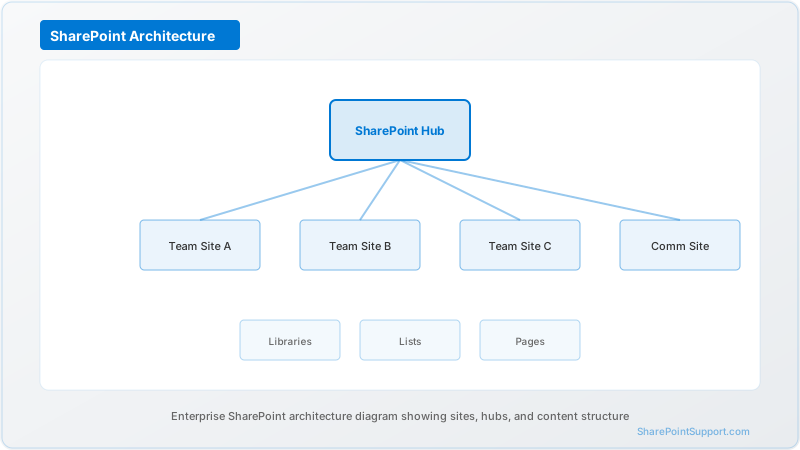
This framework provides the governance structure that enterprise organizations need before, during, and after Copilot enablement. Permission remediation is the single largest work item in any Copilot readiness program — review our SharePoint permissions and security complete guide for the permission audit scripts and remediation patterns every Copilot rollout depends on.
The Copilot Data Governance Maturity Model
Level 1: Chaotic (Most Organizations Start Here)
- No consistent metadata taxonomy
- Permissions inherited and never reviewed
- Duplicate documents across multiple sites
- No sensitivity labels deployed
- Content retention is ad hoc
Level 2: Reactive
- Basic metadata on some libraries
- Annual permission reviews (but not enforced)
- Sensitivity labels on obviously confidential content
- Retention policies for legal holds only
Level 3: Proactive (Minimum for Copilot)
- Consistent metadata taxonomy across all sites
- Quarterly permission reviews with automated remediation
- Sensitivity labels on all content tiers
- Retention policies aligned with regulatory requirements
- Content quality standards enforced
Level 4: Optimized (Target State)
- AI-assisted metadata tagging (auto-classification)
- Real-time permission monitoring and alerting
- Dynamic sensitivity labels based on content analysis
- Automated content lifecycle management
- Continuous governance posture assessment
Most organizations need to reach Level 3 before enabling Copilot. Level 4 is the ongoing optimization target.
Pillar 1: Permission Governance
The Permission Problem
In a typical enterprise SharePoint environment:
- 40-60% of sites have at least one overshared permission
- 15-25% of documents have broken permission inheritance
- 30% of Microsoft 365 Groups have no active owner
- 10-20% of external guest accounts are stale (no login in 90+ days)
Copilot does not bypass permissions — but it makes discoverable what was previously obscured by complexity.
Permission Audit Framework
# Comprehensive SharePoint permission audit script
Connect-PnPOnline -Url "https://contoso-admin.sharepoint.com" -Interactive
$auditResults = @()
$sites = Get-PnPTenantSite -Detailed -Filter "Url -like '/sites/'"
foreach ($site in $sites) {
try {
Connect-PnPOnline -Url $site.Url -Interactive
$web = Get-PnPWeb -Includes RoleAssignments, HasUniqueRoleAssignments
$roleAssignments = Get-PnPProperty -ClientObject $web -Property RoleAssignments
$isOvershared = $false
foreach ($ra in $roleAssignments) {
$member = Get-PnPProperty -ClientObject $ra -Property Member
if ($member.LoginName -match "spo-grid-all-users|everyone") {
$isOvershared = $true
}
}
$group = Get-PnPMicrosoft365Group -IncludeOwners -Identity $site.GroupId -ErrorAction SilentlyContinue
$hasOwner = ($group.Owners.Count -gt 0)
$auditResults += [PSCustomObject]@{
SiteUrl = $site.Url
Template = $site.Template
StorageUsedGB = [math]::Round($site.StorageUsageCurrent / 1024, 2)
IsOvershared = $isOvershared
HasOwner = $hasOwner
ExternalSharing = $site.SharingCapability
LastModified = $site.LastContentModifiedDate
}
} catch {
Write-Warning "Failed to audit: $($site.Url) - $($_.Exception.Message)"
}
}
$auditResults | Export-Csv -Path "CopilotReadiness_PermissionAudit.csv" -NoTypeInformation
$total = $auditResults.Count
$overshared = ($auditResults | Where-Object { $_.IsOvershared }).Count
$noOwner = ($auditResults | Where-Object { -not $_.HasOwner }).Count
Write-Host "Total sites: $total"
Write-Host "Overshared sites: $overshared ($([math]::Round($overshared/$total*100,1))%%)" -ForegroundColor Red
Write-Host "Ownerless sites: $noOwner ($([math]::Round($noOwner/$total*100,1))%%)" -ForegroundColor Yellow
Remediation Playbook
| Finding | Risk Level | Remediation |
|---------|-----------|-------------|
| "Everyone" permissions | Critical | Remove immediately, replace with specific groups |
| Ownerless groups | High | Assign owners or archive site |
| Stale guest access | High | Revoke access, implement 90-day guest review |
| Broken inheritance (docs) | Medium | Review and re-inherit or document exception |
| External sharing enabled | Medium | Restrict to specific domains or disable |
Pillar 2: Content Quality and Metadata
Metadata Taxonomy Design
A well-designed metadata taxonomy makes Copilot dramatically more effective. When documents have structured metadata, Copilot can filter, categorize, and relate content intelligently.
Core metadata columns every SharePoint library should have:
| Column | Type | Purpose |
|--------|------|---------|
| Document Type | Choice | Contract, Policy, Report, Procedure, Template |
| Department | Managed Metadata | Organizational classification |
| Confidentiality | Choice | Public, Internal, Confidential, Restricted |
| Review Date | Date | Next mandatory review date |
| Document Owner | Person | Accountable individual |
| Status | Choice | Draft, In Review, Approved, Archived |
# Deploy standard metadata columns to all team sites
$siteUrls = Get-PnPTenantSite -Filter "Template -eq 'GROUP#0'" | Select-Object -ExpandProperty Url
foreach ($siteUrl in $siteUrls) {
Connect-PnPOnline -Url $siteUrl -Interactive
$existing = Get-PnPField -Identity "EPCDocumentType" -ErrorAction SilentlyContinue
if (-not $existing) {
Add-PnPField -DisplayName "Document Type" -InternalName "EPCDocumentType" -Type Choice -Group "EPC Governance" -Choices "Contract","Policy","Report","Procedure","Template","Presentation","Spreadsheet"
Write-Host "Added Document Type column to $siteUrl" -ForegroundColor Green
}
$existing = Get-PnPField -Identity "EPCReviewDate" -ErrorAction SilentlyContinue
if (-not $existing) {
Add-PnPField -DisplayName "Review Date" -InternalName "EPCReviewDate" -Type DateTime -Group "EPC Governance"
Write-Host "Added Review Date column to $siteUrl" -ForegroundColor Green
}
}
Content Quality Scoring
Before enabling Copilot, score your content quality:
Quality Score Criteria (0-100):
- Title quality (20 points): Descriptive, not "Document1" or "Final_v3"
- Metadata completeness (20 points): All required columns populated
- Freshness (20 points): Updated within expected lifecycle
- Uniqueness (15 points): No near-duplicate documents
- Accessibility (15 points): Proper headings, alt text, readable format
- Sensitivity labeled (10 points): Appropriate label applied
Target: Average content quality score of 70+ before Copilot enablement.
Content Cleanup Automation
# Identify low-quality content for cleanup
Connect-PnPOnline -Url "https://contoso.sharepoint.com/sites/Marketing" -Interactive
$items = Get-PnPListItem -List "Documents" -PageSize 500 -Fields "FileLeafRef","Modified","Editor","File_x0020_Size"
$lowQuality = foreach ($item in $items) {
$fileName = $item.FieldValues.FileLeafRef
$modified = $item.FieldValues.Modified
$size = $item.FieldValues.File_x0020_Size
$issues = @()
if ($fileName -match "^(Document|Book|Presentation|Copy of|New |Untitled)\d*\." ) {
$issues += "Generic filename"
}
if ($modified -lt (Get-Date).AddYears(-2)) {
$issues += "Stale (2+ years)"
}
if ($size -lt 1024) {
$issues += "Nearly empty (less than 1KB)"
}
if ($issues.Count -gt 0) {
[PSCustomObject]@{
FileName = $fileName
LastModified = $modified
SizeKB = [math]::Round($size / 1024, 1)
Issues = ($issues -join "; ")
ItemId = $item.Id
}
}
}
$lowQuality | Export-Csv "ContentCleanup_Candidates.csv" -NoTypeInformation
Write-Host "Found $($lowQuality.Count) items needing cleanup"
Pillar 3: Sensitivity Labels and Information Protection
Label Taxonomy for Copilot
| Label | Copilot Behavior | Use Case |
|-------|-----------------|----------|
| Public | Full access, can summarize and cite | Marketing materials, public docs |
| Internal | Access within organization | Standard business documents |
| Confidential | Access restricted to labeled group | Financial reports, HR documents |
| Highly Confidential | Copilot cannot process | M&A documents, legal privilege |
| Regulated - HIPAA | Copilot restricted + DLP enforced | Patient health information |
| Regulated - Financial | Copilot restricted + DLP enforced | SOX-regulated financials |
Pillar 4: Retention and Lifecycle Management
Retention Policy Alignment
Copilot can surface content of any age. Without retention policies, it may reference a 10-year-old policy document that has been superseded three times.
Retention schedule by content type:
| Content Type | Retention Period | Action at Expiry | Copilot Implication |
|-------------|-----------------|-------------------|---------------------|
| Policies and Procedures | Until superseded + 1 year | Archive | Mark superseded versions clearly |
| Project Documents | Project end + 3 years | Delete | Remove from Copilot scope at project close |
| Financial Records | 7 years (SOX) | Archive | Restrict Copilot access after close |
| Employee Records | Termination + 7 years | Delete | Apply HR sensitivity label |
| Marketing Content | 2 years | Review/Delete | Prevent Copilot citing outdated campaigns |
| Meeting Recordings | 90 days | Delete | Auto-cleanup to prevent storage bloat |
Pillar 5: Governance Monitoring and Continuous Improvement
Copilot Governance Dashboard
Build a Power BI dashboard that monitors:
- Permission health score — percentage of sites with clean permissions
- Content quality score — average metadata completeness
- Label coverage — percentage of documents with sensitivity labels
- Copilot adoption — active users, interaction frequency, satisfaction
- Incident tracking — data exposure events, user complaints, governance violations
Frequently Asked Questions
How long does it take to prepare an enterprise SharePoint environment for Copilot?
For a typical enterprise with 5,000-20,000 users, expect 8-16 weeks of preparation work. This includes permission audits (2-3 weeks), content cleanup (4-6 weeks), sensitivity label deployment (2-3 weeks), and testing (2-3 weeks). Organizations with existing governance programs can move faster.
Can we deploy Copilot to some departments before others?
Yes, and we strongly recommend it. Use Restricted SharePoint Search to limit Copilot's scope during phased rollouts. This allows departments with cleaner governance postures to benefit first while other departments prepare.
What if we find thousands of overshared documents during the audit?
This is normal. Prioritize remediation by risk: (1) documents with sensitivity labels or regulated content, (2) HR and financial sites, (3) executive and legal sites, (4) general content sites. Use automated tools like SharePoint Advanced Management to bulk-remediate.
Does this framework apply to SharePoint on-premises?
No. Microsoft Copilot for SharePoint requires SharePoint Online. If you are running SharePoint 2016/2019 on-premises, you will need to migrate to SharePoint Online before deploying Copilot.
Implementation Timeline
| Week | Phase | Key Activities |
|------|-------|----------------|
| 1-2 | Assessment | Permission audit, content inventory, gap analysis |
| 3-4 | Planning | Governance policies, label taxonomy, remediation plan |
| 5-8 | Remediation | Permission fixes, content cleanup, label deployment |
| 9-10 | Validation | Test Copilot with governance controls, verify restrictions |
| 11-12 | Pilot | Deploy to 50-100 users, monitor governance posture |
| 13-16 | Rollout | Phased department deployment with monitoring |
Our governance practice builds Copilot-ready data governance frameworks for enterprises in healthcare, finance, and government. Our assessments identify every permission gap, content quality issue, and compliance risk before you flip the Copilot switch. Schedule a governance assessment today.
Enterprise Implementation Best Practices
In our 25+ years of enterprise consulting, we have guided dozens of Fortune 500 organizations through AI-powered SharePoint transformations, and the lessons learned consistently point to the same critical success factors. Deploying AI capabilities without proper data preparation leads to poor user experiences, hallucinated responses, and wasted licensing investment.
- Conduct a Data Readiness Assessment First: AI effectiveness depends entirely on the quality and organization of your SharePoint content. Before enabling AI features, audit your content for accuracy, completeness, and proper classification. Remove outdated documents, correct metadata inconsistencies, and ensure sensitivity labels are properly applied. AI models will surface whatever content they can access, so cleaning your data estate prevents the AI from generating responses based on obsolete or incorrect information.
- Implement Oversharing Remediation Before AI Deployment: The single greatest risk with AI in SharePoint is exposing content that users should not access. AI respects SharePoint permissions, which means if your permissions are overly broad, AI becomes a powerful tool for discovering content that was technically accessible but practically hidden. Run access reviews and remediation tools to identify and fix overshared sites, libraries, and documents before rolling out AI capabilities.
- Deploy in Phases with Measurable Success Criteria: Start with a pilot group of 50 to 100 users across different departments. Define specific success metrics including time saved per task, user satisfaction scores, and content discovery accuracy. Monitor these metrics for 30 days before expanding to the next wave. Phased deployment allows you to identify and resolve issues before they affect the entire organization.
- Create a Prompt Library for Your Organization: Develop a curated library of effective prompts tailored to your specific business processes and content types. Include prompts for common scenarios such as summarizing project documentation, drafting communications, and generating reports from list data. Share this library through a dedicated SharePoint site to accelerate adoption.
- Invest Heavily in Change Management: AI changes how people work. Develop role-specific training that demonstrates exactly how AI helps with daily tasks. Create champion networks within departments, host regular office hours, and celebrate early wins to build momentum.
Governance and Compliance Considerations
Deploying AI capabilities in SharePoint introduces governance and compliance dimensions that organizations must address proactively. The AI features that make these tools powerful also create risks if not properly governed within your regulatory framework.
For HIPAA-regulated healthcare organizations, AI's ability to search and summarize content means it could surface protected health information in responses to users who have technical access but no legitimate clinical need. Implement minimum necessary access controls before enabling AI features and configure audit logging to track every AI interaction involving PHI-containing libraries.
Financial services organizations must consider how AI-generated content fits within SEC recordkeeping and FINRA supervision frameworks. If AI drafts client communications or generates investment summaries from SharePoint data, those outputs may require human review, approval documentation, and retention as business records.
Government organizations subject to FedRAMP must verify that AI processing occurs within authorized boundaries and that data handling complies with security clearance requirements. Evaluate whether AI-generated summaries of classified content create derivative classification obligations.
Intellectual property considerations require attention across all industries. Content generated by AI based on your proprietary SharePoint data may contain distilled intellectual property. Establish policies addressing ownership of AI-generated content, restrictions on sharing AI summaries externally, and guidelines for human review before any AI output is used in client-facing or regulatory contexts. Partner with experienced SharePoint consulting professionals to develop AI governance policies that satisfy your compliance requirements while enabling productive use of these transformative capabilities.
Ready to deploy AI-powered capabilities in your SharePoint environment with full compliance alignment? Our specialists have guided enterprises across healthcare, financial services, and government through successful AI implementations. Contact our team for an AI readiness assessment, and discover how our SharePoint consulting services can accelerate your intelligent workplace transformation.
Common Challenges and Solutions
Organizations implementing SharePoint Copilot Readiness consistently encounter obstacles that, if left unaddressed, undermine adoption and erode stakeholder confidence. Drawing on two decades of enterprise SharePoint consulting, these are the challenges we see most frequently and the proven approaches for overcoming them.
Challenge 1: Content Sprawl and Information Architecture Degradation
Over time, SharePoint Copilot Readiness environments accumulate redundant, outdated, and trivial content that degrades search relevance and confuses users. Without proactive content lifecycle management, the signal-to-noise ratio deteriorates and user trust in the platform erodes. The resolution requires a structured approach: establishing automated retention policies that flag content for review after defined periods of inactivity, combined with content owner accountability structures that assign clear responsibility for each site collection and library. Organizations that address this proactively report 40 to 60 percent fewer support tickets within the first 90 days of deployment. Establishing a dedicated governance committee with representatives from IT, compliance, and business stakeholders ensures ongoing alignment between technical configuration and organizational objectives.
Challenge 2: Compliance and Audit Readiness Gaps
SharePoint Copilot Readiness implementations in regulated industries often lack the audit trail depth and policy enforcement rigor required by frameworks such as HIPAA, SOC 2, and GDPR. Retroactive compliance remediation is significantly more expensive and disruptive than building compliance into the initial design. We recommend embedding compliance requirements into the information architecture from day one. Configure Microsoft Purview retention labels, DLP policies, and audit logging before deploying content, and validate compliance posture through regular internal audits. Tracking these metrics through SharePoint health dashboards provides early warning indicators that allow administrators to intervene before minor issues become systemic problems affecting enterprise-wide productivity.
Challenge 3: Inconsistent Governance Across Business Units
When different departments implement SharePoint Copilot Readiness independently, inconsistent naming conventions, metadata schemas, and security configurations create silos that undermine cross-functional collaboration and complicate compliance reporting. The most effective mitigation strategy involves centralizing governance policy definition while allowing controlled flexibility at the departmental level. A hub-and-spoke governance model balances enterprise consistency with departmental autonomy. Enterprises operating in regulated industries such as healthcare and financial services must pay particular attention to this challenge because compliance violations carry significant financial and reputational consequences. Regular audits conducted quarterly at minimum help organizations maintain alignment with evolving regulatory requirements and internal policy updates.
Challenge 4: Migration and Legacy Content Complexity
Organizations transitioning legacy content into SharePoint Copilot Readiness often underestimate the complexity of mapping old structures, metadata, and permissions to modern architectures. Failed migrations erode user confidence and create parallel systems that duplicate effort. Addressing this requires conducting thorough pre-migration content audits that classify and prioritize content based on business value. Invest in automated migration tools that preserve metadata fidelity and permission integrity while providing detailed validation reports. Organizations that invest in structured change management programs achieve adoption rates 35 percent higher than those relying on organic discovery alone. Executive sponsorship combined with department-level champions creates the organizational momentum necessary for sustained success.
Integration with Microsoft 365 Ecosystem
SharePoint Copilot Readiness does not operate in isolation. Its value multiplies when connected to the broader Microsoft 365 ecosystem, creating unified workflows that eliminate context switching and reduce manual data transfer between applications.
Microsoft Teams Integration: Embed SharePoint Copilot Readiness dashboards and document libraries as Teams tabs to create unified workspaces where conversations and structured content management coexist within a single interface. Teams channels automatically provision SharePoint document libraries, which means sharepoint copilot readiness configurations and content flow seamlessly between collaborative conversations and structured document management. Users can surface SharePoint content directly within Teams tabs, reducing the friction that typically causes adoption to stall.
Power Automate Workflows: Implement scheduled flows that perform routine SharePoint Copilot Readiness maintenance tasks including permission reports, content audits, and usage analytics without requiring manual intervention. Automated workflows triggered by SharePoint events such as document uploads, metadata changes, or approval completions eliminate repetitive manual tasks. Organizations typically automate 15 to 25 processes within the first quarter, saving an average of 8 hours per week per department. These automations also create audit trails that satisfy compliance requirements for regulated industries.
Power BI Analytics: Build executive dashboards that aggregate SharePoint Copilot Readiness metrics alongside other business KPIs, providing a holistic view of digital workplace effectiveness and investment returns. Connecting SharePoint data to Power BI dashboards provides real-time visibility into content usage patterns, adoption metrics, and operational KPIs. Decision makers gain actionable intelligence without requiring manual report generation, enabling faster response to emerging trends and potential issues.
Microsoft Purview and Compliance: Implement retention policies that automatically manage SharePoint Copilot Readiness content lifecycle, preserving business-critical records for required periods while disposing of transient content to reduce storage costs and compliance exposure. Sensitivity labels, data loss prevention policies, and retention schedules configured in Microsoft Purview extend automatically to sharepoint copilot readiness content. This unified compliance framework ensures that governance policies apply consistently across the entire Microsoft 365 environment rather than requiring separate configuration for each workload. For organizations subject to HIPAA, SOC 2, or FedRAMP requirements, this integrated approach significantly reduces compliance management overhead.
Getting Started: Next Steps
Implementing SharePoint Copilot Readiness effectively requires more than technical configuration. It demands a strategic approach grounded in your organization's specific business requirements, compliance obligations, and growth trajectory. The difference between a deployment that delivers measurable ROI and one that becomes shelfware often comes down to the quality of upfront planning and expert guidance.
Begin with a focused assessment of your current SharePoint environment. Evaluate your existing information architecture, permission structures, content lifecycle policies, and user adoption patterns. Identify gaps between your current state and the target state required for successful sharepoint copilot readiness implementation. This assessment typically takes 2 to 4 weeks and produces a prioritized roadmap that aligns technical work with business outcomes.
Our SharePoint specialists have guided organizations across healthcare, financial services, government, and education through hundreds of successful implementations. We bring deep expertise in SharePoint architecture, governance frameworks, and compliance alignment that accelerates time to value while minimizing risk.
Ready to move forward? Contact our team for a complimentary consultation. We will assess your environment, identify quick wins, and develop a phased implementation plan tailored to your organization's needs and timeline. Whether you are starting from scratch or optimizing an existing deployment, our enterprise SharePoint consultants deliver the expertise and accountability that Fortune 500 organizations demand.
Written by the SharePoint Support Team
Senior SharePoint Consultants | 25+ Years Microsoft Ecosystem Experience
Our senior SharePoint consultants bring deep expertise spanning 500+ enterprise migrations and compliance implementations across HIPAA, SOC 2, and FedRAMP environments. We cover SharePoint Online, Microsoft 365, migrations, Copilot readiness, and large-scale governance.
Expert SharePoint Services
Frequently Asked Questions
What are the most common SharePoint security vulnerabilities?▼
How do we prevent data leaks through SharePoint external sharing?▼
What SharePoint security features are included with Microsoft 365 E5?▼
How do we audit who accessed sensitive documents in SharePoint?▼
What is the cost of Microsoft 365 Copilot for SharePoint?▼
Need Expert Help?
Our SharePoint consultants are ready to help you implement these strategies in your organization.
Continue Reading in Governance
Your AI Agents Now Have Mailboxes. Your Permission Model Does Not Know That.
Copilot Studio agents can now hold their own Microsoft 365 accounts — mailbox, Teams presence, Office access, governed as first-class identities. Every SharePoint permission construct you own was designed for humans who get hired and leave. There is no HR process for an agent.
GovernanceBuilding an Enterprise SharePoint Governance Framework...
Create a governance framework that balances security with productivity, enabling self-service while maintaining control.
GovernanceMicrosoft 365 Archive: Guide to Long-term Content...
Develop a comprehensive archival strategy for Microsoft 365 that balances compliance requirements, storage costs, and content accessibility.
GovernanceInformation Architecture Planning for SharePoint Success
Master the art of SharePoint information architecture with proven planning frameworks, taxonomy design principles, and navigation strategies that scale across the enterprise.
GovernanceSharePoint Term Store and Taxonomy Guide
Master the SharePoint Term Store with this comprehensive guide covering taxonomy design, managed metadata implementation, and enterprise content classification strategies.
GovernanceSharePoint Site Templates: Enterprise Guide
Learn how to create, manage, and deploy SharePoint site templates to ensure consistent site provisioning, branding, and governance across your organization.