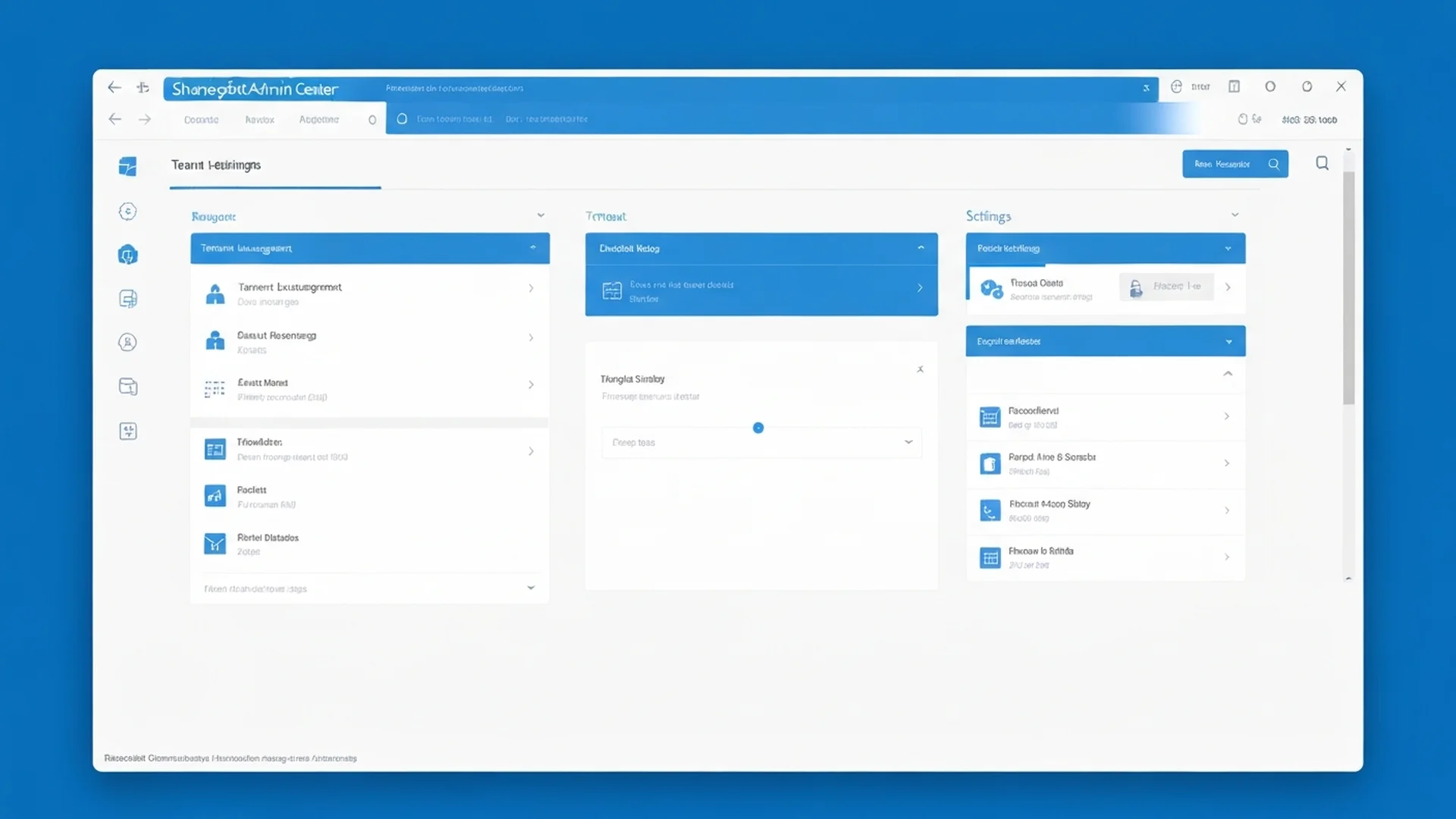
SharePoint Admin Center: Your Administration Command Center
The SharePoint Admin Center is the centralized management interface for SharePoint Online within Microsoft 365. Every administrative task from creating sites to configuring security policies to monitoring storage flows through this console. Effective SharePoint administration requires mastery of its capabilities and a systematic approach to the daily, weekly, and monthly tasks that keep a tenant healthy.
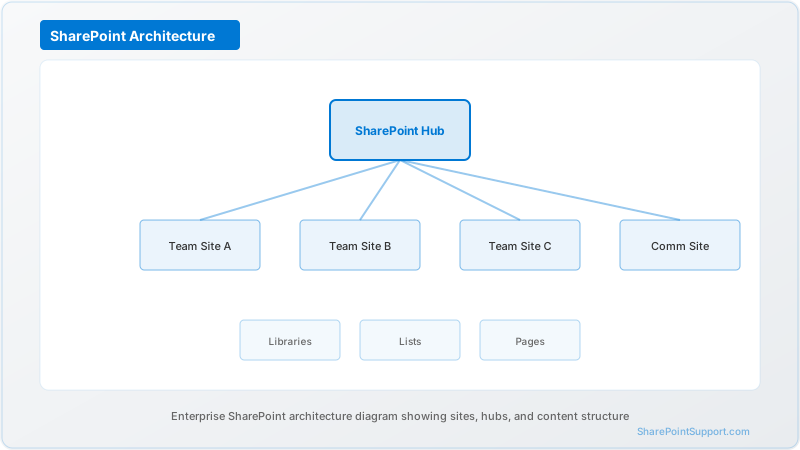
This guide provides a practical walkthrough of the admin center organized by the tasks administrators perform most frequently.
---
Getting Started
Prerequisites
To access the SharePoint Admin Center, you need one of these Azure AD roles: Global Administrator, SharePoint Administrator, or Global Reader (read-only access). Navigate to admin.microsoft.com and select SharePoint from the Admin centers list, or go directly to your tenant admin URL.
First-Time Setup Checklist
When taking over SharePoint administration for an organization, complete these steps in order. Review the current sharing policy and tighten if it is set to Anyone. Check storage usage and set quotas on sites that lack them. Verify that at least two administrators are assigned to every active site. Review external sharing reports for unexpected guest access. Document the current configuration as your baseline.
---
Site Management Operations
Creating Sites
The admin center supports creating team sites and communication sites. Team sites connect to Microsoft 365 Groups and optionally to Teams. Communication sites are standalone sites for broadcasting information.
Creation best practices:
- Always set a storage quota during creation rather than accepting the 25 TB default
- Assign a primary and secondary site administrator
- Set the external sharing level appropriate for the site's content
- Apply a sensitivity label if your organization uses them
- Associate the site with the appropriate hub
Site Inventory Management
Maintain a current inventory of all sites. Export the site list from the admin center to CSV for analysis. Track site owner, purpose, external sharing status, storage consumption, last activity date, and hub association.
```powershell
# Export comprehensive site inventory
Get-SPOSite -Limit All -Detailed | Select-Object Url, Title, Template, Owner, StorageUsageCurrent, StorageQuota, SharingCapability, LastContentModifiedDate, HubSiteId, SensitivityLabel | Export-Csv "SiteInventory.csv" -NoTypeInformation
```
Handling Orphaned Sites
Sites become orphaned when their owner leaves the organization. Identify orphaned sites by cross-referencing site owners with Azure AD active users. Reassign ownership immediately to prevent sites from becoming unmanageable.
---
Sharing and External Access
Tenant-Level Sharing Configuration
The sharing configuration hierarchy works from tenant down to site. The tenant-level setting is the maximum permissiveness. Individual sites can be set to equal or more restrictive levels but never more permissive than the tenant setting.
Recommended tenant configuration for enterprise:
Set the tenant to New and existing external users. This allows external sharing when needed but requires external users to authenticate. Override individual sites to more restrictive settings based on content sensitivity. Sites containing regulated data should be set to Only people in your organization.
Link Type Defaults
Configure the default sharing link type to reduce accidental oversharing. Set the default to Specific people rather than Anyone or People in your organization. This forces users to explicitly choose recipients rather than creating broadly accessible links.
Guest Access Management
Review guest accounts regularly. Guests who have not signed in for 90 or more days should be reviewed and potentially removed. Use Azure AD access reviews to automate this process.
```powershell
# Find all external users across the tenant
Get-SPOExternalUser -Position 0 -PageSize 50 | Select-Object DisplayName, Email, AcceptedAs, WhenCreated
```
---
Storage Administration
Monitoring Dashboard
The storage section of the admin center shows total tenant storage, used versus available storage, and per-site consumption. Set up email alerts when tenant storage reaches 80 percent and 90 percent of capacity.
Quota Strategy
Implement a tiered quota strategy. Standard sites receive 5 to 10 GB. Active project sites receive 25 to 50 GB. Department portals receive 50 to 100 GB. High-volume document repositories receive 100 to 500 GB. Adjust quotas based on actual usage patterns observed over three to six months.
Storage Optimization Actions
When storage is tight, prioritize these optimization actions. Trim version history on high-activity libraries. Clear recycle bins on large sites. Identify and remove duplicate files. Archive inactive sites to Microsoft 365 Archive. Move large media files to Azure Blob Storage or Stream.
---
Security and Compliance Settings
Conditional Access
Configure conditional access policies through Azure AD that apply to SharePoint. Common policies include requiring multi-factor authentication for external access, blocking access from non-compliant devices, restricting download capability on unmanaged devices, and requiring specific network locations for sensitive sites.
Sensitivity Labels
If your organization uses Microsoft Purview sensitivity labels, configure label policies that apply to SharePoint sites. Labels can enforce encryption, restrict sharing, set access expiration, and apply visual markings.
Audit Logging
Enable and review audit logs for SharePoint activities. Key events to monitor include external sharing actions, permission changes, site creation and deletion, large-scale file operations, and admin configuration changes.
---
Performance and Health
Site Performance
Monitor site performance through the admin center health dashboard. Identify sites with slow load times, high error rates, or degraded search performance. Common performance issues include oversized list views exceeding the 5,000-item threshold, too many web parts on a single page, large custom scripts blocking page rendering, and excessive calls to external APIs.
Service Health
Check the Microsoft 365 service health dashboard for SharePoint Online incidents and advisories. Subscribe to email notifications for service issues affecting your tenant.
---
Automation with PowerShell
Essential Admin Scripts
Build a library of PowerShell scripts for recurring tasks.
```powershell
# Weekly sharing audit
Get-SPOSite -Limit All | Where-Object { $_.SharingCapability -ne "Disabled" } | ForEach-Object {
$externalUsers = (Get-SPOExternalUser -SiteUrl $_.Url -PageSize 1).TotalUserCount
if ($externalUsers -gt 0) {
[PSCustomObject]@{
Url = $_.Url
SharingLevel = $_.SharingCapability
ExternalUsers = $externalUsers
}
}
} | Export-Csv "WeeklySharingAudit.csv" -NoTypeInformation
# Monthly storage report
Get-SPOSite -Limit All | Select-Object Url, @{N='StorageGB';E={[math]::Round($_.StorageUsageCurrent/1024, 2)}}, @{N='QuotaGB';E={[math]::Round($_.StorageQuota/1024, 2)}}, @{N='PercentUsed';E={if($_.StorageQuota -gt 0){[math]::Round(($_.StorageUsageCurrent/$_.StorageQuota)*100,1)}else{0}}} | Sort-Object StorageGB -Descending | Export-Csv "MonthlyStorage.csv" -NoTypeInformation
```
Scheduled Automation
Use Azure Automation or Power Automate to run PowerShell scripts on a schedule. Common automated tasks include weekly sharing audits, monthly storage reports, daily orphaned site checks, and quarterly permission reviews.
---
Troubleshooting Common Issues
Site Not Accessible
When users report a site is inaccessible, check the site lock state (it may be set to NoAccess or ReadOnly), verify the user has permissions, check if the site is associated with a deleted Microsoft 365 Group, and verify the site has not exceeded its storage quota.
Search Not Returning Results
If search is not returning expected results, verify the site is not excluded from search results, check that content has been indexed (new content may take up to 4 hours), verify the user has permissions to the content, and re-index the site if metadata changes are not reflected.
---
Frequently Asked Questions
How often should I review admin center settings?
Review sharing and security settings monthly. Review storage and site health weekly. Check the home dashboard and service health daily.
Can I undo admin center changes?
Most settings changes take effect immediately and there is no built-in undo function. Document your baseline configuration and use change management processes for significant setting changes.
How do I hand off admin responsibilities?
Document all custom configurations, scheduled scripts, and governance processes. Add the new administrator as a SharePoint Administrator in Azure AD. Conduct a walkthrough of the admin center, highlighting custom configurations and known issues.
---
For help establishing SharePoint administration best practices, contact our team for an admin center assessment. We help organizations build scalable administration processes that grow with their SharePoint environment. Explore our SharePoint consulting services to learn more.
Integration with Other Admin Centers
Microsoft 365 Admin Center
The Microsoft 365 admin center provides a unified view of all Microsoft 365 services. SharePoint settings accessible from the M365 admin center include user license management, service health monitoring, support ticket creation, and usage reports across all services.
Azure AD Admin Center
Many SharePoint governance decisions depend on Azure AD configuration. Conditional access policies that affect SharePoint access, guest user management and access reviews, group-based licensing for SharePoint plans, and app registration for custom integrations are all managed through Azure AD.
Power Platform Admin Center
Power Automate flows and Power Apps connected to SharePoint are managed through the Power Platform admin center. Monitor flow usage, manage environment settings, review connector permissions, and audit flow creation across the tenant.
Compliance Admin Center
Microsoft Purview compliance center manages retention policies, sensitivity labels, DLP policies, and eDiscovery cases that affect SharePoint content. SharePoint administrators should have at least read access to the compliance center to understand which policies affect their sites.
Security Operations
Monitor SharePoint-related security events through the Microsoft 365 Defender portal. Alert policies for suspicious sharing activity, impossible travel sign-ins, and mass file downloads protect your SharePoint environment from both internal and external threats.
Enterprise Implementation Best Practices
In our 25+ years of enterprise SharePoint consulting, we have managed SharePoint environments ranging from single-tenant deployments with a few hundred users to multi-geo configurations serving 200,000 users across dozens of countries. The administrative practices that maintain environment health and user satisfaction at enterprise scale require automation, delegation, and proactive monitoring rather than reactive firefighting.
- Implement a Delegated Administration Model: Central IT cannot effectively manage thousands of SharePoint sites. Delegate site-level administration to trained business owners who understand their content and users, while retaining tenant-level controls for security policies, compliance settings, and infrastructure management. Define clear boundaries between delegated and centralized responsibilities in your governance framework.
- Automate Routine Administrative Tasks: Site provisioning, permission audits, storage reporting, inactive site identification, and compliance checks should all run on automated schedules rather than manual effort. Build a library of PowerShell scripts and Power Automate flows that execute routine administrative tasks consistently and produce audit logs that demonstrate compliance with your governance policies.
- Establish Proactive Monitoring and Alerting: Configure monitoring for storage consumption trends, permission changes on sensitive sites, external sharing activity, large file uploads, bulk deletion events, and authentication anomalies. Proactive monitoring catches issues before they impact users or create compliance exposure.
- Maintain a Configuration Management Database: Document every non-default configuration setting across your SharePoint tenant including sharing policies, conditional access rules, sensitivity labels, retention policies, DLP rules, and custom site designs. This documentation is essential for troubleshooting, audit responses, disaster recovery, and onboarding new administrators.
- Plan for Platform Updates and Feature Releases: Microsoft deploys SharePoint updates continuously. Subscribe to the Microsoft 365 roadmap and message center, evaluate new features in a test tenant before they reach production, and communicate relevant changes to your user community. Organizations that manage platform changes proactively maintain user trust and avoid disruption.
Governance and Compliance Considerations
SharePoint administration carries direct compliance responsibility because administrative actions affect security controls, data protection, retention enforcement, and audit capabilities across the entire tenant. Administrative governance must ensure that powerful administrative privileges are controlled, audited, and exercised consistently with regulatory requirements.
For HIPAA-regulated organizations, SharePoint administrators with tenant-level access can view, modify, or delete protected health information across the environment. Implement privileged access management through Azure AD PIM to ensure administrative access is activated only when needed, for limited durations, with mandatory justification, and with complete audit logging. Administrative access to PHI-containing sites should trigger additional monitoring and review.
Financial services organizations must demonstrate to SOC 2 auditors that administrative access is controlled, monitored, and regularly reviewed. Implement separation of duties that prevents a single administrator from making changes without peer review, configure administrative audit logging that captures all configuration changes, and conduct quarterly administrative access reviews.
Government organizations must ensure that administrative access complies with security clearance requirements and that administrative actions on systems processing classified content are logged and monitored according to applicable security frameworks.
Maintain comprehensive documentation of all administrative configurations, delegations, and policy settings across your SharePoint tenant. This documentation serves as both operational reference and audit evidence. Implement change management processes that require documentation, approval, and testing before administrative changes are applied to production. Our SharePoint administration specialists design administrative governance frameworks that satisfy regulatory requirements while enabling efficient tenant management at enterprise scale.
Ready to optimize your SharePoint administration for enterprise scale? Our administration specialists have managed environments serving hundreds of thousands of users across complex multi-geo configurations. Contact our team for an administrative assessment, and explore how our SharePoint consulting services can streamline your tenant management operations.
Common Challenges and Solutions
Organizations implementing SharePoint Admin Center consistently encounter obstacles that, if left unaddressed, undermine adoption and erode stakeholder confidence. Drawing on two decades of enterprise SharePoint consulting, these are the challenges we see most frequently and the proven approaches for overcoming them.
Challenge 1: Content Sprawl and Information Architecture Degradation
Over time, SharePoint Admin Center environments accumulate redundant, outdated, and trivial content that degrades search relevance and confuses users. Without proactive content lifecycle management, the signal-to-noise ratio deteriorates and user trust in the platform erodes. The resolution requires a structured approach: establishing automated retention policies that flag content for review after defined periods of inactivity, combined with content owner accountability structures that assign clear responsibility for each site collection and library. Organizations that address this proactively report 40 to 60 percent fewer support tickets within the first 90 days of deployment. Establishing a dedicated governance committee with representatives from IT, compliance, and business stakeholders ensures ongoing alignment between technical configuration and organizational objectives.
Challenge 2: Compliance and Audit Readiness Gaps
SharePoint Admin Center implementations in regulated industries often lack the audit trail depth and policy enforcement rigor required by frameworks such as HIPAA, SOC 2, and GDPR. Retroactive compliance remediation is significantly more expensive and disruptive than building compliance into the initial design. We recommend embedding compliance requirements into the information architecture from day one. Configure Microsoft Purview retention labels, DLP policies, and audit logging before deploying content, and validate compliance posture through regular internal audits. Tracking these metrics through SharePoint health dashboards provides early warning indicators that allow administrators to intervene before minor issues become systemic problems affecting enterprise-wide productivity.
Challenge 3: Inconsistent Governance Across Business Units
When different departments implement SharePoint Admin Center independently, inconsistent naming conventions, metadata schemas, and security configurations create silos that undermine cross-functional collaboration and complicate compliance reporting. The most effective mitigation strategy involves centralizing governance policy definition while allowing controlled flexibility at the departmental level. A hub-and-spoke governance model balances enterprise consistency with departmental autonomy. Enterprises operating in regulated industries such as healthcare and financial services must pay particular attention to this challenge because compliance violations carry significant financial and reputational consequences. Regular audits conducted quarterly at minimum help organizations maintain alignment with evolving regulatory requirements and internal policy updates.
Challenge 4: Migration and Legacy Content Complexity
Organizations transitioning legacy content into SharePoint Admin Center often underestimate the complexity of mapping old structures, metadata, and permissions to modern architectures. Failed migrations erode user confidence and create parallel systems that duplicate effort. Addressing this requires conducting thorough pre-migration content audits that classify and prioritize content based on business value. Invest in automated migration tools that preserve metadata fidelity and permission integrity while providing detailed validation reports. Organizations that invest in structured change management programs achieve adoption rates 35 percent higher than those relying on organic discovery alone. Executive sponsorship combined with department-level champions creates the organizational momentum necessary for sustained success.
Integration with Microsoft 365 Ecosystem
SharePoint Admin Center does not operate in isolation. Its value multiplies when connected to the broader Microsoft 365 ecosystem, creating unified workflows that eliminate context switching and reduce manual data transfer between applications.
Microsoft Teams Integration: Embed SharePoint Admin Center dashboards and document libraries as Teams tabs to create unified workspaces where conversations and structured content management coexist within a single interface. Teams channels automatically provision SharePoint document libraries, which means sharepoint admin center configurations and content flow seamlessly between collaborative conversations and structured document management. Users can surface SharePoint content directly within Teams tabs, reducing the friction that typically causes adoption to stall.
Power Automate Workflows: Implement scheduled flows that perform routine SharePoint Admin Center maintenance tasks including permission reports, content audits, and usage analytics without requiring manual intervention. Automated workflows triggered by SharePoint events such as document uploads, metadata changes, or approval completions eliminate repetitive manual tasks. Organizations typically automate 15 to 25 processes within the first quarter, saving an average of 8 hours per week per department. These automations also create audit trails that satisfy compliance requirements for regulated industries.
Power BI Analytics: Build executive dashboards that aggregate SharePoint Admin Center metrics alongside other business KPIs, providing a holistic view of digital workplace effectiveness and investment returns. Connecting SharePoint data to Power BI dashboards provides real-time visibility into content usage patterns, adoption metrics, and operational KPIs. Decision makers gain actionable intelligence without requiring manual report generation, enabling faster response to emerging trends and potential issues.
Microsoft Purview and Compliance: Implement retention policies that automatically manage SharePoint Admin Center content lifecycle, preserving business-critical records for required periods while disposing of transient content to reduce storage costs and compliance exposure. Sensitivity labels, data loss prevention policies, and retention schedules configured in Microsoft Purview extend automatically to sharepoint admin center content. This unified compliance framework ensures that governance policies apply consistently across the entire Microsoft 365 environment rather than requiring separate configuration for each workload. For organizations subject to HIPAA, SOC 2, or FedRAMP requirements, this integrated approach significantly reduces compliance management overhead.
Getting Started: Next Steps
Implementing SharePoint Admin Center effectively requires more than technical configuration. It demands a strategic approach grounded in your organization's specific business requirements, compliance obligations, and growth trajectory. The difference between a deployment that delivers measurable ROI and one that becomes shelfware often comes down to the quality of upfront planning and expert guidance.
Begin with a focused assessment of your current SharePoint environment. Evaluate your existing information architecture, permission structures, content lifecycle policies, and user adoption patterns. Identify gaps between your current state and the target state required for successful sharepoint admin center implementation. This assessment typically takes 2 to 4 weeks and produces a prioritized roadmap that aligns technical work with business outcomes.
Our SharePoint specialists have guided organizations across healthcare, financial services, government, and education through hundreds of successful implementations. We bring deep expertise in SharePoint architecture, governance frameworks, and compliance alignment that accelerates time to value while minimizing risk.
Ready to move forward? Contact our team for a complimentary consultation. We will assess your environment, identify quick wins, and develop a phased implementation plan tailored to your organization's needs and timeline. Whether you are starting from scratch or optimizing an existing deployment, our enterprise SharePoint consultants deliver the expertise and accountability that Fortune 500 organizations demand.
Written by the SharePoint Support Team
Senior SharePoint Consultants | 25+ Years Microsoft Ecosystem Experience
Our senior SharePoint consultants bring deep expertise spanning 500+ enterprise migrations and compliance implementations across HIPAA, SOC 2, and FedRAMP environments. We cover SharePoint Online, Microsoft 365, migrations, Copilot readiness, and large-scale governance.
Expert SharePoint Services
Frequently Asked Questions
What are the most important daily tasks for a SharePoint administrator?▼
How do we manage SharePoint Online storage costs effectively?▼
What PowerShell modules are needed for SharePoint Online administration?▼
How do we set up a SharePoint disaster recovery plan?▼
Need Expert Help?
Our SharePoint consultants are ready to help you implement these strategies in your organization.
Continue Reading in Administration
SharePoint Storage Management: M365 Guide
Master SharePoint storage management with strategies for monitoring usage, optimizing quotas, archiving content, and planning capacity for your Microsoft 365 tenant.
AdministrationRecycle Bin Management: Data Recovery Best Practices
Master SharePoint recycle bin management for reliable data recovery. Learn first-stage and second-stage recycle bins, retention policies, PowerShell recovery commands, and enterprise backup strategies.
AdministrationSharePoint vs OneDrive: When to Use Each (And When You...
Clear guide to when to use SharePoint vs OneDrive in Microsoft 365. Explains the key differences, ideal use cases for each, how they work together, and the most common mistakes organizations make.
AdministrationSharePoint Admin Center: Complete Guide for 2026
Master the SharePoint Admin Center with this comprehensive guide covering site management, settings, policies, external sharing, storage quotas, and modern admin features.
AdministrationSharePoint Online Storage Management: Administrator...
Optimize SharePoint Online storage usage, understand tenant storage pools, manage site quotas, identify version history bloat, reclaim wasted space, and implement storage governance policies to control costs and prevent read-only site incidents.
AdministrationM365 SharePoint Licensing: Cost and Features 2026
Compare Microsoft 365 licensing plans for SharePoint. Covers Business vs Enterprise, SharePoint Plan 1 vs Plan 2, E3 vs E5, Copilot licensing, and right-sizing your investment.