
SharePoint List Views: The Complete Configuration Guide
List views are how users interact with SharePoint data. A well-configured view surfaces the right information instantly. A poorly configured view buries data in endless scrolling or forces users to search manually. Every SharePoint list and library should have thoughtfully designed views that serve specific user needs.
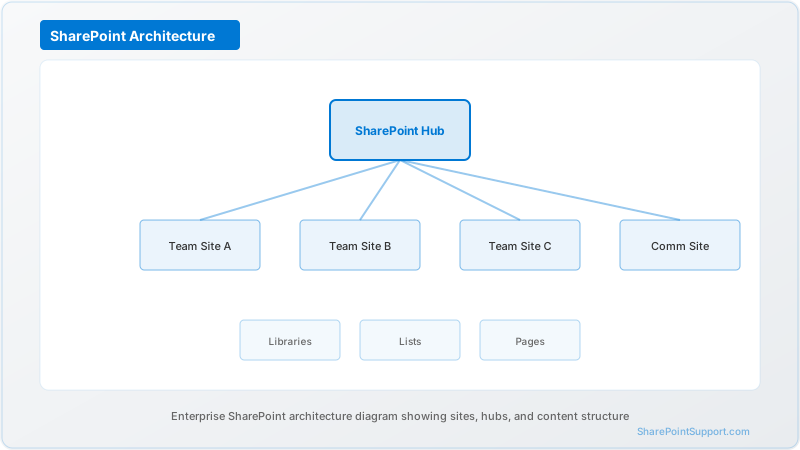
This guide covers view types, configuration, formatting, performance optimization, and governance for enterprise SharePoint environments.
---
Understanding View Types
Standard Views
The default view type that displays items in a tabular format with columns. Standard views support sorting, filtering, grouping, and column formatting. Most list interactions happen through standard views.
Calendar Views
Display date-based list items on a calendar grid. Suitable for event lists, milestone tracking, and deadline management. Configure by mapping list columns to calendar start date, end date, and title fields.
Gallery Views
Display items as visual cards in a grid layout. Each card shows a thumbnail and selected metadata. Ideal for image libraries, project portfolios, and any list where visual browsing is more effective than tabular scanning.
Board Views (Kanban)
Display items as cards organized into columns based on a Choice or Person column value. Drag items between columns to update the underlying field value. Perfect for task management, content pipelines, and status tracking workflows.
---
Creating and Configuring Views
Creating a New View
- Navigate to the list or library
- Click the view dropdown in the command bar
- Select Create new view
- Choose the view format (List, Compact list, Gallery, Board)
- Name the view and configure columns, sort order, and filters
- Save
Column Selection and Order
Select only the columns relevant to the view's purpose. A view showing all 20 columns is useless because users cannot scan it effectively. Most views should show 4 to 7 columns maximum.
Best practices: Place the most important column first (usually Title or Name). Include status or category columns for quick scanning. Add date columns for time-sensitive views. Include the Modified column to show content freshness. Hide system columns that add no user value.
Sorting
Configure default sort order based on how users need to consume the data. Sort by Modified descending to show newest items first. Sort by Due Date ascending to show upcoming deadlines. Sort by Status then Priority for task views.
Filtering
Filters limit which items appear in the view. Use filters to create purpose-specific views from a single list.
Static filters: Show items where Status equals Active. Show items where Department equals HR. Show items where Due Date is less than the next 30 days.
Dynamic filters: Show items where Assigned To equals the current user (use [Me] token). Show items where Created is greater than or equal to today minus 7 days. These dynamic filters create personalized views that show each user their own relevant items.
Grouping
Group items by a column value to create collapsible sections. Common groupings include grouping by Status to see items organized by workflow stage, grouping by Department to organize cross-departmental lists, grouping by Month for date-based content, and grouping by Category for mixed content types.
Grouping supports two levels. Group by Category then by Status to see a hierarchical organization.
---
View Formatting with JSON
Column Formatting
Apply JSON formatting to individual columns to add visual indicators like color coding, icons, progress bars, and conditional formatting.
Example: Color-coded Status column
```json
{
"$schema": "https://developer.microsoft.com/json-schemas/sp/v2/column-formatting.schema.json",
"elmType": "div",
"style": {
"padding": "4px 8px",
"border-radius": "4px",
"color": "white",
"background-color": "=if(@currentField == 'Active', '#107c10', if(@currentField == 'Pending', '#ffaa44', if(@currentField == 'Closed', '#d13438', '#666666')))"
},
"txtContent": "@currentField"
}
```
Example: Progress bar for Percentage column
```json
{
"$schema": "https://developer.microsoft.com/json-schemas/sp/v2/column-formatting.schema.json",
"elmType": "div",
"children": [
{
"elmType": "div",
"style": {
"width": "=toString(@currentField) + '%'",
"background-color": "=if(@currentField < 30, '#d13438', if(@currentField < 70, '#ffaa44', '#107c10'))",
"height": "20px",
"border-radius": "4px"
}
}
]
}
```
Row Formatting
Apply JSON formatting to entire rows to highlight items based on conditions. For example, highlight overdue items in red or highlight high-priority items with a left border.
View Formatting
Apply JSON formatting to the entire view to create completely custom layouts like custom card layouts for gallery views, timeline visualizations, and dashboard-style presentations.
---
Performance Optimization for Large Lists
The 5,000-Item Threshold
SharePoint lists have a view threshold of 5,000 items. When a list contains more than 5,000 items, views that are not properly indexed will fail with a threshold error.
How to handle large lists:
- Index columns used in view filters and sort orders. Navigate to List Settings then Indexed columns and add indexes for every column used in view queries.
- Filter views to return fewer than 5,000 items. Add filters that limit results by date range, status, or other criteria.
- Use pagination rather than trying to load all items at once. Modern views paginate automatically.
```powershell
# Create an index on a column
Set-PnPField -List "Tasks" -Identity "Status" -Values @{Indexed=$true}
Set-PnPField -List "Tasks" -Identity "DueDate" -Values @{Indexed=$true}
```
Indexed Column Strategy
You can create up to 20 indexed columns per list. Prioritize indexing columns that appear in view filters, are used in sort orders, are used in Power Automate trigger conditions, and are used in lookup relationships.
---
View Governance
Standard Views for Every List
Establish a set of standard views that every list should include. An All Items view showing all items with default sorting. A My Items view filtered to the current user. A Recently Modified view sorted by Modified descending. A view specific to the list's purpose such as Active Tasks, Pending Approvals, or This Week's Events.
Naming Conventions
Use descriptive view names that indicate what the view shows. Good names include Active Projects by Department, My Open Tasks, Documents Pending Review, and This Month's Expenses. Avoid generic names like View 1, Custom View, or Test.
Personal vs Shared Views
SharePoint supports personal views visible only to the creator and shared views visible to all users. Limit the number of shared views to prevent confusion. Encourage users to create personal views for individual needs rather than requesting new shared views.
---
Frequently Asked Questions
Can I set a default view for a list?
Yes. In List Settings, click the view name and check Set as default view. The default view is what users see when they navigate to the list without specifying a view.
How many views can a list have?
There is no hard limit on the number of views. However, more than 10 to 15 shared views creates confusion. Keep shared views focused and encourage personal views for individual needs.
Do view filters affect permissions?
No. Views filter the display of items but do not affect permissions. A user who cannot see an item due to permissions will not see it in any view. A user who can see an item will see it in any unfiltered view, regardless of view filters.
---
For help optimizing your SharePoint list views, contact our team for a SharePoint assessment. We configure list architectures for organizations where data organization directly impacts operational efficiency.
View Templates and Sharing
Creating View Templates
Design standard views that can be applied across multiple lists. While SharePoint does not natively support view templates, you can achieve this through PnP provisioning templates that include view definitions, Power Automate flows that configure views on new lists, and documented view specifications that site owners follow when setting up new lists.
View Sharing Best Practices
Share views by creating them as public views visible to all users. Communicate new view availability through site news or email. Include view links in navigation or quick links web parts so users can access specific views directly without navigating through the view dropdown.
Integration with Power BI
For advanced data analysis beyond what SharePoint views provide, connect SharePoint lists to Power BI. Power BI can create interactive dashboards from SharePoint list data, apply complex calculations and measures, combine data from multiple lists and external sources, and publish dashboards back to SharePoint pages via the Power BI web part. This extends the value of your SharePoint list data far beyond what native views offer.
View Automation with Power Automate
Create flows that automatically switch users to relevant views based on context. For example, when a user opens a project site, the flow can check their role and redirect them to the My Tasks view if they are a contributor, the All Tasks view if they are a manager, or the Dashboard view if they are an executive. This personalization improves the user experience without requiring users to manually select views.
Enterprise Implementation Best Practices
In our 25+ years of enterprise SharePoint consulting, we have designed metadata architectures for organizations managing millions of documents across hundreds of sites, and the metadata strategy consistently determines whether SharePoint becomes a powerful knowledge platform or an expensive file dump. Organizations that invest in metadata architecture before content migration achieve search satisfaction rates three to five times higher than those that do not.
- Design a Managed Term Store Strategy First: The term store is your metadata foundation. Design a taxonomy that reflects how your organization categorizes and retrieves information rather than replicating departmental silos. Establish term set owners responsible for maintaining vocabulary accuracy, adding new terms through a governed request process, and retiring obsolete terms that clutter the taxonomy.
- Implement Content Types Across Site Collections: Content types provide consistent metadata schemas that travel with documents regardless of their location. Define enterprise content types for your most common document categories and publish them from a content type hub. This approach ensures that a contract, proposal, or technical specification carries the same metadata schema whether it resides in the legal, sales, or engineering SharePoint environment.
- Automate Classification Where Possible: Manual metadata tagging is the weakest link in any metadata strategy because user compliance degrades over time. Deploy SharePoint Premium classifiers to automatically detect and tag document types, extract key metadata values, and apply retention labels based on content analysis. Automation maintains metadata quality at scale without burdening content authors.
- Configure Default Column Values and Validation: Set default metadata values at the folder and library level so that documents inherit appropriate classifications automatically. Implement column validation formulas that prevent incorrect values and provide clear error messages guiding users toward proper classification.
- Train Users on the Value of Metadata: Users who understand why metadata matters comply more consistently than users who view tagging as bureaucratic overhead. Show users how metadata powers search, drives automated workflows, enables compliance, and surfaces relevant content through dynamic views and content rollups. Connect metadata investment to tangible benefits they experience daily.
Governance and Compliance Considerations
Metadata architecture in SharePoint has direct compliance implications because classification accuracy determines whether retention policies, sensitivity labels, access controls, and discovery responses function correctly across your content estate.
For HIPAA-regulated organizations, metadata schemas must include classifications that identify content containing protected health information so that sensitivity labels, retention policies, and access controls can be automatically applied. Inaccurate or missing metadata on PHI-containing documents creates compliance gaps where regulated content may lack required encryption, retention, or access restrictions.
Financial services organizations must ensure metadata classifications support SEC recordkeeping requirements by accurately identifying business records, client communications, and financial documents subject to mandatory retention. Metadata errors that cause records to be classified incorrectly can result in premature deletion of regulated content or failure to produce responsive documents during regulatory examinations.
Government organizations must implement metadata schemas that support security classification markings, handling caveats, and dissemination controls required by applicable information security frameworks and executive orders.
Implement metadata quality monitoring that tracks classification completeness, accuracy, and consistency across your SharePoint environment. Configure reports that identify unclassified documents, documents with inconsistent metadata values, and libraries where metadata compliance falls below acceptable thresholds. Review metadata quality metrics quarterly with content owners and compliance officers, and address classification gaps before they create compliance exposure during audits or discovery requests. Our SharePoint metadata specialists design classification architectures that support compliance automation while remaining practical for content authors.
Ready to build a metadata architecture that powers intelligent content management? Our information architecture specialists have designed metadata strategies for organizations managing millions of documents across complex taxonomies. Contact our team for a metadata assessment, and discover how our SharePoint consulting services can transform your content findability and compliance posture.
Common Challenges and Solutions
Organizations implementing SharePoint List Views consistently encounter obstacles that, if left unaddressed, undermine adoption and erode stakeholder confidence. Drawing on two decades of enterprise SharePoint consulting, these are the challenges we see most frequently and the proven approaches for overcoming them.
Challenge 1: Content Sprawl and Information Architecture Degradation
Over time, SharePoint List Views environments accumulate redundant, outdated, and trivial content that degrades search relevance and confuses users. Without proactive content lifecycle management, the signal-to-noise ratio deteriorates and user trust in the platform erodes. The resolution requires a structured approach: establishing automated retention policies that flag content for review after defined periods of inactivity, combined with content owner accountability structures that assign clear responsibility for each site collection and library. Organizations that address this proactively report 40 to 60 percent fewer support tickets within the first 90 days of deployment. Establishing a dedicated governance committee with representatives from IT, compliance, and business stakeholders ensures ongoing alignment between technical configuration and organizational objectives.
Challenge 2: Compliance and Audit Readiness Gaps
SharePoint List Views implementations in regulated industries often lack the audit trail depth and policy enforcement rigor required by frameworks such as HIPAA, SOC 2, and GDPR. Retroactive compliance remediation is significantly more expensive and disruptive than building compliance into the initial design. We recommend embedding compliance requirements into the information architecture from day one. Configure Microsoft Purview retention labels, DLP policies, and audit logging before deploying content, and validate compliance posture through regular internal audits. Tracking these metrics through SharePoint health dashboards provides early warning indicators that allow administrators to intervene before minor issues become systemic problems affecting enterprise-wide productivity.
Challenge 3: Inconsistent Governance Across Business Units
When different departments implement SharePoint List Views independently, inconsistent naming conventions, metadata schemas, and security configurations create silos that undermine cross-functional collaboration and complicate compliance reporting. The most effective mitigation strategy involves centralizing governance policy definition while allowing controlled flexibility at the departmental level. A hub-and-spoke governance model balances enterprise consistency with departmental autonomy. Enterprises operating in regulated industries such as healthcare and financial services must pay particular attention to this challenge because compliance violations carry significant financial and reputational consequences. Regular audits conducted quarterly at minimum help organizations maintain alignment with evolving regulatory requirements and internal policy updates.
Challenge 4: Migration and Legacy Content Complexity
Organizations transitioning legacy content into SharePoint List Views often underestimate the complexity of mapping old structures, metadata, and permissions to modern architectures. Failed migrations erode user confidence and create parallel systems that duplicate effort. Addressing this requires conducting thorough pre-migration content audits that classify and prioritize content based on business value. Invest in automated migration tools that preserve metadata fidelity and permission integrity while providing detailed validation reports. Organizations that invest in structured change management programs achieve adoption rates 35 percent higher than those relying on organic discovery alone. Executive sponsorship combined with department-level champions creates the organizational momentum necessary for sustained success.
Integration with Microsoft 365 Ecosystem
SharePoint List Views does not operate in isolation. Its value multiplies when connected to the broader Microsoft 365 ecosystem, creating unified workflows that eliminate context switching and reduce manual data transfer between applications.
Microsoft Teams Integration: Configure Teams notifications that alert stakeholders when SharePoint List Views content changes, ensuring that distributed teams stay informed about updates without relying on manual communication workflows. Teams channels automatically provision SharePoint document libraries, which means sharepoint list views configurations and content flow seamlessly between collaborative conversations and structured document management. Users can surface SharePoint content directly within Teams tabs, reducing the friction that typically causes adoption to stall.
Power Automate Workflows: Create event-driven automations that respond to SharePoint List Views changes in real time, triggering downstream processes such as notifications, data transformations, and cross-system synchronization. Automated workflows triggered by SharePoint events such as document uploads, metadata changes, or approval completions eliminate repetitive manual tasks. Organizations typically automate 15 to 25 processes within the first quarter, saving an average of 8 hours per week per department. These automations also create audit trails that satisfy compliance requirements for regulated industries.
Power BI Analytics: Connect SharePoint List Views list and library data to Power BI datasets for advanced analytics that transform raw operational data into strategic business intelligence accessible to decision makers across the organization. Connecting SharePoint data to Power BI dashboards provides real-time visibility into content usage patterns, adoption metrics, and operational KPIs. Decision makers gain actionable intelligence without requiring manual report generation, enabling faster response to emerging trends and potential issues.
Microsoft Purview and Compliance: Configure data loss prevention policies that monitor SharePoint List Views content for sensitive information patterns, blocking or restricting sharing actions that could violate compliance requirements. Sensitivity labels, data loss prevention policies, and retention schedules configured in Microsoft Purview extend automatically to sharepoint list views content. This unified compliance framework ensures that governance policies apply consistently across the entire Microsoft 365 environment rather than requiring separate configuration for each workload. For organizations subject to HIPAA, SOC 2, or FedRAMP requirements, this integrated approach significantly reduces compliance management overhead.
Getting Started: Next Steps
Implementing SharePoint List Views effectively requires more than technical configuration. It demands a strategic approach grounded in your organization's specific business requirements, compliance obligations, and growth trajectory. The difference between a deployment that delivers measurable ROI and one that becomes shelfware often comes down to the quality of upfront planning and expert guidance.
Begin with a focused assessment of your current SharePoint environment. Evaluate your existing information architecture, permission structures, content lifecycle policies, and user adoption patterns. Identify gaps between your current state and the target state required for successful sharepoint list views implementation. This assessment typically takes 2 to 4 weeks and produces a prioritized roadmap that aligns technical work with business outcomes.
Our SharePoint specialists have guided organizations across healthcare, financial services, government, and education through hundreds of successful implementations. We bring deep expertise in SharePoint architecture, governance frameworks, and compliance alignment that accelerates time to value while minimizing risk.
Ready to move forward? Contact our team for a complimentary consultation. We will assess your environment, identify quick wins, and develop a phased implementation plan tailored to your organization's needs and timeline. Whether you are starting from scratch or optimizing an existing deployment, our enterprise SharePoint consultants deliver the expertise and accountability that Fortune 500 organizations demand.
Written by the SharePoint Support Team
Senior SharePoint Consultants | 25+ Years Microsoft Ecosystem Experience
Our senior SharePoint consultants bring deep expertise spanning 500+ enterprise migrations and compliance implementations across HIPAA, SOC 2, and FedRAMP environments. We cover SharePoint Online, Microsoft 365, migrations, Copilot readiness, and large-scale governance.
Expert SharePoint Services
Frequently Asked Questions
What are SharePoint list views and why are they important?▼
How many views can a SharePoint list have?▼
What is the difference between standard and datasheet views?▼
How do I create a view that shows items assigned to the current user?▼
What is the 5,000 item list view threshold and how do I work around it?▼
Need Expert Help?
Our SharePoint consultants are ready to help you implement these strategies in your organization.
Continue Reading in Content Management
SharePoint Content Types: Complete Implementation Guide
Master SharePoint content types to standardize document templates, enforce metadata, and improve content governance across your organization.
Content ManagementMultilingual SharePoint Sites: Global Communication Guide
Enable effective global communication with SharePoint multilingual features including page translation, navigation localization, and content management for international organizations.
Content ManagementSharePoint Alerts and Notifications Guide
Master SharePoint alerts and notifications to keep users informed about document changes, list updates, and important activities across your sites.
Content ManagementSharePoint Modern Pages: Design and Publishing Guide
Create engaging SharePoint modern pages with sections, web parts, and multimedia. Covers page design, templates, news publishing, and mobile optimization.
Content ManagementSharePoint Web Parts: Complete Configuration Guide
Master SharePoint web parts for building dynamic pages. Covers all major web parts, configuration options, custom SPFx development, and performance optimization.
Storage & CostCopilot in SharePoint Went GA — And Quietly Started Metering You
Three SharePoint features now bill per use instead of per seat, the default cap is $40 per user per month on top of your Copilot licence, and every one of them is triggered by site owners rather than admins. Here is the exposure math and how to cap it.