
Making the Case for SharePoint: An ROI Framework for IT Leaders
Every SharePoint investment requires a business case. Whether you are proposing a new implementation, a major migration, or expanded features, you need concrete ROI numbers that resonate with CFOs and CEOs.
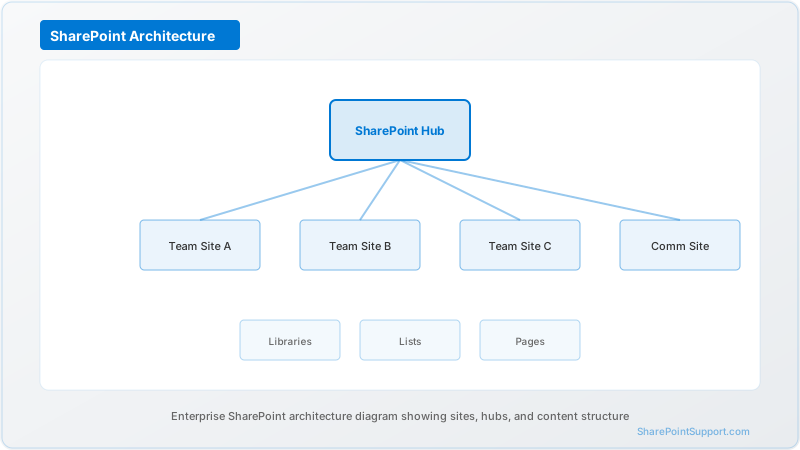
This guide provides a framework for calculating SharePoint ROI, with real data from enterprise implementations to support your business case.
The Core SharePoint Value Drivers
SharePoint generates business value across five dimensions:
1. Document Retrieval Time Reduction
Employees spend significant time searching for documents. IDC research consistently shows knowledge workers spend 20-40% of their time finding and managing information.
Before SharePoint (typical file share or legacy DMS):
- Average document search time: 8-12 minutes per search
- Employees searching for documents: 5-10 times per day
- Total time wasted: 40-120 minutes per day per knowledge worker
After SharePoint with proper metadata and search:
- Average document search time: 30-90 seconds
- Time savings: 30-50% reduction in document-related time waste
- For 500 knowledge workers at $80K/year: $2M-$4M annual productivity recovery
2. Eliminated Duplicate and Versioning Costs
When documents live in email threads, network shares, and individual desktops, version management is a nightmare.
Common costs from poor version control:
- Rework from working on wrong version: 2-8 hours per project
- Duplicate effort from working in parallel: 5-15% of project work
- Error costs from outdated policies/procedures reaching end users
SharePoint impact:
- Single source of truth with version history
- Co-authoring eliminates "save as" versioning chaos
- Microsoft found organizations see 30% reduction in version-related rework after SharePoint implementation
3. Communication and Collaboration Efficiency
Intranet and communication tools deliver measurable value:
Intranet ROI indicators:
- 30-50% reduction in email volume for internal announcements (replaced by intranet news)
- 20-40% faster onboarding (centralized resources vs. email-based orientation)
- 25-35% improvement in policy compliance (employees can find current policies)
- Forrester found modern intranets return $1.8M NPV over 3 years for a 5,000-person organization
4. Compliance Risk Reduction
For regulated industries, SharePoint compliance controls reduce the cost of compliance and the risk of violations.
Compliance cost savings:
- DLP policies prevent accidental sharing of PHI/PII
- Retention labels automate legal hold and disposition
- Sensitivity labels prevent data leaving your environment
- Audit logs provide evidence for regulatory examinations
Risk reduction value:
- HIPAA violations: $100-$50,000 per violation, up to $1.9M per violation category per year
- SOC 2 audit preparation: 40-60% faster with SharePoint compliance controls
- eDiscovery response: 70-80% faster with SharePoint search and legal hold
5. Infrastructure Cost Elimination
Migrating from on-premises SharePoint or file servers to SharePoint Online eliminates:
- Server hardware refresh ($15K-$50K per server, refresh every 5-7 years)
- Windows Server and SQL Server licensing
- Data center / co-location costs
- IT staff time for patching, maintenance, and incident response
For a 500-person organization: $150K-$400K in annual infrastructure savings.
Sample ROI Calculation: 500-Person Financial Services Firm
Scenario: Migration from SharePoint Server 2019 + file shares to SharePoint Online with governance implementation.
Investment:
- Migration and implementation: $120,000
- Annual Microsoft 365 E3 licensing (incremental): $90,000/year (offset by eliminated licenses)
Annual Benefits:
- Document search time savings (500 users, 2 hrs/week at $65/hr): $3,380,000
- Eliminated SharePoint on-premises infrastructure: $180,000
- SOC 2 compliance efficiency (1.5 FTE reduction): $150,000
- Reduced IT incident tickets (30% reduction, 0.5 FTE): $60,000
- Total Annual Benefits: $3,770,000
ROI Calculation:
- Year 1 Net Benefit: $3,770,000 - $210,000 = $3,560,000
- Investment Recovery: < 1 month
- 3-Year NPV (8% discount): ~$9.2M
- 3-Year ROI: 4,400%
*Note: Document productivity benefits vary significantly by organization. Use your organization's actual data — even conservative estimates (50% of the example above) show compelling ROI.*
Building Your Business Case Document
Structure your SharePoint business case in 5 sections:
Section 1: Executive Summary (1 page)
- Problem statement (current pain points)
- Proposed solution (SharePoint implementation scope)
- Investment required
- Expected ROI and payback period
- Risk of inaction (status quo costs)
Section 2: Current State Analysis (2-3 pages)
Quantify your current problems with data:
- Storage costs: How much are you paying for file server infrastructure?
- Compliance gaps: Any recent incidents, fines, or audit findings?
- IT support volume: How many tickets relate to file sharing, access issues, versioning?
- User survey results: How long do employees spend finding documents?
Section 3: Proposed Solution (2-3 pages)
Describe the SharePoint solution:
- Scope: what's being implemented (migration, intranet, compliance controls)
- Implementation approach and timeline
- Change management and training plan
- Integration with existing systems
Section 4: Financial Analysis (2 pages)
Present three scenarios (conservative, base, optimistic):
- Implementation cost
- Annual operating cost change (licensing, IT staff)
- Annual benefit estimates by category
- NPV, IRR, and payback period
- Sensitivity analysis showing break-even
Section 5: Risk Analysis (1 page)
Address implementation risks and mitigations:
- Data migration risk: mitigated by professional services and backup strategy
- User adoption risk: mitigated by change management program
- Timeline risk: mitigated by phased approach
- Risk of doing nothing (growing technical debt, compliance exposure)
Industry-Specific ROI Drivers
Healthcare
- HIPAA compliance automation: $200K-$500K in annual compliance staff savings
- Clinical document management: 20-30% reduction in administrative burden
- Patient records coordination: 15-25% reduction in care coordination time
Financial Services
- Trade documentation: 40-60% faster document retrieval for audits
- Client portals: 30-50% reduction in client service calls
- Regulatory compliance: 50-70% faster examination response
Government
- FOIA request processing: 60-80% faster with SharePoint search
- Records management: Automated retention eliminates manual file purging
- Cross-agency collaboration: Secure sharing replaces email-based document exchange
Manufacturing
- Quality management documentation: 40-60% reduction in document control staff time
- Supplier collaboration: Secure portals replace email-based supplier management
- Audit readiness: ISO audit preparation 50% faster with structured document libraries
Next Steps for Your Business Case
Our team can help you build a compelling SharePoint business case with:
- Current State Assessment: We interview stakeholders and quantify your current costs
- ROI Modeling: Custom financial model for your organization
- Peer Benchmarks: Data from similar-sized organizations in your industry
- Executive Presentation: Board-ready slides for your C-suite pitch
Contact us for a free business case consultation →
Or see our SharePoint pricing guide for implementation investment ranges.
Enterprise Implementation Best Practices
In our 25+ years managing enterprise SharePoint environments, we have built ROI business cases for hundreds of organizations ranging from mid-market companies to Fortune 100 enterprises. The business cases that succeed in securing executive approval share common attributes that go beyond simple cost calculations.
- Quantify the Cost of Inaction: The most powerful ROI argument is not what SharePoint will save but what continuing without it will cost. Calculate the annual cost of the current state including productivity lost to manual document search, compliance risk exposure from ungoverned content, storage infrastructure costs for on-premises file servers, and IT labor spent maintaining legacy systems. Present this as the cost of doing nothing to create urgency for the investment decision.
- Use Department-Specific Value Propositions: A single enterprise-wide ROI number often fails to resonate with departmental budget holders who must approve their portion of the investment. Build department-specific value calculations that quantify benefits for legal such as eDiscovery cost reduction, HR such as onboarding efficiency, finance such as audit preparation time, and operations such as document collaboration improvements. Present each department with their specific return to build coalition support for the enterprise investment.
- Build a Phased Investment Model: Executive stakeholders are more comfortable approving phased investments than large upfront commitments. Structure your business case around phases that deliver measurable value at each stage. Phase 1 delivers core document management and governance. Phase 2 adds workflow automation and process improvements. Phase 3 enables advanced analytics and AI capabilities. Each phase should have its own ROI calculation demonstrating that value compounds across phases through SharePoint consulting implementation.
- Include Change Management Costs in the Business Case: Underestimating change management is the most common cause of unrealized SharePoint ROI. Include training development and delivery costs, communication campaign costs, champion program costs, and productivity dip during transition in your investment model. Organizations that invest 15 to 20 percent of their total SharePoint budget in change management consistently achieve higher adoption rates and faster ROI realization.
- Establish Baseline Metrics Before Implementation: The business case is only credible if you can demonstrate improvement against measured baselines. Before implementation, measure document search times, process cycle times, storage costs, compliance preparation times, and user satisfaction scores. These baselines become the comparison points for post-implementation ROI calculations and executive reporting.
Governance and Compliance Considerations
The ROI business case must explicitly address compliance value because regulatory compliance drives significant cost savings and risk reduction that are often the strongest financial arguments for SharePoint investment.
For HIPAA-regulated organizations, quantify the cost of potential PHI breaches and compliance violations. The average cost of a healthcare data breach exceeds $10 million according to IBM research, and HIPAA penalties range from $100 to $50,000 per violation up to $1.5 million per year per violation category. SharePoint's sensitivity labels, DLP policies, and audit logging directly reduce breach risk and compliance violation exposure. Include risk-adjusted cost avoidance in your business case as a primary value driver.
For financial services organizations, calculate the cost of regulatory examination findings and the labor cost of audit preparation under the current system. Organizations that implement SharePoint governance with proper retention labels and audit trails typically reduce audit preparation time by 50 to 70 percent, representing significant FTE savings that recur annually. Include SOC 2 audit efficiency improvements in your financial services business case.
Government organizations should quantify the cost of achieving and maintaining FedRAMP or CMMC compliance on legacy platforms versus SharePoint Online where Microsoft maintains platform-level certifications. The shared responsibility model significantly reduces the compliance labor burden, and this reduction should be quantified in your business case as avoided compliance infrastructure and staffing costs. Our SharePoint support team helps organizations build compliance-focused business cases.
Measuring Success and ROI
Post-implementation ROI measurement validates your business case assumptions and provides evidence for continued investment. Establish a measurement framework before implementation and report results quarterly to executive stakeholders.
Track actual productivity improvements comparing pre and post implementation metrics for document search time, process cycle times, and collaboration efficiency. Monitor compliance cost reductions including audit preparation time, incident response time, and regulatory finding resolution time. Calculate infrastructure cost savings from eliminated legacy systems, reduced storage costs, and reduced IT labor for system maintenance. Measure user adoption rates and correlate them with productivity improvements to demonstrate the relationship between adoption investment and value realization. Track help desk ticket volume and resolution time for content-related issues. Report ROI quarterly to executive sponsors using a standardized dashboard that compares actual results against business case projections.
Build an unassailable business case for SharePoint investment. Contact our team for a complimentary ROI assessment and let our SharePoint consulting experts help you quantify the value SharePoint will deliver to your organization.
Common Challenges and Solutions
Organizations implementing SharePoint ROI consistently encounter obstacles that, if left unaddressed, undermine adoption and erode stakeholder confidence. Drawing on two decades of enterprise SharePoint consulting, these are the challenges we see most frequently and the proven approaches for overcoming them.
Challenge 1: Content Sprawl and Information Architecture Degradation
Over time, SharePoint ROI environments accumulate redundant, outdated, and trivial content that degrades search relevance and confuses users. Without proactive content lifecycle management, the signal-to-noise ratio deteriorates and user trust in the platform erodes. The resolution requires a structured approach: establishing automated retention policies that flag content for review after defined periods of inactivity, combined with content owner accountability structures that assign clear responsibility for each site collection and library. Organizations that address this proactively report 40 to 60 percent fewer support tickets within the first 90 days of deployment. Establishing a dedicated governance committee with representatives from IT, compliance, and business stakeholders ensures ongoing alignment between technical configuration and organizational objectives.
Challenge 2: Compliance and Audit Readiness Gaps
SharePoint ROI implementations in regulated industries often lack the audit trail depth and policy enforcement rigor required by frameworks such as HIPAA, SOC 2, and GDPR. Retroactive compliance remediation is significantly more expensive and disruptive than building compliance into the initial design. We recommend embedding compliance requirements into the information architecture from day one. Configure Microsoft Purview retention labels, DLP policies, and audit logging before deploying content, and validate compliance posture through regular internal audits. Tracking these metrics through SharePoint health dashboards provides early warning indicators that allow administrators to intervene before minor issues become systemic problems affecting enterprise-wide productivity.
Challenge 3: Inconsistent Governance Across Business Units
When different departments implement SharePoint ROI independently, inconsistent naming conventions, metadata schemas, and security configurations create silos that undermine cross-functional collaboration and complicate compliance reporting. The most effective mitigation strategy involves centralizing governance policy definition while allowing controlled flexibility at the departmental level. A hub-and-spoke governance model balances enterprise consistency with departmental autonomy. Enterprises operating in regulated industries such as healthcare and financial services must pay particular attention to this challenge because compliance violations carry significant financial and reputational consequences. Regular audits conducted quarterly at minimum help organizations maintain alignment with evolving regulatory requirements and internal policy updates.
Challenge 4: Migration and Legacy Content Complexity
Organizations transitioning legacy content into SharePoint ROI often underestimate the complexity of mapping old structures, metadata, and permissions to modern architectures. Failed migrations erode user confidence and create parallel systems that duplicate effort. Addressing this requires conducting thorough pre-migration content audits that classify and prioritize content based on business value. Invest in automated migration tools that preserve metadata fidelity and permission integrity while providing detailed validation reports. Organizations that invest in structured change management programs achieve adoption rates 35 percent higher than those relying on organic discovery alone. Executive sponsorship combined with department-level champions creates the organizational momentum necessary for sustained success.
Integration with Microsoft 365 Ecosystem
SharePoint ROI does not operate in isolation. Its value multiplies when connected to the broader Microsoft 365 ecosystem, creating unified workflows that eliminate context switching and reduce manual data transfer between applications.
Microsoft Teams Integration: SharePoint ROI content surfaces directly in Teams channels through embedded tabs and adaptive cards, giving team members instant access to relevant documents and dashboards without leaving their collaborative workspace. Teams channels automatically provision SharePoint document libraries, which means sharepoint roi configurations and content flow seamlessly between collaborative conversations and structured document management. Users can surface SharePoint content directly within Teams tabs, reducing the friction that typically causes adoption to stall.
Power Automate Workflows: Build approval workflows that route SharePoint ROI content through structured review chains, automatically notifying approvers and escalating overdue items to maintain process velocity. Automated workflows triggered by SharePoint events such as document uploads, metadata changes, or approval completions eliminate repetitive manual tasks. Organizations typically automate 15 to 25 processes within the first quarter, saving an average of 8 hours per week per department. These automations also create audit trails that satisfy compliance requirements for regulated industries.
Power BI Analytics: Visualize SharePoint ROI usage patterns and adoption metrics through Power BI dashboards that update automatically, giving leadership real-time visibility into platform health and user engagement. Connecting SharePoint data to Power BI dashboards provides real-time visibility into content usage patterns, adoption metrics, and operational KPIs. Decision makers gain actionable intelligence without requiring manual report generation, enabling faster response to emerging trends and potential issues.
Microsoft Purview and Compliance: Apply sensitivity labels to SharePoint ROI content automatically based on classification rules, ensuring that confidential and regulated information receives appropriate protection throughout its lifecycle. Sensitivity labels, data loss prevention policies, and retention schedules configured in Microsoft Purview extend automatically to sharepoint roi content. This unified compliance framework ensures that governance policies apply consistently across the entire Microsoft 365 environment rather than requiring separate configuration for each workload. For organizations subject to HIPAA, SOC 2, or FedRAMP requirements, this integrated approach significantly reduces compliance management overhead.
Getting Started: Next Steps
Implementing SharePoint ROI effectively requires more than technical configuration. It demands a strategic approach grounded in your organization's specific business requirements, compliance obligations, and growth trajectory. The difference between a deployment that delivers measurable ROI and one that becomes shelfware often comes down to the quality of upfront planning and expert guidance.
Begin with a focused assessment of your current SharePoint environment. Evaluate your existing information architecture, permission structures, content lifecycle policies, and user adoption patterns. Identify gaps between your current state and the target state required for successful sharepoint roi implementation. This assessment typically takes 2 to 4 weeks and produces a prioritized roadmap that aligns technical work with business outcomes.
Our SharePoint specialists have guided organizations across healthcare, financial services, government, and education through hundreds of successful implementations. We bring deep expertise in SharePoint architecture, governance frameworks, and compliance alignment that accelerates time to value while minimizing risk.
Ready to move forward? Contact our team for a complimentary consultation. We will assess your environment, identify quick wins, and develop a phased implementation plan tailored to your organization's needs and timeline. Whether you are starting from scratch or optimizing an existing deployment, our enterprise SharePoint consultants deliver the depth and accountability enterprise SharePoint work requires.
Written by the SharePoint Support Team
Senior SharePoint Consultants | 25+ Years Microsoft Ecosystem Experience
Our senior SharePoint consultants bring deep expertise spanning 500+ enterprise migrations and compliance implementations across HIPAA, SOC 2, and FedRAMP environments. We cover SharePoint Online, Microsoft 365, migrations, Copilot readiness, and large-scale governance.
Expert SharePoint Services
Frequently Asked Questions
What should a SharePoint governance framework include?▼
How do we enforce SharePoint governance without slowing down users?▼
Who should own SharePoint governance in an enterprise?▼
How often should we review and update our SharePoint governance policies?▼
How do we build executive support for a SharePoint investment?▼
Need Expert Help?
Our SharePoint consultants are ready to help you implement these strategies in your organization.
Continue Reading in Governance
SharePoint Governance Policy Template
Ready-to-use SharePoint governance policy template covering site creation, naming conventions, permissions, external sharing, content lifecycle, and Microsoft 365 Copilot governance.
GovernanceSharePoint Document Library Best Practices: Complete Setup Guide for 2026
Master SharePoint document library configuration. Covers metadata columns, content types, views, version history, retention labels, permissions, co-authoring, and performance optimization for enterprise libraries.
GovernanceSharePoint Metadata and Taxonomy Guide
Build a scalable enterprise metadata and taxonomy strategy for SharePoint. Learn managed metadata, term stores, content types, columns, and how to drive user adoption.
GovernanceSharePoint Content Types: Enterprise Implementation Guide
Master SharePoint content types to standardize document management across your organization. Learn how to create, configure, and publish content types from the Content Type Hub, associate document templates, and drive consistent metadata at scale.
GovernanceSharePoint Records Management with Microsoft Purview
Implement enterprise records management in SharePoint using Microsoft Purview. Covers retention labels, records declaration, disposition reviews, regulatory records, and ISO 15489 alignment.
GovernanceSharePoint Copilot Readiness: Data Governance Framework
A comprehensive data governance framework to prepare your SharePoint environment for Microsoft Copilot — covering permissions, content quality, sensitivity labels, and compliance.