SharePoint Site Templates: Enterprise Standardization Guide
Consistent site creation is fundamental to SharePoint governance. Without standardization, organizations end up with inconsistent branding, missing security configurations, and governance gaps that compound over time. Site templates solve this by providing pre-configured blueprints that enforce organizational standards while enabling rapid site provisioning.
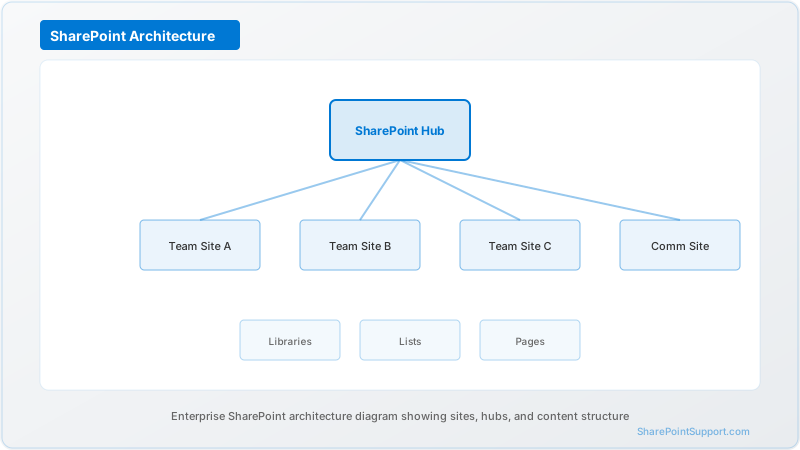
This guide covers every templating approach available in SharePoint Online, from the built-in template gallery to advanced PnP provisioning and custom site designs.
---
Understanding Template Types
Built-In Site Templates
SharePoint Online includes a gallery of pre-built templates for common scenarios. These templates configure page layouts, web parts, lists, and navigation for specific use cases.
Available templates include:
- Crisis Management for emergency response coordination
- Department for departmental landing pages
- Human Resources for HR portals
- IT Help Desk for support ticket management
- Project Management for project coordination
- Event Planning for event management
- Training for learning content delivery
- Retail Management for retail operations
Built-in templates are a good starting point but cannot be customized. They provide a consistent foundation that you can modify after site creation.
Custom Site Templates (Save Site as Template)
Modern SharePoint allows saving any site as a template. This captures the site's page layouts and content, web part configurations, custom lists and libraries, navigation structure, site columns and content types, and theme settings.
To save a site as a template, go to Site Settings then select Save site as template from the gear menu. The template becomes available in the template gallery when creating new sites.
Limitations: Templates do not capture permissions, workflows, or content (only structure). Large sites may not save reliably.
Site Designs and Site Scripts
Microsoft's recommended approach for enterprise site templating uses Site Designs (the user-facing template selection) backed by Site Scripts (JSON-based configuration).
Site Designs are the templates users see when creating a new site. They include a title, description, thumbnail, and one or more associated site scripts.
Site Scripts are JSON files that define actions executed during site provisioning. Supported actions include creating lists and libraries with custom columns, applying themes, setting external sharing capability, installing SPFx solutions, triggering Power Automate flows, joining a hub site, and setting regional settings.
```json
{
"$schema": "https://developer.microsoft.com/json-schemas/sp/site-design-script-actions.schema.json",
"actions": [
{
"verb": "createSPList",
"listName": "Project Tasks",
"templateType": 171,
"subactions": [
{
"verb": "addSPField",
"fieldType": "Choice",
"displayName": "Priority",
"choices": ["Critical", "High", "Medium", "Low"]
},
{
"verb": "addSPField",
"fieldType": "User",
"displayName": "Assigned To"
}
]
},
{
"verb": "applyTheme",
"themeName": "Corporate Brand"
},
{
"verb": "setSiteExternalSharingCapability",
"capability": "ExistingExternalUserSharingOnly"
},
{
"verb": "associateHubSite",
"hubSiteId": "hub-site-guid-here"
},
{
"verb": "triggerFlow",
"url": "https://prod-xx.logic.azure.com/workflows/...",
"name": "Post-Provisioning Setup"
}
]
}
```
Deploying Site Designs via PowerShell:
```powershell
# Add the site script
$script = Get-Content "SiteScript.json" -Raw
$siteScript = Add-SPOSiteScript -Title "Enterprise Project Site Script" -Content $script
# Create the site design
Add-SPOSiteDesign -Title "Enterprise Project Site" -WebTemplate "64" -SiteScripts $siteScript.Id -Description "Standard project site with governance configurations" -PreviewImageUrl "https://contoso.sharepoint.com/SiteAssets/project-template-thumbnail.png"
```
PnP Provisioning Templates
The PnP (Patterns and Practices) provisioning engine provides the most comprehensive templating capability. PnP templates capture everything about a site including pages with full content and web parts, content types and site columns, list structures and views, navigation, theme, and regional settings, search configuration, and tenant-level artifacts.
Extracting a PnP template:
```powershell
# Connect to the source site
Connect-PnPOnline -Url "https://contoso.sharepoint.com/sites/TemplateSource" -Interactive
# Extract the template
Get-PnPSiteTemplate -Out "ProjectTemplate.xml" -Handlers Lists, ContentTypes, Fields, Pages, Navigation, SiteSecurity, Theme
```
Applying a PnP template:
```powershell
# Connect to the target site
Connect-PnPOnline -Url "https://contoso.sharepoint.com/sites/NewProject" -Interactive
# Apply the template
Invoke-PnPSiteTemplate -Path "ProjectTemplate.xml"
```
---
Enterprise Template Strategy
Template Catalog
Build a template catalog that covers your organization's common site types. A typical enterprise needs 5 to 10 templates.
Recommended templates:
- Department Portal (communication site): branded landing page, news, events, document library, quick links
- Project Site (team site): task list, document library, meeting notes, project dashboard
- Community of Practice (communication site): discussion board, resource library, event calendar
- Client Engagement (team site with restricted sharing): external sharing enabled, NDA document library, project tracker
- Policy Library (communication site): policy document library with metadata, approval workflow, version control
Template Governance
Establish a governance process for templates. Designate a template owner who maintains and updates each template. Review templates quarterly for accuracy and relevance. Test templates on a non-production site before deploying updates. Document the intended use case, target audience, and governance rules for each template.
Provisioning Workflow
For enterprise environments, combine site designs with Power Automate flows to create a governed provisioning process. The user submits a site request form specifying the purpose, owner, template, and hub association. A Power Automate flow routes the request for approval. Upon approval, the flow creates the site using PnP provisioning. Post-provisioning steps apply hub association, set permissions, and notify the requestor.
---
Template Versioning
Managing Template Updates
When organizational standards change, templates must be updated. However, updating a template does not retroactively change sites already created from it. For existing sites, apply updates using PnP provisioning scripts that target specific configuration changes.
Version control for templates:
Store template files (JSON site scripts, PnP XML templates) in a SharePoint document library or Git repository. Use version numbers in template names to track changes. Maintain a changelog documenting what changed in each version.
---
Frequently Asked Questions
Can I restrict which templates users see?
Yes. Site designs can be scoped to specific security groups. Users outside the group do not see the template when creating new sites.
Do templates work with Teams?
Team sites created through Teams use default templates. To apply custom templates to Teams-created sites, trigger a site design application via Power Automate after the team is created.
Can I include sample content in templates?
PnP templates can include page content and list items. Site designs (JSON-based) cannot include content, only structural elements. Use PnP for templates that need pre-populated content.
---
For help building an enterprise site template strategy, contact our SharePoint team for a governance assessment. We design template frameworks for organizations with hundreds of sites where consistency and compliance drive template requirements. Explore our SharePoint consulting services to learn more.
Advanced Template Patterns
Template with Automated Provisioning Pipeline
For enterprise environments, build a complete provisioning pipeline that goes beyond basic templates.
The pipeline flow:
- A user submits a site request form in SharePoint
- Power Automate routes the request for approval based on the template type
- Upon approval, an Azure Function provisions the site using PnP provisioning engine
- The function applies the PnP template with full configuration including pages, lists, navigation, and content types
- Post-provisioning scripts configure hub association, apply sensitivity labels, set storage quotas, and add the site to the governance inventory
- The requestor receives a notification with the new site URL and onboarding documentation
Template Testing Framework
Before deploying template updates, test them in a development tenant or a designated test site collection. Create a template testing checklist that verifies all lists and libraries are created correctly, content types and columns are configured properly, navigation links resolve correctly, theme and branding are applied, permissions are set according to governance policy, and Power Automate flows associated with the template are functional.
Template Analytics
Track which templates are used most frequently and gather user feedback on template quality. Use this data to prioritize template improvements, retire unused templates, and identify demand for new template types.
Template Localization
For multilingual organizations, create localized versions of templates. PnP provisioning templates support parameterization, so you can create a single template with language-specific parameters for site title, list names, column display names, and navigation labels. This reduces template maintenance burden while supporting global deployments.
Template Compliance Tagging
For regulated industries, include compliance-related configuration in templates. A template for a healthcare department should automatically apply HIPAA-related sensitivity labels, configure retention policies for medical records, restrict external sharing, and enable audit logging. This ensures every new site meets compliance requirements from creation without relying on administrators to remember manual configuration steps.
Template Maintenance and Lifecycle
Quarterly Template Review
Schedule quarterly reviews of all active templates. During each review, verify that all template components (lists, libraries, columns, navigation) still function correctly after SharePoint updates. Check that branding elements (themes, logos, header settings) are current with organizational standards. Review template usage statistics to identify templates that are no longer being used. Gather feedback from site owners who recently created sites from templates to identify improvement opportunities.
Template Deprecation Process
When a template needs to be retired, follow a structured deprecation process. Announce the deprecation to all site owners with a timeline. Provide a migration path from the deprecated template to the replacement. Remove the template from the template gallery after the deprecation date. Archive the template definition (JSON, PnP XML) for reference. Document the retirement in the template registry.
Template Versioning with Source Control
Store all template definitions in a Git repository for version control. Each template change gets a commit message explaining what changed and why. Use branches for template development and merge to main only after testing. Tag releases with version numbers that correspond to template gallery versions. This approach provides a complete audit trail of template changes and enables rollback if a template update causes issues.
Enterprise Implementation Best Practices
In our 25+ years of enterprise SharePoint consulting, we have designed governance frameworks for organizations spanning healthcare systems with 50,000 employees to financial services firms managing billions in assets. The governance implementations that succeed share a common trait: they balance control with enablement rather than defaulting to restriction.
- Start with a Governance Charter and Executive Sponsorship: Governance without executive backing fails. Secure a C-level sponsor who understands that governance protects the organization and enables productivity rather than restricting it. Document a governance charter that defines scope, authority, roles, decision-making processes, and escalation paths. This charter serves as the constitutional foundation for all governance decisions.
- Adopt a Tiered Governance Model: Not all sites require the same level of control. Classify your SharePoint sites into tiers based on data sensitivity and business criticality. Tier 1 sites containing regulated data require strict controls including mandatory sensitivity labels, restricted sharing, and quarterly access reviews. Tier 2 sites need moderate controls. Tier 3 sites for team collaboration operate with lighter governance to encourage adoption.
- Automate Policy Enforcement at Scale: Manual governance does not scale beyond a few dozen sites. Use Power Automate workflows to enforce naming conventions, trigger access reviews, notify site owners of policy violations, and manage content lifecycle automatically. Automation reduces IT workload while ensuring consistent policy application across thousands of sites.
- Create Self-Service Guardrails: Rather than requiring IT approval for every action, implement guardrails that guide users toward compliant behavior. Pre-approved site templates, managed metadata term sets, and sensitivity label recommendations allow business users to work independently while staying within governance boundaries.
- Establish a Governance Review Cadence: Review governance policies quarterly to account for new Microsoft 365 features, changing compliance requirements, and organizational growth. Conduct a comprehensive governance audit annually that includes permission analysis, storage utilization review, inactive site cleanup, and policy effectiveness measurement.
Governance and Compliance Considerations
Governance frameworks must satisfy the compliance requirements specific to your industry while remaining practical enough for daily operation. The most effective governance frameworks are those designed with regulatory compliance as a core requirement rather than an afterthought.
For HIPAA-regulated healthcare organizations, your governance framework must include specific controls for protected health information including access logging, minimum necessary access enforcement, encryption requirements, and business associate agreement tracking for any external sharing. Sensitivity labels should automatically apply encryption to documents containing PHI, and your retention policies must align with HIPAA's six-year minimum retention requirement.
Financial services organizations operating under SOC 2 need governance controls that demonstrate security, availability, processing integrity, confidentiality, and privacy of customer data. Your governance framework should map directly to SOC 2 trust service criteria, with automated evidence collection for audit readiness. SharePoint audit logs, access reviews, and change management records all serve as SOC 2 evidence.
Government agencies and contractors subject to FedRAMP or CMMC must implement governance controls satisfying federal security requirements including FIPS 140-2 compliant encryption, strict access controls based on security clearance levels, and comprehensive audit trails meeting NIST 800-53 control families.
Regardless of your specific regulatory environment, your governance framework should include data classification policies, retention schedules complying with applicable regulations, incident response procedures, and regular compliance assessments verifying controls function as designed. Working with experienced SharePoint governance consultants who understand your regulatory landscape ensures your framework addresses compliance from day one.
Ready to build a governance framework that protects your organization while enabling productivity? Our governance specialists have helped hundreds of enterprises design SharePoint governance programs that satisfy auditors and empower users. Contact our team for a complimentary governance assessment, and discover how our SharePoint consulting services can transform your compliance posture.
Common Challenges and Solutions
Organizations implementing SharePoint Site Templates consistently encounter obstacles that, if left unaddressed, undermine adoption and erode stakeholder confidence. Drawing on two decades of enterprise SharePoint consulting, these are the challenges we see most frequently and the proven approaches for overcoming them.
Challenge 1: Migration and Legacy Content Complexity
Organizations transitioning legacy content into SharePoint Site Templates often underestimate the complexity of mapping old structures, metadata, and permissions to modern architectures. Failed migrations erode user confidence and create parallel systems that duplicate effort. The resolution requires a structured approach: conducting thorough pre-migration content audits that classify and prioritize content based on business value. Invest in automated migration tools that preserve metadata fidelity and permission integrity while providing detailed validation reports. Organizations that address this proactively report 40 to 60 percent fewer support tickets within the first 90 days of deployment. Establishing a dedicated governance committee with representatives from IT, compliance, and business stakeholders ensures ongoing alignment between technical configuration and organizational objectives.
Challenge 2: Permission and Access Sprawl
As SharePoint Site Templates scales across departments, permission structures inevitably become more complex. Without active governance, permission inheritance breaks down, sharing links proliferate, and sensitive content becomes accessible to unintended audiences. We recommend implementing quarterly access reviews using the SharePoint Admin Center combined with automated reports that flag permission anomalies. Establish a principle of least privilege as the default and require documented justification for elevated access grants. Tracking these metrics through SharePoint health dashboards provides early warning indicators that allow administrators to intervene before minor issues become systemic problems affecting enterprise-wide productivity.
Challenge 3: Performance and Scalability Bottlenecks
Large-scale SharePoint Site Templates deployments frequently encounter performance issues as content volumes grow beyond initial design parameters. Large lists, deeply nested folder structures, and poorly optimized custom solutions contribute to slow page loads and frustrated users. The most effective mitigation strategy involves conducting regular performance audits that identify bottlenecks before they impact user experience. Implement list view thresholds, indexed columns, and pagination strategies that maintain responsive performance at enterprise scale. Enterprises operating in regulated industries such as healthcare and financial services must pay particular attention to this challenge because compliance violations carry significant financial and reputational consequences. Regular audits conducted quarterly at minimum help organizations maintain alignment with evolving regulatory requirements and internal policy updates.
Challenge 4: Search Relevance and Content Discoverability
Poor search experiences are among the top complaints users raise about SharePoint Site Templates deployments. When search returns irrelevant results or fails to surface critical documents, users abandon the platform in favor of ad-hoc workarounds like email attachments and local file shares. Addressing this requires investing in managed metadata term stores, consistent content type usage, and search schema configuration. Promote high-value content through bookmarks and acronyms in Microsoft Search, and regularly review search analytics to identify and close discoverability gaps. Organizations that invest in structured change management programs achieve adoption rates 35 percent higher than those relying on organic discovery alone. Executive sponsorship combined with department-level champions creates the organizational momentum necessary for sustained success.
Integration with Microsoft 365 Ecosystem
SharePoint Site Templates does not operate in isolation. Its value multiplies when connected to the broader Microsoft 365 ecosystem, creating unified workflows that eliminate context switching and reduce manual data transfer between applications.
Microsoft Teams Integration: SharePoint Site Templates content surfaces directly in Teams channels through embedded tabs and adaptive cards, giving team members instant access to relevant documents and dashboards without leaving their collaborative workspace. Teams channels automatically provision SharePoint document libraries, which means sharepoint site templates configurations and content flow seamlessly between collaborative conversations and structured document management. Users can surface SharePoint content directly within Teams tabs, reducing the friction that typically causes adoption to stall.
Power Automate Workflows: Build approval workflows that route SharePoint Site Templates content through structured review chains, automatically notifying approvers and escalating overdue items to maintain process velocity. Automated workflows triggered by SharePoint events such as document uploads, metadata changes, or approval completions eliminate repetitive manual tasks. Organizations typically automate 15 to 25 processes within the first quarter, saving an average of 8 hours per week per department. These automations also create audit trails that satisfy compliance requirements for regulated industries.
Power BI Analytics: Visualize SharePoint Site Templates usage patterns and adoption metrics through Power BI dashboards that update automatically, giving leadership real-time visibility into platform health and user engagement. Connecting SharePoint data to Power BI dashboards provides real-time visibility into content usage patterns, adoption metrics, and operational KPIs. Decision makers gain actionable intelligence without requiring manual report generation, enabling faster response to emerging trends and potential issues.
Microsoft Purview and Compliance: Apply sensitivity labels to SharePoint Site Templates content automatically based on classification rules, ensuring that confidential and regulated information receives appropriate protection throughout its lifecycle. Sensitivity labels, data loss prevention policies, and retention schedules configured in Microsoft Purview extend automatically to sharepoint site templates content. This unified compliance framework ensures that governance policies apply consistently across the entire Microsoft 365 environment rather than requiring separate configuration for each workload. For organizations subject to HIPAA, SOC 2, or FedRAMP requirements, this integrated approach significantly reduces compliance management overhead.
Getting Started: Next Steps
Implementing SharePoint Site Templates effectively requires more than technical configuration. It demands a strategic approach grounded in your organization's specific business requirements, compliance obligations, and growth trajectory. The difference between a deployment that delivers measurable ROI and one that becomes shelfware often comes down to the quality of upfront planning and expert guidance.
Begin with a focused assessment of your current SharePoint environment. Evaluate your existing information architecture, permission structures, content lifecycle policies, and user adoption patterns. Identify gaps between your current state and the target state required for successful sharepoint site templates implementation. This assessment typically takes 2 to 4 weeks and produces a prioritized roadmap that aligns technical work with business outcomes.
Our SharePoint specialists have guided organizations across healthcare, financial services, government, and education through hundreds of successful implementations. We bring deep expertise in SharePoint architecture, governance frameworks, and compliance alignment that accelerates time to value while minimizing risk.
Ready to move forward? Contact our team for a complimentary consultation. We will assess your environment, identify quick wins, and develop a phased implementation plan tailored to your organization's needs and timeline. Whether you are starting from scratch or optimizing an existing deployment, our enterprise SharePoint consultants deliver the depth and accountability enterprise SharePoint work requires.
Written by the SharePoint Support Team
Senior SharePoint Consultants | 25+ Years Microsoft Ecosystem Experience
Our senior SharePoint consultants bring deep expertise spanning 500+ enterprise migrations and compliance implementations across HIPAA, SOC 2, and FedRAMP environments. We cover SharePoint Online, Microsoft 365, migrations, Copilot readiness, and large-scale governance.
Expert SharePoint Services
Frequently Asked Questions
What should a SharePoint governance framework include?▼
How do we enforce SharePoint governance without slowing down users?▼
Who should own SharePoint governance in an enterprise?▼
How often should we review and update our SharePoint governance policies?▼
How do we apply consistent branding across all SharePoint sites?▼
Need Expert Help?
Our SharePoint consultants are ready to help you implement these strategies in your organization.
Continue Reading in Governance
SharePoint ROI: Building the Business Case Investment
How to calculate SharePoint ROI for your organization. Includes real productivity metrics, cost savings data, compliance risk reduction, and a business case template for IT leaders to present to C-suite executives.
GovernanceSharePoint Governance Policy Template
Ready-to-use SharePoint governance policy template covering site creation, naming conventions, permissions, external sharing, content lifecycle, and Microsoft 365 Copilot governance.
GovernanceSharePoint Document Library Best Practices: Complete Setup Guide for 2026
Master SharePoint document library configuration. Covers metadata columns, content types, views, version history, retention labels, permissions, co-authoring, and performance optimization for enterprise libraries.
GovernanceSharePoint Metadata and Taxonomy Guide
Build a scalable enterprise metadata and taxonomy strategy for SharePoint. Learn managed metadata, term stores, content types, columns, and how to drive user adoption.
GovernanceSharePoint Content Types: Enterprise Implementation Guide
Master SharePoint content types to standardize document management across your organization. Learn how to create, configure, and publish content types from the Content Type Hub, associate document templates, and drive consistent metadata at scale.
GovernanceSharePoint Records Management with Microsoft Purview
Implement enterprise records management in SharePoint using Microsoft Purview. Covers retention labels, records declaration, disposition reviews, regulatory records, and ISO 15489 alignment.