The Employee Experience Platform Question
Microsoft Viva Connections is the component of Viva that surfaces SharePoint content inside Microsoft Teams as a unified employee experience. In 2026 it is the primary way that most enterprises intend to modernize the intranet experience. The promise is an employee experience that employees actually use because it lives inside the tool (Teams) where they already spend their workday.
The promise is real, but the execution is where most implementations stumble. Viva Connections depends on a well-designed SharePoint home site, a carefully curated dashboard, and a feed strategy that delivers value in the first 30 seconds of use. When those pieces are right, Viva Connections produces adoption rates of 60 to 80 percent of active Teams users within 90 days. When they are wrong, it produces a feature that leadership invested in and employees ignore.
This guide walks through the home site architecture that supports Viva Connections, the dashboard design patterns that drive adoption, the feed strategy that keeps content fresh, and the governance model for ongoing operation.
The Home Site Foundation
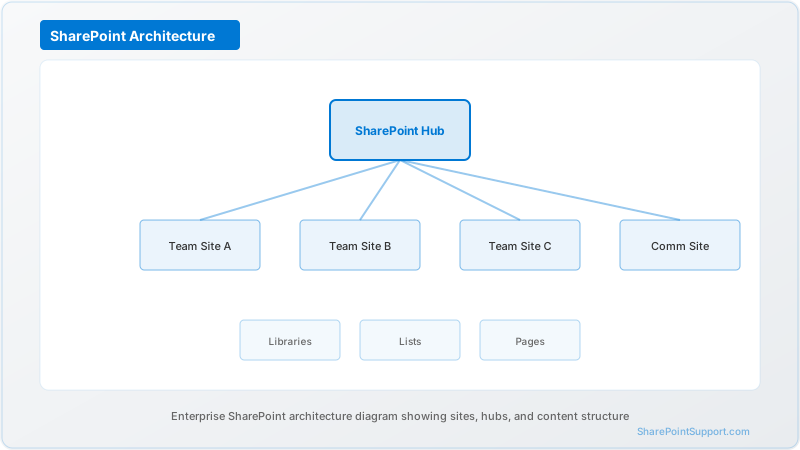
Viva Connections requires a SharePoint home site. The home site is the top-level landing page for the entire intranet and is the source of the Viva Connections experience inside Teams.
Home Site Technical Requirements
A home site is a communication site that has been designated as the tenant's home site using Set-SPOHomeSite. The designation unlocks several capabilities including enhanced analytics, global navigation integration, and the Viva Connections experience.
```powershell
# Designate a communication site as the home site
Connect-SPOService -Url "https://contoso-admin.sharepoint.com"
Set-SPOHomeSite -HomeSiteUrl "https://contoso.sharepoint.com/sites/home"
# Verify the home site designation
Get-SPOHomeSite
```
Home Site Design Principles
The home site is not just another SharePoint page. It is the gateway to the entire digital workplace. The design principles that matter:
- Load in under 2 seconds. Slow home sites destroy adoption. Minimize web parts, use CDN for images, and test performance under realistic conditions.
- Personalize without overwhelming. Audience targeting for navigation, news, and content rollups makes the home site feel relevant to each employee without requiring per-employee configuration.
- Design for three audiences simultaneously. Executives who visit monthly need different content than operational employees who visit daily. A well-designed home site serves both.
- Integrate global navigation. The home site's megamenu becomes the global navigation inside Viva Connections. Invest in the megamenu design.
The Dashboard
The Viva Connections dashboard is the collection of cards that employees see when they open Viva Connections inside Teams. The dashboard is the single most important element of the employee experience because it is what employees see first and most often.
Dashboard Design Principles
Good dashboards follow four principles.
Principle 1: Dashboard-as-a-tool, not dashboard-as-a-newsfeed. Cards should help employees complete tasks, not just consume content. Clock-in cards, benefits enrollment cards, approval action cards, and expense submission cards are the patterns that drive engagement.
Principle 2: Audience targeting on every card. Different employee populations need different cards. A frontline worker needs shift information, safety checklists, and policy access. A corporate knowledge worker needs benefits, learning, and project tools. Use audience targeting to deliver the right cards to the right people.
Principle 3: Limit card count. A dashboard with 20 cards is a dashboard no one reads. Keep the card count to 6 to 10 per audience. Prioritize cards that are actionable and timely.
Principle 4: Prefer high-value cards over novel cards. The card catalog has many options, but the cards that drive engagement are the ones that integrate with systems employees already use. HR systems, IT service desks, approval workflows, and learning platforms all produce high-value cards.
Card Types That Actually Work
The most commonly used cards in enterprise deployments:
- Approvals Card: Shows pending approvals from Power Platform, SharePoint, and integrated systems. Drives engagement because it contains actionable work items.
- Viva Learning Card: Surfaces relevant learning content for the employee. Works particularly well for role-based learning paths.
- Shifts Card (for frontline): Displays the employee's schedule, shift swaps, and clock-in/out actions. Essential for frontline audiences.
- Assigned Tasks Card: Pulls tasks from Planner, To Do, and integrated project tools.
- ServiceNow or Custom IT Service Card: Lets employees submit tickets and check status without leaving Viva Connections.
- Third-Party Integration Cards: Custom cards integrated with business systems like Workday, SAP, or Salesforce drive adoption in the populations that use those systems daily.
Custom Card Development
Custom dashboard cards can be built using the SharePoint Framework (SPFx) Adaptive Card Extensions (ACE) model. Custom cards are appropriate when no prebuilt card meets the need and the use case justifies the development investment. Simple cards take 1 to 2 weeks to build; complex cards with external system integration can take 4 to 8 weeks.
The Feed Strategy
The Viva Connections feed is the stream of news and announcements that employees see below the dashboard. The feed's quality determines whether employees scroll past the dashboard to read more, or leave Viva Connections after completing their dashboard actions.
Content Sources
The feed pulls from multiple sources: SharePoint news from the home site and its associated sites, organization-wide announcements, Yammer (Viva Engage) posts if configured, and custom content through the feed API.
Audience Targeting for Feed
Audience-target every news article. An enterprise-wide announcement goes to everyone. A department announcement goes to the department. A role-specific announcement goes to that role. Without audience targeting, the feed becomes a firehose that nobody reads in detail.
Editorial Cadence
The feed quality depends on editorial cadence. Enterprises that publish 3 to 5 high-quality news items per week sustain engagement. Enterprises that publish 20 items per day burn out their audience. The right cadence depends on the organization size and communication culture, but most large enterprises land in the 3-to-10 items per week range for enterprise-wide content.
Boosted Posts
The feed supports boosted posts that appear at the top of the feed for a specified period. Use boosting sparingly; boosting too many posts erodes the signal. Reserve boosting for truly enterprise-critical announcements.
The Mobile Experience
Viva Connections has a distinct mobile experience inside the Teams mobile app. The mobile experience is particularly important for frontline workers who may only interact with the intranet through mobile.
Mobile-Specific Design
The mobile experience renders the dashboard cards and the feed, but with different sizing and interaction patterns. Design cards with mobile in mind: tap targets should be large, text should be readable at mobile sizes, and card content should work without relying on hover states.
Offline Behavior
Teams has offline support for some content. Viva Connections dashboard cards that work offline (such as schedule display for Shifts) provide value even when the employee is in a low-connectivity environment. Cards that require real-time data should display clear offline states.
Governance Model
Viva Connections requires governance across three dimensions.
Home Site Governance
The home site is the tenant's most-visited page, and it requires active ownership. Assign a dedicated home site owner (typically from internal communications), establish a publication schedule, implement a quarterly review of navigation accuracy, and monitor home site performance with real user metrics.
Dashboard Governance
Dashboard configuration should be managed through a defined change process. Proposed card additions require justification, audience mapping, and performance impact assessment. Cards should be retired when they stop providing value, measured by interaction rates and feedback.
Feed Governance
The feed requires editorial governance to maintain content quality. The pattern that works has a small editorial team (internal communications, HR, IT leadership) that reviews and approves enterprise-wide posts, while departmental contributors can publish within their audience without central approval.
Measurement and Continuous Improvement
The metrics that matter for Viva Connections.
- Monthly active users. Percentage of Teams users who opened Viva Connections at least once in the month.
- Weekly active users. Percentage who opened it at least once per week. Healthy is 50 percent or higher.
- Dashboard card interactions per user per week. Measures whether the dashboard is delivering value.
- Feed engagement rate. Percentage of feed items that receive a click, like, or comment.
- Mobile usage share. Percentage of usage coming from mobile, particularly important for frontline audiences.
- Time to action for key tasks. For actions surfaced through dashboard cards, measure the time from card interaction to task completion.
Review these metrics monthly and use the insights to adjust card configuration, feed content, and home site design.
Common Failure Modes
Three patterns consistently cause Viva Connections rollouts to underperform.
Failure 1: Launching without frontline audience consideration. Viva Connections is most impactful for frontline populations who historically have had limited intranet access. Launching without specific consideration for frontline needs (shift information, safety, compliance tasks) leaves the highest-value audience unengaged.
Failure 2: Copying the old intranet into Viva Connections. Migrating the old intranet's structure into Viva Connections without redesigning for the experience produces a worse version of the old intranet. The opportunity is to redesign the experience around dashboard cards and targeted feeds, not to port the old design.
Failure 3: No ongoing investment. Viva Connections launches well and then stagnates because no one owns continuous improvement. The dashboard ages, the feed becomes stale, and adoption declines over time. The fix is assigning dedicated ownership with a mandate for continuous improvement.
Getting Started
A structured Viva Connections deployment follows a 90-day pattern. Phase 1 (Days 1-30) establishes the home site, designs the initial dashboard, and runs usability tests with representative users. Phase 2 (Days 31-60) deploys to a pilot population of 500 to 2,000 users, iterates based on feedback, and validates the mobile experience. Phase 3 (Days 61-90) rolls out to the full organization with communication, training, and governance structures in place.
Our SharePoint specialists design and deploy Viva Connections across enterprises with internal communications, HR, and IT leadership stakeholders. Contact our team to scope a Viva Connections engagement, or review our SharePoint consulting services for the full methodology.
Written by the SharePoint Support Team
Senior SharePoint Consultants | 25+ Years Microsoft Ecosystem Experience
Our senior SharePoint consultants bring deep expertise spanning 500+ enterprise migrations and compliance implementations across HIPAA, SOC 2, and FedRAMP environments. We cover SharePoint Online, Microsoft 365, migrations, Copilot readiness, and large-scale governance.
Expert SharePoint Services
Frequently Asked Questions
What is Microsoft Viva Connections?▼
Do we need a SharePoint home site for Viva Connections?▼
What types of cards work best on the Viva Connections dashboard?▼
How do we target Viva Connections content to different audiences?▼
Can Viva Connections work for frontline workers?▼
How do we build custom cards for Viva Connections?▼
What is the difference between the Viva Connections feed and SharePoint News?▼
How do we measure Viva Connections adoption?▼
Need Expert Help?
Our SharePoint consultants are ready to help you implement these strategies in your organization.
Continue Reading in Intranets
Designing Modern SharePoint Intranets: 2025 Best...
Create engaging employee experiences with modern SharePoint intranet design principles and real-world examples.
IntranetsViva Connections Deployment: Building Your Modern...
Deploy Microsoft Viva Connections to create a personalized employee experience hub that brings together communications, resources, and tools in one accessible location.
IntranetsSharePoint Intranet Design Best Practices: 2026 Guide
Expert guide to designing a modern SharePoint intranet. Covers hub site architecture, navigation design, homepage design, content strategy, search optimization, and governance for enterprise intranets.
IntranetsSharePoint Intranet Design: 10 Best Practices (2026)
Design a modern SharePoint intranet with these 10 best practices covering UX, navigation, hub sites, mobile, branding, and employee engagement.
Storage & CostCopilot in SharePoint Went GA — And Quietly Started Metering You
Three SharePoint features now bill per use instead of per seat, the default cap is $40 per user per month on top of your Copilot licence, and every one of them is triggered by site owners rather than admins. Here is the exposure math and how to cap it.
Emergency SupportYour External Partners Are Losing Access Right Now, and Nobody Is Telling You
SharePoint One-Time Passcode retires through October and November 2026. External users without an Entra B2B guest account lose access to links they have used for years — silently, with no notification to them or to you. Here is how to find them before they give up.