How to Brand and Customize SharePoint Sites for Your Organization
SharePoint branding and customization transforms generic out-of-the-box sites into professional, branded experiences that reflect your organization's visual identity, improve user adoption, and reinforce corporate culture. Modern SharePoint provides extensive branding capabilities through the change-the-look panel, custom themes, site designs, header configurations, and SPFx extensions, eliminating the need for the fragile master page customizations of the past.
In our 25+ years of designing SharePoint environments for enterprise organizations, we have created branded intranets, department portals, and project sites for Fortune 500 companies. The key to successful branding is balancing visual identity with usability and maintainability. This guide covers every aspect of modern SharePoint branding.
Modern SharePoint Branding Options
Change the Look Panel
The Change the Look panel in site settings provides the simplest branding controls. You can modify the theme colors, header layout, navigation style, footer content, and header background image. These changes apply to the entire site and are available to site owners without any development skills.
Choose from Microsoft's pre-built themes or create a custom theme that matches your corporate color palette. Custom themes define primary color, body text color, body background color, and hover color values that cascade throughout the entire site.
Custom Theme Creation
For precise brand alignment, create custom themes using the SharePoint theme generator tool or PowerShell. Define your exact brand colors and deploy the theme to your tenant so it appears as an option for all site owners.
```powershell
# Deploy a custom theme to the tenant
Connect-SPOService -Url "https://tenant-admin.sharepoint.com"
$themepalette = @{
"themePrimary" = "#0078d4"
"themeLighterAlt" = "#eff6fc"
"themeLighter" = "#deecf9"
"themeLight" = "#c7e0f4"
"themeTertiary" = "#71afe5"
"themeSecondary" = "#2b88d8"
"themeDarkAlt" = "#106ebe"
"themeDark" = "#005a9e"
"themeDarker" = "#004578"
"neutralLighterAlt" = "#faf9f8"
"neutralLighter" = "#f3f2f1"
"neutralLight" = "#edebe9"
"neutralQuaternaryAlt" = "#e1dfdd"
"neutralQuaternary" = "#d0d0d0"
"neutralTertiaryAlt" = "#c8c6c4"
"neutralTertiary" = "#a19f9d"
"neutralSecondary" = "#605e5c"
"neutralPrimaryAlt" = "#3b3a39"
"neutralPrimary" = "#323130"
"neutralDark" = "#201f1e"
"black" = "#000000"
"white" = "#ffffff"
}
Add-SPOTheme -Name "Corporate Brand" -Palette $themepalette -IsInverted $false
```
Site Header Customization
Header Layouts
SharePoint offers four header layout options. Standard displays the site logo, title, and navigation. Compact reduces the header height for content-dense sites. Minimal shows only the site logo and hamburger navigation. Extended provides a large hero area with background image, site title, and description.
Choose the header layout based on the site's purpose. Intranets and communication sites benefit from the Extended layout with a compelling hero image. Operational team sites work better with Compact or Minimal layouts that maximize content space.
Logo and Title Configuration
Upload your organization's logo and configure the site title, description, and logo placement. SharePoint supports both a standard logo and a secondary logo that appears when the header is scrolled. Use SVG format for logos to ensure crisp rendering at all screen sizes and resolutions.
Navigation Design
Mega Menu Configuration
Modern SharePoint supports mega menu navigation that displays multiple columns of links organized by category. This is ideal for intranets and large sites with diverse content areas. Configure the mega menu through the site navigation editor where you can create categories, add links, organize into columns, and apply audience targeting.
Hub Navigation
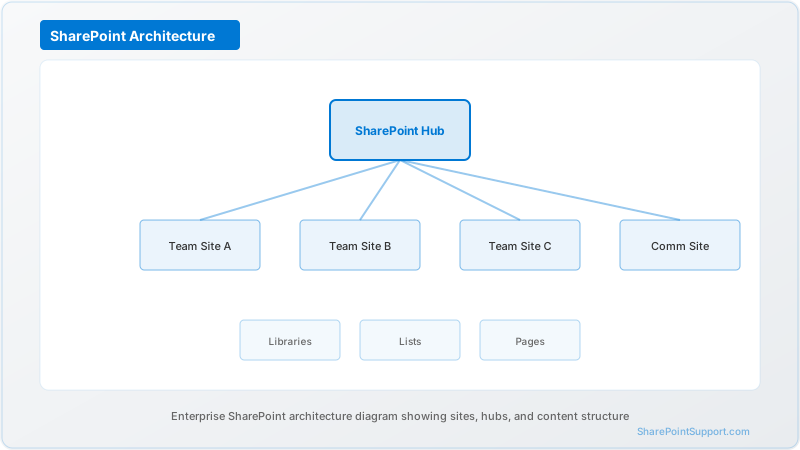
For multi-site environments, hub navigation provides consistent cross-site navigation. All sites associated with a hub inherit the hub navigation bar, providing a unified branding experience across the entire hub ecosystem. Design hub navigation to include the most-used resources across all associated sites.
Footer Configuration
Enable the site footer to display organization-wide links, legal disclaimers, and contact information. The footer appears on all pages within the site and can be configured with multiple columns of links, logos, and text. Use audience targeting on footer links to show different content to different user groups.
Page Templates and Site Designs
Custom Page Templates
Create reusable page templates that enforce consistent layout and branding across the organization. Authors select from approved templates when creating new pages, ensuring brand compliance without restricting content creation.
Site Designs and Site Scripts
Site designs automate the application of branding, navigation, content types, and lists when new sites are created. Define a site script in JSON that specifies the theme, navigation links, default lists, content types, and regional settings to apply automatically.
```json
{
"$schema": "https://developer.microsoft.com/json-schemas/sp/site-design-script-actions.schema.json",
"actions": [
{ "verb": "applyTheme", "themeName": "Corporate Brand" },
{ "verb": "setRegionalSettings", "timeZone": 4, "locale": 1033 },
{ "verb": "setSiteLogo", "url": "/sites/brand/SiteAssets/corporate-logo.svg" }
]
}
```
SPFx Extensions for Advanced Branding
For branding requirements beyond what the built-in tools provide, SPFx extensions offer limitless customization. Application customizers inject custom headers, footers, or notification bars on every page. Field customizers change how list column data is rendered. Command set extensions add custom buttons to list and library toolbars.
Use SPFx extensions for custom notification banners, emergency alert bars, branded navigation mega menus with dynamic content, and custom footer components that pull data from SharePoint lists.
Branding Governance
Establish branding governance to maintain consistency as sites proliferate. Define approved themes and make them available tenant-wide. Disable the ability for site owners to apply custom themes if brand consistency is critical. Use site designs to enforce branding automatically on new sites. Conduct quarterly audits to identify sites that deviate from brand standards.
Our custom branding services help organizations design and implement professional SharePoint branding that reflects their corporate identity. Contact us to discuss your branding and customization needs.
Enterprise Branding Governance at Scale
Multi-Brand Organizations
Large organizations with multiple business units or brands need a branding governance framework that balances corporate consistency with brand-specific identity. Create a master theme that establishes the corporate color palette and typography. Create sub-themes for each business unit that use the corporate foundation while incorporating brand-specific accent colors and logos.
Deploy themes through the SharePoint admin center and restrict which themes are available to which sites. Use site designs to automatically apply the correct theme when new sites are provisioned for specific business units. This prevents brand inconsistency while allowing appropriate variation.
Branding Compliance Auditing
Conduct quarterly branding audits to identify sites that deviate from standards. Use PowerShell to report on which theme each site uses, whether custom CSS has been applied outside approved channels, and whether logos and headers match the approved brand assets.
```powershell
# Audit site themes across the tenant
Connect-SPOService -Url "https://tenant-admin.sharepoint.com"
$sites = Get-SPOSite -Limit All
foreach ($site in $sites) {
$theme = Get-SPOSiteDesignRights -Identity $site.Url -ErrorAction SilentlyContinue
Write-Output "$($site.Url): Theme applied"
}
```
Maintaining Brand Consistency During Site Lifecycle
Branding can drift over time as site owners customize their sites beyond the initial design. Implement governance processes that include automated checks when sites are modified, periodic visual reviews of high-traffic sites, and documented procedures for requesting branding changes. Use Communication Compliance policies to detect unauthorized branding modifications.
Advanced Customization with CSS and JSON
Modern List and Library Formatting
JSON column formatting and view formatting provide lightweight customizations that do not require SPFx development. Format status columns with color-coded badges, add progress bars to percentage columns, create card-style list views, and add conditional formatting that highlights overdue items or flagged content.
```json
{
"$schema": "https://developer.microsoft.com/json-schemas/sp/v2/column-formatting.schema.json",
"elmType": "div",
"style": {
"background-color": "=if(@currentField == 'Active', '#dff6dd', if(@currentField == 'Expired', '#fde7e9', '#fff4ce'))"
},
"txtContent": "@currentField"
}
```
Custom Web Part Styling
When SPFx web parts need to match your brand precisely, use the theme context available in SPFx to access the current site's theme colors dynamically. This ensures your custom web parts adapt automatically when the site theme changes, without requiring code modifications. Access theme colors through this.context.serviceScope.consume(ThemeProvider.serviceKey).
Performance Considerations for Branded Sites
Complex branding customizations can impact page load performance. Large hero images, custom fonts loaded from external sources, and heavy SPFx extensions all add to page weight and load time. Optimize brand assets for web delivery: compress images, use SVG format for logos and icons, host fonts locally or through the Office 365 CDN, and lazy-load non-critical branding elements.
Test page performance after applying branding changes using Google Lighthouse and the SharePoint page diagnostics tool. Ensure that branded pages maintain a Largest Contentful Paint under 2.5 seconds and avoid layout shifts caused by late-loading brand elements.
Accessibility and Branding Compliance
Branding customizations must comply with WCAG 2.1 AA accessibility standards. Custom themes must maintain a minimum 4.5 to 1 contrast ratio between text and background colors. Custom fonts must be legible at standard sizes on both desktop and mobile screens. Navigation elements must be keyboard accessible and provide visible focus indicators. Test all branding customizations with screen readers to ensure that custom headers, footers, and navigation components announce correctly.
Create an accessibility checklist for branding reviews that covers contrast ratios, font readability, keyboard navigation, screen reader compatibility, and motion sensitivity for animated elements. Include this checklist in your branding governance process so every branding change is validated for accessibility before deployment.
Enterprise Implementation Best Practices
In our 25+ years of enterprise SharePoint consulting, we have designed and deployed branded SharePoint experiences for organizations ranging from global financial institutions to healthcare systems with strict brand compliance requirements. The branding implementations that succeed long-term balance visual impact with maintainability and performance.
- Use the SharePoint Theming Framework Exclusively: Avoid custom CSS injection and DOM manipulation for branding purposes. SharePoint's theming framework provides consistent color, typography, and spacing customization that survives platform updates without breaking. Custom CSS solutions require ongoing maintenance every time Microsoft updates the SharePoint UI and frequently create accessibility issues that the native theming framework avoids.
- Design a Hub-Based Branding Strategy: Use hub site associations to cascade consistent branding across groups of related sites. Each hub can define its own theme, logo, header, and footer configuration that automatically applies to all associated sites. This approach ensures brand consistency across hundreds of sites without requiring manual configuration of each individual SharePoint site.
- Optimize All Visual Assets for Web Performance: Every custom image, icon, and logo added to your SharePoint branding directly impacts page load performance. Compress all images to web-optimized formats, use SVG for logos and icons where possible, implement responsive image sizes that serve appropriate resolutions for desktop and mobile devices, and leverage the SharePoint CDN to serve branding assets from edge locations closest to your users.
- Create Reusable Page Templates for Content Consistency: Design page templates for your most common content patterns including news articles, policy pages, department landing pages, and project portals. These templates ensure visual consistency, reduce page creation time, and guide content authors toward effective layouts without requiring design expertise.
- Establish a Branding Governance Process: Document your branding standards in a style guide that covers color usage, typography, imagery guidelines, logo placement, and web part configuration standards. Require branding review for any site that deviates from standard templates and update your branding standards annually to reflect evolving brand requirements and new SharePoint capabilities.
Governance and Compliance Considerations
SharePoint branding and design customizations create compliance considerations that organizations frequently overlook, particularly around accessibility requirements, content security, and the governance of custom code deployed across the tenant.
For organizations subject to Section 508, ADA, or equivalent accessibility regulations, all branding customizations must comply with WCAG 2.1 AA standards. Custom themes must maintain sufficient color contrast ratios, custom fonts must be readable at all supported zoom levels, and custom layouts must be navigable via keyboard and compatible with screen readers. Accessibility compliance is not optional and should be verified before deploying branding changes to production.
Financial services organizations must ensure that branding customizations do not interfere with required compliance disclosures, regulatory notices, or mandatory footer content. Custom themes and page layouts should accommodate compliance content requirements without allowing business users to inadvertently remove required elements.
Healthcare organizations must verify that branded communication sites and patient-facing portals meet HIPAA requirements for secure content delivery and that branding assets do not introduce third-party tracking or analytics that could compromise patient privacy.
Establish a branding governance process that requires accessibility testing, security review of custom code, and compliance validation before deploying branding changes to production. Maintain a branding change log that documents what was changed, when, by whom, and the test results for accessibility and compliance. Review your branding architecture during platform updates to ensure customizations remain compatible and compliant. Our SharePoint branding specialists create visually compelling experiences that satisfy accessibility requirements and maintain compliance with your regulatory framework.
Ready to create a SharePoint experience that reflects your brand and engages your users? Our branding specialists have designed enterprise SharePoint experiences for organizations with the highest visual standards. Contact our team for a branding consultation, and explore how our SharePoint consulting services can transform your digital workplace appearance.
Common Challenges and Solutions
Organizations implementing SharePoint Branding Customization consistently encounter obstacles that, if left unaddressed, undermine adoption and erode stakeholder confidence. Drawing on two decades of enterprise SharePoint consulting, these are the challenges we see most frequently and the proven approaches for overcoming them.
Challenge 1: Permission and Access Sprawl
As SharePoint Branding Customization scales across departments, permission structures inevitably become more complex. Without active governance, permission inheritance breaks down, sharing links proliferate, and sensitive content becomes accessible to unintended audiences. The resolution requires a structured approach: implementing quarterly access reviews using the SharePoint Admin Center combined with automated reports that flag permission anomalies. Establish a principle of least privilege as the default and require documented justification for elevated access grants. Organizations that address this proactively report 40 to 60 percent fewer support tickets within the first 90 days of deployment. Establishing a dedicated governance committee with representatives from IT, compliance, and business stakeholders ensures ongoing alignment between technical configuration and organizational objectives.
Challenge 2: Performance and Scalability Bottlenecks
Large-scale SharePoint Branding Customization deployments frequently encounter performance issues as content volumes grow beyond initial design parameters. Large lists, deeply nested folder structures, and poorly optimized custom solutions contribute to slow page loads and frustrated users. We recommend conducting regular performance audits that identify bottlenecks before they impact user experience. Implement list view thresholds, indexed columns, and pagination strategies that maintain responsive performance at enterprise scale. Tracking these metrics through SharePoint health dashboards provides early warning indicators that allow administrators to intervene before minor issues become systemic problems affecting enterprise-wide productivity.
Challenge 3: Search Relevance and Content Discoverability
Poor search experiences are among the top complaints users raise about SharePoint Branding Customization deployments. When search returns irrelevant results or fails to surface critical documents, users abandon the platform in favor of ad-hoc workarounds like email attachments and local file shares. The most effective mitigation strategy involves investing in managed metadata term stores, consistent content type usage, and search schema configuration. Promote high-value content through bookmarks and acronyms in Microsoft Search, and regularly review search analytics to identify and close discoverability gaps. Enterprises operating in regulated industries such as healthcare and financial services must pay particular attention to this challenge because compliance violations carry significant financial and reputational consequences. Regular audits conducted quarterly at minimum help organizations maintain alignment with evolving regulatory requirements and internal policy updates.
Challenge 4: User Adoption Resistance
Many organizations deploy SharePoint Branding Customization with technically sound configurations but fail to achieve meaningful adoption because end users default to familiar workflows. The root cause is almost always insufficient change management rather than flawed technology. Addressing this requires developing role-specific training modules that demonstrate tangible time savings for each user persona, combined with executive communications that reinforce the strategic importance of the transition. Organizations that invest in structured change management programs achieve adoption rates 35 percent higher than those relying on organic discovery alone. Executive sponsorship combined with department-level champions creates the organizational momentum necessary for sustained success.
Integration with Microsoft 365 Ecosystem
SharePoint Branding Customization does not operate in isolation. Its value multiplies when connected to the broader Microsoft 365 ecosystem, creating unified workflows that eliminate context switching and reduce manual data transfer between applications.
Microsoft Teams Integration: SharePoint Branding Customization content surfaces directly in Teams channels through embedded tabs and adaptive cards, giving team members instant access to relevant documents and dashboards without leaving their collaborative workspace. Teams channels automatically provision SharePoint document libraries, which means sharepoint branding customization configurations and content flow seamlessly between collaborative conversations and structured document management. Users can surface SharePoint content directly within Teams tabs, reducing the friction that typically causes adoption to stall.
Power Automate Workflows: Build approval workflows that route SharePoint Branding Customization content through structured review chains, automatically notifying approvers and escalating overdue items to maintain process velocity. Automated workflows triggered by SharePoint events such as document uploads, metadata changes, or approval completions eliminate repetitive manual tasks. Organizations typically automate 15 to 25 processes within the first quarter, saving an average of 8 hours per week per department. These automations also create audit trails that satisfy compliance requirements for regulated industries.
Power BI Analytics: Visualize SharePoint Branding Customization usage patterns and adoption metrics through Power BI dashboards that update automatically, giving leadership real-time visibility into platform health and user engagement. Connecting SharePoint data to Power BI dashboards provides real-time visibility into content usage patterns, adoption metrics, and operational KPIs. Decision makers gain actionable intelligence without requiring manual report generation, enabling faster response to emerging trends and potential issues.
Microsoft Purview and Compliance: Apply sensitivity labels to SharePoint Branding Customization content automatically based on classification rules, ensuring that confidential and regulated information receives appropriate protection throughout its lifecycle. Sensitivity labels, data loss prevention policies, and retention schedules configured in Microsoft Purview extend automatically to sharepoint branding customization content. This unified compliance framework ensures that governance policies apply consistently across the entire Microsoft 365 environment rather than requiring separate configuration for each workload. For organizations subject to HIPAA, SOC 2, or FedRAMP requirements, this integrated approach significantly reduces compliance management overhead.
Getting Started: Next Steps
Implementing SharePoint Branding Customization effectively requires more than technical configuration. It demands a strategic approach grounded in your organization's specific business requirements, compliance obligations, and growth trajectory. The difference between a deployment that delivers measurable ROI and one that becomes shelfware often comes down to the quality of upfront planning and expert guidance.
Begin with a focused assessment of your current SharePoint environment. Evaluate your existing information architecture, permission structures, content lifecycle policies, and user adoption patterns. Identify gaps between your current state and the target state required for successful sharepoint branding customization implementation. This assessment typically takes 2 to 4 weeks and produces a prioritized roadmap that aligns technical work with business outcomes.
Our SharePoint specialists have guided organizations across healthcare, financial services, government, and education through hundreds of successful implementations. We bring deep expertise in SharePoint architecture, governance frameworks, and compliance alignment that accelerates time to value while minimizing risk.
Ready to move forward? Contact our team for a complimentary consultation. We will assess your environment, identify quick wins, and develop a phased implementation plan tailored to your organization's needs and timeline. Whether you are starting from scratch or optimizing an existing deployment, our enterprise SharePoint consultants deliver the depth and accountability enterprise SharePoint work requires.
Written by the SharePoint Support Team
Senior SharePoint Consultants | 25+ Years Microsoft Ecosystem Experience
Our senior SharePoint consultants bring deep expertise spanning 500+ enterprise migrations and compliance implementations across HIPAA, SOC 2, and FedRAMP environments. We cover SharePoint Online, Microsoft 365, migrations, Copilot readiness, and large-scale governance.
Expert SharePoint Services
Frequently Asked Questions
How do we apply consistent branding across all SharePoint sites?▼
Can we customize SharePoint page layouts beyond the standard options?▼
What are SharePoint site designs and site scripts?▼
Should we hire a designer for our SharePoint intranet project?▼
Need Expert Help?
Our SharePoint consultants are ready to help you implement these strategies in your organization.
Continue Reading in Design
SharePoint Page Layouts and Templates: Design Guide
Design professional SharePoint pages with modern layouts and templates. Covers section design, content zones, reusable templates, and page provisioning automation.
Content ManagementMultilingual SharePoint Sites: Global Communication Guide
Enable effective global communication with SharePoint multilingual features including page translation, navigation localization, and content management for international organizations.
ComplianceSharePoint Accessibility: WCAG Compliance Guide
Ensure your SharePoint sites are accessible to all users with this comprehensive WCAG compliance guide covering design principles, testing tools, and remediation strategies.
CommunicationSharePoint News Web Part: Best Practices
Master the SharePoint News web part with strategies for engaging internal communications, news layouts, audience targeting, and driving employee engagement.
BasicsSharePoint Pages vs Sites: Understanding the Difference
Clarify the distinction between SharePoint pages and sites, learn when to use each, and understand how they work together to create effective information architecture.
IntegrationMicrosoft Planner + SharePoint: Task Management
Learn how to integrate Microsoft Planner with SharePoint for seamless task management, project tracking, and team collaboration within your digital workplace.