
SharePoint Page Layouts and Templates: The Design Guide
Modern SharePoint pages use a flexible section-based layout system that replaces the rigid page layouts of classic SharePoint publishing. Understanding how to design effective page layouts and create reusable templates is essential for building a professional, consistent SharePoint environment that users actually want to use.
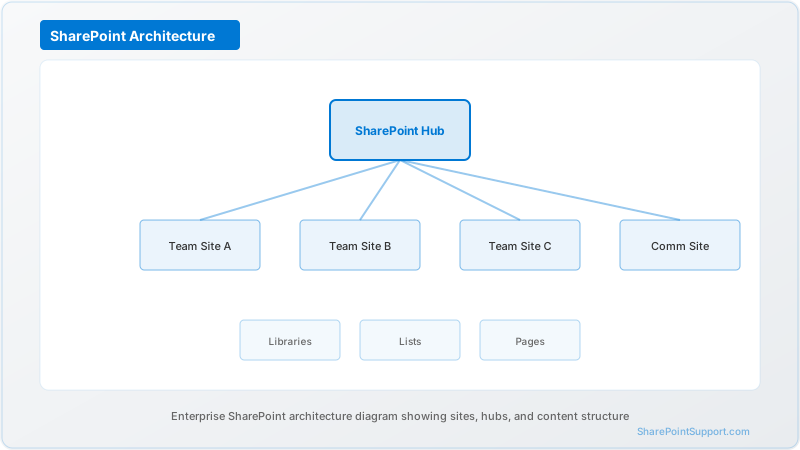
This guide covers layout fundamentals, section design patterns, template creation, and automated provisioning for enterprise environments.
---
Modern Page Layout System
How Layouts Work
Modern SharePoint pages consist of vertical sections stacked from top to bottom. Each section can be divided into columns, and web parts are placed within columns. This creates a flexible grid system that adapts to different screen sizes.
Section column options:
- One column full width for hero images, banners, and full-width content
- Two columns equal split for side-by-side content
- Two columns one-third left, two-thirds right for sidebar layouts
- Two columns two-thirds left, one-third right for main content with sidebar
- Three columns equal split for dashboard-style layouts
- Vertical section adds a persistent sidebar alongside the main content area
Section Backgrounds
Each section supports four background options: None (white), Neutral (light gray), Soft (light tint of the theme primary color), and Strong (dark background with white text). Alternating section backgrounds creates visual rhythm and helps users distinguish content areas.
---
Layout Design Patterns
Landing Page Layout
The most common layout for department portals, intranet home pages, and hub sites.
Structure:
- Section 1: Full-width hero web part with key announcements (Strong background)
- Section 2: Three-column layout with quick links, news, and events (No background)
- Section 3: Two-column layout with highlighted content and people directory (Neutral background)
- Section 4: Full-width section with call-to-action and contact information (Soft background)
Article Page Layout
For news posts, blog-style content, and long-form articles.
Structure:
- Section 1: Full-width header image (No background)
- Section 2: Two-thirds/one-third layout with article text on the left and author info and related links on the right (No background)
- Section 3: Full-width section for related content and call-to-action (Neutral background)
Dashboard Layout
For metrics, KPIs, and data-heavy pages.
Structure:
- Section 1: Full-width header with page title and description (Strong background)
- Section 2: Three-column layout with KPI cards using the embed or quick chart web parts (No background)
- Section 3: Two-column layout with detailed charts and data tables (Neutral background)
- Section 4: Full-width section with drill-down links to detailed reports (No background)
Knowledge Base Layout
For documentation, FAQs, and reference content.
Structure:
- Section 1 with vertical section: Main content area with text web part (left), category navigation (right sidebar)
- Section 2: Full-width FAQ section with collapsible sections
- Section 3: Related articles using highlighted content web part (Neutral background)
---
Creating Page Templates
Save as Template
Design a page with your desired layout and web part configuration, then save it as a template.
- Create a new page and design the layout
- Add placeholder content and configure web parts
- Go to Page details (gear icon on the page)
- Click Save as template
- Enter a template name and description
- The template appears in the template gallery for future page creation
Template Best Practices
Include placeholder content that demonstrates how the template should be used. Replace placeholder text with actual content when creating a page from the template.
Configure web part settings so users do not need to configure from scratch. Set default data sources, layouts, and filtering on web parts like Highlighted Content and News.
Document the template with a companion page or instruction text that explains the intended use case, target audience, and content guidelines.
Limit templates to 10 to 15 per site. Too many templates create decision paralysis. Focus on templates for the most common page types.
Template Categories
Organize templates into logical categories that match your content creation patterns.
News templates: Standard news post, executive update, product announcement, event recap.
Department templates: Team page, resource page, onboarding page.
Project templates: Project overview, status update, milestone report.
Reference templates: Policy page, procedure page, FAQ page, knowledge base article.
---
PnP Page Provisioning
Programmatic Page Creation
For automated page creation at scale, use PnP PowerShell to provision pages with predefined layouts and content.
```powershell
# Create a new page with sections and web parts
Connect-PnPOnline -Url "https://contoso.sharepoint.com/sites/Intranet" -Interactive
# Add a new page
$page = Add-PnPPage -Name "Department-Overview" -LayoutType Article
# Add sections
Add-PnPPageSection -Page $page -SectionTemplate OneColumn -Order 1
Add-PnPPageSection -Page $page -SectionTemplate TwoColumnLeft -Order 2
Add-PnPPageSection -Page $page -SectionTemplate OneColumn -Order 3
# Add web parts to sections
Add-PnPPageTextPart -Page $page -Section 1 -Column 1 -Text "
Welcome to Our Department
This is the department overview page.
"# Publish the page
Set-PnPPage -Identity "Department-Overview" -Publish
```
Template-Based Provisioning
Create a base page programmatically and use it as a template for batch provisioning.
```powershell
# Provision pages for multiple departments from a template
$departments = @("HR", "Finance", "Legal", "IT", "Marketing")
foreach ($dept in $departments) {
$page = Add-PnPPage -Name "$dept-Overview" -LayoutType Article
Add-PnPPageSection -Page $page -SectionTemplate TwoColumnRight -Order 1
Add-PnPPageTextPart -Page $page -Section 1 -Column 1 -Text "
$dept Department
Welcome to the $dept department page.
"Set-PnPPage -Identity "$dept-Overview" -Publish
Write-Host "Created page for $dept"
}
```
---
Responsive Design Considerations
Mobile Behavior
Modern SharePoint pages are responsive by default. Multi-column sections stack vertically on mobile devices. The order of stacking follows left to right, top to bottom. Design your layouts with this stacking behavior in mind so that content makes sense when viewed on a phone.
Testing Responsive Layouts
Test every page template on a phone, tablet, and desktop. Check that content stacks logically on mobile, images resize appropriately, text remains readable without horizontal scrolling, interactive elements (buttons, links) have adequate touch targets, and hero images do not crop important content on small screens.
---
Layout Governance
Layout Standards Document
Create a standards document that defines approved section layouts for each page type, required web parts and their configuration, background color usage guidelines, image sizing and formatting requirements, and accessibility requirements for all page elements.
Review Process
Establish a review process for pages before publication. For high-visibility pages (intranet home, department portals), require design review by a designated SharePoint champion or communications team member. For standard pages, provide self-service guidelines and spot-check periodically.
---
Frequently Asked Questions
Can I create custom section layouts beyond the built-in options?
No. Modern SharePoint supports only the built-in section column layouts. For completely custom layouts, use SPFx web parts that implement their own internal grid system.
Can templates include content or just structure?
Templates include both structure and content. Web part configurations, text content, and placeholder images are all captured in the template. Users replace placeholder content when creating a page from the template.
How do I update an existing template?
Edit the template page, make changes, and save. Existing pages created from the template are not updated retroactively. Only new pages created from the template reflect the changes.
---
For help designing page layouts and templates for your SharePoint environment, contact our design team for a design assessment. We build SharePoint page systems for organizations where consistent communication and professional presentation are critical for employee engagement.
Advanced Page Design Patterns
Interactive Dashboard Pages
Create dashboard-style pages that combine data from multiple sources. Use the List web part to display key metrics from SharePoint lists. Add the Power BI web part for interactive charts and visualizations. Include the Quick Chart web part for simple, real-time KPI displays. Combine these with the Text web part for context and explanations.
Content Hub Pages
Build content hub pages that serve as central access points for specific topics. Use the Highlighted Content web part configured with managed metadata filters to automatically aggregate related content from across the tenant. Add a Quick Links section for curated resources. Include a News web part filtered to the topic for recent updates. These pages update automatically as new content is tagged with the relevant metadata.
Employee Onboarding Pages
Create a multi-page onboarding experience using SharePoint pages linked through consistent navigation. Page 1 covers welcome and company overview. Page 2 covers IT setup and tools. Page 3 covers benefits and HR policies. Page 4 covers team introductions and key contacts. Page 5 covers first-week tasks and milestones. Use the page template feature to ensure every department's onboarding pages follow the same structure while containing department-specific content.
Executive Communication Pages
Design pages specifically for executive communications with a professional, distraction-free layout. Use a single-column layout with generous section spacing. Feature a large hero image with the executive's photo. Use pull quotes for key messages. Include a video embed for recorded messages. Keep the design clean with minimal web parts to focus attention on the message.
Enterprise Implementation Best Practices
In our 25+ years of enterprise SharePoint consulting, we have designed communication strategies and publishing architectures for organizations that need to reach tens of thousands of employees with consistent, timely, and engaging content. The communication sites and news features in SharePoint provide powerful enterprise publishing capabilities when properly configured and governed.
- Establish a Communication Site Architecture Strategy: Design your communication site portfolio with clear purpose separation. Create dedicated communication sites for corporate news, department announcements, policy updates, and executive communications. Each site should have defined content owners, publishing workflows, and audience targeting configuration that ensures the right content reaches the right employees.
- Implement News Publishing Workflows: Enterprise communications require editorial review before publication. Configure approval workflows using Power Automate that route news posts through appropriate reviewers based on content type, audience scope, and sensitivity. Require legal review for policy changes, communications review for company-wide announcements, and department owner approval for team-level news.
- Leverage Audience Targeting for Relevance: SharePoint's audience targeting capability ensures users see content relevant to their role, department, and location. Configure targeting on news web parts, navigation links, and page sections using Azure AD security groups and Microsoft 365 groups. Relevant content drives engagement while reducing information overload that causes employees to disengage from internal communications entirely.
- Design Pages for Scanability and Mobile Consumption: Enterprise employees spend seconds, not minutes, on internal communications. Design pages with clear headlines, concise summaries, bullet-pointed key takeaways, and prominent calls to action. Test page layouts on mobile devices where over 40 percent of intranet consumption occurs and ensure critical information is visible without scrolling.
- Measure Communication Effectiveness: Track page views, unique readers, average time on page, and click-through rates for calls to action. Compare these metrics against your audience size to calculate reach and engagement rates. Use these insights to refine your content strategy, optimize publishing frequency, and demonstrate the value of internal communications investment to executive stakeholders.
Governance and Compliance Considerations
Enterprise communications published through SharePoint carry compliance implications related to content accuracy, accessibility, required disclosures, and retention of organizational communications for regulatory and legal purposes.
For HIPAA-regulated organizations, internal communications that reference patient populations, clinical outcomes, or health plan details must be access-controlled to prevent unauthorized disclosure of aggregate health information that could be combined with other data to identify individuals. Apply sensitivity labels to health-related communications and restrict access to personnel with legitimate business need.
Financial services organizations must ensure that internal communications containing financial results, strategic plans, or market-moving information are restricted to authorized personnel until public disclosure. Implement communication compliance policies that detect potential insider information in SharePoint news posts and route flagged content for compliance review before publication.
Government organizations must ensure that official communications published through SharePoint comply with records management requirements, accessibility standards, and any applicable public affairs review processes.
Establish a communications governance framework that defines publishing authority, editorial review requirements, compliance review triggers, accessibility standards, and retention policies for published content. Configure approval workflows that enforce these governance requirements automatically and maintain audit trails of the publishing process. Archive superseded communications rather than deleting them to maintain a complete record of organizational messaging. Our SharePoint communications specialists design publishing architectures that support effective employee engagement while maintaining compliance with regulatory and accessibility requirements across your organization.
Ready to transform your internal communications with SharePoint? Our communications specialists have designed publishing architectures that reach tens of thousands of employees with engaging, compliant content. Contact our team for a communications strategy consultation, and discover how our SharePoint consulting services can elevate your employee engagement.
Common Challenges and Solutions
Organizations implementing SharePoint Page Layouts Templates consistently encounter obstacles that, if left unaddressed, undermine adoption and erode stakeholder confidence. Drawing on two decades of enterprise SharePoint consulting, these are the challenges we see most frequently and the proven approaches for overcoming them.
Challenge 1: Content Sprawl and Information Architecture Degradation
Over time, SharePoint Page Layouts Templates environments accumulate redundant, outdated, and trivial content that degrades search relevance and confuses users. Without proactive content lifecycle management, the signal-to-noise ratio deteriorates and user trust in the platform erodes. The resolution requires a structured approach: establishing automated retention policies that flag content for review after defined periods of inactivity, combined with content owner accountability structures that assign clear responsibility for each site collection and library. Organizations that address this proactively report 40 to 60 percent fewer support tickets within the first 90 days of deployment. Establishing a dedicated governance committee with representatives from IT, compliance, and business stakeholders ensures ongoing alignment between technical configuration and organizational objectives.
Challenge 2: Compliance and Audit Readiness Gaps
SharePoint Page Layouts Templates implementations in regulated industries often lack the audit trail depth and policy enforcement rigor required by frameworks such as HIPAA, SOC 2, and GDPR. Retroactive compliance remediation is significantly more expensive and disruptive than building compliance into the initial design. We recommend embedding compliance requirements into the information architecture from day one. Configure Microsoft Purview retention labels, DLP policies, and audit logging before deploying content, and validate compliance posture through regular internal audits. Tracking these metrics through SharePoint health dashboards provides early warning indicators that allow administrators to intervene before minor issues become systemic problems affecting enterprise-wide productivity.
Challenge 3: Inconsistent Governance Across Business Units
When different departments implement SharePoint Page Layouts Templates independently, inconsistent naming conventions, metadata schemas, and security configurations create silos that undermine cross-functional collaboration and complicate compliance reporting. The most effective mitigation strategy involves centralizing governance policy definition while allowing controlled flexibility at the departmental level. A hub-and-spoke governance model balances enterprise consistency with departmental autonomy. Enterprises operating in regulated industries such as healthcare and financial services must pay particular attention to this challenge because compliance violations carry significant financial and reputational consequences. Regular audits conducted quarterly at minimum help organizations maintain alignment with evolving regulatory requirements and internal policy updates.
Challenge 4: Migration and Legacy Content Complexity
Organizations transitioning legacy content into SharePoint Page Layouts Templates often underestimate the complexity of mapping old structures, metadata, and permissions to modern architectures. Failed migrations erode user confidence and create parallel systems that duplicate effort. Addressing this requires conducting thorough pre-migration content audits that classify and prioritize content based on business value. Invest in automated migration tools that preserve metadata fidelity and permission integrity while providing detailed validation reports. Organizations that invest in structured change management programs achieve adoption rates 35 percent higher than those relying on organic discovery alone. Executive sponsorship combined with department-level champions creates the organizational momentum necessary for sustained success.
Integration with Microsoft 365 Ecosystem
SharePoint Page Layouts Templates does not operate in isolation. Its value multiplies when connected to the broader Microsoft 365 ecosystem, creating unified workflows that eliminate context switching and reduce manual data transfer between applications.
Microsoft Teams Integration: Embed SharePoint Page Layouts Templates dashboards and document libraries as Teams tabs to create unified workspaces where conversations and structured content management coexist within a single interface. Teams channels automatically provision SharePoint document libraries, which means sharepoint page layouts templates configurations and content flow seamlessly between collaborative conversations and structured document management. Users can surface SharePoint content directly within Teams tabs, reducing the friction that typically causes adoption to stall.
Power Automate Workflows: Implement scheduled flows that perform routine SharePoint Page Layouts Templates maintenance tasks including permission reports, content audits, and usage analytics without requiring manual intervention. Automated workflows triggered by SharePoint events such as document uploads, metadata changes, or approval completions eliminate repetitive manual tasks. Organizations typically automate 15 to 25 processes within the first quarter, saving an average of 8 hours per week per department. These automations also create audit trails that satisfy compliance requirements for regulated industries.
Power BI Analytics: Build executive dashboards that aggregate SharePoint Page Layouts Templates metrics alongside other business KPIs, providing a holistic view of digital workplace effectiveness and investment returns. Connecting SharePoint data to Power BI dashboards provides real-time visibility into content usage patterns, adoption metrics, and operational KPIs. Decision makers gain actionable intelligence without requiring manual report generation, enabling faster response to emerging trends and potential issues.
Microsoft Purview and Compliance: Implement retention policies that automatically manage SharePoint Page Layouts Templates content lifecycle, preserving business-critical records for required periods while disposing of transient content to reduce storage costs and compliance exposure. Sensitivity labels, data loss prevention policies, and retention schedules configured in Microsoft Purview extend automatically to sharepoint page layouts templates content. This unified compliance framework ensures that governance policies apply consistently across the entire Microsoft 365 environment rather than requiring separate configuration for each workload. For organizations subject to HIPAA, SOC 2, or FedRAMP requirements, this integrated approach significantly reduces compliance management overhead.
Getting Started: Next Steps
Implementing SharePoint Page Layouts Templates effectively requires more than technical configuration. It demands a strategic approach grounded in your organization's specific business requirements, compliance obligations, and growth trajectory. The difference between a deployment that delivers measurable ROI and one that becomes shelfware often comes down to the quality of upfront planning and expert guidance.
Begin with a focused assessment of your current SharePoint environment. Evaluate your existing information architecture, permission structures, content lifecycle policies, and user adoption patterns. Identify gaps between your current state and the target state required for successful sharepoint page layouts templates implementation. This assessment typically takes 2 to 4 weeks and produces a prioritized roadmap that aligns technical work with business outcomes.
Our SharePoint specialists have guided organizations across healthcare, financial services, government, and education through hundreds of successful implementations. We bring deep expertise in SharePoint architecture, governance frameworks, and compliance alignment that accelerates time to value while minimizing risk.
Ready to move forward? Contact our team for a complimentary consultation. We will assess your environment, identify quick wins, and develop a phased implementation plan tailored to your organization's needs and timeline. Whether you are starting from scratch or optimizing an existing deployment, our enterprise SharePoint consultants deliver the expertise and accountability that Fortune 500 organizations demand.
Written by the SharePoint Support Team
Senior SharePoint Consultants | 25+ Years Microsoft Ecosystem Experience
Our senior SharePoint consultants bring deep expertise spanning 500+ enterprise migrations and compliance implementations across HIPAA, SOC 2, and FedRAMP environments. We cover SharePoint Online, Microsoft 365, migrations, Copilot readiness, and large-scale governance.
Expert SharePoint Services
Frequently Asked Questions
What page layout options are available in SharePoint Online?▼
How do I create a reusable page template in SharePoint?▼
Can I create custom page layouts with code in SharePoint Online?▼
What is the difference between a site template and a page template?▼
How do I apply consistent branding across SharePoint page layouts?▼
Need Expert Help?
Our SharePoint consultants are ready to help you implement these strategies in your organization.
Continue Reading in Design
SharePoint Branding and Customization: Complete Guide
Master SharePoint branding with this comprehensive guide to themes, custom designs, headers, footers, and creating cohesive brand experiences across your digital workplace.
Storage & CostCopilot in SharePoint Went GA — And Quietly Started Metering You
Three SharePoint features now bill per use instead of per seat, the default cap is $40 per user per month on top of your Copilot licence, and every one of them is triggered by site owners rather than admins. Here is the exposure math and how to cap it.
Emergency SupportYour External Partners Are Losing Access Right Now, and Nobody Is Telling You
SharePoint One-Time Passcode retires through October and November 2026. External users without an Entra B2B guest account lose access to links they have used for years — silently, with no notification to them or to you. Here is how to find them before they give up.
GovernanceYour AI Agents Now Have Mailboxes. Your Permission Model Does Not Know That.
Copilot Studio agents can now hold their own Microsoft 365 accounts — mailbox, Teams presence, Office access, governed as first-class identities. Every SharePoint permission construct you own was designed for humans who get hired and leave. There is no HR process for an agent.
Storage & CostFile-Level Archiving Is GA — And It Quietly Pulls Files Out of Copilot
Microsoft 365 Archive went file-level in July 2026, cutting cold storage to $0.05/GB/month. Most coverage treats the Copilot exclusion as a bonus. It is a tradeoff, it is silent, and it turns a billing decision into an AI-relevance decision.
ArchitectureSharePoint Online Limits in 2026: What Actually Breaks at Scale
Everyone can recite the 5,000-item threshold. Almost nobody can tell you what genuinely fails first in a large tenant — and in 2026 the answer changed, because agents and Copilot now query your lists too.