The Stakes of Choosing the Wrong SharePoint Consultant
A bad SharePoint consulting engagement does not just waste money — it creates technical debt that takes years to undo. We have been called in to fix the aftermath of failed SharePoint projects more times than we can count: migrations that lost data, intranets that nobody uses, governance frameworks that exist on paper and nowhere else, and custom solutions that break with every update.
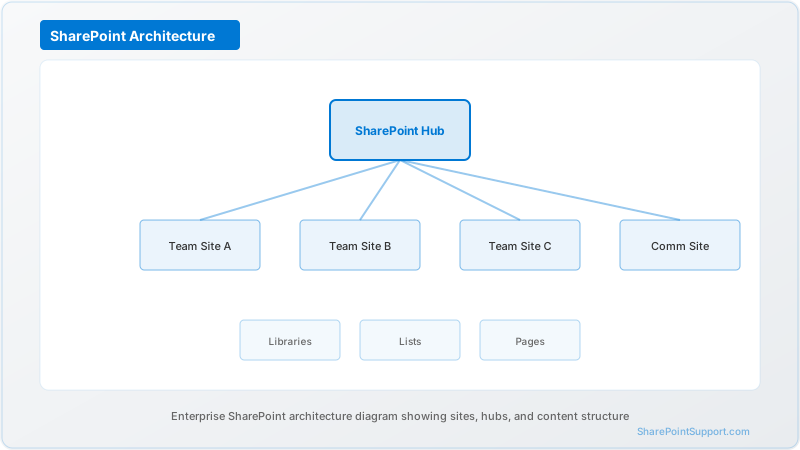
In our 25+ years in the SharePoint consulting space, we have seen the full spectrum of consulting firms — from elite specialists who deliver transformative results to generalist firms that assign junior developers to complex enterprise projects. This guide helps you tell the difference before you sign a contract.
---
What to Look For in a SharePoint Consulting Firm
1. Deep Microsoft Ecosystem Expertise
SharePoint does not exist in isolation. In 2026, a SharePoint project touches Azure AD/Entra ID, Microsoft Teams, Power Platform, Microsoft Purview, Copilot, Viva, and Azure services. A firm that only knows SharePoint cannot deliver a complete solution.
Questions to ask:
- What Microsoft certifications do your consultants hold individually?
- How many Microsoft 365 enterprise deployments has your firm completed in the past 3 years?
- Can you demonstrate experience with Copilot deployment and AI governance in SharePoint?
- What is your firm's Microsoft Partner designation and specialization areas?
What good looks like:
- Individual consultants with current Microsoft 365 certifications (MS-700, MS-100, MS-500, AZ-104)
- Firm-level Microsoft Solutions Partner designation in Modern Work or Security
- Published case studies with named client references (not just logos)
- Experience with the Copilot era — firms that have not done Copilot-related work in 2025-2026 are behind
2. Industry-Specific Compliance Experience
If you are in healthcare, financial services, government, or any regulated industry, your SharePoint consulting firm must understand your compliance requirements. A firm that knows SharePoint but not HIPAA will build technically correct solutions that fail your compliance audit.
Questions to ask:
- Have you implemented SharePoint solutions in [your industry] before?
- Can you describe how you configured SharePoint for [specific regulation] compliance?
- Will you be available to support our compliance audit if questions arise about the SharePoint implementation?
- Do you have experience with GCC High (for government) or BAA-governed environments (for healthcare)?
Red flag: If the firm says "we can learn your compliance requirements during the project," move on. Compliance expertise takes years to develop.
3. Proven Methodology
Enterprise SharePoint projects fail when consulting firms wing it. Look for a documented methodology that covers discovery, design, build, test, deploy, and hypercare.
What a mature methodology includes:
- Discovery and assessment phase with documented deliverables
- Architecture design with client review and approval gates
- Iterative development with sprint demos and feedback cycles
- User acceptance testing with defined pass/fail criteria
- Deployment plan with rollback procedures
- Hypercare period with defined support levels and escalation paths
- Knowledge transfer to your internal team
Red flag: If the consulting firm cannot produce a sample project plan or methodology document during the sales process, they do not have one.
4. References and Case Studies
The best predictor of future performance is past performance. Demand references from organizations similar to yours in size, industry, and project type.
Reference check questions:
- Was the project delivered on time and on budget?
- How did the firm handle scope changes and unexpected challenges?
- Were the consultants senior and experienced, or did the firm bait-and-switch with junior staff?
- Would you hire this firm again for your next SharePoint project?
- What would you do differently if you could start the engagement over?
What to look for in case studies:
- Specific metrics: "Migrated 5 TB of content for 10,000 users in 12 weeks" not "helped a large enterprise modernize"
- Named industries and compliance frameworks
- Described challenges and how they were overcome
- Post-implementation results (adoption rates, user satisfaction, performance improvements)
---
The RFP Process
Writing an Effective SharePoint RFP
A well-written RFP attracts qualified firms and discourages unqualified ones. A vague RFP attracts every firm with a pulse.
Essential RFP sections:
| Section | Contents |
|---------|----------|
| Executive Summary | Business context, why this project, what success looks like |
| Current Environment | SharePoint version, user count, content volume, custom solutions, known issues |
| Project Scope | Specific deliverables, in-scope and out-of-scope items |
| Technical Requirements | Architecture constraints, compliance requirements, integration needs |
| Evaluation Criteria | How proposals will be scored (technical, cost, experience, references) |
| Timeline | Project milestones and hard deadlines |
| Budget Range | Provide a range to calibrate responses — $200K-$400K, not "TBD" |
| Submission Requirements | Format, deadline, questions process, presentation expectations |
Evaluating RFP Responses
Scoring framework:
| Criterion | Weight | What to Evaluate |
|-----------|--------|-----------------|
| Technical Approach | 30% | Solution architecture, methodology, risk mitigation |
| Team Qualifications | 25% | Named consultants, certifications, relevant experience |
| Relevant Experience | 20% | Similar projects, industry, size, compliance |
| Cost | 15% | Total cost, rate transparency, value for money |
| References | 10% | Reference quality, relevance, satisfaction |
Important: Cost should never be the primary evaluation criterion. The cheapest proposal is often the most expensive in total when you factor in rework, delays, and failed deployments. A $400K project that delivers on time is cheaper than a $250K project that requires $200K in remediation.
---
Pricing Models and What They Mean
Time and Materials (T&M)
The firm bills for hours worked at agreed-upon rates. You pay for actual effort.
Pros: Flexible for evolving requirements, no premium for uncertainty
Cons: Open-ended budget risk, requires active project management from your side
Best for: Discovery phases, advisory engagements, projects with undefined scope
Typical rates (2026):
- Senior architect: $275-$400/hour
- Senior consultant: $225-$325/hour
- Mid-level consultant: $175-$250/hour
- Junior consultant: $125-$175/hour
Fixed Price
The firm quotes a total price for defined deliverables. You pay a set amount regardless of hours.
Pros: Budget certainty, risk transferred to the consulting firm
Cons: Requires precise scope definition, change orders for anything not in scope
Best for: Well-defined projects with clear deliverables (migration of X sites, build intranet with Y pages)
Managed Services / Retainer
Monthly fee for ongoing SharePoint support, maintenance, and optimization.
Pros: Predictable monthly cost, dedicated resources, proactive maintenance
Cons: May not be cost-effective for organizations with low SharePoint activity
Best for: Ongoing support after project completion, organizations without internal SharePoint expertise
Typical retainer pricing (2026):
- Basic support (20 hours/month): $4,000-$6,000/month
- Standard support (40 hours/month): $7,000-$12,000/month
- Premium support (80 hours/month): $12,000-$20,000/month
---
Red Flags to Watch For
1. Bait-and-Switch Staffing
The firm presents senior architects in the sales process, then staffs the project with junior consultants. This is the most common complaint in SharePoint consulting.
Protection: Require named resources in the contract with the right to approve replacements. Include a clause that key roles (architect, project manager) cannot be changed without written approval.
2. No Discovery Phase
A firm that jumps straight to building without a discovery and assessment phase does not understand enterprise SharePoint. Discovery is not optional — it identifies risks, validates assumptions, and prevents expensive mistakes.
3. Reluctance to Provide References
If a firm cannot provide 3-5 references for similar projects, they either do not have the experience or their clients are not willing to vouch for them. Either way, it is a disqualifier.
4. One-Size-Fits-All Proposals
If the proposal feels templated and does not address your specific environment, requirements, or industry, the firm is not invested in understanding your needs. A quality proposal reflects genuine analysis of your RFP.
5. No Post-Deployment Support
Firms that build and walk away leave you holding the bag. Any quality firm includes a hypercare period and offers ongoing support options. If the firm's engagement ends at deployment, they are not a partner — they are a vendor.
6. Unfamiliarity with Current Technology
If the firm's proposals reference SharePoint 2013 architecture patterns, do not mention Copilot, and have no experience with the new SharePoint experience released in March 2026, they are behind the curve. SharePoint evolves fast; your consulting firm must keep up.
---
The Selection Process
Step 1: Long List (4-6 firms)
Identify firms through Microsoft Partner directory, industry referrals, analyst reports, and online research. Send the RFP to 4-6 firms.
Step 2: Short List (2-3 firms)
Score proposals and select 2-3 firms for presentations. Focus on technical approach, team qualifications, and relevant experience.
Step 3: Presentations and Demos
Invite short-listed firms for 90-minute presentations. Require them to bring the actual consultants who will work on your project, not just sales representatives.
Step 4: Reference Checks
Contact 2-3 references per finalist. Ask the tough questions: on-time delivery, budget adherence, team quality, and overall satisfaction.
Step 5: Negotiation and Contract
Negotiate with the preferred firm. Key contract terms: milestone-based payment, staffing commitments, scope change process, intellectual property ownership, and service level agreements for post-deployment support.
If you are evaluating SharePoint consulting firms and want a vendor-neutral second opinion on proposals you have received, our consulting team offers advisory services. Contact us for a consultation.
---
Frequently Asked Questions
How much should I budget for a SharePoint consulting engagement?
Budget ranges by project type: SharePoint migration ($200K-$750K for 10,000 users), intranet build ($100K-$400K), governance implementation ($150K-$400K), Copilot readiness ($75K-$200K). These ranges include consulting, tooling, and project management but not Microsoft licensing.
Should I choose a large firm (Accenture, Deloitte) or a specialist firm?
It depends on your project. Large firms offer scale and brand credibility but assign junior consultants to SharePoint projects because it is not their strategic focus. Specialist firms offer deeper expertise and senior attention but may lack capacity for very large programs. For SharePoint-specific projects, specialist firms typically deliver better outcomes. For programs that span multiple technologies, large firms may provide better coordination.
How do I know if a consulting firm is actually a Microsoft partner?
Search the Microsoft Solution Partner directory at partner.microsoft.com. Verify the firm's specific designations and specializations. Ask to see their partner agreement and any specialization badges. Be wary of firms that claim "Microsoft Solutions Partner" — that designation was retired in 2022 and replaced with Solutions Partner designations.
What should I do if the project goes wrong?
Escalate immediately. Contact the firm's engagement manager (not the project manager) and demand a corrective action plan within one week. If the plan is insufficient, invoke the termination clause in your contract. Document all issues in writing for potential legal action. Most importantly, do not let a failing project continue for months — early intervention is critical.
Can I bring in a second firm to audit the first firm's work?
Absolutely. Independent technical reviews are common and valuable. A second firm can audit architecture decisions, code quality, security configurations, and compliance controls. This is especially valuable for large engagements where the stakes are high. Budget $20K-$50K for a thorough independent review.
Enterprise Implementation Best Practices
In our 25+ years of enterprise SharePoint consulting, we have guided hundreds of organizations through complex SharePoint initiatives spanning every industry and organizational scale. The implementation patterns that consistently deliver successful outcomes share common characteristics regardless of the specific feature or capability being deployed.
- Conduct a Thorough Requirements and Readiness Assessment: Before beginning any SharePoint implementation, invest time in understanding both the business requirements and the technical readiness of your environment. Assess your current content architecture, permission structures, integration dependencies, and user readiness. This assessment typically reveals 20 to 30 percent more complexity than initial stakeholder estimates suggest.
- Deploy in Controlled Phases with Pilot Groups: Start with a pilot group of 50 to 100 representative users from different departments and roles. Define measurable success criteria for each phase and collect structured feedback through surveys and interviews. Phased deployment reduces risk, builds organizational confidence, and generates the internal success stories that accelerate broader adoption.
- Invest in Change Management and Training: Technology implementations fail when organizations underinvest in helping people adapt to new tools and processes. Develop role-specific training that demonstrates how the new capability helps users accomplish their actual daily tasks. Create champion networks, host office hours, and celebrate early wins to build momentum across the organization.
- Automate Governance and Compliance Controls: Manual governance does not scale beyond a few dozen users or sites. Implement automated policy enforcement using Power Automate workflows, sensitivity labels, retention policies, and SharePoint administrative tools that ensure consistent compliance without creating bottlenecks or relying on individual user behavior.
- Establish Monitoring, Metrics, and Continuous Improvement: Define key performance indicators before deployment and track them systematically. Monitor adoption rates, user satisfaction, performance metrics, and business outcome improvements. Review these metrics monthly with stakeholders and use them to drive iterative improvements rather than treating the initial deployment as the finished state.
Governance and Compliance Considerations
Governance frameworks must satisfy the compliance requirements specific to your industry while remaining practical enough for daily operation. The most effective governance frameworks are those designed with regulatory compliance as a core requirement rather than an afterthought.
For HIPAA-regulated healthcare organizations, your governance framework must include specific controls for protected health information including access logging, minimum necessary access enforcement, encryption requirements, and business associate agreement tracking for any external sharing. Sensitivity labels should automatically apply encryption to documents containing PHI, and your retention policies must align with HIPAA's six-year minimum retention requirement.
Financial services organizations operating under SOC 2 need governance controls that demonstrate security, availability, processing integrity, confidentiality, and privacy of customer data. Your governance framework should map directly to SOC 2 trust service criteria, with automated evidence collection for audit readiness. SharePoint audit logs, access reviews, and change management records all serve as SOC 2 evidence.
Government agencies and contractors subject to FedRAMP or CMMC must implement governance controls satisfying federal security requirements including FIPS 140-2 compliant encryption, strict access controls based on security clearance levels, and comprehensive audit trails meeting NIST 800-53 control families.
Regardless of your specific regulatory environment, your governance framework should include data classification policies, retention schedules complying with applicable regulations, incident response procedures, and regular compliance assessments verifying controls function as designed. Working with experienced SharePoint governance consultants who understand your regulatory landscape ensures your framework addresses compliance from day one.
Ready to transform your SharePoint environment into a strategic business asset? Our specialists have guided hundreds of enterprises through successful SharePoint implementations across healthcare, financial services, government, and other regulated industries. Contact our team for a comprehensive assessment, and discover how our SharePoint consulting services can deliver the outcomes your organization needs.
Common Challenges and Solutions
Organizations implementing SharePoint consistently encounter obstacles that, if left unaddressed, undermine adoption and erode stakeholder confidence. Drawing on two decades of enterprise SharePoint consulting, these are the challenges we see most frequently and the proven approaches for overcoming them.
Challenge 1: Content Sprawl and Information Architecture Degradation
Over time, SharePoint environments accumulate redundant, outdated, and trivial content that degrades search relevance and confuses users. Without proactive content lifecycle management, the signal-to-noise ratio deteriorates and user trust in the platform erodes. The resolution requires a structured approach: establishing automated retention policies that flag content for review after defined periods of inactivity, combined with content owner accountability structures that assign clear responsibility for each site collection and library. Organizations that address this proactively report 40 to 60 percent fewer support tickets within the first 90 days of deployment. Establishing a dedicated governance committee with representatives from IT, compliance, and business stakeholders ensures ongoing alignment between technical configuration and organizational objectives.
Challenge 2: Compliance and Audit Readiness Gaps
SharePoint implementations in regulated industries often lack the audit trail depth and policy enforcement rigor required by frameworks such as HIPAA, SOC 2, and GDPR. Retroactive compliance remediation is significantly more expensive and disruptive than building compliance into the initial design. We recommend embedding compliance requirements into the information architecture from day one. Configure Microsoft Purview retention labels, DLP policies, and audit logging before deploying content, and validate compliance posture through regular internal audits. Tracking these metrics through SharePoint health dashboards provides early warning indicators that allow administrators to intervene before minor issues become systemic problems affecting enterprise-wide productivity.
Challenge 3: Inconsistent Governance Across Business Units
When different departments implement SharePoint independently, inconsistent naming conventions, metadata schemas, and security configurations create silos that undermine cross-functional collaboration and complicate compliance reporting. The most effective mitigation strategy involves centralizing governance policy definition while allowing controlled flexibility at the departmental level. A hub-and-spoke governance model balances enterprise consistency with departmental autonomy. Enterprises operating in regulated industries such as healthcare and financial services must pay particular attention to this challenge because compliance violations carry significant financial and reputational consequences. Regular audits conducted quarterly at minimum help organizations maintain alignment with evolving regulatory requirements and internal policy updates.
Challenge 4: Migration and Legacy Content Complexity
Organizations transitioning legacy content into SharePoint often underestimate the complexity of mapping old structures, metadata, and permissions to modern architectures. Failed migrations erode user confidence and create parallel systems that duplicate effort. Addressing this requires conducting thorough pre-migration content audits that classify and prioritize content based on business value. Invest in automated migration tools that preserve metadata fidelity and permission integrity while providing detailed validation reports. Organizations that invest in structured change management programs achieve adoption rates 35 percent higher than those relying on organic discovery alone. Executive sponsorship combined with department-level champions creates the organizational momentum necessary for sustained success.
Integration with Microsoft 365 Ecosystem
SharePoint does not operate in isolation. Its value multiplies when connected to the broader Microsoft 365 ecosystem, creating unified workflows that eliminate context switching and reduce manual data transfer between applications.
Microsoft Teams Integration: Configure Teams notifications that alert stakeholders when SharePoint content changes, ensuring that distributed teams stay informed about updates without relying on manual communication workflows. Teams channels automatically provision SharePoint document libraries, which means sharepoint configurations and content flow seamlessly between collaborative conversations and structured document management. Users can surface SharePoint content directly within Teams tabs, reducing the friction that typically causes adoption to stall.
Power Automate Workflows: Create event-driven automations that respond to SharePoint changes in real time, triggering downstream processes such as notifications, data transformations, and cross-system synchronization. Automated workflows triggered by SharePoint events such as document uploads, metadata changes, or approval completions eliminate repetitive manual tasks. Organizations typically automate 15 to 25 processes within the first quarter, saving an average of 8 hours per week per department. These automations also create audit trails that satisfy compliance requirements for regulated industries.
Power BI Analytics: Connect SharePoint list and library data to Power BI datasets for advanced analytics that transform raw operational data into strategic business intelligence accessible to decision makers across the organization. Connecting SharePoint data to Power BI dashboards provides real-time visibility into content usage patterns, adoption metrics, and operational KPIs. Decision makers gain actionable intelligence without requiring manual report generation, enabling faster response to emerging trends and potential issues.
Microsoft Purview and Compliance: Configure data loss prevention policies that monitor SharePoint content for sensitive information patterns, blocking or restricting sharing actions that could violate compliance requirements. Sensitivity labels, data loss prevention policies, and retention schedules configured in Microsoft Purview extend automatically to sharepoint content. This unified compliance framework ensures that governance policies apply consistently across the entire Microsoft 365 environment rather than requiring separate configuration for each workload. For organizations subject to HIPAA, SOC 2, or FedRAMP requirements, this integrated approach significantly reduces compliance management overhead.
Getting Started: Next Steps
Implementing SharePoint effectively requires more than technical configuration. It demands a strategic approach grounded in your organization's specific business requirements, compliance obligations, and growth trajectory. The difference between a deployment that delivers measurable ROI and one that becomes shelfware often comes down to the quality of upfront planning and expert guidance.
Begin with a focused assessment of your current SharePoint environment. Evaluate your existing information architecture, permission structures, content lifecycle policies, and user adoption patterns. Identify gaps between your current state and the target state required for successful sharepoint implementation. This assessment typically takes 2 to 4 weeks and produces a prioritized roadmap that aligns technical work with business outcomes.
Our SharePoint specialists have guided organizations across healthcare, financial services, government, and education through hundreds of successful implementations. We bring deep expertise in SharePoint architecture, governance frameworks, and compliance alignment that accelerates time to value while minimizing risk.
Ready to move forward? Contact our team for a complimentary consultation. We will assess your environment, identify quick wins, and develop a phased implementation plan tailored to your organization's needs and timeline. Whether you are starting from scratch or optimizing an existing deployment, our enterprise SharePoint consultants deliver the expertise and accountability that Fortune 500 organizations demand.
Written by the SharePoint Support Team
Senior SharePoint Consultants | 25+ Years Microsoft Ecosystem Experience
Our senior SharePoint consultants bring deep expertise spanning 500+ enterprise migrations and compliance implementations across HIPAA, SOC 2, and FedRAMP environments. We cover SharePoint Online, Microsoft 365, migrations, Copilot readiness, and large-scale governance.
Expert SharePoint Services
Frequently Asked Questions
What should I look for in a SharePoint consulting firm?▼
How much does SharePoint consulting typically cost?▼
What is the difference between a Microsoft Solutions Partner and a Solutions Partner?▼
Should I hire a local or remote SharePoint consulting firm?▼
What questions should I ask during a SharePoint consulting evaluation?▼
Need Expert Help?
Our SharePoint consultants are ready to help you implement these strategies in your organization.
Continue Reading in Consulting
Copilot in SharePoint Went GA — And Quietly Started Metering You
Three SharePoint features now bill per use instead of per seat, the default cap is $40 per user per month on top of your Copilot licence, and every one of them is triggered by site owners rather than admins. Here is the exposure math and how to cap it.
Emergency SupportYour External Partners Are Losing Access Right Now, and Nobody Is Telling You
SharePoint One-Time Passcode retires through October and November 2026. External users without an Entra B2B guest account lose access to links they have used for years — silently, with no notification to them or to you. Here is how to find them before they give up.
GovernanceYour AI Agents Now Have Mailboxes. Your Permission Model Does Not Know That.
Copilot Studio agents can now hold their own Microsoft 365 accounts — mailbox, Teams presence, Office access, governed as first-class identities. Every SharePoint permission construct you own was designed for humans who get hired and leave. There is no HR process for an agent.
Storage & CostFile-Level Archiving Is GA — And It Quietly Pulls Files Out of Copilot
Microsoft 365 Archive went file-level in July 2026, cutting cold storage to $0.05/GB/month. Most coverage treats the Copilot exclusion as a bonus. It is a tradeoff, it is silent, and it turns a billing decision into an AI-relevance decision.
ArchitectureSharePoint Online Limits in 2026: What Actually Breaks at Scale
Everyone can recite the 5,000-item threshold. Almost nobody can tell you what genuinely fails first in a large tenant — and in 2026 the answer changed, because agents and Copilot now query your lists too.
Emergency SupportYour SharePoint Farm Is Now Unpatched: The Emergency Support Playbook
SharePoint Server 2016 and 2019 hit end of support on July 14, 2026 — and unlike Windows Server, there is no Extended Security Updates program to buy. Here is what changes operationally, and how our 24/7/365 emergency response works when it does.