How Do You Create Custom SharePoint Site Templates in 2026?
SharePoint site templates in 2026 are created using site designs (JSON-based site scripts) for simple configurations and PnP Provisioning templates for complex enterprise deployments that include pages, web parts, navigation, content types, and branding. In our 25+ years managing enterprise SharePoint environments, we have found that organizations without standardized site templates waste an average of 40 hours per month on manual site configuration and suffer from inconsistent branding, missing governance controls, and user confusion from non-uniform site structures.
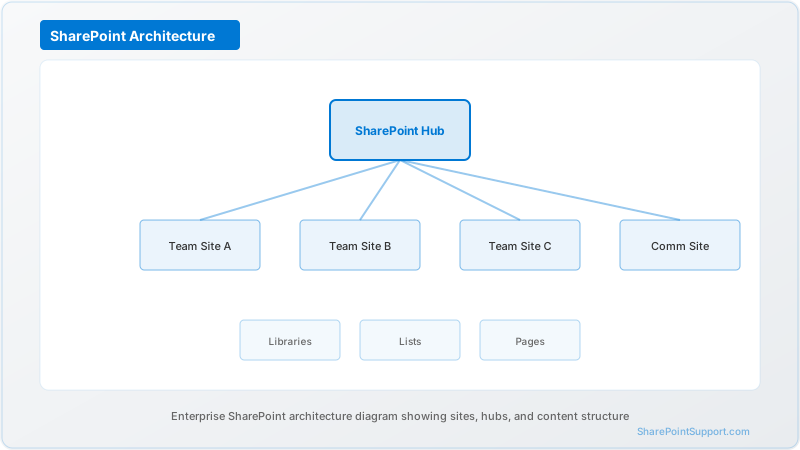
Site templates are the foundation of scalable SharePoint governance. When every project site, department hub, and community looks different, users waste time learning new layouts instead of getting work done. A well-designed template library ensures every new site launches with the right structure, permissions, navigation, and branding — ready for immediate use.
Understanding the Template Ecosystem
SharePoint Online offers multiple approaches to site templating, each suited to different complexity levels.
Built-In Templates
Microsoft provides a growing library of built-in templates accessible from the "New site" dialog. These cover common scenarios like team collaboration, project management, crisis communication, and event management. They are a good starting point but rarely meet enterprise-specific requirements without customization.
Site Designs and Site Scripts
Site designs are the native SharePoint Online mechanism for custom templates. A site design is a collection of site scripts — JSON files that define actions to execute when a site is created. Actions include creating lists, applying themes, setting navigation, adding site columns, and triggering Power Automate flows.
Site designs appear in the "New site" dialog alongside built-in templates, providing a seamless experience for end users. They can be scoped to the entire tenant or specific groups of users.
PnP Provisioning Templates
The PnP (Patterns and Practices) Provisioning framework is a community-driven, Microsoft-supported engine for comprehensive site provisioning. PnP templates can define everything a site design can, plus pages with web parts, managed metadata term sets, search configurations, content type hierarchies, and complex permission structures.
PnP templates are defined in XML or JSON and applied using PnP PowerShell or the PnP Provisioning Service. They are the standard for enterprise-grade site templating.
Custom Site Templates (Save Site as Template)
SharePoint Online allows users to save an existing site as a template. This captures the site structure, lists, content types, and pages (without content). The saved template appears in the template gallery for reuse. This is the simplest approach but has limitations — it does not capture all configurations and can create drift over time.
Designing Effective Site Templates
Start with Information Architecture
Before building templates, define your site architecture:
- What types of sites does your organization need? (Project sites, department hubs, community sites, client portals)
- What should every site include? (Standard navigation, required libraries, governance metadata)
- What should be customizable? (Logo, color accent, department-specific lists)
- What should be locked down? (Permission levels, sharing settings, retention policies)
Template Design Principles
Principle 1: Minimal viable structure. Include only what every site of that type needs. Adding too many lists, libraries, and pages to a template creates clutter that users immediately try to delete.
Principle 2: Consistent navigation. Every template should include a standard navigation structure that follows your organization's information architecture. Hub navigation for cross-site links, site navigation for within-site links.
Principle 3: Pre-configured governance. Apply sensitivity labels, sharing restrictions, and retention policies as part of the template. Do not rely on site owners to configure governance after creation.
Principle 4: Branded but flexible. Apply organizational branding (logo, colors, fonts) through the template but allow site owners to customize within brand guidelines (accent color selection from an approved palette).
Building Site Designs with Site Scripts
Creating Your First Site Script
Site scripts are JSON arrays of actions. Here is a foundational example that creates a project site with standard lists and a custom theme:
The script would create a Documents library with custom columns (Project Code, Document Type, Status), a Project Tasks list with columns for assignee, due date, and priority, apply the organization's custom theme, set the site logo, configure the navigation with links to key resources, and trigger a Power Automate flow that notifies the IT governance team of the new site creation.
Registering Site Designs
Use PowerShell to register your site script and associate it with a site design. Specify whether the design applies to Team sites (GROUP#0) or Communication sites (SITEPAGEPUBLISHING#0). Add a preview image and description that appear in the site creation dialog to help users choose the right template.
Advanced Site Script Actions
Site scripts support over 30 actions in 2026, including:
- createSPList / addSPList: Create lists and libraries with custom columns and views
- applyTheme: Apply a custom color theme
- setSiteLogo: Set the site logo URL
- addNavLink: Add navigation links
- setRegionalSettings: Configure language, time zone, and locale
- triggerFlow: Launch a Power Automate flow for post-provisioning tasks
- associateHubSite: Associate the new site with a hub site
- installSolution: Install an SPFx solution package
- setSiteExternalSharingCapability: Configure sharing settings
PnP Provisioning for Enterprise Templates
For templates that exceed site script capabilities — which is most enterprise scenarios — PnP Provisioning is the standard.
Creating a PnP Template from an Existing Site
The fastest way to create a PnP template is to configure a "golden" site manually, then extract its configuration using PnP PowerShell. The extraction captures site structure, content types, fields, lists, views, pages, web parts, navigation, themes, and more.
After extraction, clean up the template to remove site-specific details (URLs, GUIDs) and parameterize values that should change per instance (site name, owner, department).
Applying PnP Templates
Apply templates using PnP PowerShell during or after site creation. For self-service scenarios, combine a basic site design (for the creation dialog) with a Power Automate flow that applies the full PnP template after creation. This gives users a familiar template selection experience while delivering enterprise-grade provisioning behind the scenes.
Template Versioning and Maintenance
Treat templates like code — store them in a Git repository, version them, and test changes before deploying to production. We recommend maintaining a template development site where changes are tested before updating the production template.
Create a template maintenance schedule: review and update templates quarterly to incorporate new SharePoint features, updated branding, and refined governance controls.
Custom Look Book and Template Gallery
Building an Internal Look Book
Create a SharePoint Communication site that serves as your organization's template gallery. Include screenshots, descriptions, and use cases for each available template. This helps site requestors choose the right template and reduces the number of misconfigured sites.
Template Request and Approval Workflow
Not every user should be able to create sites directly. Implement a Power Automate approval workflow where users request a new site by filling out a form (site name, purpose, template type, owner, expected membership). An approver reviews the request, and upon approval, the site is automatically provisioned using the selected template.
This workflow ensures governance without creating a bottleneck — approvals should target a 4-hour SLA to avoid frustrating users into shadow IT.
Branding and Theming
SharePoint Theme Generator
Use the SharePoint Theme Generator tool (fabricweb.z5.web.core.windows.net/pr-deploy-site/refs/heads/7.0/theming-designer) to create custom color themes that match your organizational branding. Export the theme JSON and deploy it using PowerShell.
Custom Headers and Footers
SharePoint Online supports custom headers, footers, and navigation through the SharePoint admin center and SPFx Application Customizers. Use these to add consistent elements across all sites — company logo, footer links, support contact information, and legal disclaimers.
Responsive Design Considerations
All SharePoint templates must work on mobile devices. Test your templates on phones and tablets, ensure web parts are responsive, and verify that custom elements do not break the mobile layout. SharePoint's modern experience is responsive by default, but custom CSS and SPFx extensions can introduce layout issues.
Migration Considerations
When migrating to SharePoint Online, design your target templates before migration. Map source sites to target templates to ensure consistent structure post-migration. Our migration services include template design as a standard deliverable.
Enterprise Governance Integration
Templates should enforce governance automatically. Configure sensitivity labels, DLP policies, retention policies, and sharing restrictions as part of every template. Our SharePoint consulting services help organizations design template libraries that embed governance into every site from creation.
For ongoing template management and updates, our support plans include quarterly template reviews and updates. Contact us to discuss your template standardization needs.
Frequently Asked Questions
What is the difference between a site design and a site template?
A site design is a collection of site scripts (JSON actions) that run when a site is created. A site template is a broader term that includes site designs, PnP provisioning templates, and saved-site templates. Site designs are limited to about 30 predefined actions, while PnP templates can configure virtually every aspect of a site.
Can I update a template after sites have been created from it?
Site designs can be re-applied to existing sites to apply new actions. However, they do not remove or modify existing configurations — they only add. PnP templates can be applied incrementally with more granular control over updates. For major template changes, plan a phased rollout and communicate changes to site owners.
How many templates should an organization have?
Most enterprises need 5 to 10 templates: a general team site, a project site, a department hub, a community site, a client portal, and a few industry or function-specific templates. Resist the urge to create a template for every minor variation — use a base template with optional customization instead.
Can I restrict which templates users can see?
Yes. Site designs can be scoped to specific security groups using PowerShell. Users outside the group will not see the template in the site creation dialog. This allows you to offer specialized templates to specific departments while keeping the general template gallery clean.
How do I handle template changes across hundreds of existing sites?
For site designs, use PowerShell to re-apply the updated design to existing sites in batch. For PnP templates, use PnP PowerShell scripting to apply incremental changes. Always test changes on a pilot group of sites before tenant-wide deployment.
What is the PnP provisioning engine and is it supported by Microsoft?
PnP (Patterns and Practices) is a community-driven initiative with strong Microsoft involvement. While not an official Microsoft product, it is widely used and recommended by Microsoft for enterprise provisioning scenarios that exceed native site design capabilities. Microsoft employees actively contribute to the PnP project.
Can templates include pre-built pages with web parts?
Site designs cannot create pages with web parts. PnP provisioning templates can, and this is one of the primary reasons enterprises choose PnP over native site designs. A PnP template can include fully designed home pages, document center pages, and dashboard pages with configured web parts.
How do I manage templates across multiple tenants?
Store templates in a shared repository (Azure DevOps, GitHub) and deploy to each tenant using CI/CD pipelines. Parameterize tenant-specific values (URLs, admin accounts, theme colors) so the same template source can be deployed to development, staging, and production tenants.
Enterprise Implementation Best Practices
In our 25+ years of enterprise SharePoint consulting, we have designed and deployed branded SharePoint experiences for organizations ranging from global financial institutions to healthcare systems with strict brand compliance requirements. The branding implementations that succeed long-term balance visual impact with maintainability and performance.
- Use the SharePoint Theming Framework Exclusively: Avoid custom CSS injection and DOM manipulation for branding purposes. SharePoint's theming framework provides consistent color, typography, and spacing customization that survives platform updates without breaking. Custom CSS solutions require ongoing maintenance every time Microsoft updates the SharePoint UI and frequently create accessibility issues that the native theming framework avoids.
- Design a Hub-Based Branding Strategy: Use hub site associations to cascade consistent branding across groups of related sites. Each hub can define its own theme, logo, header, and footer configuration that automatically applies to all associated sites. This approach ensures brand consistency across hundreds of sites without requiring manual configuration of each individual SharePoint site.
- Optimize All Visual Assets for Web Performance: Every custom image, icon, and logo added to your SharePoint branding directly impacts page load performance. Compress all images to web-optimized formats, use SVG for logos and icons where possible, implement responsive image sizes that serve appropriate resolutions for desktop and mobile devices, and leverage the SharePoint CDN to serve branding assets from edge locations closest to your users.
- Create Reusable Page Templates for Content Consistency: Design page templates for your most common content patterns including news articles, policy pages, department landing pages, and project portals. These templates ensure visual consistency, reduce page creation time, and guide content authors toward effective layouts without requiring design expertise.
- Establish a Branding Governance Process: Document your branding standards in a style guide that covers color usage, typography, imagery guidelines, logo placement, and web part configuration standards. Require branding review for any site that deviates from standard templates and update your branding standards annually to reflect evolving brand requirements and new SharePoint capabilities.
Governance and Compliance Considerations
SharePoint branding and design customizations create compliance considerations that organizations frequently overlook, particularly around accessibility requirements, content security, and the governance of custom code deployed across the tenant.
For organizations subject to Section 508, ADA, or equivalent accessibility regulations, all branding customizations must comply with WCAG 2.1 AA standards. Custom themes must maintain sufficient color contrast ratios, custom fonts must be readable at all supported zoom levels, and custom layouts must be navigable via keyboard and compatible with screen readers. Accessibility compliance is not optional and should be verified before deploying branding changes to production.
Financial services organizations must ensure that branding customizations do not interfere with required compliance disclosures, regulatory notices, or mandatory footer content. Custom themes and page layouts should accommodate compliance content requirements without allowing business users to inadvertently remove required elements.
Healthcare organizations must verify that branded communication sites and patient-facing portals meet HIPAA requirements for secure content delivery and that branding assets do not introduce third-party tracking or analytics that could compromise patient privacy.
Establish a branding governance process that requires accessibility testing, security review of custom code, and compliance validation before deploying branding changes to production. Maintain a branding change log that documents what was changed, when, by whom, and the test results for accessibility and compliance. Review your branding architecture during platform updates to ensure customizations remain compatible and compliant. Our SharePoint branding specialists create visually compelling experiences that satisfy accessibility requirements and maintain compliance with your regulatory framework.
Ready to create a SharePoint experience that reflects your brand and engages your users? Our branding specialists have designed enterprise SharePoint experiences for organizations with the highest visual standards. Contact our team for a branding consultation, and explore how our SharePoint consulting services can transform your digital workplace appearance.
Common Challenges and Solutions
Organizations implementing SharePoint Site Templates consistently encounter obstacles that, if left unaddressed, undermine adoption and erode stakeholder confidence. Drawing on two decades of enterprise SharePoint consulting, these are the challenges we see most frequently and the proven approaches for overcoming them.
Challenge 1: Migration and Legacy Content Complexity
Organizations transitioning legacy content into SharePoint Site Templates often underestimate the complexity of mapping old structures, metadata, and permissions to modern architectures. Failed migrations erode user confidence and create parallel systems that duplicate effort. The resolution requires a structured approach: conducting thorough pre-migration content audits that classify and prioritize content based on business value. Invest in automated migration tools that preserve metadata fidelity and permission integrity while providing detailed validation reports. Organizations that address this proactively report 40 to 60 percent fewer support tickets within the first 90 days of deployment. Establishing a dedicated governance committee with representatives from IT, compliance, and business stakeholders ensures ongoing alignment between technical configuration and organizational objectives.
Challenge 2: Permission and Access Sprawl
As SharePoint Site Templates scales across departments, permission structures inevitably become more complex. Without active governance, permission inheritance breaks down, sharing links proliferate, and sensitive content becomes accessible to unintended audiences. We recommend implementing quarterly access reviews using the SharePoint Admin Center combined with automated reports that flag permission anomalies. Establish a principle of least privilege as the default and require documented justification for elevated access grants. Tracking these metrics through SharePoint health dashboards provides early warning indicators that allow administrators to intervene before minor issues become systemic problems affecting enterprise-wide productivity.
Challenge 3: Performance and Scalability Bottlenecks
Large-scale SharePoint Site Templates deployments frequently encounter performance issues as content volumes grow beyond initial design parameters. Large lists, deeply nested folder structures, and poorly optimized custom solutions contribute to slow page loads and frustrated users. The most effective mitigation strategy involves conducting regular performance audits that identify bottlenecks before they impact user experience. Implement list view thresholds, indexed columns, and pagination strategies that maintain responsive performance at enterprise scale. Enterprises operating in regulated industries such as healthcare and financial services must pay particular attention to this challenge because compliance violations carry significant financial and reputational consequences. Regular audits conducted quarterly at minimum help organizations maintain alignment with evolving regulatory requirements and internal policy updates.
Challenge 4: Search Relevance and Content Discoverability
Poor search experiences are among the top complaints users raise about SharePoint Site Templates deployments. When search returns irrelevant results or fails to surface critical documents, users abandon the platform in favor of ad-hoc workarounds like email attachments and local file shares. Addressing this requires investing in managed metadata term stores, consistent content type usage, and search schema configuration. Promote high-value content through bookmarks and acronyms in Microsoft Search, and regularly review search analytics to identify and close discoverability gaps. Organizations that invest in structured change management programs achieve adoption rates 35 percent higher than those relying on organic discovery alone. Executive sponsorship combined with department-level champions creates the organizational momentum necessary for sustained success.
Integration with Microsoft 365 Ecosystem
SharePoint Site Templates does not operate in isolation. Its value multiplies when connected to the broader Microsoft 365 ecosystem, creating unified workflows that eliminate context switching and reduce manual data transfer between applications.
Microsoft Teams Integration: SharePoint Site Templates content surfaces directly in Teams channels through embedded tabs and adaptive cards, giving team members instant access to relevant documents and dashboards without leaving their collaborative workspace. Teams channels automatically provision SharePoint document libraries, which means sharepoint site templates configurations and content flow seamlessly between collaborative conversations and structured document management. Users can surface SharePoint content directly within Teams tabs, reducing the friction that typically causes adoption to stall.
Power Automate Workflows: Build approval workflows that route SharePoint Site Templates content through structured review chains, automatically notifying approvers and escalating overdue items to maintain process velocity. Automated workflows triggered by SharePoint events such as document uploads, metadata changes, or approval completions eliminate repetitive manual tasks. Organizations typically automate 15 to 25 processes within the first quarter, saving an average of 8 hours per week per department. These automations also create audit trails that satisfy compliance requirements for regulated industries.
Power BI Analytics: Visualize SharePoint Site Templates usage patterns and adoption metrics through Power BI dashboards that update automatically, giving leadership real-time visibility into platform health and user engagement. Connecting SharePoint data to Power BI dashboards provides real-time visibility into content usage patterns, adoption metrics, and operational KPIs. Decision makers gain actionable intelligence without requiring manual report generation, enabling faster response to emerging trends and potential issues.
Microsoft Purview and Compliance: Apply sensitivity labels to SharePoint Site Templates content automatically based on classification rules, ensuring that confidential and regulated information receives appropriate protection throughout its lifecycle. Sensitivity labels, data loss prevention policies, and retention schedules configured in Microsoft Purview extend automatically to sharepoint site templates content. This unified compliance framework ensures that governance policies apply consistently across the entire Microsoft 365 environment rather than requiring separate configuration for each workload. For organizations subject to HIPAA, SOC 2, or FedRAMP requirements, this integrated approach significantly reduces compliance management overhead.
Getting Started: Next Steps
Implementing SharePoint Site Templates effectively requires more than technical configuration. It demands a strategic approach grounded in your organization's specific business requirements, compliance obligations, and growth trajectory. The difference between a deployment that delivers measurable ROI and one that becomes shelfware often comes down to the quality of upfront planning and expert guidance.
Begin with a focused assessment of your current SharePoint environment. Evaluate your existing information architecture, permission structures, content lifecycle policies, and user adoption patterns. Identify gaps between your current state and the target state required for successful sharepoint site templates implementation. This assessment typically takes 2 to 4 weeks and produces a prioritized roadmap that aligns technical work with business outcomes.
Our SharePoint specialists have guided organizations across healthcare, financial services, government, and education through hundreds of successful implementations. We bring deep expertise in SharePoint architecture, governance frameworks, and compliance alignment that accelerates time to value while minimizing risk.
Ready to move forward? Contact our team for a complimentary consultation. We will assess your environment, identify quick wins, and develop a phased implementation plan tailored to your organization's needs and timeline. Whether you are starting from scratch or optimizing an existing deployment, our enterprise SharePoint consultants deliver the expertise and accountability that Fortune 500 organizations demand.
Written by the SharePoint Support Team
Senior SharePoint Consultants | 25+ Years Microsoft Ecosystem Experience
Our senior SharePoint consultants bring deep expertise spanning 500+ enterprise migrations and compliance implementations across HIPAA, SOC 2, and FedRAMP environments. We cover SharePoint Online, Microsoft 365, migrations, Copilot readiness, and large-scale governance.
Expert SharePoint Services
Frequently Asked Questions
How do we apply consistent branding across all SharePoint sites?▼
Can we customize SharePoint page layouts beyond the standard options?▼
What are SharePoint site designs and site scripts?▼
Should we hire a designer for our SharePoint intranet project?▼
Need Expert Help?
Our SharePoint consultants are ready to help you implement these strategies in your organization.
Continue Reading in Customization
Copilot in SharePoint Went GA — And Quietly Started Metering You
Three SharePoint features now bill per use instead of per seat, the default cap is $40 per user per month on top of your Copilot licence, and every one of them is triggered by site owners rather than admins. Here is the exposure math and how to cap it.
Emergency SupportYour External Partners Are Losing Access Right Now, and Nobody Is Telling You
SharePoint One-Time Passcode retires through October and November 2026. External users without an Entra B2B guest account lose access to links they have used for years — silently, with no notification to them or to you. Here is how to find them before they give up.
GovernanceYour AI Agents Now Have Mailboxes. Your Permission Model Does Not Know That.
Copilot Studio agents can now hold their own Microsoft 365 accounts — mailbox, Teams presence, Office access, governed as first-class identities. Every SharePoint permission construct you own was designed for humans who get hired and leave. There is no HR process for an agent.
Storage & CostFile-Level Archiving Is GA — And It Quietly Pulls Files Out of Copilot
Microsoft 365 Archive went file-level in July 2026, cutting cold storage to $0.05/GB/month. Most coverage treats the Copilot exclusion as a bonus. It is a tradeoff, it is silent, and it turns a billing decision into an AI-relevance decision.
ArchitectureSharePoint Online Limits in 2026: What Actually Breaks at Scale
Everyone can recite the 5,000-item threshold. Almost nobody can tell you what genuinely fails first in a large tenant — and in 2026 the answer changed, because agents and Copilot now query your lists too.
Emergency SupportYour SharePoint Farm Is Now Unpatched: The Emergency Support Playbook
SharePoint Server 2016 and 2019 hit end of support on July 14, 2026 — and unlike Windows Server, there is no Extended Security Updates program to buy. Here is what changes operationally, and how our 24/7/365 emergency response works when it does.